Overview
9 stories in this issue. The first 3 are today's priorities.
Hot Model Updates
- Top · GLM-5.3 arrives on Amazon Bedrock for coding and long-horizon agents
- Top · OpenAI will watermark ChatGPT and Codex text in the EU
- Top · Claude Opus 5.5 and Sonnet 5.5 come to AWS GovCloud
Global AI News
- JEPA-Anything: one world model across seven fields, from physics to biology
- SageMaker's new aws-ai-ml skill lets coding agents tune inference
- HackerRank makes its Chakra AI interviewer generally available after 500K interviews
Regional and Early Signals
- OpenAI says GPT-6 Astra and 6.1 Sol run about 50% faster by default; a user measured less
- DeepSeek reportedly raising at least $12 billion, led by CATL and Tencent
- Gemini "Call for Me" may start calling friends and family for you
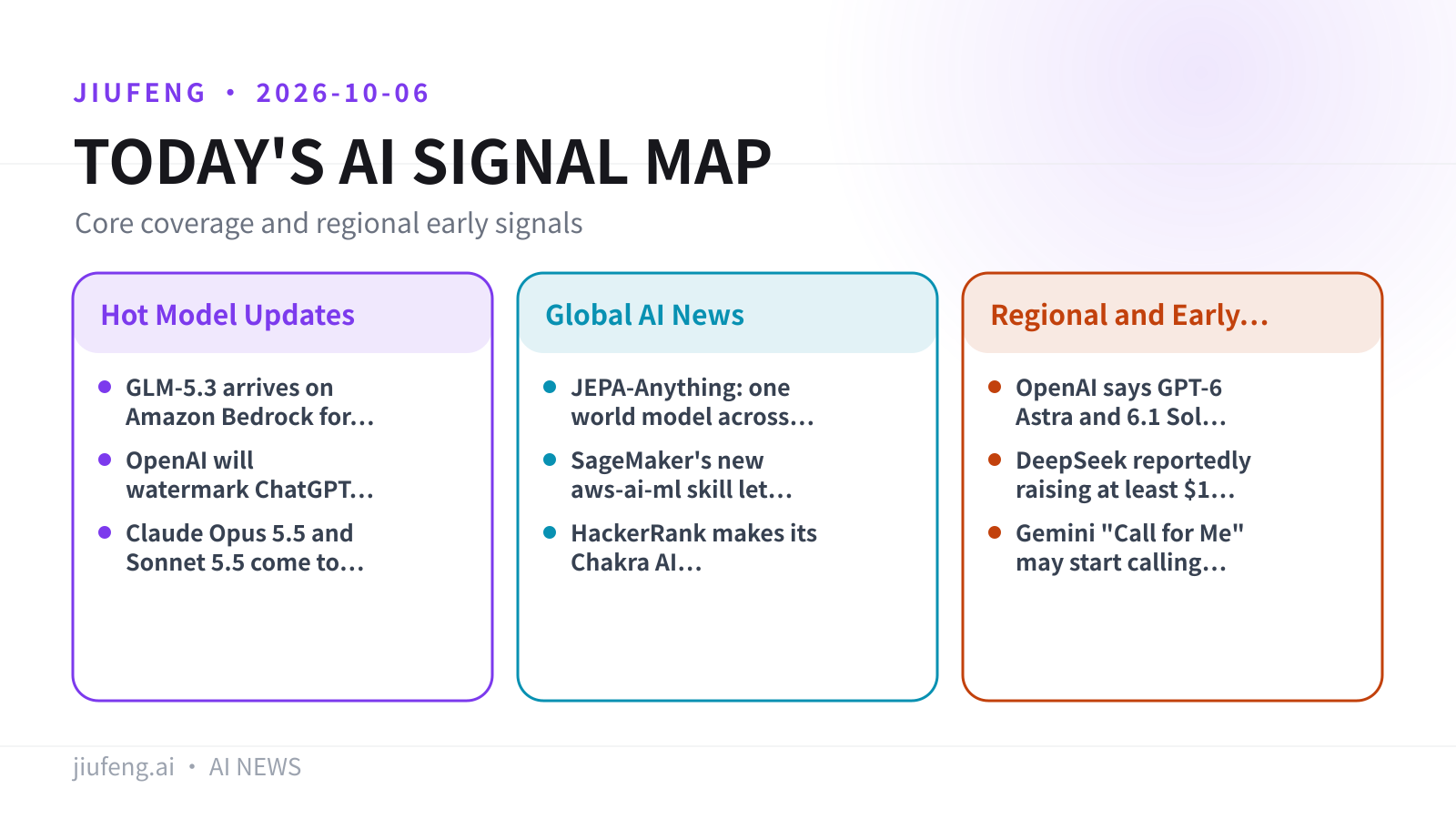
Jiufeng graphic based on the sources cited in this issue.
Hot Model Updates
01/09
GLM-5.3 arrives on Amazon Bedrock for coding and long-horizon agents
Z.ai's GLM-5.3 went live on Amazon Bedrock on October 5th with AWS-managed inference, but only eligible enterprise customers can use it.
According to AWS's launch post, GLM-5.3 is available on Amazon Bedrock through fully managed APIs, so users do not need to run their own inference infrastructure. Z.ai announced the availability on X on October 6th.
- Scale: the AWS post cites the Hugging Face release as a 753B-parameter mixture-of-experts (MoE) model; the Bedrock model documentation lists 744B total parameters with about 40B active per token
- Benchmarks: the AWS post lists results published by Z.ai: 84.5 on CyberGym, and a 50% improvement over GLM 5.2 on Z.ai's internal coding benchmark
- Focus: optimized for coding and long-horizon agentic tasks
- Interface: OpenAI-compatible APIs, with prompt caching, cross-Region inference and service tiers
- Example workload: AWS walks through authorized security testing of your own applications with the open-source tool Strix
Limitations: GLM-5.3 on Bedrock is limited to eligible enterprise customers. RuntimeWire notes that the launch materials disagree on the parameter count, and that the model runs only through cross-Region inference routing on Bedrock. The benchmark figures are Z.ai's own, and the internal coding benchmark is not public.

Image source: Amazon Web Services; mirrored on Jiufeng R2.
Source: AWS Machine Learning Blog · Bedrock model documentation · Z.ai on X · RuntimeWire · Hugging Face
02/09
OpenAI will watermark ChatGPT and Codex text in the EU
To meet the EU AI Act's transparency requirements, OpenAI will add an invisible watermark to text generated by ChatGPT and Codex in the EU.
OpenAI explained the approach in an October 5th blog post. According to TechCrunch, the AI Act's transparency rules took effect on August 2nd and require AI companies to mark AI-generated content in a way other systems can identify.
Limitations: OpenAI itself says editing the text can make the watermark harder to detect.
Source: OpenAI · TechCrunch
03/09
Claude Opus 5.5 and Sonnet 5.5 come to AWS GovCloud
Claude Opus 5.5 and Sonnet 5.5 are available on Amazon Bedrock in the AWS GovCloud (US) Regions, where they can be paired with Claude Code for workloads covered by regulations such as ITAR.
AWS describes how to call both models through Bedrock in GovCloud (US) and connect them to Claude Code for AI-assisted development. The table below shows each model's certification status on Bedrock, as listed in the AWS post:
| Model | FedRAMP | DoD IL4/IL5 |
|---|---|---|
| Claude Sonnet 5 | Class D (formerly High) | Authorized |
| Claude Opus 5.5 | Class D | Not listed |
| Claude Sonnet 5.5 | Class D | Not listed |
Limitations: AWS states that the post is for informational purposes only, that the approach may not suit every organization or compliance program, and that readers should verify each model's current certification status.
Source: AWS Machine Learning Blog · Claude Code IDE integrations
Global AI News
04/09
JEPA-Anything: one world model across seven fields, from physics to biology
A team led by PhAI Labs extended Yann LeCun's JEPA architecture into a cross-domain world model and used it to find a liver cancer treatment candidate.
The team, led by PhAI Labs with collaborators from Stanford, Oxford and Princeton, calls the model JEPA-Anything. It covers seven fields, including robotics and biomedicine. Until now, each field has typically needed its own world model; the researchers want to show that a single shared principle is enough. Their method splits future states into several partial predictions instead of funneling everything into one, which the team says picks up patterns that standard models miss. The liver cancer treatment candidate it found killed more tumor cells in lab samples and mice than either of its components alone.
Limitations: the work is a research paper. The liver cancer results come only from lab samples and mouse experiments, not clinical trials.
Source: The Decoder · arXiv paper
05/09
SageMaker's new aws-ai-ml skill lets coding agents tune inference
AWS released the aws-ai-ml skill through the Agent Toolkit for AWS, so coding agents such as Kiro, Claude Code and Codex can benchmark SageMaker inference deployments and recommend configurations.
The skill works with any coding agent that supports the Model Context Protocol (MCP). Once it is installed, an agent can benchmark inference endpoints, recommend deployment configurations, compare performance runs and generate ready-to-run SageMaker Python SDK v3 code. AWS also notes that Kiro and Claude Code agents can search for and load skills at runtime through the AWS MCP Server.
Limitations: all of these capabilities are described in AWS's own blog post, which gives no independently measured results.
Source: AWS Machine Learning Blog · GitHub: agent-toolkit-for-aws
06/09
HackerRank makes its Chakra AI interviewer generally available after 500K interviews
On October 5th, HackerRank made Chakra, its AI interview agent, available to all customers after about six months of testing.
Chakra runs interviews and watches candidates as they work. Its evaluations look at the answers and also at how candidates reached them. HackerRank says Chakra conducted more than 500,000 interviews during testing. Snowflake, Snorkel and Capgemini were among the companies that tried it, and HackerRank also used it internally.
Limitations: the 500,000 figure is the company's own claim. The report gives no data on evaluation accuracy or bias.
Source: TechCrunch
Regional and Early Signals
07/09
OpenAI says GPT-6 Astra and 6.1 Sol run about 50% faster by default; a user measured less
Codex lead Tibo said that for the next 28 days the team will either ship an improvement or reset usage limits every day; on day one OpenAI said default inference speed reached 50 TPS. (Chinese-language source)
According to QbitAI, GPT-6 Astra and GPT-6.1 Sol are now about 50% faster by default, at 50 TPS. This applies both to official subscriptions and to third-party tools connected through Sign in with ChatGPT, such as OpenCode, Pi, Amp and Devin. Users had widely complained that the models were slow. Tibo apologized publicly, said GPT-6.1 Sol had seen a large surge in load over the previous two days, and announced a usage reset for paid accounts. On the same day, OpenAI said it would test visual ads during image generation in ChatGPT.
Limitations: this comes from a single Chinese-language report. QbitAI says user @stalkermustang measured about 35 TPS after four hours, short of Tibo's claim of 50 TPS within two hours.
Source: QbitAI (Chinese-language source)
08/09
DeepSeek reportedly raising at least $12 billion, led by CATL and Tencent
Bloomberg reports that DeepSeek is close to closing a new funding round of at least $12 billion, which could approach $15 billion.
DeepSeek first aimed to raise about $7.5 billion at a valuation of roughly $75 billion. Battery maker CATL and Tencent are contributing the largest shares. According to the report, investor interest is driven mainly by the cost and performance of the V4-Flash model. After the round closes, DeepSeek plans to restructure for an IPO in early 2027. It is also building a data center with at least 160,000 Huawei AI chips. Founder Liang Wenfeng wants to keep developing open-weight models.
Limitations: the information comes from unnamed people familiar with the matter. CATL declined to comment, and Tencent and DeepSeek did not respond. The round had been paused after Liang's comments about the company's reliance on Nvidia chips went viral.
Source: The Decoder
09/09
Gemini "Call for Me" may start calling friends and family for you
An APK teardown by Android Authority found a "Gemini Calling" intro screen suggesting Call for Me could expand from business calls to personal ones.
The intro screen's examples include "Call Mom and tell her I will be 15 minutes late" and "Call John and ask if he is coming for dinner." Android Authority also found granular permission settings.
Limitations: this is only evidence from app code; Google has not announced the feature. Based on the examples, The Verge expects that even if it launches, Gemini would likely be limited to simple, text-message-style calls.
Source: The Verge
Write a prompt in your browser and get an image — 1K, 2K or 4K output, up to 15 reference images. 50 free generations on sign-up, no credit card.
Generate free