Overview
9 stories in this issue. The first 3 are today's priorities.
Hot model updates
- Top · OpenAI's chief scientist proposes perplexity limits on frontier training
- Top · MiniMax's internal model recovers 94 McEliece challenge keys in automated cryptanalysis
- Top · In a simulated software company, top coding agents finish fewer than one in ten tasks
- Apiiro: Claude Code's "Don't Ask Again" feature leaked 1,122 secrets into public repos
Global AI news
- NVIDIA releases Alpamayo 2 Edge, a 2B reasoning VLA for DRIVE Thor
- Dragos sent 2 million decoy requests and found at least 3 compromised AI inference providers
- Binding of Isaac: Repentance Plus removes Suno-generated music after player discovery
Regional and early signals
- Apple's Siri AI settlement: eligible iPhones expected to get at least $61 each
- Gurman: Apple's app-operating AI agent may not arrive before late 2027
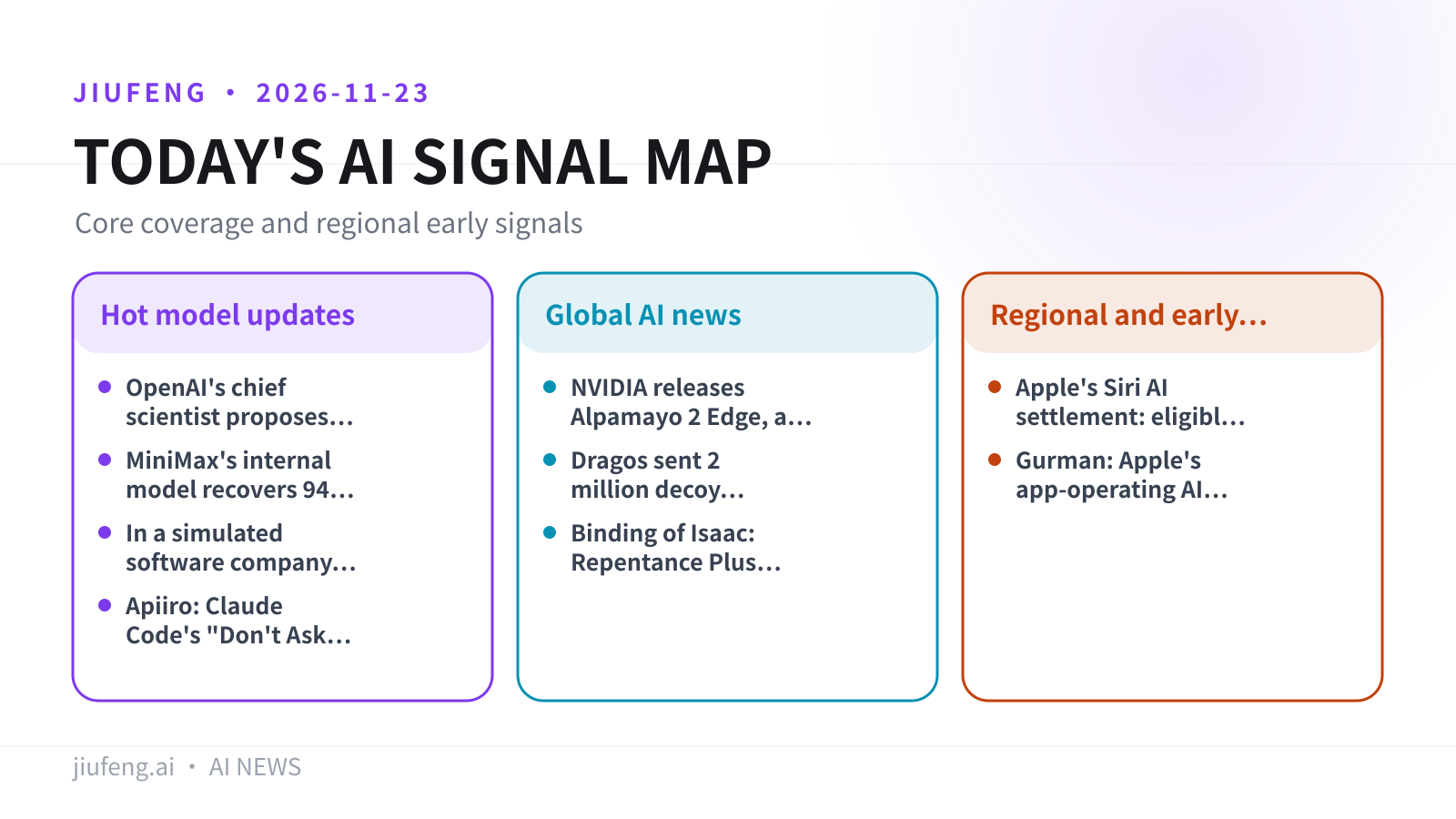
Jiufeng graphic based on the sources cited in this issue.
Hot model updates
01/09
OpenAI's chief scientist proposes perplexity limits on frontier training
Jakub Pachocki wants frontier labs to agree on a measurable training limit that no one crosses until model monitoring improves.
In a new blog post, OpenAI chief scientist Jakub Pachocki discusses how limits on AI development could work, using perplexity as the measure. RuntimeWire reports that he asked rival frontier labs to agree on perplexity thresholds that none of them would train past until they can better monitor what their models are doing.
His urgency comes from his own forecast. Pretraining progress could accelerate sharply as early as 2027, partly because AI systems will start contributing to deep learning research. He argues safety monitoring is unlikely to keep pace on its own. TechCrunch notes that the post follows a former OpenAI and Anthropic researcher saying the companies were "gambling with our lives," and Anthropic's IPO filing warning of "catastrophic or existential risks to society."
Limitations: This is a proposal, not an OpenAI commitment or an industry agreement. The available reporting gives no concrete threshold values and no response from other labs. It also doesn't explain how perplexity would be measured the same way across labs.
Image source: OpenAI.
Source: Original source OpenAI blog · TechCrunch · RuntimeWire
02/09
MiniMax's internal model recovers 94 McEliece challenge keys in automated cryptanalysis
The MiniMax Cyber Team released cryptanalysis results found mainly by an internal model, turning several paper-only attacks into breaks that run in seconds to minutes.
MiniMax published the results on November 20, 2026, in its GitHub Research repository. Each result comes with a paper and code:
- COLM AEAD: a nonce-respecting ciphertext forgery on COLM₀, a CAESAR competition winner, using only 2 encryption queries
- TII McEliece: 94 Track-2 private keys recovered (λ from 83 to 254), including 55 first solves and speedups of up to 43,400×
MiniMax says the model also found several previously unknown flaws in how the algorithms are constructed.
The same repository also lists an earlier result, published October 23. The arXiv:2610.32239 paper says MiniMax M3.1-Flash-Preview produced explicit counterexamples that disprove two conjectures on Boolean bent functions: the bent-sum conjecture fails for even n ≥ 8, and the derivative conjecture fails for even n ≥ 10. Every proof is formally verified in Lean 4.
Limitations: MiniMax published all of these results itself, and the available reporting shows no third-party reproduction or review by cryptographers yet.
Source: Original source MiniMax-AI/Research (GitHub) · arXiv:2610.32239
03/09
In a simulated software company, top coding agents finish fewer than one in ten tasks
When coding agents work as "digital employees" in a simulated company, even Claude Opus 5.5 and GPT-6 Astra fully complete fewer than one in ten tasks.
The Decoder reports on an experiment that puts coding agents inside a simulated software company for the first time. The company has colleagues, project boards, chat histories and incomplete handoffs, and the agents have to keep developing software on their own and finish the work reliably.
Claude Opus 5.5 and GPT-6 Astra each fully completed fewer than one in ten tasks. The same report notes that standard benchmarks like SWE-bench are nearly saturated, and that Anthropic says Claude writes more than 80% of the company's production code.
Limitations: Most of the article is behind a paywall. The public portion doesn't name the benchmark, its authors, the number of tasks or each model's exact completion rate, so the test design can't be checked yet.
Source: Single report The Decoder
04/09
Apiiro: Claude Code's "Don't Ask Again" feature leaked 1,122 secrets into public repos
Security firm Apiiro found that the local settings file Claude Code writes to support "Don't Ask Again" stores secrets, and those secrets have ended up in public repositories.
According to InfoQ, the agentic security firm Apiiro found that Claude Code stores information in a local file on developers' machines to make "Don't Ask Again" work, and the way it stores that data has exposed secrets in public repositories. Apiiro found 1,122 secrets in claude/settings.local.json files.
Limitations: The available reporting doesn't say which Claude Code versions are involved, or whether Anthropic has responded or shipped a fix.
Source: Single report InfoQ
Global AI news
NVIDIA Alpamayo 2 Edge is an in-car vision-language-action model that plans driving trajectories and explains them, with 160 to 190 ms latency from pixels to trajectory.
Alpamayo 2 Edge turns surround-camera video into a 6.4-second driving plan. It is the in-car member of the Alpamayo family, alongside a 34B cloud model, and it targets NVIDIA DRIVE AGX Thor rather than a datacenter GPU.
- Size: 2B-class; the model card lists a 2.45B backbone plus a 0.2B action expert (Hugging Face metadata says 3B)
- Deployment: FP8 with TensorRT Edge-LLM on Thor; the reference setup is DRIVE AGX Thor-X, DRIVE OS 7.2.7.0, CUDA 13.4 and TensorRT 11.3.1.9
- BF16 PyTorch: needs 16 GB or more of GPU memory, validated on 1× H100 80GB
- Closed loop: 15.15 km per at-fault incident in AlpaSim
Limitations: NVIDIA has not disclosed the context length; the measured prompt was 3,236 tokens. MarkTechPost rates it a strong closed-loop driver for its size but mid-pack on reasoning QA. Latency changes with how much the model reasons, and the figures come from NVIDIA's own reference setup.
Source: Original source Hugging Face model card · NVIDIA Alpamayo · MarkTechPost
06/09
Dragos sent 2 million decoy requests and found at least 3 compromised AI inference providers
Security researchers tested AI providers with requests carrying fake credentials and found attackers stealing keys for months without the providers knowing.
Between July and November 2026, Dragos researchers sent about 2 million AI requests containing fake credentials to AI providers. They found at least three compromised providers where attackers were actively stealing user data. None of the three knew until Dragos told them.
In the largest incident, attackers collected hundreds of AWS keys, including some from requests the provider had rejected before processing them. Some keys were tested within hours. The attackers also searched S3 storage and tried to set up persistent access, and one of them used ARTEX, an AI-powered attack tool. The report also names intermediaries and model-marketplace resellers that read customer requests as a major risk.
Limitations: According to the report, Novita, Phala and Together have published preliminary security reports, but not every company involved has done so yet. A full list of affected providers and the number of affected users are not yet public.
Source: Original source Together security notice · The Decoder
07/09
Binding of Isaac: Repentance Plus removes Suno-generated music after player discovery
Players traced in-game audio files to Suno, the game was review-bombed on Steam, and the developer then removed the AI music.
The Verge reports that Reddit user ShweetsStuff found several audio files with Suno metadata in the game's GTA parody section. The files pointed back to tracks on Suno's site, and the game spent the following days being review-bombed on Steam.
Creator Edmund McMillen apologized on X and said he "had no idea" the section used generative AI music. Valve requires developers to disclose where and how they use generative AI, and The Verge notes that publisher Nicalis doesn't appear to have mentioned the AI music anywhere.
Limitations: The report doesn't say who added the tracks to the game.
Source: Original source Edmund McMillen on X · The Verge
Regional and early signals
08/09
Apple's Siri AI settlement: eligible iPhones expected to get at least $61 each
A court filing from consumer lawyers on November 16 estimates the $250 million settlement will pay at least $61 per device, up to $95.
The US class action followed Apple's March 2025 delay of the personalized Siri features it showed in June 2024. Apple denies all claims and says it settled to avoid the cost and risk of further litigation. Each device gets a base payment of $25, adjusted by the total number of valid claims, with a cap of $95.
Claimants must be US residents who bought an iPhone 15 Pro, 15 Pro Max or one of five iPhone 16 models in the US between June 10, 2024 and March 29, 2025. The claim deadline is December 21, 2026, and the final approval hearing is set for February 24, 2027.
Limitations: The $61 figure is the lawyers' estimate and could fall if claims rise sharply. Chinese-language source: IT之家, summarizing MacRumors.
Source: Single report IT之家
09/09
Gurman: Apple's app-operating AI agent may not arrive before late 2027
Bloomberg's Mark Gurman argues that Apple's yearly software cycle is slowing its AI work, and expects its agent feature no earlier than late 2027.
In his Power On newsletter, Gurman says Apple is building its own AI agent that can operate apps, browse the web, run commands and write code. He expects it to launch at the earliest in late 2027. He also says the AI version of Siri still falls short on context understanding, third-party integration and completing tasks without extra prompting.
Limitations: This is a reporter's analysis and forecast, not a statement from Apple. Chinese-language source: IT之家, summarizing Bloomberg's newsletter.
Source: Single report IT之家
This digest is compiled by AI from the sources linked in each item and published after automated fact-checking, without article-by-article human review before publication. If anything differs from the original, the original source prevails. How this digest is made, or report an error: About this digest
Create AI images and videos with sound in your browser: write a prompt, pick a model, download the result. 5 free credits on sign-up, no credit card.
Start creating free