Overview
11 stories in this issue. The first 3 are today's priorities.
Hot model updates
- Top · Zhipu's GLM-5.4 runs 28 layers twice in a 750B loop model
- Top · ERNIE 5.5 Flash Preview weights released under Apache 2.0
- Top · vLLM supports ERNIE 5.5 Flash Preview on day 0, with 40% faster indexing at 1M context
- Gemini 4 agent teams find faster quantum algorithms, checked by formal verification
Global AI news
- Amazon Bedrock launches a trusted access API, starting with two Anthropic enterprise programs
- Nothing's Ear Note earbuds will record and transcribe conversations with AI
- Supertake raises a $20M seed round to turn market views into portfolios with trading agents
Regional and early signals
- Huajin Securities adopts Qwen Office, with 73 AI skills for research and risk control
- Ant's OceanBase launches the OceanLake AI data platform and open-sources its AI database
- Xiaomi Browser on phones and tablets now supports extensions, including an AI assistant
- Chinese edge-AI firm proposes an "Edge SuperPOD", claiming 270% more throughput without new chips or models
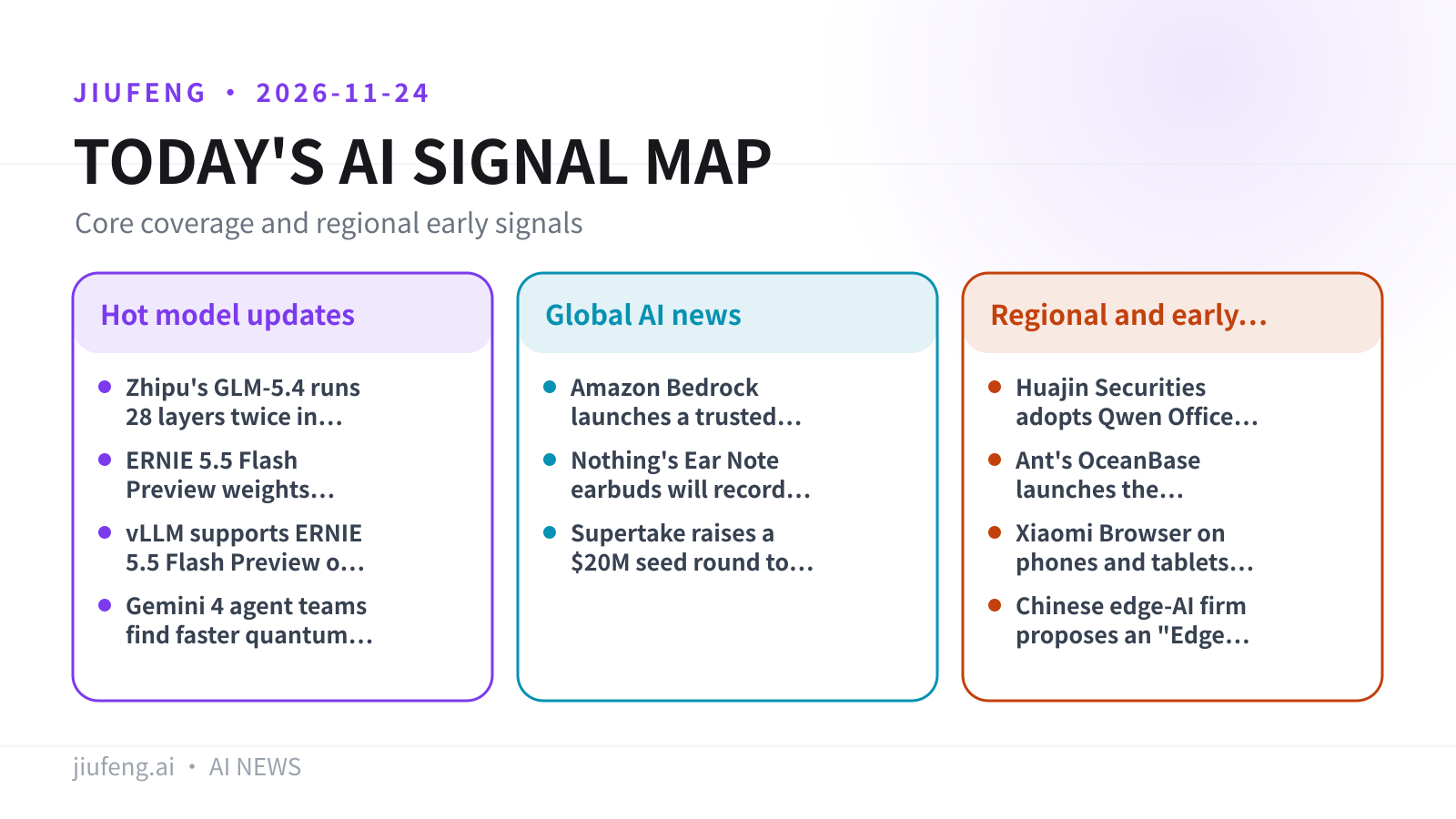
Jiufeng graphic based on the sources cited in this issue.
Hot model updates
GLM-5.4 is Z.ai's first flagship built on a loop transformer. It gets a deeper network by repeating computation, without adding parameters.
According to The Decoder and MarkTechPost, GLM-5.4 has about 750 billion parameters. It runs a shared block of 28 GLM-5 layers twice, and the second pass refines the intermediate results of the first. The network gets deeper while the parameter count stays the same.
- Cost control: dedicated control gates, a shared token cache and sparse attention keep memory and compute from rising sharply
- Company claim: Z.ai says the 750B model can match models with 2 to 3 trillion parameters
- Positioning: Z.ai calls it the start of "Generalized Coding", where code is used to generate videos, games and CAD models
- Availability: for now it runs only inside Z.ai's own products (GLM Coding Plan, ZCode, Z.ai Chat); API access and open weights are both planned after safety work is done
The Decoder reports that OpenAI already uses a similar loop architecture. Z.ai writes that, at the same compute budget, loop models trained from scratch have so far performed worse than models without shared weights. So Z.ai did not train GLM-5.4 from scratch. It converted an existing model into a loop model.
Limitations: The claim that it matches 2-3T-parameter models comes from Z.ai, and the reporting gives no benchmark scores to check it against. There is no date for API access or open weights.

Image source: zhipu.
Source: Original source Z.ai · The Decoder · MarkTechPost
On November 24, Baidu released the weights of ERNIE 5.5 Flash Preview under Apache 2.0. Developers can run the model locally and fine-tune it.
The weights and related files are on Hugging Face and ModelScope. The model can be served with vLLM, SGLang and other inference frameworks.
- Size: 280B total parameters, 14B active per token
- Context: up to 1M tokens
- Leaderboard: 1668 on CodeArena WebDev, second among open models and fourth among Chinese models, behind Kimi K3.1 Pro and Qwen3.8-Max
- License: Apache 2.0
Limitations: This is still a Preview release. For Terminal-Bench, AutomationBench and other tests, the reports only call the model "competitive" and give no scores.
Source: Original source ERNIE blog · Leiphone (Chinese-language source) · QbitAI (Chinese-language source)
03/11
vLLM supports ERNIE 5.5 Flash Preview on day 0, with 40% faster indexing at 1M context
ERNIE 5.5 Flash Preview runs on the released vllm==0.32.0 wheel through a standalone plugin, vLLM-ERNIE.
The vLLM blog lays out the architecture. The model has 43 layers: 37 use Heavily Compressed Attention (HCA) and 6 use MLA with DSA sparse attention. It also has a low-rank attention gate, Virtual Head Attention (VHA), Multi-Router Latent MoE, mHC residual streams and a MultiMax output head.
- FlashIndexer: an indexer accelerator released with the weights. It uses dynamic head routing and threshold pre-filtering to cut indexing cost, which gives a 40% speedup at 1M context
- Quantization: in the default checkpoint, routed experts are stored in MXFP4 (W4A8) and everything else in FP8
- Other acceleration: structure-aware kernel fusion, W4A8 QAT and DSpark speculative decoding
Limitations: Support comes from a separate plugin package and is not built into vLLM's main codebase. The 40% speedup was measured at 1M context.
Source: Original source vLLM Blog · vLLM-ERNIE · ERNIE blog
04/11
Gemini 4 agent teams find faster quantum algorithms, checked by formal verification
Google DeepMind had teams of Gemini 4 agents improve well-known quantum algorithms, producing more efficient quantum circuits. It also open-sourced the Lean library used to verify them.
The circuits are meant for simulating fusion energy, chemistry and enzymes. Circuits this resource-heavy cannot be tested on classical computers or on today's small quantum processors, so the team used formal verification to confirm they are correct.
DeepMind has published the Lean library, the problem specifications and the verified solutions on GitHub.
Limitations: These circuits will not run on real hardware any time soon. The post says some important applications will still need more resources than early quantum hardware can offer, even with the best algorithms.
Source: Original source Google DeepMind
Global AI news
05/11
Amazon Bedrock launches a trusted access API, starting with two Anthropic enterprise programs
Bedrock's trusted access program API is generally available. Two Anthropic programs, Enterprise Frontier Safeguards (EFS) and Enterprise Data Controls (EDC), enter public preview at the same time.
The API gives developers one place to find, request and enroll in model providers' trusted access programs. Frontier labs apply stricter safety monitoring to their most capable models, and those rules still apply on Bedrock. Eligible customers can choose where retained data is stored and how it is reviewed.
Both programs cover Claude Fable and Claude Mythos on Bedrock. They also cover Claude Opus 5.5 and Sonnet 5.5 when used through the Cyber Verification Program (CVP).
Limitations: EFS and EDC are still in public preview. Each program has its own terms and approval process, so access is not instant.
Source: Original source AWS Machine Learning Blog
06/11
Nothing's Ear Note earbuds will record and transcribe conversations with AI
Nothing's next AI device, Ear Note, records and transcribes conversations using microphones in the earbuds or the charging case. It is set to launch on December 8.
A companion app manages recordings, transcripts and AI-generated summaries. CEO Carl Pei has demonstrated the device to Bloomberg.
Limitations: Nothing has not announced a price. The report also says its rumored AI smartwatch and smart glasses have been delayed.
Source: Original source Carl Pei (X) · The Verge
07/11
Supertake raises a $20M seed round to turn market views into portfolios with trading agents
Users tell Supertake what they think the market will do. Frontier AI models and trading agents then build a real investment portfolio around that view, so users don't have to pick stocks themselves.
Adjacent (Nico Wittenborn) led the round, with Coinbase Ventures and Union Square Ventures joining. Angel investors include Nat Friedman (head of product at Meta Superintelligence Labs), Vercel CEO Guillermo Rauch, Nikita Bier, Scott Belsky and Nemil Dalal.
Limitations: The report does not say which models Supertake uses or what it charges. It also gives no track record for the portfolios.
Source: Single report TechCrunch
Regional and early signals
08/11
Huajin Securities adopts Qwen Office, with 73 AI skills for research and risk control
Huajin Securities built an AI workbench on Qwen Office (千问办公) that covers research, investment management and monitoring. It now has 73 specialized AI skills.
| Task | Before | After |
|---|---|---|
| Pre-market research prep | 2 hours | under 10 minutes |
| Daily risk consolidation | 2+ hours | 5 minutes |
The monitoring dashboard pulls data automatically over MCP connections and colors limits at two levels: a warning at 80% and a breach at 100%. Users can drill into any metric to see a 90-day trend. Breaches now show up the same day. Before, they surfaced a day or more later.
Limitations: The figures come from the two companies and have not been checked by anyone else. The report does not say which Qwen model version the workbench runs on. Chinese-language source.
Source: Single report Leiphone
09/11
Ant's OceanBase launches the OceanLake AI data platform and open-sources its AI database
At its AI data conference on November 24, OceanBase launched OceanLake, a lakehouse AI data platform. The OceanBase AI database is now open source as well, under the project name OceanSeek.
OceanLake puts a database's real-time transactions, a data warehouse's analytics and a data lake's open storage on one platform. It manages structured, semi-structured and unstructured data together. OceanBase says the platform runs more than 30 million "flash apps" (闪应用) for Ant's Lingguang. It also says the platform cut the time Ant's Afu needs to set up model evaluation environments from days to minutes.
Limitations: The report gives no license or repository link for the open-source project. Chinese-language source.
Source: Single report QbitAI
10/11
Xiaomi Browser on phones and tablets now supports extensions, including an AI assistant
Xiaomi Browser's mobile versions now support extensions for ad blocking, web translation, an AI assistant and script management.
Phones need version 20.32 or later, and tablets need version 20.6 or later. A Xiaomi employee previewed the feature in June.
Limitations: For now, only the built-in recommended extensions are available, and users cannot install third-party extension packages themselves. Xiaomi has not said which model the AI assistant extension uses. Chinese-language source.
Source: Single report IT Home
11/11
Chinese edge-AI firm proposes an "Edge SuperPOD", claiming 270% more throughput without new chips or models
辛米尔科技, a Chinese edge-AI company, proposes the Edge SuperPOD. It links cameras, robots, edge boxes and other kinds of devices so they can work on the same AI task together.
The system uses cross-modal feature encoding, spatiotemporal association and a unified scene representation to bring visual, 3D and audio data into one task context. Depending on the task, nodes can exchange structured events, features or compact multimodal tokens with each other, which means less raw data gets sent more than once. The company says that, with the same chips and models, effective task throughput rises by 270%.
Limitations: The 270% figure is the company's own claim. The report gives no test scenario, device mix or baseline. Chinese-language source.
Source: Single report QbitAI
This digest is compiled by AI from the sources linked in each item and published after automated fact-checking, without article-by-article human review before publication. If anything differs from the original, the original source prevails. How this digest is made, or report an error: About this digest
Create AI images and videos with sound in your browser: write a prompt, pick a model, download the result. 5 free credits on sign-up, no credit card.
Start creating free