Overview
8 stories in this issue. The first 3 are today's priorities.
Global AI News
- Top · Architect Labs unveils Frostbite, an AI-designed interaction net CPU
- Top · vLLM runs Kimi-K3's agentic KV cache on NVMe on MI355X
- Top · Microsoft AI chief Suleyman backs OpenAI's frontier training limits
- Anthropic's prospectus confirms on-site gas power at some planned data centers
- IBM's 2026 breach report: 1 in 4 malicious breaches were AI-enabled
Hot Model Updates
- GLM-5.4 joins Z.ai's Coding Plan with vision and 50% more weekly quota
Regional and Early Signals
- Edge0-145B: a 145B open on-device model that runs with 12 GB of VRAM
- Shanghai AI Lab says an AI-identified vitamin C additive is in use at storage plants

Jiufeng graphic based on the sources cited in this issue.
Global AI News
01/08
Architect Labs unveils Frostbite, an AI-designed interaction net CPU
Architect Labs says AI agents took Frostbite from interaction net theory all the way to final 7 nm GDS, and pre-silicon tests show 4.59x the performance per watt of a modern in-order CPU core.
Frostbite uses a new instruction set built around interaction nets and runs interaction net programs directly in hardware. Programs are written in Vine, a Rust-like language, and compiled to an IR called Ivy. The chip is a mesh of tiles, and each tile has its own small local memory. The launch post says the agents co-designed the ISA and the chip architecture starting from interaction net theory alone.
- Area: 1 quad (2×2 tiles) plus 4 L3 nodes takes 0.792 mm² on 7 nm
- Clock: final GDS closes at 500 MHz on 7 nm
- Energy split: in a quad, fetch, decode and issue drop from 27% of TCPU energy to 6%, while the on-chip network and scheduler take 26%
| Metric (vs 1 in-order core) | Multiple |
|---|---|
| Perf per watt (geomean, 25) | 4.59x |
| Perf per area | 8.77x |
| Perf per watt (conv2d, best) | 23.12x |
Limitations: All results are pre-silicon. There is no chip yet, and the company says an FPGA-hosted playground is planned. The comparison is against a single in-order core, not an out-of-order high-performance core, and every figure is self-reported.
Source: Original source Architect Labs launch post · SPLASH-2 benchmark · MarkTechPost
vLLM says a MoRI UMBP KV pool on NVMe matched a DRAM pool of the same size within 1% when running Kimi-K3 on AMD Instinct MI355X GPUs.
The test ran Kimi-K3 on vLLM and compared NVMe and DRAM KV pools of equal capacity. They came out within 1% of each other. The post argues for skipping the DRAM tier and keeping long-running agent KV cache on NVMe. By its cost math, drives that hold a full day of agent KV cost less than DRAM that holds 31 minutes.
Limitations: This is one test on the official vLLM blog, on one GPU (AMD MI355X) and one model (Kimi-K3). The post doesn't say how other GPUs, models or workloads would do.
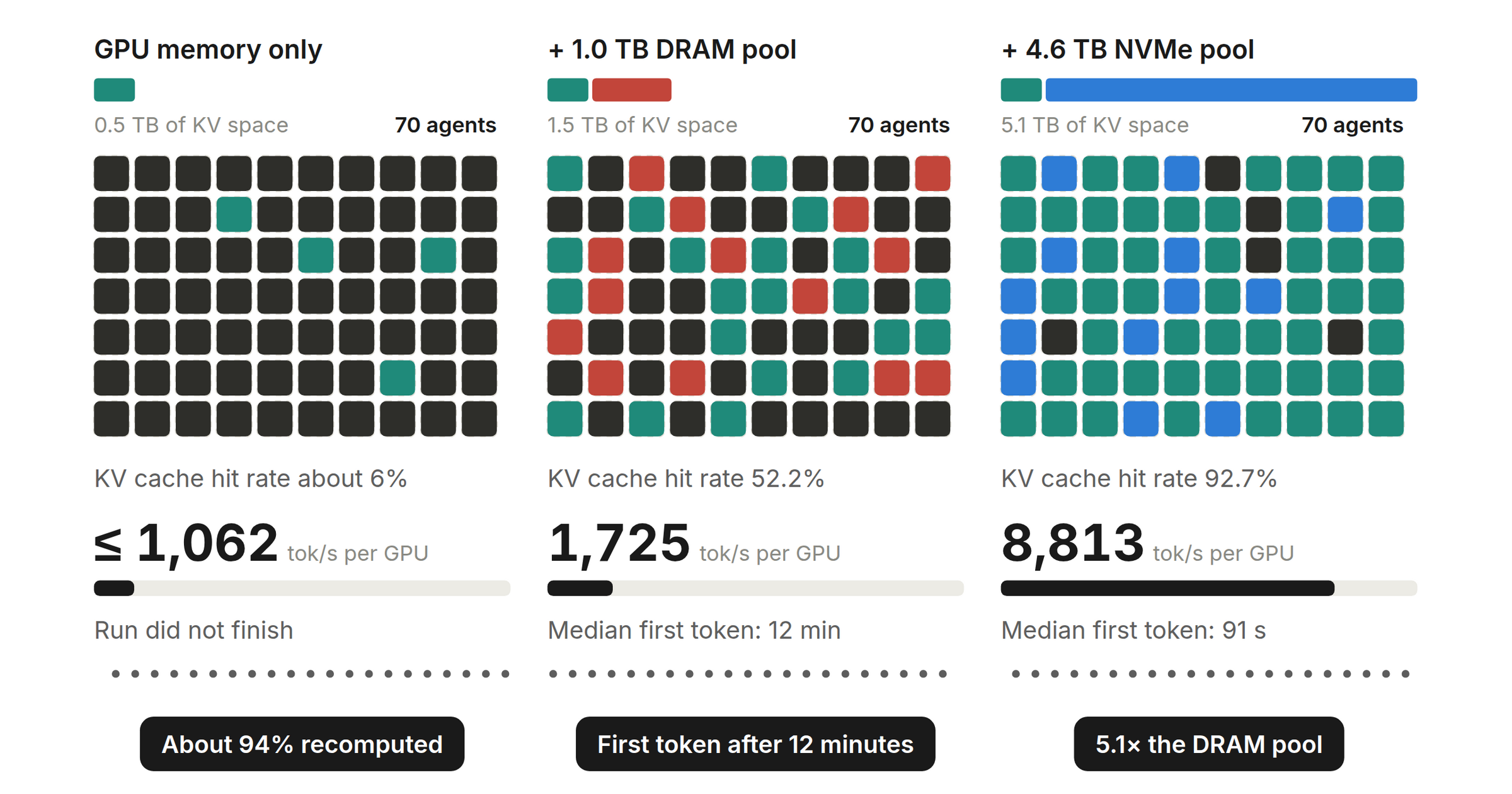
Image source: vllm.
Source: Original source vLLM Blog
Mustafa Suleyman, CEO of Microsoft AI, said on X that he backs OpenAI's proposal for shared perplexity thresholds that labs would not cross until model monitoring improves.
Under the proposal, developers would commit to common limits on frontier training and stay below them until they can better understand and monitor AI behavior. Suleyman posted his support in an X thread on November 23. He also reported a figure of 0.819 for Microsoft's MAI-2 Base on a metric tied to OpenAI's proposal. We covered the proposal itself in the previous issue. What's new is that another frontier lab has endorsed it publicly.
Limitations: The report doesn't say which threshold the 0.819 figure maps to, or whether any other labs have responded. The proposal is still a voluntary commitment with no binding force.
Source: Single report RuntimeWire
04/08
Anthropic's prospectus confirms on-site gas power at some planned data centers
Anthropic's IPO prospectus gives no fuel mix, but it confirms that some planned data centers will run on gas generated on site, and that Anthropic pays for that fuel.
An outside estimate published last week, which reached the Hacker News front page, says about 87% of Anthropic's power in 2028 will come from natural gas and 11% from coal. RuntimeWire checked it against the filing. The prospectus gives no percentages, but it does describe gas-fired sites and confirms on-site gas generation at some planned data centers.
Limitations: The 87% and 11% figures are a third-party estimate that Anthropic has not confirmed. The filing itself gives no fuel-mix numbers.
Source: Single report RuntimeWire
05/08
IBM's 2026 breach report: 1 in 4 malicious breaches were AI-enabled
A MarkTechPost glossary of 27 AI-era cybersecurity terms cites IBM's 2026 Cost of a Data Breach Report: 1 in 4 malicious breaches were AI-enabled, up 56% year over year.
The piece starts from the point that AI now sits on both sides of the security fight, and the vocabulary has changed with it. Its jailbreak entry describes a jailbreak as tricking a model into ignoring its safety training, usually through role-play, fake context or sheer volume, and cites Anthropic's many-shot jailbreaking research. Its backdoor (sleeper agent) entry defines a backdoor as hidden behavior that only activates on a secret trigger, with Anthropic's Sleeper Agents paper as the example.
Limitations: This is a glossary, not new research. The IBM figures are quoted secondhand, and the article doesn't describe the report's sample.
Source: Original source Anthropic: Many-shot jailbreaking · Sleeper Agents paper · MarkTechPost
Hot Model Updates
06/08
GLM-5.4 joins Z.ai's Coding Plan with vision and 50% more weekly quota
GLM-5.4 is now available to all GLM Coding Plan users. It adds vision and replaces the text-only GLM-5.3 as the plan's flagship.
Zixuan Li, Z.ai's head of global ecosystem, announced on X on November 23 that GLM-5.4 is open to every GLM Coding Plan subscriber, with stronger all-round coding. Users on weekly quotas get 50% more quota than they had with GLM-5.3.
- In Claude Code: set the model to
glm-5.4[1m] - In other tools: set it to
glm-5.4 - Role: replaces the text-only GLM-5.3 as the plan flagship
Limitations: The details come from Li's X thread as relayed by a single outlet. The report gives no benchmark scores, pricing changes or parameter count.
Source: Single report RuntimeWire
Regional and Early Signals
Wujie Fangzhou open-sourced Edge0-145B, a 145B-parameter on-device model that it calls the first 100B-plus on-device native foundation model. It can run offline on a PC or high-end laptop. (Chinese-language source)
- Parameters: 145B total
- Minimum setup: a PC with 12 GB VRAM and 20 GB system RAM, or a Mac with 48 GB unified memory
- Speed: over 80 tokens/s in the official demo video
- Traction: reached #1 on Hugging Face's Text Generation list three days after release
Limitations: The company says the model is comparable to cloud models such as Claude Opus 4.6 and DeepSeek-V4-Flash, but those are its own evaluations and nobody has reproduced them independently. The report gives no license or active parameter count.
Source: Single report QbitAI (Chinese-language source)
08/08
Shanghai AI Lab says an AI-identified vitamin C additive is in use at storage plants
Shanghai AI Lab reportedly used AI to help find an iron–chromium flow battery electrolyte formulation, and its vitamin C additive has reached energy storage plants.
The work targets the electrolyte formulation of iron–chromium flow batteries. AI helped identify the additive.
Limitations: The capacity, efficiency and cost gains are the project's own claims, and the report provides no independent data.
Source: Single report Pandaily
This digest is compiled by AI from the sources linked in each item and published after automated fact-checking, without article-by-article human review before publication. If anything differs from the original, the original source prevails. How this digest is made, or report an error: About this digest
Create AI images and videos with sound in your browser: write a prompt, pick a model, download the result. 5 free credits on sign-up, no credit card.
Start creating free