Overview
9 stories in this issue. The first 3 are today's priorities.
Hot Model Updates
- Top · GPT-Live-1.1 hits the API, with idle time billed at $0.02 per minute
- Top · OpenAI publishes prompt templates for GPT-6.2 Astra and Sol, and drops temperature and top_p
Global AI News
- Top · Signal restricts mobile screenshots over AI surveillance concerns
- Pandex serves 2.8 million official European legal documents over MCP
- Amazon reportedly in talks to buy chip-software startup Decart for up to $7.5B
- Nvidia researchers say many tasks don't need huge context windows
- InfoQ maps agentic AI architecture: context engineering, multi-agent coordination and platforms
Regional and Early Signals
- South Korea's president visits SK and AWS's Ulsan data center, planned at 103MW for phase one
- Stuttgart's HammerHAI AI factory doubles performance at about 700 kW
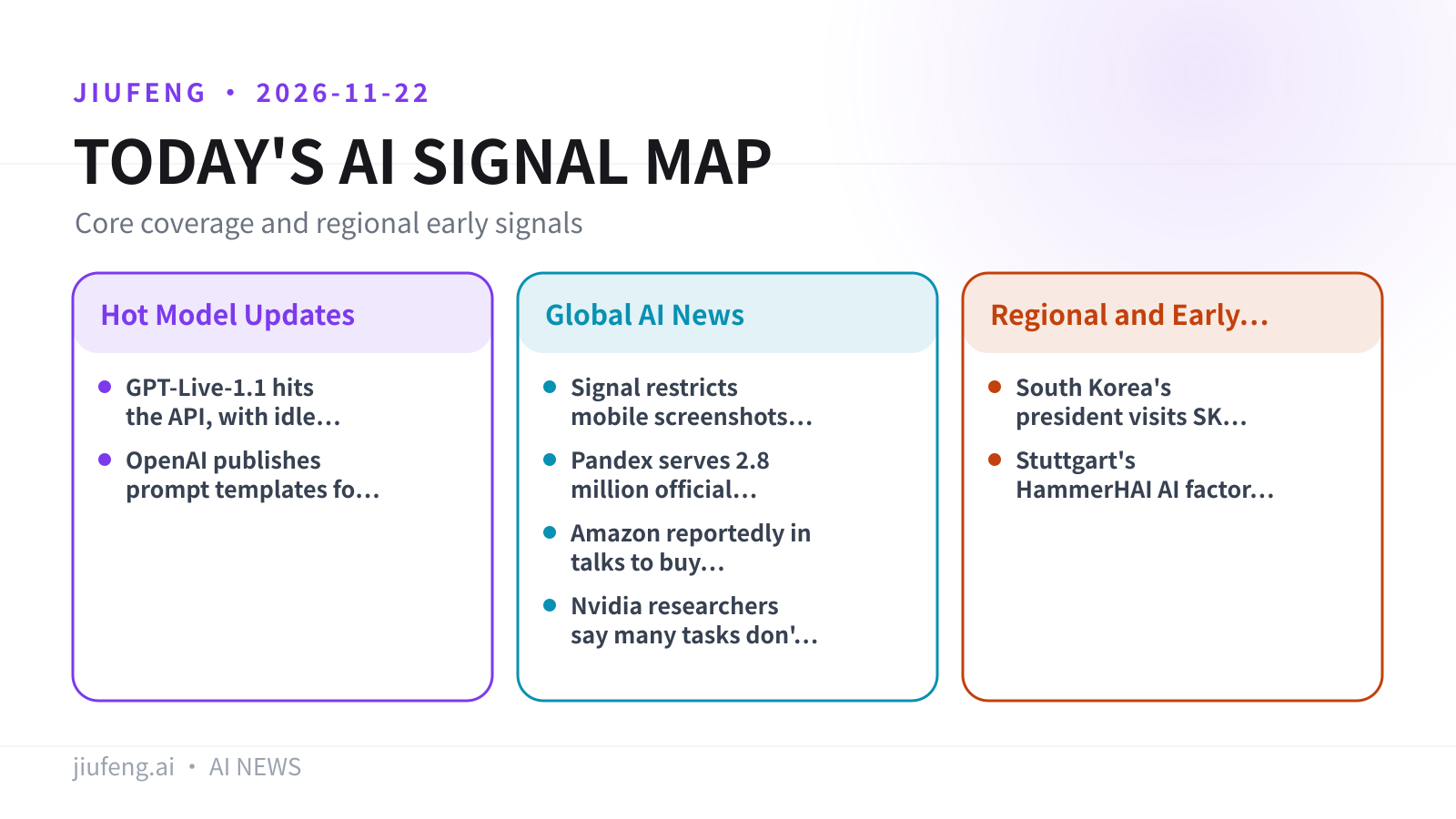
Jiufeng graphic based on the sources cited in this issue.
Hot Model Updates
OpenAI has opened its full-duplex voice model GPT-Live-1.1 in the API, and a new standby state makes idle voice-agent sessions cheaper.
OpenAI has made GPT-Live-1.1 available in its API under the model ID gpt-live-1.1. It is a full-duplex voice model for multilingual conversations, so it can listen while it speaks. Its predecessor, GPT-Live-1, reached the API on September 10, 2026. OpenAI says the new version has more natural and consistent accents across languages and completes tasks more reliably.
- Context: each Live session has a 128,000-token default context window
- Access: runs only in OpenAI's cloud, via
v1/live/sessions, with clients connecting over WebRTC or WebSocket - Standby billing: idle WebRTC time costs $0.02 per minute
- Claimed gains over GPT-Live-1: accents, transcription, handling of letters and numbers, and task completion
Limitations: OpenAI has published no benchmark scores, so the improvements are its own claims. There are no open weights and no quantized variants. The report says the standby rate covers idle WebRTC time and does not say whether WebSocket connections get it.

Image source: OpenAI Developers.
Source: Original source OpenAI model docs · OpenAI forum announcement · OpenAI Devs · MarkTechPost
02/09
OpenAI publishes prompt templates for GPT-6.2 Astra and Sol, and drops temperature and top_p
Developers moving to GPT-6.2 should review their system prompts, because the new models answer more briefly by default and some API behavior has changed.
OpenAI's model documentation now includes copy-ready prompts for GPT-6.2 Astra and Sol. They cover writing style, initiative and coding, and target common behaviors OpenAI observed in both releases. Astra is built for the most demanding tasks, while Sol handles complex work at lower cost. OpenAI says Astra writes more briefly and directly by default than earlier models. The templates tell the models to make reasonable assumptions instead of stopping to ask follow-up questions.
The coding template tells the models to reuse existing code, avoid unnecessary abstractions, and write new tests only on request or for specific errors. Two things changed in the API. Editing conversation history now discards earlier reasoning content, which can affect token costs and answer quality. The temperature and top_p parameters have been removed.
Limitations: these are prompting recommendations, not a model update, and developers need to verify the results themselves. Code that still sends temperature or top_p, or relies on rewriting conversation history, will need changes.
Source: Original source OpenAI developer docs · The Decoder
Global AI News
03/09
Signal restricts mobile screenshots over AI surveillance concerns
Signal treats AI surveillance as an "existential threat" and is now restricting screenshots in its Android and iOS apps.
TechCrunch reports that Signal is limiting users' ability to take screenshots in both its Android and iOS apps. The report frames the change as Signal's response to what it calls the "existential threat" of AI surveillance.
Limitations: the report refers to the Android and iOS apps. It does not detail when the restriction applies or whether it blocks ways of reading the screen other than screenshots.
Source: Single report TechCrunch
04/09
Pandex serves 2.8 million official European legal documents over MCP
Pandex lets agents pull official legal text and check the law as it stood on a past date.
Pandex searches European legislation and highest-court decisions and returns official passages that agents can quote, cite and check. The service is in beta.
- Scale: 2.8 million documents
- Scope: legislation and highest-court decisions across nine jurisdictions
- Point-in-time: agents can check the law as it stood on a past date
- Access: one REST API and one Model Context Protocol (MCP) server
Limitations: the service is still in beta and covers nine jurisdictions. The source gives no pricing for the REST API.
Source: Single report RuntimeWire
05/09
Amazon reportedly in talks to buy chip-software startup Decart for up to $7.5B
According to the report, a deal would give Amazon software that runs AI workloads efficiently across chips and could strengthen its Trainium business.
The Financial Times reports that Amazon is nearing a deal valued at up to $7.5 billion to buy Decart, an Israeli AI startup. Decart was founded by Dean Leitersdorf, Moshe Shalev and Orian Leitersdorf and builds software that runs AI workloads more efficiently across chips. The FT says talks are at an advanced stage and a deal could come as soon as early next week.
Limitations: this is secondhand reporting of the FT story, and the FT notes the talks could still collapse.
Source: Single report RuntimeWire
06/09
Nvidia researchers say many tasks don't need huge context windows
An Nvidia research team argues that models often don't need their full context window, and that periodic summaries plus targeted lookups worked about as well in many tests.
The report describes the context window as a model's working memory. GPT-4 launched in March 2023 with 8,192 tokens. GPT 5.6 Sol now handles around one million, roughly 120 times as much. The researchers argue that filling the full window is slow, expensive and error-prone. Their alternative is to write periodic summaries and look up specific information when needed, which in many tests performed about as well as using the full window.
Limitations: the full article is paywalled. The available reporting gives no benchmark names, scores or paper link, so it is not yet possible to check which tasks the "about as well" result covers.
Source: Single report The Decoder
07/09
InfoQ maps agentic AI architecture: context engineering, multi-agent coordination and platforms
An InfoQ overview argues that agentic systems are following the microservices path: companies build and run their own first, then managed commercial products take over.
The article traces how agent context grew from fixed preset prompts into dynamic context, drawn from other agents' outputs, context handoffs, or external data pulled in through RAG. As context piled up, reasoning quality dropped, and context engineering emerged as a practice of its own. The article links to an Anthropic engineering post on the topic.
On evaluation, the article notes that LLM calls make agentic systems slower, so throughput, latency and error rates alone are not enough. It cites a paper by Google and MIT researchers that tested several multi-agent coordination strategies, each with a set of configuration parameters. For protocols it lists Agent2Agent (A2A) and MCP. Among agentic AI platforms and frameworks it lists LangChain/LangGraph, CrewAI, Azure AI Foundry, Google Agent SDK (ADK) and Amazon Bedrock AgentCore Gateway.
Limitations: this is an overview article, not a product or model launch. The microservices comparison is the author's view, and the article gives no quantitative data to back it.
Source: Original source Anthropic: context engineering · Multi-agent scaling paper · Amazon Bedrock AgentCore Gateway docs · InfoQ · InfoQ China (Chinese-language source)
Regional and Early Signals
08/09
South Korea's president visits SK and AWS's Ulsan data center, planned at 103MW for phase one
In Ulsan, Lee Jae-myung said "speed is crucial" in the global AI race and pointed to a shortage of construction workers for data centers.
Citing Reuters, IT Home reports that South Korean President Lee Jae-myung visited a data center under construction in Ulsan on November 21. SK Group and Amazon Web Services are developing the project together. South Korea's science and ICT ministry estimated last year that total investment would reach about 7 trillion won by 2029, with operations planned for the second half of 2027. SK Chairman Chey Tae-won said in September that first-phase capacity should reach 103MW by 2029, with plans to add nearly 900MW more later. About 900 people work on the site, and Lee asked ministries to work out how to train the construction workers AI infrastructure needs.
Limitations: Chinese-language source. The investment and capacity figures are government estimates or company plans, not built capacity. No timeline has been given for the nearly 900MW expansion.
Source: Single report IT Home (Chinese-language source)
09/09
Stuttgart's HammerHAI AI factory doubles performance at about 700 kW
The High-Performance Computing Center Stuttgart says Europe's public AI factories should be judged by how many companies can actually use them, not just by their chips.
At SC26, Bastian Koller, managing director of the High-Performance Computing Center Stuttgart, said the HammerHAI AI factory is built around a Hewlett Packard Enterprise system with Nvidia Grace Blackwell chips. The new system doubles the performance of its 3.2-megawatt predecessor while drawing about 700 kilowatts. The center focuses on SMEs and startups and offers hands-on support as well as compute. It also emphasizes avoiding vendor lock-in and handling data carefully.
Limitations: these figures come from an interview with the center's head, not from independent testing.
Source: Single report SiliconANGLE
This digest is compiled by AI from the sources linked in each item and published after automated fact-checking, without article-by-article human review before publication. If anything differs from the original, the original source prevails. How this digest is made, or report an error: About this digest
Create AI images and videos with sound in your browser: write a prompt, pick a model, download the result. 5 free credits on sign-up, no credit card.
Start creating free