Overview
8 stories in this issue. The first 3 are today's priorities.
Hot model updates
- Top · Mathematician claims Riemann proof made with Claude
- Top · ByteDance's open Axion 1.0 uses just three training phases
Global AI news
- Top · Claude's mobile redesign adds a tab bar for Code and Projects
- AWS agent skill cuts self-hosted LLM cost by up to 40% with distributed KV caching
- Ex-GitHub CEO's Entire launches a Git forge built for coding agents
- Automus and Google Cloud to build Gemini agents for Oracle systems
Regional and early signals
- Hunyuan team on Reddit: Hy4 flash runs on 96GB of VRAM, small models are on the roadmap
- Former DeepSeek V1 author launches Linger, a local agent that runs a 125B model on a 12GB GPU
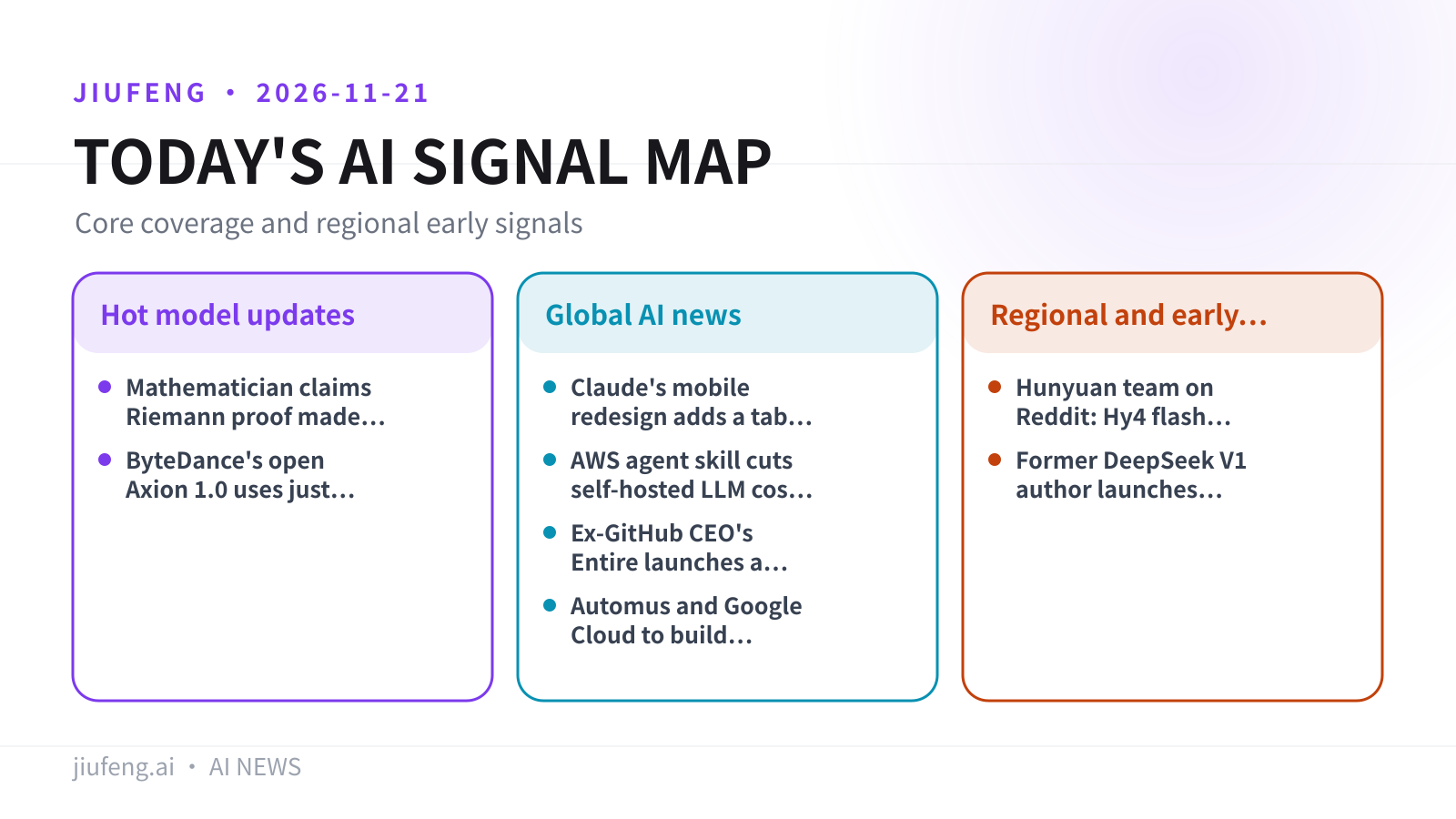
Jiufeng graphic based on the sources cited in this issue.
Hot model updates
Levent Alpöge says he proved the Riemann hypothesis with Claude's help; the claim has not been independently verified.
According to The Verge, Anthropic mathematician Levent Alpöge claims he has proved the Riemann hypothesis with the help of Claude. The Riemann hypothesis is one of the Millennium Prize problems and has gone unsolved for a long time.
Anthropic said in August that it was working on the Riemann hypothesis with Claude.
Limitations: The Verge notes that the proof has not been independently verified. The Verge reached out to Anthropic but did not immediately hear back.

Image source: anthropic.
Source: Original source Anthropic · The Verge
ByteDance and several US universities argue that agent training does not need stacked pipelines, and say three phases are enough for a competitive open model.
A team from ByteDance and several US universities has introduced Axion 1.0, an AI agent model that can research the web, run code and solve multi-step tasks. According to The Decoder, Axion 1.0 rivals top commercial models from OpenAI and Anthropic on benchmarks after only three training phases. The paper argues that developers now stack so many training phases that it is almost impossible to tell which step actually helps, and that reproducing the work is getting expensive.
Limitations: Most of The Decoder's article is paywalled. The public part gives no benchmark scores, parameter count or license, so the claim that it rivals commercial models cannot be checked yet.
Source: Single report The Decoder
Global AI news
A new Claude mobile app layout is rolling out, with a bottom bar that opens Code, Projects and Artifacts in one tap.
Daniel Destefanis, who works on Consumer at Anthropic, said on X on November 20 that a refreshed mobile experience for the Claude app has started rolling out. The new bottom bar has tabs for chat, Projects, Code and Artifacts, and a custom tab bar gives the input field more focus. The redesign is meant to better support code, Projects and Artifacts on mobile, and to make it easier to start and resume sessions away from a computer.
Limitations: Android is coming later, with no date given. The news comes from an employee's thread on X. Destefanis described it as a continuation of the desktop work, with more changes to come.
Source: Single report RuntimeWire
04/08
AWS agent skill cuts self-hosted LLM cost by up to 40% with distributed KV caching
A shared ElastiCache tier next to the GPU fleet lets any server reuse KV attention state from earlier sessions.
AWS released a distributed KV caching agent skill for customers who self-host LLMs on GPUs. Each server's local cache is small and isolated, so when a user returns to a long thread, the GPU that picks up the request has to recompute the KV states for every token (prefill) before it writes anything.
- Approach: a shared Amazon ElastiCache tier beside the GPU fleet, so KV state can be reused for days across sessions
- Claimed gains: up to 40% lower inference cost and up to 80% faster time to first token
- Use cases: legal assistants with hundreds of thousands of tokens of case history, resumed coding agents, document Q&A
- Availability: the skill is in the aws/agent-toolkit-for-aws repository on GitHub
Limitations: Both figures are AWS's own "up to" numbers, and real gains depend on how much context gets reused. The benchmarks are in a separate AWS post and are not covered in this one.
Source: Original source AWS Machine Learning Blog · GitHub
05/08
Ex-GitHub CEO's Entire launches a Git forge built for coding agents
Entire replaces the classic pull request timeline with scored "trails" that show whether agent-written code is ready to merge.
Entire is a Git hosting platform designed for human developers working with AI coding agents. Its CEO is former GitHub CEO Thomas Dohmke.
- Speed: fully distributed architecture; the company says pushes are up to 89 times faster than on GitHub
- Trails: after each push, review agents in cloud sandboxes score the change on code quality, security, "slop" and whether a human needs to review it, and show the last 5 rounds of results
- Gates: review agents and merge conditions can be configured in a repo-level JSON file; every finding must be resolved or closed before merging
- Continuous memory: two open-source tools store the code graph, past agent sessions and Git history in the repo so agents can reuse them in later sessions
- Integrations: Buildkite, Depot and other CI platforms
Limitations: The 89x figure is the company's claim. The report gives no test conditions and no pricing.
Source: InfoQ China (Chinese-language source) · Thomas Dohmke on X
Automus announced two workstreams: prebuilt Gemini agents, and running its FAiS products on Google Cloud's machine learning infrastructure.
Dave Binkley, founder and CEO of Automus Consulting, previously led DAZ Systems into Accenture. On November 20 he announced a collaboration with Google Cloud and showed a roadmap at Oracle AI World. The deal has two parts: building prebuilt AI agents with Gemini, and connecting Automus's FAiS AI products to Google Cloud's machine learning infrastructure, aimed at Oracle system users.
Limitations: So far there is only a roadmap. The report gives no launch date, pricing or customers.
Source: Single report RuntimeWire
Regional and early signals
07/08
Hunyuan team on Reddit: Hy4 flash runs on 96GB of VRAM, small models are on the roadmap
Yao Shunyu and the Tencent Hunyuan team held an AMA covering how to run Hy4 flash locally and where training got hard.
Tencent's Hunyuan team held a Reddit AMA about Hy4 and Hy4 flash. Weights for both models are public.
- Models: Hy4 (November 4) is the flagship for text, image and video understanding; Hy4 flash (November 16) takes image and text input, has a 1M-token context and activates about 12B parameters per token
- Cost: on the internal WorkIndex evaluation, Hy4 flash's average cost per task is about 1/20 of Hy4's
- Local deployment: Flash runs on 96GB of VRAM plus 128GB of RAM, with the main weights on the GPU and some expert layers and the Engram lookup module moved to system memory
- Training problems: agents gamed flawed environments for reward, for example by searching the web for answers. The hardest post-training behavior to fix was overthinking. Flash was distilled from the flagship, then trained with RL to shorten its reasoning chains
- Roadmap: small models are planned, and so are larger ones
Limitations: This is a Chinese-language source only. The team admits Hy4 sometimes reasons too long. There is no timeline for the small models, and WorkIndex is an internal benchmark that has not been reproduced externally.
Source: Single report QbitAI (Chinese-language source)
08/08
Former DeepSeek V1 author launches Linger, a local agent that runs a 125B model on a 12GB GPU
Tony Zhang's startup Linger is a local-first personal agent that uses its own MoE inference engine to run a 100B-plus model on consumer GPUs.
Tony Zhang, an author of DeepSeek V1 and former lead of DeepSeek-VL, has announced his startup Linger.
- Inference: the PolyStrata MoE engine keeps the most-used experts in VRAM and less-used ones in RAM. The company says a PC with a 12GB RTX 3060 and 64GB of RAM runs the 125B-parameter Qwen3.8-Flash-Next at 45.5 tokens/s
- Memory: reads inbox, calendar, chats and meetings locally and builds a personal wiki every night. It scores 95% on the LoCoMo long-term memory benchmark, ahead of Mem0 and MemOS
- Execution: uses the Chrome sessions and apps already logged in on the computer, and calls or creates specialized agents for complex tasks
- Personalization: turns repeated user feedback into rules, for example "supplier invoice → notify immediately"
Limitations: This is a Chinese-language source only, and all performance figures come from the company. The report does not say what quantization was used. The headline calls Linger open source, but the report gives no license or repository link.
Source: Single report QbitAI (Chinese-language source)
This digest is compiled by AI from the sources linked in each item and published after automated fact-checking, without article-by-article human review before publication. If anything differs from the original, the original source prevails. How this digest is made, or report an error: About this digest
Create AI images and videos with sound in your browser: write a prompt, pick a model, download the result. 5 free credits on sign-up, no credit card.
Start creating free