Overview
9 stories in this issue. The first 3 are today's priorities.
Hot model updates
- Top · OpenAI tightens GPT-6.2 safeguards: reasoning extraction now succeeds less than 1% of the time
- Top · NVIDIA releases Nemotron-Labs-Sigma: 14 open continuous diffusion LM checkpoints
- Top · Waddle Labs says Waddle-1 scored 81 on the Robocurve robot benchmark
Global AI news
- METR updates its time-horizon chart: models are weaker on judgment tasks
- Google Search adds an AI Mode sidebar and temporary threads worldwide
- SageMaker HyperPod adds a Global Inference Gateway that routes across Regions and clusters
- Trump threatens a "tremendous tax" on companies that build AI data centers abroad
Regional and early signals
- Grab adds layers of crash defense as AI-generated code changes grow
- Lingzhang Robotics shows nine dexterous hands; its space manipulation system has passed spacecraft installation tests
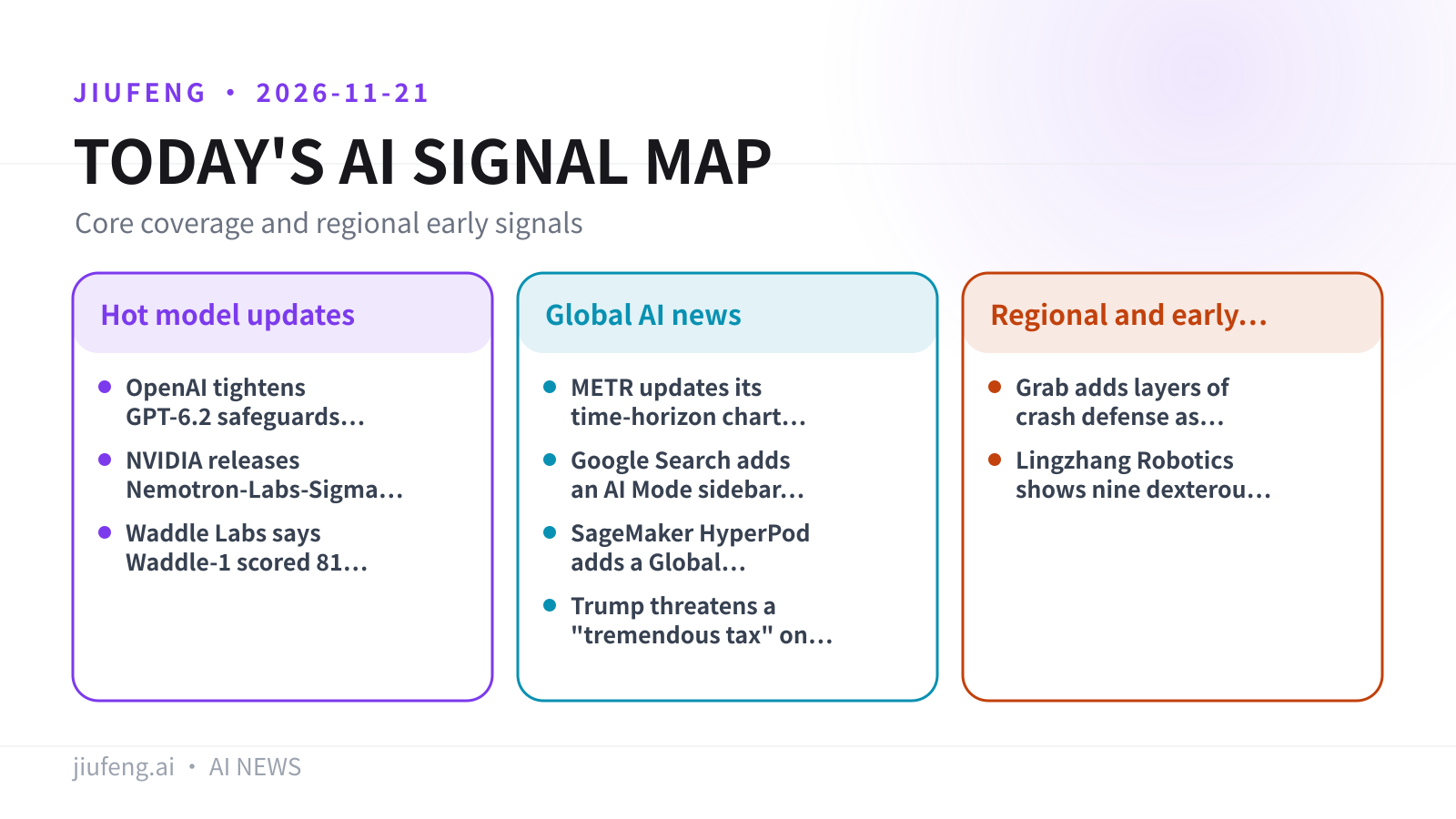
Jiufeng graphic based on the sources cited in this issue.
Hot model updates
01/09
OpenAI tightens GPT-6.2 safeguards: reasoning extraction now succeeds less than 1% of the time
In OpenAI's internal red-team tests, attacks that extract protected reasoning from GPT-6.2 Astra succeeded 0.2% of the time, down from 54.0%.
The new safeguards cover GPT-6.2 Astra and GPT-6.2 Sol. OpenAI's adaptive black-box red-teaming results:
| Attack type | GPT-6 Astra, original (ASR %) | GPT-6.2 Astra, updated (ASR %) |
|---|---|---|
| Prior-request reasoning | 54.0 | 0.2 |
| Current-request reasoning | 22.9 | 0.9 |
The defenses work on two levels:
- Individual requests: targeted training, input and output filters on messages and tool calls, and API blocks that stop older models from reading protected reasoning.
- Coordinated campaigns: OpenAI bans thousands to tens of thousands of accounts each week.
Some of the improvements are coming to GPT-6 Astra.
Limitations: The numbers come from OpenAI's own automated testing, and no third party has reproduced them. The report gives no separate results for GPT-6.2 Sol.

Image source: OpenAI.
Source: Original source OpenAI · The Decoder
02/09
NVIDIA releases Nemotron-Labs-Sigma: 14 open continuous diffusion LM checkpoints
Nemotron-Labs-Sigma is a family of 3B and 8B continuous diffusion language models with 14 open checkpoints. It denoises text in a 16-D embedding space instead of on discrete tokens.
The research team calls Sigma the first large-scale family of continuous diffusion language models. It says working in a continuous space makes few-step distillation and trajectory steering practical for text.
- Size: 3B and 8B, 14 checkpoints in total.
- License: released on Hugging Face under the NVIDIA Nemotron Open Model License; the model card says commercial use is allowed.
- Context: 4,096 tokens, or 8,192 for Sigma-8B-instruct.
- Hardware: one NVIDIA GPU in bfloat16 (Ampere, Lovelace, Hopper, Blackwell); about 120–140 tokens/s on one H100.
- Scores: Sigma-8B base averages 71.16 on NVIDIA's 6-task suite, ahead of NLD-8B at 70.22. Sigma-8B-instruct scores 91.96 on GSM8K with 256 DDPM steps. The distilled model averages 70.34, with 88.44 on GSM8K and 65.18 on HumanEval.
Limitations: The same model and sampler score only 17.00 on AIME25. There is no CPU support and no quantized variants are listed.
Source: Original source Hugging Face collection · arXiv paper · MarkTechPost
Waddle Labs, a two-person YC startup, says its robot-use agent Waddle-1 scored 81 in Robocurve evaluations, ahead of GPT-6.2 Astra and Dream-1.
Waddle Labs, based in San Francisco, announced Waddle-1 in an X thread on November 20. The company describes it as a cloud reasoning agent that controls bimanual robots zero-shot on tasks it has not seen before. A preview API is open.
| Model | Company-stated score | Robocurve leaderboard (RoboDojo-RC Tier 1, %) |
|---|---|---|
| Waddle-1 | 81 | Not stated |
| GPT-6.2 Astra | 65 | 65.7 |
| Dream-1 | 59 | 59.5 |
Limitations: The 81 is Waddle Labs' own figure. The report confirms the leaderboard scores for the two comparison models but does not say whether Waddle-1 is listed on the leaderboard. RuntimeWire is the only outlet reporting it so far.
Source: Single report RuntimeWire
Global AI news
04/09
METR updates its time-horizon chart: models are weaker on judgment tasks
METR, an AI evaluation nonprofit, has updated its time-horizon chart. Some capabilities are still improving exponentially, but models do worse on tasks that need judgment than on coding.
METR has models attempt a large set of tasks that humans have completed. Each task's difficulty is the time humans needed to finish it, and models are rated by the length of tasks they can complete. The original chart showed that this length doubled roughly every four months for frontier models. The update adds more tasks, some that take humans far longer and others that are more open-ended.
Researcher Kapoor said he was not surprised that models fall short on open-ended tasks such as designing an AI evaluation. He and his co-authors discussed this in a preprint in August.
Limitations: MIT Technology Review notes that the original chart was widely misread because its measures are complex.
Source: Original source Kapoor et al. preprint · MIT Technology Review
05/09
Google Search adds an AI Mode sidebar and temporary threads worldwide
Google is rolling out a collapsible sidebar on its desktop Search homepage worldwide so users can reopen recent AI searches. AI Mode is also getting temporary threads that leave no history.
Google Search VP Robby Stein announced the update on X. The sidebar sits on the left of the AI Mode interface and lets users:
- Start threads: open a new search thread;
- Search threads: look through existing ones;
- Notebooks: create notebooks;
- Recent items: open recent queries and settings.
Temporary threads don't use prior context, aren't saved to history, and don't affect future recommendations. They disappear once closed.
Limitations: Stein says the sidebar helped users keep researching during testing, but Google has not published the test data.
Source: Original source Robby Stein on X · The Decoder
06/09
SageMaker HyperPod adds a Global Inference Gateway that routes across Regions and clusters
Amazon SageMaker HyperPod Global Inference Gateway is one managed endpoint that sends inference requests to HyperPod clusters in one Region or across several.
The global gateway picks the cluster and carries the request over the AWS backbone. It fails over automatically and authenticates with SigV4 and IAM. Inside each cluster, the existing Inference Gateway still picks the pod, based on real-time signals such as KV cache utilization and queue depth.
AWS's example is a traffic peak where requests queue on one cluster while GPUs on another cluster, sometimes in another Region, sit idle.
Limitations: This is AWS's own product announcement; there is no independent reporting yet.
Source: Original source AWS blog: Global Inference Gateway
07/09
Trump threatens a "tremendous tax" on companies that build AI data centers abroad
US President Donald Trump said companies that build data centers outside the US will face a "tremendous tax."
Trump spoke at a press conference on Friday after his summit with Xi Jinping and Vladimir Putin: "We're not going to allow our companies to build data centers outside of our country." The Verge notes that states and cities across the US are restricting new applications to build data centers.
Limitations: So far this is only a spoken statement. The report gives no tax rate, legal mechanism or timeline.
Source: Multiple outlets The Verge · AP
Regional and early signals
08/09
Grab adds layers of crash defense as AI-generated code changes grow
Southeast Asian super-app Grab says AI coding assistants have increased the amount of code changed in each release. It has added crash safeguards at every stage of development and release.
- Pre-merge to pre-production: static checks with Android Lint, SwiftLint and custom rules; unit, UI and QA testing; then Grab Early Access (GEA), a pre-production gate that ships early builds to internal users and monitors them.
- Release: staged rollouts that pause when crash rates look abnormal, and feature flags that can be switched off past a threshold without a new release.
- Post-release: real-time monitoring with Firebase Crashlytics and BigQuery, automated triage that maps crashes to specific PRs, and postmortems that feed new lint rules and tests.
Limitations: The report gives no before-and-after crash-rate figures.
Source: Multiple outlets InfoQ · InfoQ China
09/09
Lingzhang Robotics shows nine dexterous hands; its space manipulation system has passed spacecraft installation tests
Wuxi-based Lingzhang Robotics showed nine dexterous hands, from two to five fingers, at a manufacturing expo in Nanjing. Its heavy-duty industrial model can grip up to 30 kg.
The 11th World Intelligent Manufacturing Expo ran November 19–21. Lingzhang's hands are tendon-driven. Its LZ-Pro heavy-duty industrial hand carries up to 30 kg and was shown in two-arm demos moving bins of parts and gripping, inserting and tightening aviation connectors. The LZ-Space system combines a robotic arm, a five-fingered hand and teleoperation, and has completed installation tests on satellites and spacecraft.
Limitations: These were trade-show demos. The company says it still has to validate continuous operation with each customer's parts before deploying on production lines, and LZ-Space flight tests depend on upcoming missions. Chinese-language source only.
Source: Single report Leiphone (Chinese-language source)
This digest is compiled by AI from the sources linked in each item and published after automated fact-checking, without article-by-article human review before publication. If anything differs from the original, the original source prevails. How this digest is made, or report an error: About this digest
Create AI images and videos with sound in your browser: write a prompt, pick a model, download the result. 5 free credits on sign-up, no credit card.
Start creating free