Overview
8 stories in this issue. The first 3 are today's priorities.
Hot Model Updates
- Top · GPT-6.2 Astra and Sol: shorter answers, less admitted uncertainty
Global AI News
- Top · AWS TorchNeuron runs PyTorch on Trainium with a one-line change
- Top · Pinterest and Intel extend open-source gProfiler to profile whole fleets on demand
- AWS Quick adds a Meta ads connector for managing campaigns in natural language
- MarkTechPost ranks personal AI agents on memory, security and cost
Regional & Early Signals
- LianLian and Visa complete APAC's first B2B agentic payment, then launch XWorker
- Bilibili asks users how to govern a wave of AI agent accounts
- A 367K-parameter Transformer fits on a floppy and runs on a 486
Hot Model Updates
An Artificial Analysis style evaluation finds both GPT-6.2 models answer 34–40% shorter than their predecessors, while their scores for admitting uncertainty fell sharply.
Artificial Analysis found that OpenAI's GPT-6.2 Astra and Sol give answers 34–40% shorter than the previous generation. They get to the point faster and use far fewer headings and em dashes. The biggest drop is in admitting uncertainty:
| Model | Predecessor score | GPT-6.2 score |
|---|---|---|
| GPT-6.2 Astra | 96 | 24 |
| GPT-6.2 Sol | 98 | 51 |
The Decoder ran its own comparison across all eight personality indexes. Astra and Sol score lower on structure and transparency than Anthropic's Claude Fable 5.2 and Opus 5.5. Opus 5.5 has the highest informativeness score of the four and ranks near the top for information density.
Limitations: This is a third-party evaluation of response style, not of answer accuracy. The four-model comparison is The Decoder's own analysis of the published indexes.
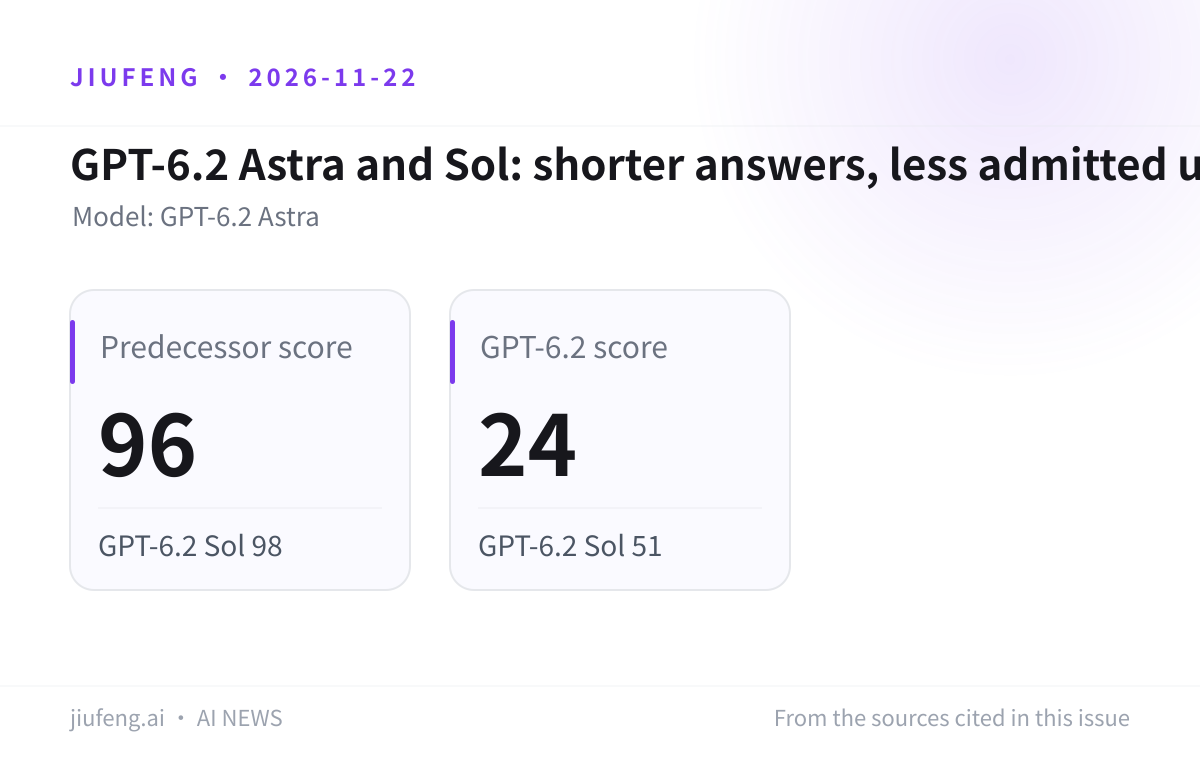
Jiufeng graphic based on the sources cited in this issue.
Source: Original source Artificial Analysis on X · The Decoder
Global AI News
02/08
AWS TorchNeuron runs PyTorch on Trainium with a one-line change
AWS launched TorchNeuron, a native PyTorch backend, at PyTorch Conference North America 2026. Existing code needs almost no changes.
- Migration: with
torch.acceleratordevice detection, the only change is swapping.to('cuda')for.to('neuron') - Distributed: native support for DDP, FSDP2 and DTensor, plus streams and events via
torch_neuronx.Stream/torch_neuronx.Event - Validation: Annapurna Labs VP Colin Brace says the team validated the 100,000 most popular models and more than 800 architectures
- Custom ops: NKI (Neuron Kernel Interface) kernels can be called directly in model code in place of sequences of ATen operations
- Adopters: Cartesia for voice AI inference; the Lieber Institute for Brain Development for drug-target discovery
Limitations: The report gives no throughput or cost figures. Commenters on LinkedIn, including Yasuo Maeda of Liner Notes Consulting, said the real test is production performance, cost per token and reproducibility.
Image source: GitHub.
Source: Original source GitHub: torch-neuronx · AWS Trainium · InfoQ China (Chinese-language source)
03/08
Pinterest and Intel extend open-source gProfiler to profile whole fleets on demand
Instead of building a closed in-house platform, Pinterest worked with Intel to extend gProfiler and contributed the new features back to the open-source project.
Pinterest runs hundreds of thousands of instances for 640 million monthly active users, with services written in Java, Python, C++, Go and Node.js. gProfiler coordinates perf, async-profiler and eBPF-based Python profiling to produce one flame graph for every process on a host, without changes to application code.
What's new: profiling can be triggered remotely for a service, host or cluster through the UI or API. Hardware data such as cache behavior, memory bandwidth and CPU stalls comes in through Intel PerfSpect. PMC flame graphs and wall-clock profiling were also added. While idle, the agent uses under 1% CPU and about 100 MB of memory.
Limitations: The report does not say how much cost or capacity Pinterest saved.
Source: Original source GitHub: gProfiler · InfoQ · InfoQ China (Chinese-language source)
04/08
AWS Quick adds a Meta ads connector for managing campaigns in natural language
With the new Meta ads AI connector, marketers can create and manage Meta campaigns without leaving AWS Quick.
According to the AWS blog, the connector lets Quick call operations on Meta's ads Model Context Protocol (MCP) server. Advertisers can use natural language to create, manage and analyze campaigns. Examples include pulling performance insights, creating product catalogs, and editing or creating campaigns, all while staying connected to Meta's ad management network.
Limitations: The announcement comes from AWS's own blog. It gives no pricing, regional availability or independent testing.
Source: Original source AWS Machine Learning Blog
05/08
MarkTechPost ranks personal AI agents on memory, security and cost
MarkTechPost ranked Hermes Agent, OpenClaw, Gemini Spark, OpenAI dots, Meta Muse and Perplexity Personal Computer on memory, security defaults and real cost.
The products fall into two camps. Self-hosted agents run on the user's own machine or server and can use any model. Managed agents run on a vendor's cloud VM and come bundled with a subscription. OpenClaw started in November 2025 as Clawdbot, a weekend project by Peter Steinberger.
MarkTechPost's comparison table also lists two details. OpenAI dots' security defaults are listed as read-only proactive research with passwords hidden from the model. Perplexity Personal Computer requires a Pro or Max subscription.
Limitations: The scoring criteria and ranking are MarkTechPost's own editorial choices. Prices are US list prices.
Source: Single report MarkTechPost
Regional & Early Signals
06/08
LianLian and Visa complete APAC's first B2B agentic payment, then launch XWorker
At the 11th Singapore FinTech Festival, agentic payments moved from white papers to real transactions.
The festival ran Nov 18–20. On opening day, MAS chairman Gan Kim Yong announced three national AI missions for financial services, one of which is enabling AI agents to execute transactions safely. AXS, Visa and Mastercard opened an agentic bill-payment network covering more than 800 billers.
On Nov 18, LianLian Digital said it had completed APAC's first real B2B agentic transaction with Visa using a payment token. The purchase was office supplies. The next day it launched LianLian XWorker. Its Agent Wallet manages agent identity, payment intent, transaction permissions and budget, while XPay and XCard handle payment execution.
Limitations: Chinese-language source, single outlet. The transaction amount was not disclosed, and "first in APAC" is the company's own claim.
Source: Single report TMTPost (Chinese-language source)
07/08
Bilibili asks users how to govern a wave of AI agent accounts
AI "big fat fish" accounts are flooding comment sections. Bilibili opened a survey and asked these accounts to label themselves as AI.
On Nov 20, Bilibili's official community account published a consultation on AI agent accounts. The trend began with "Claude 大小姐在运营", an account whose topics, videos and day-to-day operation are all handled by AI. A later account, "DeepSeek 鲸鱼娘在运营", drew more than 3 million views on its first video. Some users built a browser plugin to block the AI comments. Bilibili asked these accounts to show their AI identity in their name or bio and to limit how often they post.
Limitations: Chinese-language source. This is still a consultation with no concrete rules yet, and the report gives no count of such accounts.
Source: Single report IT Home (Chinese-language source)
08/08
A 367K-parameter Transformer fits on a floppy and runs on a 486
Developer WollyMonjac released Tiny 2.1, a tiny question-answering Transformer that runs under DOS.
- Size: 367,000 parameters, 4 layers, hidden dimension 96, reads and generates one character at a time
- Hardware: 486DX or Pentium under DOS with about 540 KB of conventional memory; the program fits on a floppy of under 1,475,000 bytes
- Build: written in Turbo C 2.0; can read answers aloud through the PC speaker
- License: MIT, with a training folder so users can add their own data
- Made with: according to the GitHub page, the code was written by Fable 5.2 and the model was trained by Opus 5.5
Limitations: Chinese-language source. This is not a large language model, and the developer admits it will "very confidently make things up" outside its training data. The report does not link to the project.
Source: Single report IT Home (Chinese-language source)
This digest is compiled by AI from the sources linked in each item and published after automated fact-checking, without article-by-article human review before publication. If anything differs from the original, the original source prevails. How this digest is made, or report an error: About this digest
Create AI images and videos with sound in your browser: write a prompt, pick a model, download the result. 5 free credits on sign-up, no credit card.
Start creating free