Overview
8 stories in this issue. The first 3 are today's priorities.
Hot model updates
- Top · GPT-6 Astra tops Co-Design Bench but fully solves only 26.4% of tasks
- Top · Ascend says it validated Kimi K3.1 Pro LoRA fine-tuning on a 128-card Atlas 950 SuperPoD
- Top · Tencent releases a DSpine drafter for Qwen3.8-27B, with 2.71–3.84x speedups in agent tests
- MoE routing compared across 10 open models: 384 experts in DeepSeek-V4-Pro, top-1 in Llama 4 Maverick
Global AI news
- Google open-sources the Elephant-Goldfish Model plugin: coding agents write a spec first, then face 5 review stages
- Rohan Varma, who led Codex product at OpenAI, leaves the company
Regional and early signals
- Moore Threads updates AICUBE to MTT AIOS 1.6.1 with smart-home control and local AI NAS management
- Zhipu's GLM models to join China Mobile Cloud's MoMA model platform
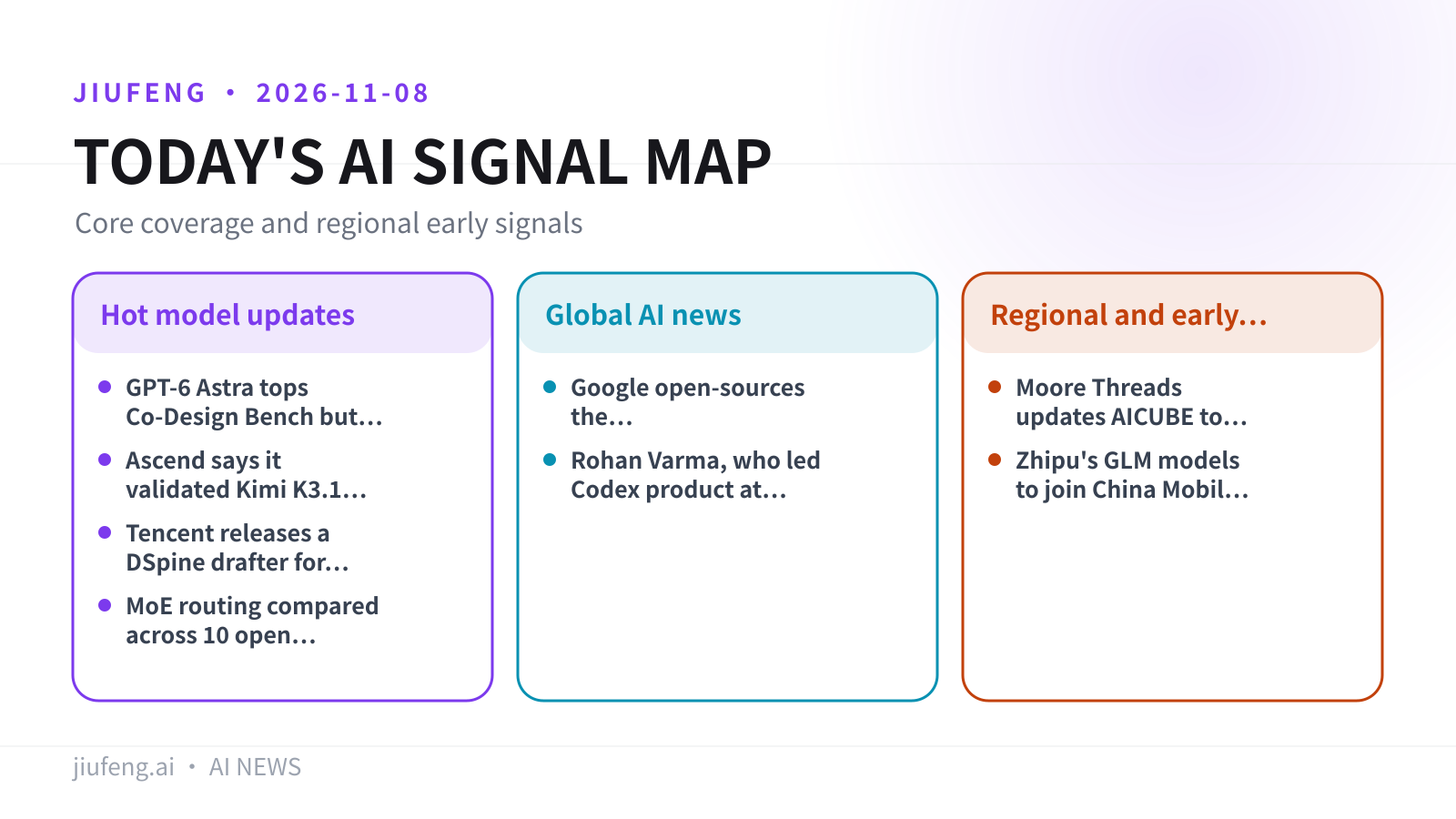
Jiufeng graphic based on the sources cited in this issue.
Hot model updates
The benchmark is built from real user change requests. GPT-6 Astra ranks first of the 10 models tested, yet humans still have to finish about three out of four tasks.
Researchers from Alibaba and several Asian universities released Co-Design Bench, a coding-agent benchmark. Its tasks come from real user change requests that had already tripped up agents in practice. Agents must rework existing web apps, and some requests include images, audio recordings, videos or documents as input.
- First place: GPT-6 Astra meets about 70% of a task's requirements on average and fully solves 26.4% of tasks
- Second and third: Claude Opus 5 and Qwen3.8-Max
- Last place: Grok 4.6
- Harness effect: the same Qwen3.8-27B scores 75% or 56% depending on the harness
- Token use: on smaller change tasks, GLM-5.2 uses close to 6x the tokens of GPT-6 Astra and still scores markedly lower
The authors say they built a new test because existing coding benchmarks are saturated, which puts the near-perfect scores on older tests into perspective.
Limitations: In most tasks the agent handles the bulk of the work but leaves at least one detail unfinished, so users almost always have to clean up by hand.
Source: Original source Paper on arXiv · The Decoder
02/08
Ascend says it validated Kimi K3.1 Pro LoRA fine-tuning on a 128-card Atlas 950 SuperPoD
Ascend says it has validated LoRA fine-tuning of the 2.8-trillion-parameter Kimi K3.1 Pro on one 128-card Huawei Ascend SuperPoD, citing a 15% average gain from Swap Core caching.
Pandaily reports that Huawei Ascend says it validated LoRA fine-tuning of Kimi K3.1 Pro on a 128-card Atlas 950 SuperPoD. The model has 2.8 trillion parameters. Ascend cites a 15% average gain from its Swap Core caching.
Limitations: These are Ascend's own claims, and the 15% figure is Ascend's own number. This item relies on a single report from Pandaily.
Source: Single report Pandaily
03/08
Tencent releases a DSpine drafter for Qwen3.8-27B, with 2.71–3.84x speedups in agent tests
No model swap needed: Tencent posted a five-layer speculative-decoding draft checkpoint on Hugging Face to speed up Qwen3.8-27B inference.
- Format: five-layer DSpine draft checkpoint (tencent/Qwen3.8-27B-DSpine-b16) on Hugging Face
- Speedup: 2.71x to 3.84x the autoregressive baseline in Tencent's agent throughput tests
- Code: the GitHub changelog reads "[2026-11] Added support for Qwen3.8-27B inference"
RuntimeWire argues that agent workloads produce long, tool-heavy responses. A downloadable drafter raises the accepted-token length, which can cut latency and serving cost.
Limitations: The speedups come from Tencent's own tests. The repository dates the support entry only to the month. The roadmap lists the Qwen3.8-27B draft weight release as a separate item, so the month-level entry is not a dated record of when the checkpoint was first uploaded.
Image source: huggingface.
Source: Original source Hugging Face · GitHub · RuntimeWire
04/08
MoE routing compared across 10 open models: 384 experts in DeepSeek-V4-Pro, top-1 in Llama 4 Maverick
Two models that both say "17B active" can route tokens in very different ways. MarkTechPost checked expert counts, top-k and load balancing against each model's config.json.
The 10 models range from Qwen3.6-35B-A3B (35B total, 3B active) to DeepSeek-V4-Pro (1.6T total, 49B active). All of them use token-choice routing. Routed expert counts range from 8 to 384, and top-k ranges from 1 to 8.
| Model | Total / active | Routed experts | Top-k | Shared experts | Load balancing |
|---|---|---|---|---|---|
| Mixtral 8x7B | 47B / 13B | 8 | 2 | 0 | Aux loss, coef 0.02 |
| gpt-oss-120b | 117B / 5.1B | 128 | 4 | 0 | Not in config |
| Qwen3.6-35B-A3B | 35B / 3B | 256 | 8 | 1 | Aux loss, coef 0.001 |
| Llama 4 Maverick | 400B / 17B | 128 | 1 | 1 | Not disclosed |
| DeepSeek-V4-Pro | 1.6T / 49B | 384 | 6 | 1 | noaux_tc |
DeepSeek-V4-Pro raises the routed expert count to 384 and lowers top-k from 8 to 6. Its score function becomes sqrtsoftplus, the first 3 MoE layers use hash routing, and noaux_tc balancing carries over. For deployment, gpt-oss-120b fits on one 80 GB GPU with MXFP4, while DeepSeek-V4-Pro and Kimi K2 need multi-GPU expert parallelism. In Kimi K2's experiments, sparsity 48 needed 1.69x fewer FLOPs than sparsity 8 at equal validation loss.
Limitations: Llama 4 Maverick and gpt-oss do not publish their gating or load-balancing method in config.json, so those fields cannot be checked. The article compiles published configs; it is not a new model release.
Source: Original source NVIDIA Megatron Bridge docs · Mixtral config · Meta Llama 4 · MarkTechPost
Global AI news
05/08
Google open-sources the Elephant-Goldfish Model plugin: coding agents write a spec first, then face 5 review stages
Before any code is written, fresh subagents with no conversation history attack the spec. Google says thousands of its engineers use it.
- Contents: 7 skills, 9 reviewer personas, 6 brainstorm lenses, 5 review stages
- Model: no model weights; your agent supplies the LLM and the plugin uses your existing model quota
- Runs on: any harness that can spawn fresh subagents, including Antigravity, Claude Code 2.1.271+, Claude Cowork, Codex and ChatGPT
- Tests: Codex 0.163.0 ran 15 native fresh-context reviewers in order; 2 live tests passed in 573.13s
The idea is to catch wrong assumptions in a Markdown spec file instead of in a pull request.
Limitations: No accuracy benchmark has been published; the evidence so far is adoption and end-to-end harness test runs. The Claude Cowork run stopped partway through the stages.
Source: Original source GitHub · MarkTechPost
He was Cursor's first product manager before leading Codex product at OpenAI, and he has now left.
Rohan Varma announced on X that he has left OpenAI. He described his short time on the Codex team as spanning three or four company evolutions. Before that, he founded venture-backed startups of his own.
Limitations: He did not name his next employer and said only that he will return to work after a few days off. The available reporting does not say whether OpenAI has named a successor.
Source: Original source Rohan Varma on X · RuntimeWire
Regional and early signals
07/08
Moore Threads updates AICUBE to MTT AIOS 1.6.1 with smart-home control and local AI NAS management
Moore Threads' AICUBE update adds Matter/ZigBee device control, Olares file management and semantic photo search.
MTT AIOS 1.6.1 adds four features: Matter/ZigBee smart-home control, Olares file management, semantic photo search and a desktop-pet mode.
Limitations: This item relies on a single report from Pandaily, and the feature list is as described there.
Source: Single report Pandaily
On November 6, China Mobile Cloud and Zhipu signed a cooperation agreement, and GLM models will be listed on Mobile Cloud's MaaS platform.
The two companies plan a joint "Token development center" focused on adapting to domestic compute and tuning models. Zhipu's GLM series will join MoMA, Mobile Cloud's model-as-a-service platform. They also plan joint AI coding products and combined "compute + model + application" offerings for finance, government and other sectors. Mobile Cloud general manager Sun Shaoling and Zhipu CEO Zhang Peng attended the signing.
Limitations: Chinese-language source only; no global English coverage yet. The report does not say which GLM versions will be listed, when, or at what price, and this is a signed agreement rather than a launch.
Source: Single report IT Home (Chinese-language source)
This digest is compiled by AI from the sources linked in each item and published after automated fact-checking, without article-by-article human review before publication. If anything differs from the original, the original source prevails. How this digest is made, or report an error: About this digest
Create AI images and videos with sound in your browser: write a prompt, pick a model, download the result. 5 free credits on sign-up, no credit card.
Start creating free