Overview
11 stories in this issue. The first 3 are today's priorities.
Hot Model Updates
- Top · Anthropic: Claude's cross-session memory works better with selective notes
- Top · Claude builds interactive sites with HTML-in-Canvas, with 15 demos
- Top · OpenAI expands free frontier-model access to 200,000 researchers
Global AI News
- NVIDIA Vera Rubin sweeps MLPerf Training v6.1 in its debut
- NVIDIA unveils Rubin HPC at SC26, expected in 2028
- OpenAI launches a child-abuse imagery classifier that flags AI-generated content
- Duco moves financial data automation to Bedrock AgentCore at 20B transactions a month
- Noeri launches with $110M for enterprise AI that keeps improving itself
Regional and Early Signals
- Huawei Cloud open-sources CloudRobo-WM1.2, an embodied world model
- Ant Lingbo's first embodied-AI challenge: all 15 finalists built on LingBot-VLA 2.0
- Google adds a Gemini assistant and coding-agent skills to AdMob; MCP server in early testing
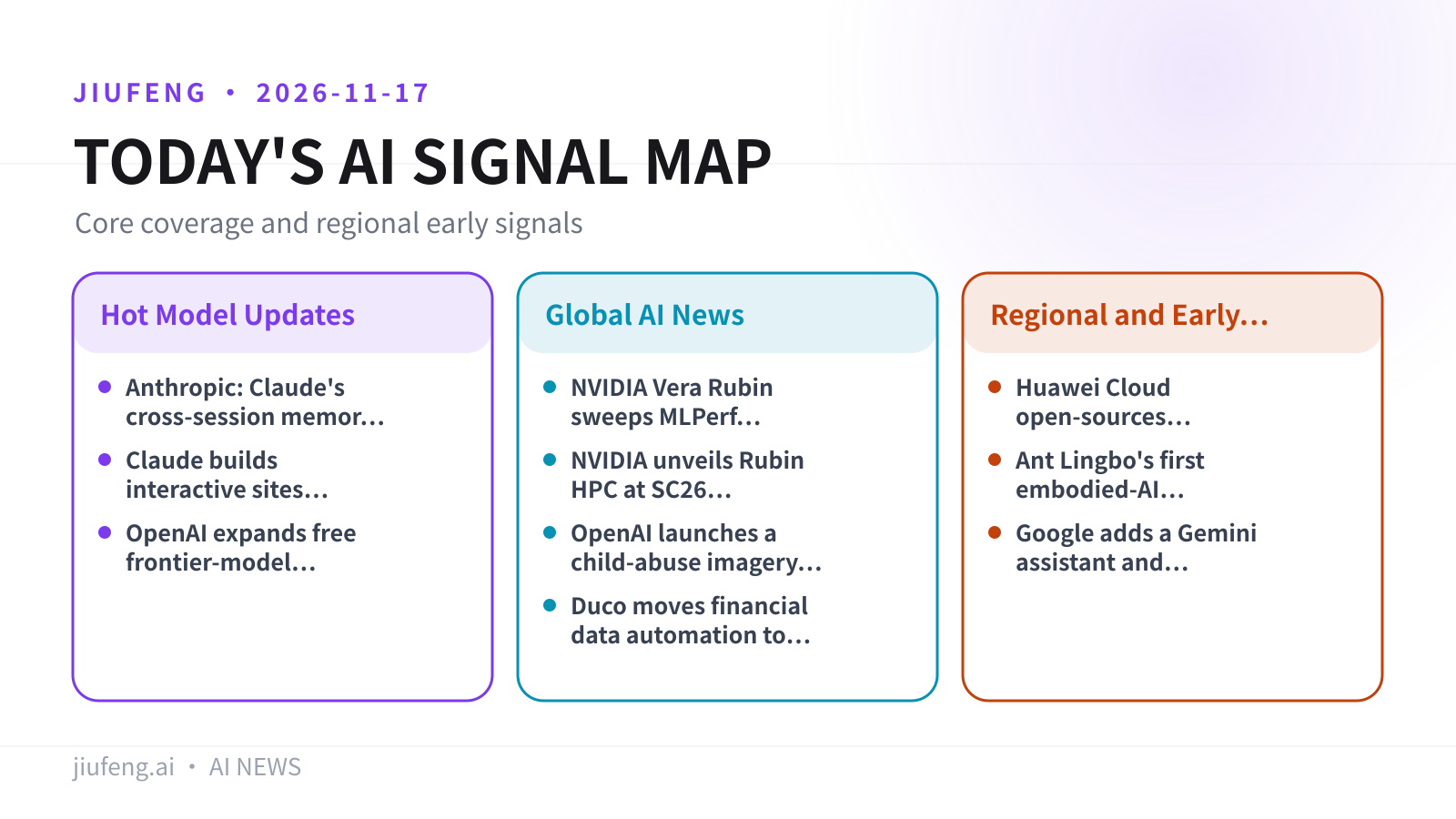
Jiufeng graphic based on the sources cited in this issue.
Hot Model Updates
01/11
Anthropic: Claude's cross-session memory works better with selective notes
The model stays unchanged and Claude keeps knowledge across sessions by writing notes. Recording strategies and rules works better than logging every step.
In a research post, Anthropic tested how Claude can write information to a notes folder and read it back in later sessions. Selectively recording strategies and rules worked much better than logging every step. Full logs overwhelm the model with outdated data.
The post also describes "Dreaming," a process that runs after a session ends. During idle periods, the system reviews earlier session transcripts, corrects faulty notes on its own and builds structured knowledge collections. In a Pokémon Red test, the newer Claude Fable 5 got four times as far as the comparison model.
Limitations: This is a research post, not a product launch. The report does not say whether Dreaming is available to users. The source notes that each model played the Pokémon test only once.

Image source: anthropic.
Source: Original source Anthropic Research · The Decoder
Claude can now place real text, buttons and other web elements inside canvas graphics and 3D effects, and they remain clickable and selectable.
Standard HTML elements are clickable and readable by screen readers but hard to warp visually. Canvas can draw anything, but the browser treats it as a flat image. HTML-in-Canvas puts real page elements inside canvas graphics and keeps them interactive. Felix Rieseberg, who works on Claude at Anthropic, wrote on X that Claude can now build "bizarre & beautiful sites" with the feature, which he said reminds him of the Flash era.
A demo page shows 15 examples, including sites rendered as knitting patterns, 3D cubes and exploded layer views. The content stays as real text you can highlight and copy. Google is developing HTML-in-Canvas as a web standard, and it currently works in Chrome and Edge.
Limitations: The news comes from an employee's post on X, not formal release notes. The capability depends on a browser feature that is still being standardized, and the report mentions support only in Chrome and Edge.
Source: Original source Felix Rieseberg on X · The Decoder
OpenAI is expanding its ChatGPT for Academic Researchers program to 200,000 researchers worldwide. It has also published a survey of more than 1,800 scientists who use ChatGPT.
According to OpenAI, the expanded program gives 200,000 researchers worldwide free access to its frontier models. OpenAI has also published "Science at the Frontier," a survey of more than 1,800 scientists on how they use ChatGPT in research. It covers daily workflows, self-reported productivity and expectations for discovery.
Limitations: The announcement summary does not state eligibility, which models are included or how long free access lasts. The productivity findings are self-reported by scientists, not measured in controlled experiments.
Source: Original source OpenAI: Broadening access to AI for scientists · OpenAI: Science at the Frontier
Global AI News
04/11
NVIDIA Vera Rubin sweeps MLPerf Training v6.1 in its debut
In its first MLPerf submission, NVIDIA says Vera Rubin won every Training v6.1 benchmark and delivered more than 10x generational gains in throughput per watt in its first Endpoints entry.
NVIDIA says the Vera Rubin platform ranked first on every MLPerf Training v6.1 benchmark. In its first MLPerf Endpoints submission, it delivered more than 10x generational gains in throughput per watt for agentic AI, a measure of how much agentic work a system completes per watt of power. MLPerf Training measures how quickly a system can train a set of models to a target accuracy.
Limitations: These figures come from NVIDIA's own blog, which does not list results from other submitters. NVIDIA's statement that performance will keep rising as its CUDA software stack improves is a vendor promise.
Source: Original source NVIDIA Blog
05/11
NVIDIA unveils Rubin HPC at SC26, expected in 2028
Rubin HPC is a new GPU in the Vera Rubin platform, built for simulation and data processing in science, engineering and analytics.
- CUDA cores: more than 50,000 on a single GPU, which NVIDIA calls a record
- Sparse data acceleration: keeps the cores fed with data
- Interconnect: seventh-generation NVLink for faster GPU-to-GPU connectivity
- Target use: running simulations to test the materials, molecules and designs that agents propose
- Availability: NVIDIA says it is expected to be available in 2028
Limitations: The announcement gives no pricing or specific performance figures, and all specs above come from NVIDIA's own blog.
Source: Original source NVIDIA Blog: Rubin HPC
06/11
OpenAI launches a child-abuse imagery classifier that flags AI-generated content
At a press briefing in Washington, OpenAI introduced a classifier for detecting child sexual abuse imagery and is offering it free to vetted organizations.
According to The Verge, OpenAI announced the classifier at a Monday press briefing in Washington, DC. It is designed to better detect abusive imagery of children, including whether an image is AI-generated. OpenAI calls it the first broadly available classifier of this kind with AI-generated flagging, and says it produces fewer false positives for humans to review and is better at identifying abusive content.
OpenAI is also giving vetted organizations free access, publishing guidance for developers on detecting this type of content, and helping train law enforcement on using AI in investigations.
Limitations: The accuracy gains and the "first" claim come from OpenAI, and the report cites no independent evaluation.
Source: Original source OpenAI · The Verge
07/11
Duco moves financial data automation to Bedrock AgentCore at 20B transactions a month
Duco, a data automation platform for tier-one banks, rebuilt its agentic AI stack on Amazon Bedrock and AgentCore, with each bank's data isolated.
- Scale: 20 billion transactions a month for more than 200 clients
- Clients: 7 of the world's top 20 banks and 10 of the top 20 asset managers
- Architecture: strict per-tenant isolation, multiple models and an MCP integration
- Evolution: moved from traditional ML for predictive labeling to Bedrock's agentic capabilities
Limitations: This is a customer case study on AWS's own blog. The results come from Duco and AWS and have not been independently verified.
Source: Original source AWS Machine Learning Blog
08/11
Noeri launches with $110M for enterprise AI that keeps improving itself
Noeri, founded by Yejin Choi and Carlos Guestrin, has launched with $110 million in funding to build "living" AI systems for companies.
Menlo Ventures led the round, with Madrona Ventures, Kindred Ventures, Wing Venture Capital and NEA participating, along with Snowflake and Cisco Ventures. The founders are Stanford researchers who previously spent years working on self-improving systems at the University of Washington. Noeri's software studies a company's data, workflows and business processes, then proposes changes to specific tasks, such as different instructions.
Limitations: The report does not disclose the valuation, number of customers or a product launch date. No public data yet backs the self-improvement claims.
Source: Single report SiliconANGLE
Regional and Early Signals
Huawei Cloud released and open-sourced CloudRobo-WM1.2, an embodied world model built natively for Ascend chips. Huawei says it ranks first on RoboTwin 2.0 and Libero Pro 2.0.
CloudRobo-WM1.2 uses a shared world-model backbone for prediction-enhanced world representations and generates actions directly from the world model through its DualAct architecture. The model weights are open; the training framework code and the WAM Ascend compute library are open only to selected core partners. Huawei Cloud also claims that 80% of Chinese embodied-AI companies use Ascend Cloud.
Limitations: Chinese-language source, reported only by TMTPost. The report gives no actual benchmark scores, and the rankings and market-share figure are Huawei Cloud's own claims.
Source: Single report TMTPost (Chinese-language source)
10/11
Ant Lingbo's first embodied-AI challenge: all 15 finalists built on LingBot-VLA 2.0
Finalists all used the open pretrained model LingBot-VLA 2.0 on the same robot hardware and compute in a 48-hour real-robot contest. Team TARS won with 82.5 points.
The final was held in Shanghai's Zhangjiang area on November 14 with 15 teams. There were three tasks: picking fruit and vegetables with one arm, placing cosmetics into a transparent box with one arm, and clearing table waste into a bin with two arms working together. Each team ran three real-robot rounds, and its best total score counted. The winning team simplified cluttered multi-object scenes into single-object grasps to work around the VLA model's perception limits in clutter.
Limitations: Chinese-language source, reported only by Leiphone. The report gives no parameter count or benchmark results for LingBot-VLA 2.0 itself.
Source: Single report Leiphone (Chinese-language source)
11/11
Google adds a Gemini assistant and coding-agent skills to AdMob; MCP server in early testing
Google is bringing Ask AdMob, a conversational assistant built on Gemini, and AdMob agent skills for AI coding assistants to its mobile ad platform.
Ask AdMob sits inside developers' AdMob accounts. It can check ad settings, find integration errors, suggest ways to raise revenue and set brand-safety rules in natural language. The agent skills are pre-written, tested guides that let coding assistants help integrate ads, migrate to the new SDK and verify implementations.
Limitations: Only the agent skills are available now. Ask AdMob testing is planned for the coming months, and the MCP server is in early testing, with broader testing expected in early 2027. Chinese-language source, reported here only by IT Home.
Source: Single report IT Home (Chinese-language source)
This digest is compiled by AI from the sources linked in each item and published after automated fact-checking, without article-by-article human review before publication. If anything differs from the original, the original source prevails. How this digest is made, or report an error: About this digest
Create AI images and videos with sound in your browser: write a prompt, pick a model, download the result. 5 free credits on sign-up, no credit card.
Start creating free