Overview
8 stories in this issue. The first 3 are today's priorities.
Hot Model Updates
- Top · Claude Fable 5.2 skips pixels and paints stroke by stroke in Python
- Top · GPT-6 Astra helps turn a lattice Standard Model idea into a detailed proof
- Top · Grok Bot for Windows adds a switch that bills X reads to your own account
Global AI News
- Haru-4B: a multilingual full-duplex model that listens and speaks at once
- DeepSpeed's cost-based prefill buckets halve latency on an uneven Qwen batch
- Australia's central bank sees AI hitting young software and service workers first
- Congress pushes tighter AI chip export rules after the Nvidia spy scandal
Regional & Early Signals
- Indian startup Bharat Semi raises a $24M seed round for AI image sensors
Hot Model Updates
Fable 5.2 writes code that places simulated brushstrokes on a virtual canvas. One parking-garage scene took about 700,000 strokes.
According to The Decoder, Anthropic's Claude Fable 5.2 does not use the diffusion approach common to image models like Midjourney. It writes Python code that places hundreds of thousands of simulated brushstrokes on a virtual canvas. It also simulates bristle texture and how the paint goes on, and it paints over its own mistakes.
- Parking-garage scene: about 700,000 strokes
- Bird painting: built from 111 coordinate sequences, with deviations painted over afterward
- Public demo: developer Jake Eaton posted on X how he asked Fable 5.2 to paint a deliberately hard subject
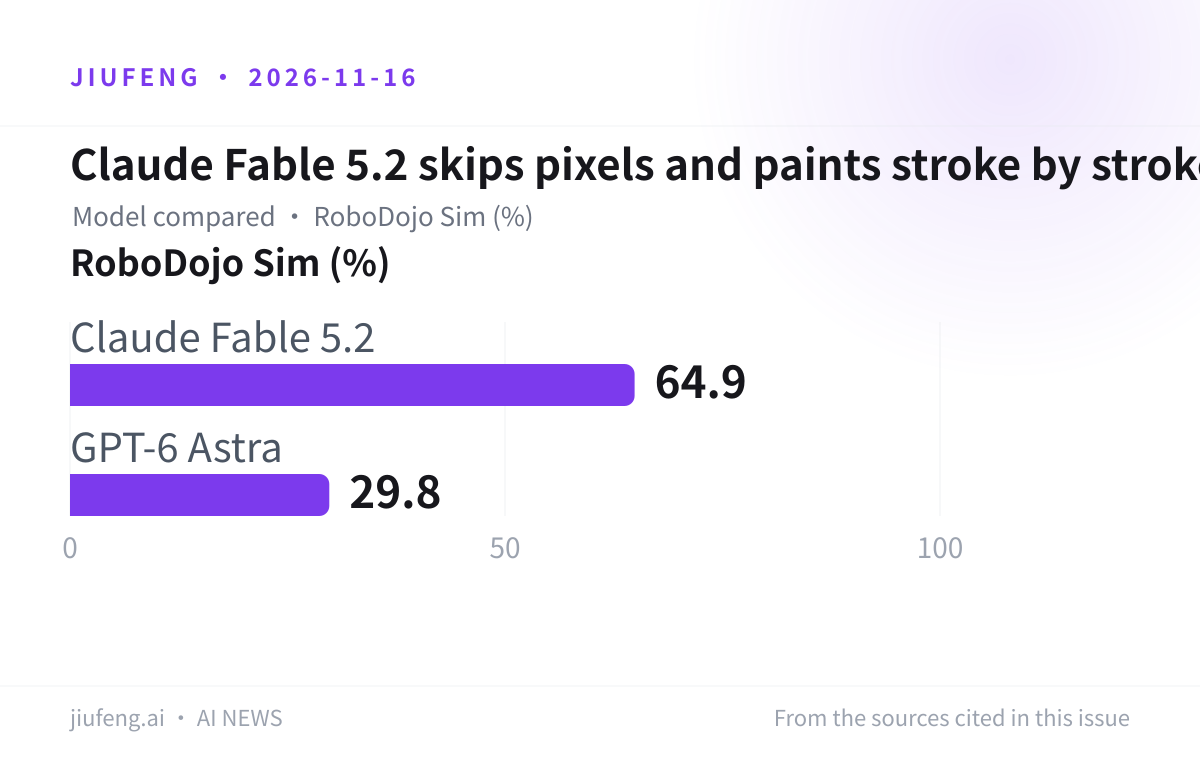
The report also cites Anthropic's internal RoboDojo Sim benchmark:
| Model | RoboDojo Sim (%) |
|---|---|
| Claude Fable 5.2 | 64.9 |
| GPT-6 Astra | 29.8 |
Limitations: RoboDojo Sim is Anthropic's own benchmark, not a public third-party leaderboard. According to the report, Fable 5.2 was slower than GPT-6 Astra in a real-world test with a physical robot arm and had worse fine motor control. The painting is a demonstration for now. The source does not say it will ship as an image feature or API.
Jiufeng graphic based on the sources cited in this issue.
Image source: anthropic.
Source: Original source Anthropic: Fable 5.2 · Jake Eaton on X · The Decoder
02/08
GPT-6 Astra helps turn a lattice Standard Model idea into a detailed proof
OpenAI presents a candidate nonperturbative lattice definition of the Standard Model and explains how GPT-6 Astra helped develop the idea into a detailed proof.
OpenAI has published a post on what it calls a candidate nonperturbative lattice definition of the Standard Model. The post describes how GPT-6 Astra helped turn the idea into a detailed proof.
Limitations: OpenAI's own headline calls this "a step toward" a definition, and the definition is still a candidate. The public summary does not name the authors or give the proof's length. It also does not say whether the work has been submitted for peer review. Read the full post to see exactly what GPT-6 Astra did.
Source: Original source OpenAI: A step toward defining the Standard Model on a lattice
03/08
Grok Bot for Windows adds a switch that bills X reads to your own account
RuntimeWire found a "Use my X account for reads" option in Grok Bot 1.0.3. With it on, reads count against your account's rate limits and are billed at X API prices.
RuntimeWire statically inspected the signed Grok Bot Windows 1.0.3 package. In the X connector it found a new setting, "Use my X account for reads," which switches between your own account and a shared one. A warning says reads placed on your account use its rate limits and are billed at X API pricing. The client code also has a native handler that saves the choice.
Limitations: RuntimeWire did not test live billing. The code does not show whether the service actually follows the setting on any given request.
Source: Single report RuntimeWire
Global AI News
04/08
Haru-4B: a multilingual full-duplex model that listens and speaks at once
Every 133 ms, Haru-4B takes in one frame of user audio and produces one frame of its own audio and text, so listening and speaking never wait for each other.
higurashi-ai has released Haru-4B and its inference code on Hugging Face and GitHub. Haru-4B is a pretrained base model. The code comes in three implementations, plus a web demo.
- Full-duplex timing: 7.5 Hz, one frame every 133 ms; user audio, model audio and model text are summed into a single language-model position
- Continuous audio: each frame is a 64-dimensional latent, generated in one step by a small MLP head using MeanFlow sampling; there is no separate audio transformer and there are no discrete audio tokens
- Character and voice: a text card sets the character, and a short reference clip sets the voice
- Languages: 9 (English, Spanish, Portuguese, German, French, Chinese, Japanese, Russian, Korean)
Limitations: this is a base model, not a dialogue-tuned release. The public pages give no latency or naturalness scores. Check the Hugging Face model card for the license.
Source: Original source Hugging Face: Haru-4B · GitHub: higurashi-ai/Haru
05/08
DeepSpeed's cost-based prefill buckets halve latency on an uneven Qwen batch
A new opt-in planner in DeepSpeed, adaptive_prefill, cut latency on a batch of mixed-length Qwen requests from 1.68 to 0.84 seconds.
According to RuntimeWire, a commit landed on the master branch of Microsoft's DeepSpeed on November 15. It changes how prompts enter generation on the rollout path. Before the GPU does any work, the planner estimates the cost and then picks a route: ordinary batched generation, one prefill bucket per request, or something in between. It only runs when adaptive_prefill=True is set.
| Run | Latency (s) |
|---|---|
| Default path | 1.68 |
| adaptive_prefill | 0.84 |
Limitations: the numbers come from a contributor's own single-GPU FP32 test on one skewed Qwen batch. They say nothing about multi-GPU or lower-precision setups. The commit is in master, but the original PR #8786 still showed as open when the report captured it.
Source: Single report RuntimeWire
06/08
Australia's central bank sees AI hitting young software and service workers first
Since ChatGPT launched in late 2022, job postings in Australia have fallen most in the jobs most exposed to AI, and workers aged 15 to 24 are faring worst.
Mike Major of the Reserve Bank of Australia (RBA) built a system that tracks the groups AI should affect first: entry-level workers, and highly exposed jobs such as programming, clerical work and customer service. Postings have fallen in every group since late 2022, with the steepest drop in the most exposed group (quintile 5). Within that group, workers aged 15 to 24 and recent graduates have lower employment and higher unemployment than older workers. Employment among the older workers has actually risen.
Limitations: Major warns against drawing conclusions too early. The study does not show that AI caused the decline. It measures how exposed each job is to AI in theory, not how much companies actually use AI. The post-pandemic economic cycle and changes in remote work may also affect the data.
Source: Multiple outlets The Decoder · IT Home (Chinese-language)
07/08
Congress pushes tighter AI chip export rules after the Nvidia spy scandal
After reports on former Nvidia CEO Jensen Huang's relationship with a suspected Chinese spy, lawmakers from both parties back measures to tighten AI chip export rules.
According to The Verge, Democrats and Republicans have both voiced support for measures and bills that would tighten AI chip export rules. They have also demanded that Huang and other Nvidia leaders testify before Congress. Senate Minority Leader Chuck Schumer said Huang and the Trump administration need to answer to Congress. Senate Banking Committee Chairman Tim Scott has sent letters to Huang and others.
Limitations: so far there are statements and letters but no new export rule. The spy allegations have not been confirmed.
Source: Single report The Verge
Regional & Early Signals
08/08
Indian startup Bharat Semi raises a $24M seed round for AI image sensors
Bharat Semi has no revenue yet. It says it has design wins with General Atomics and Kaynes Semicon and plans to start commercial production in 2027.
TechCrunch reports that Bharat Semi, an Indian semiconductor startup founded nearly five years ago, has raised $24 million in seed funding to develop AI-enabled image sensors. It is targeting customers in the US and other overseas markets. The company says it has design wins with US defense technology firm General Atomics and India's Kaynes Semicon.
Limitations: the sensors are still in development, and the first commercial production is not planned until 2027. The company has no revenue. The design wins are the company's own claim, and the report gives no order values or volumes.
Source: Single report TechCrunch
This digest is compiled by AI from the sources linked in each item and published after automated fact-checking, without article-by-article human review before publication. If anything differs from the original, the original source prevails. How this digest is made, or report an error: About this digest
OpenAI’s latest image model, strongest at legible text and dense layouts — posters, packaging, dashboards. Generate in your browser. 5 free credits on sign-up, no credit card.
Open GPT Image 2.5