Overview
9 stories in this issue. The first 3 are today's priorities.
Hot model updates
- Top · LithosAI posts Kimi-K3.1-Pro-DSpark, a speculative-decoding draft head for K3.1 Pro
- Top · Claude's second watermark wave lands Nov 16, with Opus 4.6 delayed
- Top · AT&T's security system adds Gemini for Home, with natural-language video search
Global AI news
- OpenAI to acquire Pierre Computer Company to expand Codex's code tools
- Former Claude Code product lead Cat Wu joins OpenAI to run Core Products product management
- Phonon TTS runs on-device, and its 31M version is Apache 2.0
- Dharma Field Extractor: a 2B model that pulls requested fields from any document into JSON
- AWS shows how to plug Jev and Strands Decider into AgentCore Evaluations
Regional and early signals
- XROGO launches a robot staffing plan for machine tending and facility inspection
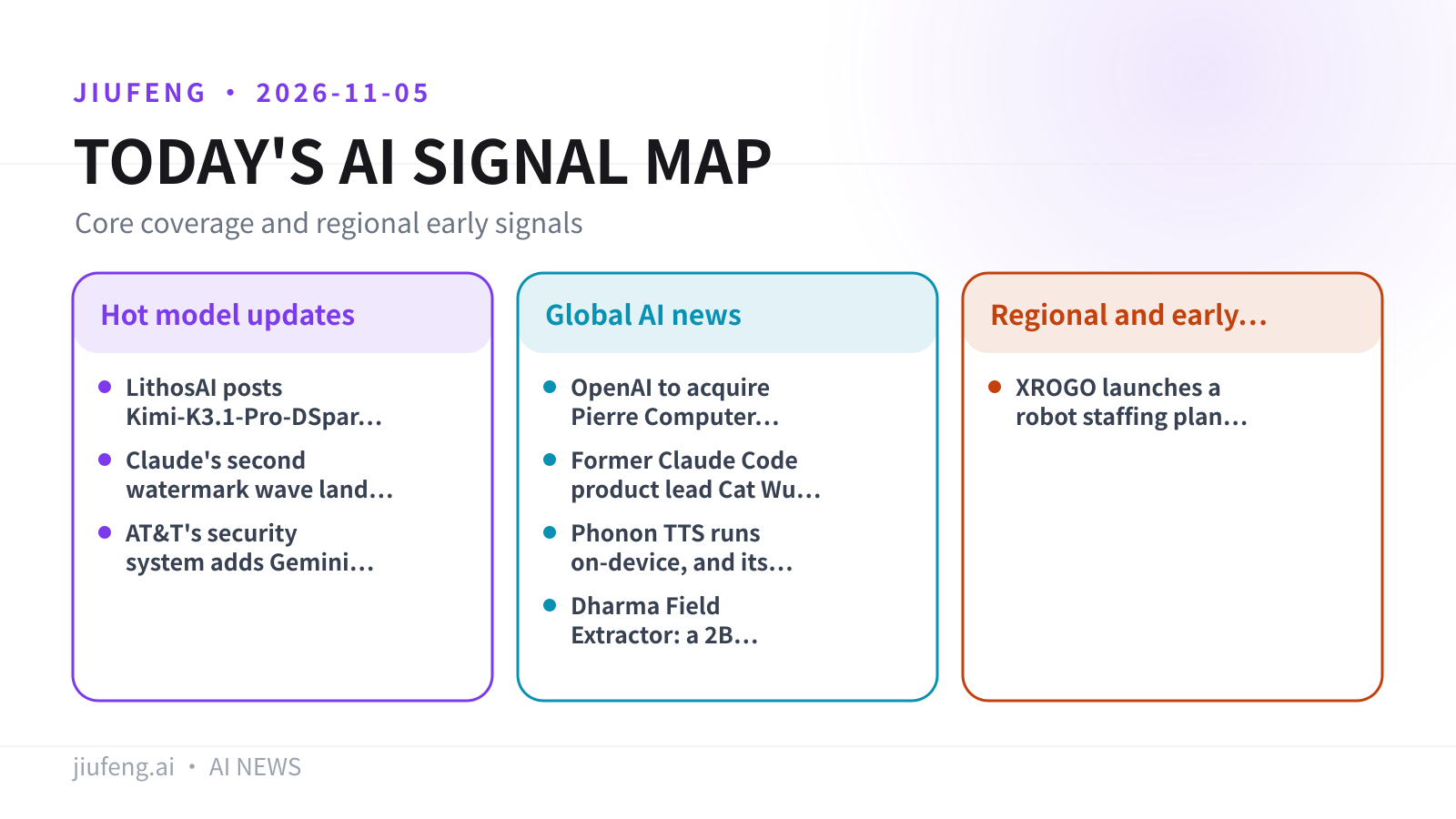
Jiufeng graphic based on the sources cited in this issue.
Hot model updates
01/09
LithosAI posts Kimi-K3.1-Pro-DSpark, a speculative-decoding draft head for K3.1 Pro
LithosAI has published a DSpark draft head on Hugging Face for lossless speculative decoding with Kimi-K3.1-Pro. It is not a new Kimi model.
The Hugging Face repository LithosAI/Kimi-K3.1-Pro-DSpark was built by LithosAI. Its model card describes a DSpark draft head that pairs with Kimi-K3.1-Pro for lossless speculative decoding: the draft head proposes candidate tokens and Kimi-K3.1-Pro verifies them. RuntimeWire's model catalog also lists the repository, under the text-generation task.
- Repository: LithosAI/Kimi-K3.1-Pro-DSpark
- Purpose: lossless speculative decoding for Kimi-K3.1-Pro
- Parameters: 2,249,289,601 (about 2.25B)
- Status: a public model repository, not an inference endpoint
Limitations: RuntimeWire states that repository presence "does not establish a release date or inference availability." The draft head is meant to run alongside Kimi-K3.1-Pro and is not a standalone chat model.
Image source: huggingface.
Source: Original source Hugging Face repository · RuntimeWire
Anthropic emailed API customers again: four more older Claude models get text watermarks starting November 16, and Opus 4.6 has slipped from the first wave into this one.
According to a November 4 update from The Decoder, Claude Opus 4.6, Opus 4.5, Sonnet 4.5 and Haiku 4.5 will get text watermarking starting November 16, 2026. The rollout on Amazon Bedrock may take a few extra days. Opus 4.6 was originally in the first wave, due November 3. Anthropic explicitly confirms the delay to November 16 but gives no reason. The changes come ahead of the EU AI Act's December deadline.
| Model | Watermark start |
|---|---|
| Claude Mythos 5 | Nov 3 (not in new email; likely on schedule) |
| Claude Opus 4.7 | Nov 3 (same) |
| Claude Sonnet 4.6 | Nov 3 (same) |
| Claude Opus 4.6 | Delayed to Nov 16 |
| Claude Opus 4.5 | Nov 16 |
| Claude Sonnet 4.5 | Nov 16 |
| Claude Haiku 4.5 | Nov 16 |
Limitations: all four models in this wave share a sampling restriction. The watermark only applies when temperature, top_p and top_k are left at their defaults. The Decoder notes that API users on older models such as Opus 4.6 and Sonnet 4.6 can turn the watermark off by changing sampling settings. That the first-wave models went live is inferred from the new email; Anthropic has not separately confirmed it.
Source: Single report The Decoder
03/09
AT&T's security system adds Gemini for Home, with natural-language video search
AT&T's Connected Life home security system now works with Gemini for Home, which can summarize camera events and search recorded footage in plain language.
AT&T says Connected Life is the "first" home security product to integrate with Google Home Premium. With the update, Gemini can describe events captured by the cameras in detail, such as who delivered a package and how many items were dropped off. Users can search footage with questions like "What dug up the yard last night?" and get daily summaries of activity inside and outside the home.
Limitations: the features are only available with AT&T's professional Connected Life monitoring plan, which costs $29.99 a month. The "first" claim comes from AT&T.
Source: Single report The Verge
Global AI news
OpenAI will acquire Pierre Computer Company to expand Codex's tools for building, understanding and reviewing code.
In an official announcement, OpenAI said it will acquire Pierre Computer Company, Inc. According to the announcement, the deal is meant to expand Codex's tools for building, understanding and reviewing code.
Limitations: the announcement says OpenAI "will acquire" the company, so the deal has not closed. The available information gives no price, no closing timeline and no plan for Pierre's existing products.
Source: Original source OpenAI
05/09
Former Claude Code product lead Cat Wu joins OpenAI to run Core Products product management
Cat Wu, who led Claude Code and Cowork at Anthropic, is moving to OpenAI to lead product management for Core Products.
Catherine "Cat" Wu announced on X on November 5 that she is joining OpenAI to lead product management for Core Products, the organization led by Thibault "Tibo" Sottiaux. RuntimeWire reports that she led Claude Code and Cowork at Anthropic until October 30, and that Core Products owns ChatGPT, Codex, the API and agent infrastructure. She wrote that the team will build "agents that have your back and your team's, and keep you in control."
Limitations: beyond that statement of direction, the available reporting gives no specific product plans or timeline.
Source: Original source Cat Wu on X · RuntimeWire
06/09
Phonon TTS runs on-device, and its 31M version is Apache 2.0
The gradium team published a launch recap for Phonon, an on-device text-to-speech model that needs no server or network. The smallest 31M version is free for commercial use.
Phonon is a small text-to-speech model that runs on the user's own device, with no server or network, so typed text stays local. The team opened the weights two weeks ago. This November 5 post covers the launch, the demos and how the model did on Hugging Face's Open TTS Leaderboard.
- Phonon 31m: Apache 2.0, free even in commercial products
- Other versions: CC BY-NC, free for non-commercial projects; commercial use is priced separately
- Deployment: local on-device inference, no network required
Limitations: the post is written by the developers themselves, and the exact leaderboard rank and scores behind the "tops the benchmarks" headline are in the original post's leaderboard section. Only the 31m version is free for commercial use.
Source: Original source Hugging Face Blog · GitHub source
07/09
Dharma Field Extractor: a 2B model that pulls requested fields from any document into JSON
Dharma-AI released Dharma Field Extractor, a 2-billion-parameter model that returns only the fields you ask for, as structured JSON.
The model follows Dharma-AI's April OCR model, DharmaOCR-LITE. Where OCR returns all the text on a page, Field Extractor returns only the requested fields, aimed at contracts, court filings, invoices, IDs and forms. The team says it outperformed every frontier LLM it tested, at a fraction of the cost.
- Parameters: 2B
- Input: any document type
- Output: JSON with the requested fields
- Predecessor: DharmaOCR-LITE (April, with a paper)
Limitations: the claim that it beats every frontier model tested comes from the team's own evaluation; which models it was compared against, and their scores, are in the source's tables. The arXiv paper covers the earlier DharmaOCR-LITE, not this model.
Source: Original source Hugging Face Blog · DharmaOCR paper
08/09
AWS shows how to plug Jev and Strands Decider into AgentCore Evaluations
AWS walks through connecting the decision models Jev and Strands Decider to Amazon Bedrock AgentCore Evaluations as custom evaluators, so agents get calibrated probabilities instead of free-text verdicts.
Decision models take a structured state and a fixed set of allowed answers, and return a calibrated probability over those answers. That suits narrow questions such as whether a response stayed on policy or whether a tool call is safe to approve. AgentCore Evaluations scores agents on demand during development, in batch against stored sessions, and online against production traffic. It ships 15 built-in evaluators and supports custom evaluators of two kinds: LLM-as-a-judge, or code-based evaluators running in AWS Lambda. This integration uses the code-based route.
| Decision model | Deployment |
|---|---|
| Jev | Hosted by TypeSafe |
| Strands Decider | Open source, run by the user |
Limitations: this is an integration tutorial, not a new feature. If you run Strands Decider yourself, it has to sit inside a VPC so the Lambda function can reach it, and deployment and operations fall on you. The full sample code is in the AgentCore samples repository.
Source: Original source AWS Machine Learning Blog · AgentCore samples
Regional and early signals
09/09
XROGO launches a robot staffing plan for machine tending and facility inspection
At CeMAT ASIA 2026, XROGO launched a "robots on the job" program that rents robots plus service into machine-tending and inspection roles.
On November 3 at CeMAT ASIA 2026, XROGO announced the program with two initial scenarios. The first is loading, unloading and part handling at machine tools and heat-treatment equipment. The second is inspection and monitoring in server rooms and power distribution rooms, with remote staff handling authorization, review and exceptions. The main model is robot rental plus service, with frontline workers teaching the robots and engineers providing training and validation. Chinese-language source.
Limitations: this was announced in a trade-show talk, and the source gives no pricing, customer names or productivity data. Warehouse tasks such as sorting and loading are still at the "joint assessment" stage.
Source: Single report QbitAI (Chinese-language source)
This digest is compiled by AI from the sources linked in each item and published after automated fact-checking, without article-by-article human review before publication. If anything differs from the original, the original source prevails. How this digest is made, or report an error: About this digest
Create AI images and videos with sound in your browser: write a prompt, pick a model, download the result. 5 free credits on sign-up, no credit card.
Start creating free