Overview
10 stories in this issue. The first 3 are today's priorities.
Hot model updates
- Top · Claude maps the first 3D structure of a prokaryotic vault
- Top · ChatGPT adds GIF generation with the new Images 2.6 model
- Top · CloudOpsBench: Claude Fable 5.1 completes 60% of cloud ops tasks
- Ricursive opens Ripple-65B Preview, scoring 80.5 on Terminal-Bench 2.1
Global AI news
- Meta acquires Conductor, which will wind down its coding-agent app
- Baseten launches Grid to route and govern enterprise coding agents
- Apple reportedly cuts some engineers' daily AI budgets to $200
- Uber says AI agents booked only 4 rides last quarter
Regional and early signals
- Apple Intelligence opens for testing in China, with Qwen for complex tasks
- XHEART launches 700-TOPS X7 Ultra driving chip, claiming 98.7% NPU use
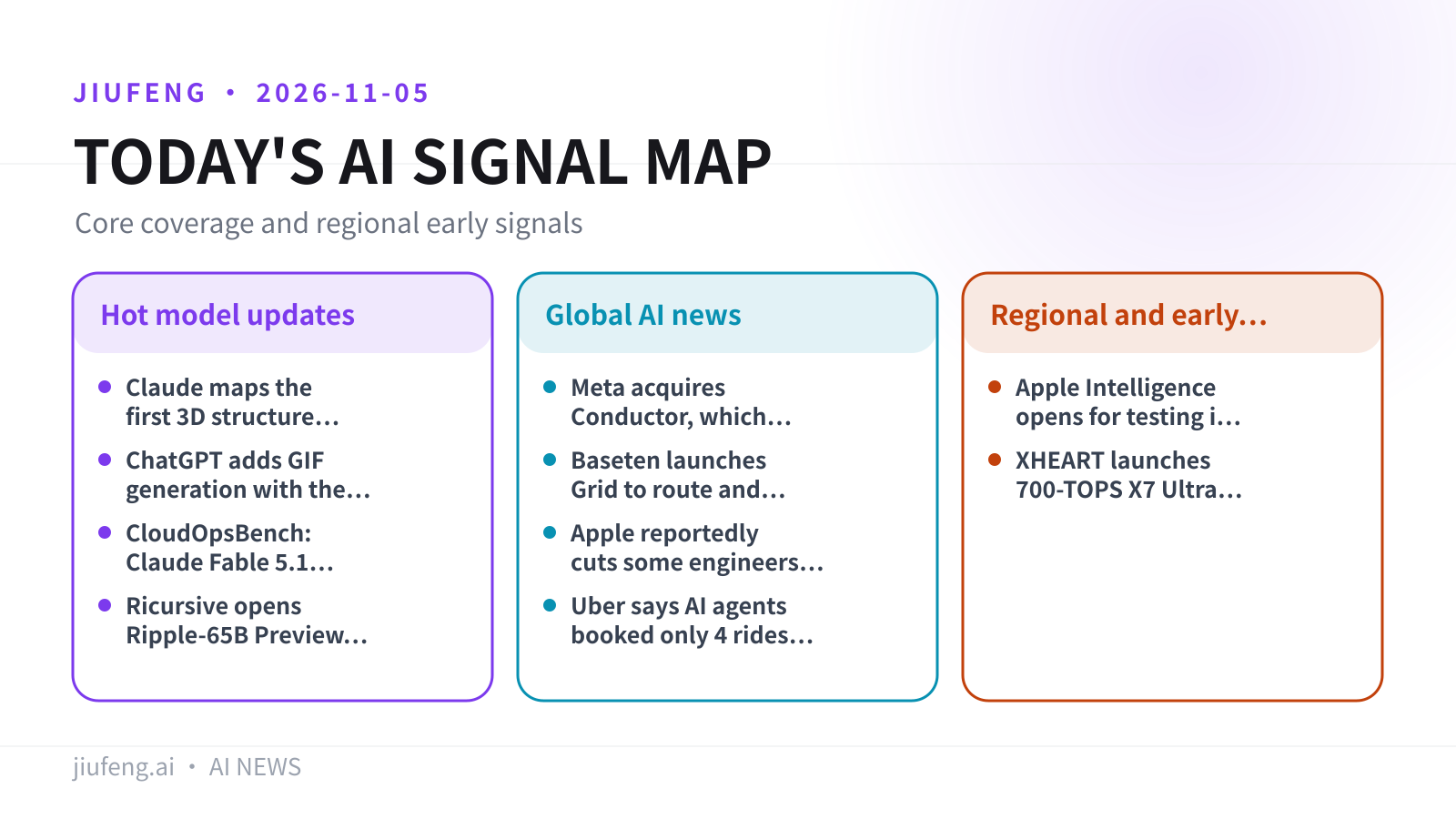
Jiufeng graphic based on the sources cited in this issue.
Hot model updates
Anthropic's biology team used Claude across a full lab workflow to map the first 3D structure of a vault particle from prokaryotic life, released as a preprint.
Vault particles have been visible in human cells since 1986, and their function is still unconfirmed. Until now, known vault structures came only from eukaryotes such as mammals. Anthropic announced on November 4 a 96-copy phage vault and says it was made in E. coli in under four months.
According to the report, researchers can produce this prokaryotic version in E. coli, purify it in about 90 minutes and resize it by editing protein repeats. That gives biologists an easier system for testing how vaults assemble and what they contain. The work was submitted to bioRxiv as a preprint, alongside a research post.
Limitations: Anthropic documents its own mistakes. A protocol error went on for two weeks, and Claude produced a flawed, mirrored map; human researchers caught both. The result is still a preprint.
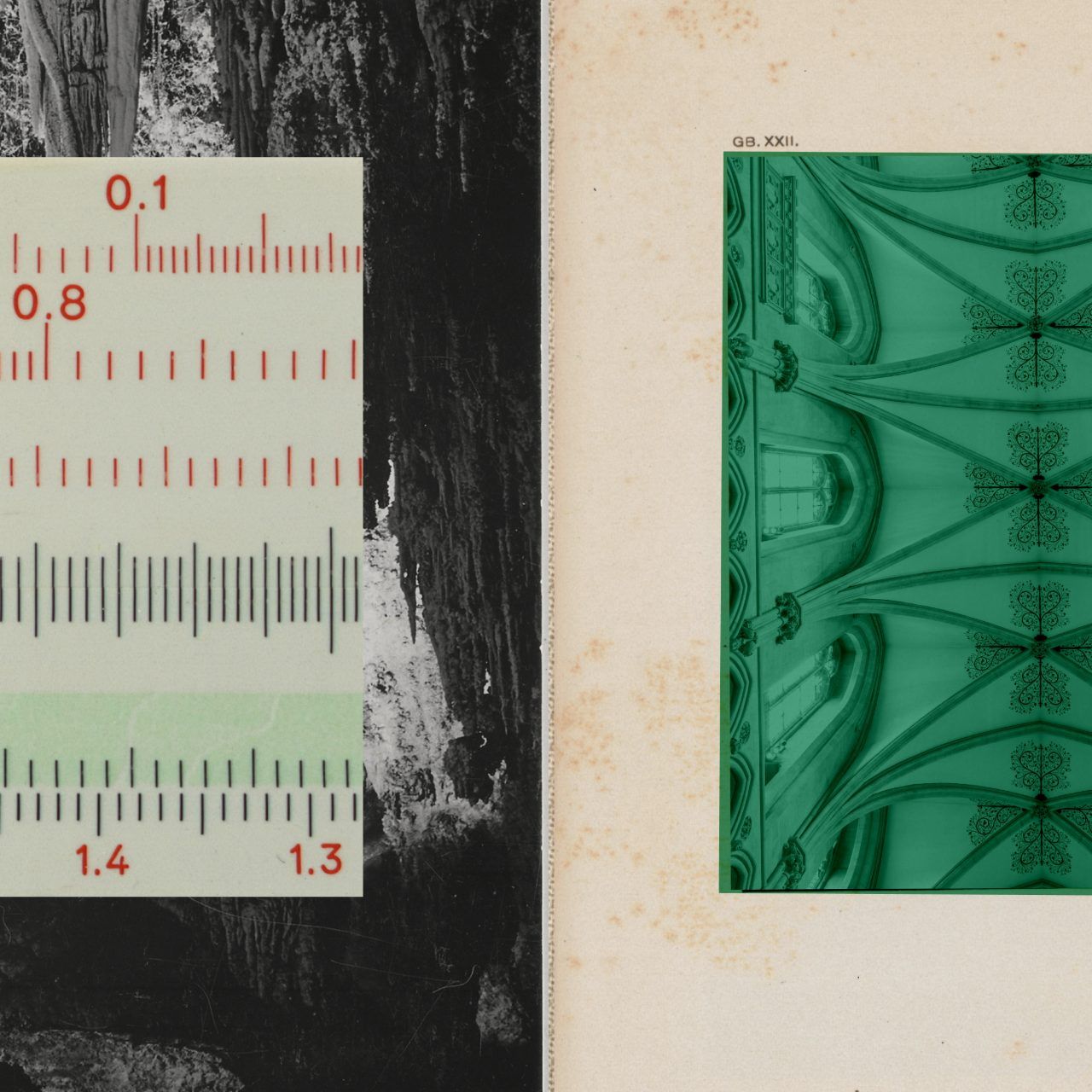
Image source: anthropic.
Source: Original source Anthropic research post · Preprint PDF · RuntimeWire
02/10
ChatGPT adds GIF generation with the new Images 2.6 model
OpenAI's new Images 2.6 model lets ChatGPT turn text prompts or photos into animated GIFs, with adjustable speed and frame-level editing.
The Decoder, citing The Verge, reports that the feature is rolling out to all ChatGPT and Codex users on web, desktop and mobile. Users can start from a text prompt or an uploaded photo, then change the animation speed or edit individual frames.
In OpenAI's example, a prompt for a dancing cat produces several slightly different images of the same character, strung together flipbook-style; the character stays recognizable from frame to frame. Images 2.6 is also meant to speed up image generation overall. For developers, OpenAI released the API models GPT-Image-2.6 "Flare" (efficiency) and "Sunburst" (quality); both variants first appeared with Images 2.5.
Limitations: The report gives no API pricing, frame limits or resolution specs. The point about frame consistency comes from the report's reading of OpenAI's examples, not from a measured evaluation.
Source: Original source OpenAI: Images 2.5 (Flare/Sunburst launch) · The Decoder
A University of Michigan team released the open-source CloudOpsBench. Even the best model finishes only 60% of tasks, and about 80% of failures come from reasoning rather than missing knowledge.
CloudOpsBench 1.0 has 45 AWS tasks written by experienced DevOps engineers. They cover fixing services, removing resources, restricting access rights, rolling out updates and decommissioning projects. Every task runs the same way in the real AWS cloud and in an emulator. The team is led by Ang Chen.
| Model | Tasks completed (%) |
|---|---|
| Claude Fable 5.1 | 60 |
| GPT-6 Astra | 53 |
About 80% of failures happen because agents misjudge a task's scope, skip relevant services or stop too early. Roughly 20% are wrong actions, some with irreversible effects on the infrastructure. No model completes every task.
Limitations: Only AWS is supported for now; GCP, Azure and OCI are planned. With 45 tasks the benchmark is small, and the report gives scores for only two models.
Source: Original source GitHub: CloudOpsBench · The Decoder
04/10
Ricursive opens Ripple-65B Preview, scoring 80.5 on Terminal-Bench 2.1
Chip-design AI company Ricursive Intelligence released open weights for Ripple-65B Preview, a 65B dense model for agentic coding, under Apache 2.0.
Ripple-65B Preview was pretrained from scratch. It is a general-purpose version of the proprietary model behind Ricursive's AI chip design platform. Ricursive reports a Terminal-Bench 2.1 score of 80.52, which it calls the top self-reported score among US open-weight models. The MoE models it beats on that test have 501B to 975B total parameters.
- Size: 65B dense (65B active), pretrained on 12T tokens, up to 1M context
- License: Apache 2.0, with 3 checkpoints, including instruction-tuned BF16 and NVFP4 builds; weights are on Hugging Face
- Speed: about 250 tok/s in BF16 on 2x B200; an experimental NVFP4 build targets NVIDIA DGX Spark
- Architecture: gated attention, global NoPE, value residuals, and FFN activation clipping as used in gpt-oss
- Hosting: Together AI's page lists the model as "Coming soon" to its Serverless API
Limitations: All scores are self-reported. Ricursive's own table shows the model trailing larger MoE models on knowledge and science coding; its SciCode score of 39.4 is the lowest of the five models listed. It is still a preview.
Source: Original source Hugging Face: Ripple-65B-Preview · Together AI · MarkTechPost
Global AI news
05/10
Meta acquires Conductor, which will wind down its coding-agent app
Meta has acquired AI coding startup Conductor, whose app runs several coding agents at once. Terms were not disclosed, and the existing product is being shut down in stages.
Axios first reported the deal, and Conductor confirmed on its website that it is joining Meta. Its software lets a developer run several coding agents at once, each in an isolated copy of the codebase, then review and merge their work. Supported agents include Claude Code, Codex and Cursor, and users pay through their own subscriptions and keys. When Conductor announced its Series A in March, it said Meta, Google and Spotify each had dozens of engineers using the product.
Shutdown schedule: new sign-ups and downloads stopped on the day of the announcement. Conductor Cloud, the hosted version that runs agents in sandboxed virtual machines, goes read-only on November 13 and shuts down with data deleted on November 20. The local Mac app keeps working until early 2027, after which it gets no further updates.
Limitations: The report does not give the deal value.
Source: Single report SiliconANGLE
06/10
Baseten launches Grid to route and govern enterprise coding agents
Inference company Baseten opened Grid in preview on November 4. It is a gateway, routing and guardrails layer for coding agents, and Baseten claims nearly 70% savings in a benchmark.
Baseten said on X that Grid routes requests, monitors usage and governs access across coding agents. Platform teams can set budgets, keep audit records and send traffic to cheaper models, including Baseten's own. Opendoor is the named customer.
Limitations: The nearly 70% saving comes from Baseten's own benchmark, and the method is not published. Access is through a waitlist.
Source: Original source Baseten (X) · RuntimeWire
07/10
Apple reportedly cuts some engineers' daily AI budgets to $200
Bloomberg's Mark Gurman reports that in October Apple cut some engineers' daily AI spending cap from $300 to $200, with more cuts planned.
According to Gurman, some teams' caps are set to fall to $100 a day, and other teams could see $25. Apple is still pushing for wider internal AI use.
| Stage | Daily AI cap (USD) |
|---|---|
| Before October | 300 |
| From October (some engineers) | 200 |
| Planned (certain teams) | 100 |
| Possible (other teams) | 25 |
Limitations: These figures come from press reporting, not from Apple. The $25 figure appears only in Gurman's X post, not in the secondary summary of the Bloomberg report.
Source: Original source Mark Gurman (X) · RuntimeWire
08/10
Uber says AI agents booked only 4 rides last quarter
On its earnings call, Uber said third-party AI agents arranged only four rides in Q3 2026.
Food delivery numbers were somewhat higher: Uber Eats recorded around 500 orders placed by AI agents during Halloween week. The report compares these with a total of 320 million Uber rides and Uber Eats deliveries. According to The Verge, this is the first time Uber has disclosed such figures, at a time of growing concern that AI agents could bypass its platform.
Limitations: The report does not say what period the 320 million figure covers, or how Uber identifies an order as coming from a third-party agent.
Source: Single report The Verge
Regional and early signals
09/10
Apple Intelligence opens for testing in China, with Qwen for complex tasks
The iOS 27.3 developer beta opens Apple Intelligence to users in mainland China. It runs on Apple's own models together with Alibaba's Qwen.
In ifanr's hands-on test, photo cleanup and basic text polishing run on the device. For complex tasks, Siri, Writing Tools and Visual Intelligence call Qwen's cloud models. The system first asks for consent and requires signing in to a Qwen account. The new Siri also accepts typed input after a double-tap on the bottom bar.
The update is about 12GB. Natural-language photo search, Memories videos and lock-screen notification summaries need indexing first, which can take one to two days. The public release is expected in December.
Limitations: This is the first developer beta, and it has bugs. In testing, Siri still could not handle two tasks in one request or deeper system control. This is a single hands-on report (Chinese-language source).
Source: Single report ifanr (Chinese-language source)
10/10
XHEART launches 700-TOPS X7 Ultra driving chip, claiming 98.7% NPU use
Autonomous-driving chipmaker XHEART launched the X7 Ultra in Suzhou on October 29, focusing on real utilization with production models rather than headline TOPS.
CEO Li Zonglin said the X7 Ultra delivers 700 TOPS for large models, and the next-generation X9 targets 3,000 TOPS. In tests with a production driving model, XHEART reports 98.7% NPU utilization, 80% lower memory-bandwidth use and 100% better inference efficiency. Media reports say the test model was Momenta's R7 world model.
The next day, Horizon Robotics founder Yu Kai criticized the industry's "equivalent TOPS" figures. His example: Horizon's Journey 6P is 560 TOPS under NVIDIA's method but could be marketed as 1,960 TOPS under an "equivalent" method.
Limitations: All performance figures are vendor claims with no independent testing. The report notes that tailoring the chip to Momenta's model gains efficiency but gives up openness and compatibility. This comes from a single analysis piece (Chinese-language source).
Source: Single report TMTPost (Chinese-language source)
This digest is compiled by AI from the sources linked in each item and published after automated fact-checking, without article-by-article human review before publication. If anything differs from the original, the original source prevails. How this digest is made, or report an error: About this digest
OpenAI’s latest image model, strongest at legible text and dense layouts — posters, packaging, dashboards. Generate in your browser. 5 free credits on sign-up, no credit card.
Open GPT Image 2.5