Overview
9 stories in this issue. The first 3 are today's priorities.
Hot model updates
- Top · GPT-5.6 Sol promo pricing reportedly ends Nov 30, output up 50%
- Top · Tencent launches Hy4 with first vision and computer-use support, weights due soon
- Top · Mistral's Timestral: four forecasting models from 5M parameters that can run on CPUs
Global AI news
- Google turns off Search in schools that turn off its AI
- Google Antigravity's cheminformatics skills propose new macrocycles in an hour
- Ai2 releases StateBench to test state tracking over long documents
- Nexus Mods makes AI disclosure mandatory, with 60 days for existing mods
Regional and early signals
- GPT-6 Astra edits 0.016% of Qwen's weights, lifting MATH-500 from 7.9% to 48.1%
- China Merchants' Lion Rock lab releases embodied reasoning model Lion-ER-35B-A3B
Hot model updates
An OpenAI customer email says GPT-5.6 Sol's promotional API pricing ends on November 30; OpenAI's public docs only guarantee the promo rate through at least November 21.
According to RuntimeWire, an OpenAI email to customers says GPT-5.6 Sol's promotional API pricing will end on November 30, 2026, and Standard rates will return. At the prices in the report, output costs would rise 50% and input costs 25%.
| Price tier | Input (per 1M tokens) | Cached input (per 1M tokens) | Output (per 1M tokens) |
|---|---|---|---|
| Current promo | $4 | — | $20 |
| Standard | $5 | $0.50 | $30 |
Limitations: The email is the only source for the November 30 cutoff and for the return to these rates on that date. OpenAI's public model docs guarantee the promo rate at least through November 21 and give no end date.
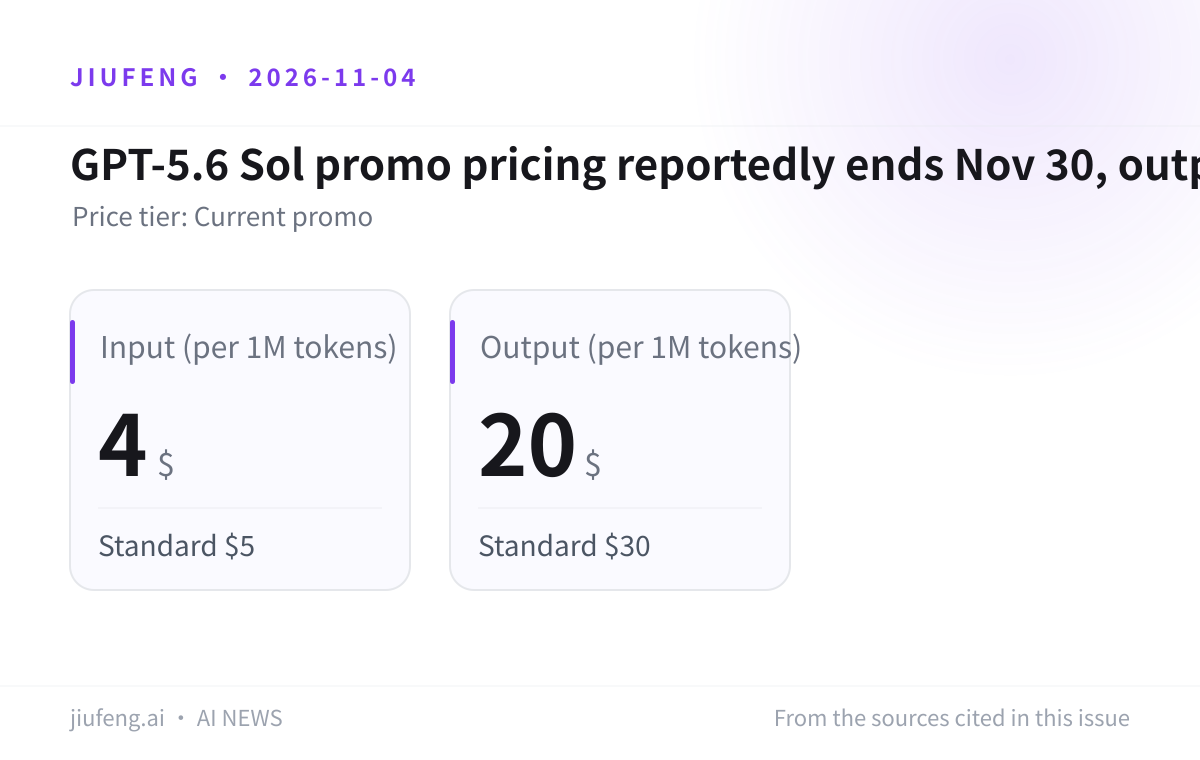
Jiufeng graphic based on the sources cited in this issue.
Image source: OpenAI Developers.
Source: Original source OpenAI API docs: GPT-5.6 Sol · RuntimeWire
02/09
Tencent launches Hy4 with first vision and computer-use support, weights due soon
Tencent released Hy4, its newest large language model, with visual understanding and computer use for the first time, and says weights and system cards will follow in the coming days.
Tencent's announcement lists these changes:
- Vision: new in Hy4. It covers fine-grained image processing, complex chart analysis and mathematical visual reasoning.
- Computer use: new in Hy4. It can operate both command-line and graphical interfaces.
- Other improvements: instruction following, long-context comprehension and long-horizon agentic tasks.
- Open release: weights and system cards are planned for the coming days, with a safety focus on cybersecurity and biological safety.
The release also gives evaluation results. On WorkBuddy scenarios, Hy4 averaged 83.18 with a 96.15% pass rate and placed first in 9 of 12 scenarios. In a financial blind evaluation it scored 3.04, against 2.97 for DeepSeek-V4.1-Flash.
Limitations: "Joining the ranks of the world's leading open-source models" is Tencent's own description, and all of these results were published by Tencent. The weights are not out yet, so the open-source terms can't be checked.
Source: Original source Tencent Newsroom
03/09
Mistral's Timestral: four forecasting models from 5M parameters that can run on CPUs
Mistral's first time-series foundation model family, Timestral, has four models from 5 million to 209 million parameters, and Mistral says they run on standard server CPUs.
RuntimeWire reports that Mistral launched Timestral on October 15, 2026. It forecasts operational data such as factory sensors, energy use and financial flows, and can model related data streams together with planned inputs.
- Size: 4 models, 5M to 209M parameters.
- Hardware: Mistral says inference runs on standard server CPUs, no GPU needed.
- Deployment: customers can control where it is deployed.
- Benchmarks: Mistral says it has submitted results to GIFT-Eval and TIME.
Limitations: The family launched in mid-October, so this is not same-day news. RuntimeWire notes that its benchmark lead is still a company claim until the results and evaluation setup can be compared directly.
Source: Original source Mistral Newsroom · RuntimeWire
Global AI news
04/09
Google turns off Search in schools that turn off its AI
Google's K-12 student accounts will have Gemini and Search off by default, and administrators can't disable Gemini while keeping Search.
In an education update, Google says Gemini, Gemini Notebook, Gemini in Classroom and Google Search "will be entirely off" for K-12 student accounts unless administrators explicitly turn them on. Turning off Gemini-powered features also means turning off Search, and students will see a notice that Search isn't available. Chris Phillips, Google's vice president of education, told The New York Times that "Search and AI are deeply integrated."
Limitations: The Verge reports that several lawmakers and local leaders have responded, including Sen. Bernie Sanders. The report doesn't say how many schools or students are affected.
Source: Original source Google education update · The Verge
05/09
Google Antigravity's cheminformatics skills propose new macrocycles in an hour
Google DeepMind's new Cheminformatics Skills for Antigravity let an agent finish in about an hour a drug-design iteration that usually takes days.
DeepMind used real-world lung cancer treatments as the test case. The agent searched thousands of compounds, ran matched molecular pair analysis, and proposed novel rigidified macrocycles with synthetic routes in about an hour. DeepMind says one iteration of this workflow usually takes several days: curating data from charts and literature, training predictive models, and proposing candidate molecules.
Limitations: The post shows candidate molecules and routes that the agent proposed. It doesn't report whether any of them have been synthesized or tested.
Source: Original source Google DeepMind
06/09
Ai2 releases StateBench to test state tracking over long documents
Ai2's StateBench tests long-context state tracking at four difficulty levels, with data and code released.
StateBench checks whether a model can keep track of an entity's correct state as it changes across a long document, such as variables reassigned in code or characters and objects moving through a story. The lowest level, R-trivial, uses immutable assignment: the model only has to recover the first value, which never changes. The second level, Aperiodic, asks for the most recent value. The hardest level includes the S₅ problem: tracking how a series of swaps rearranges five objects. Ai2 released a tech report, the dataset and code on GitHub.
Limitations: This summary doesn't repeat per-model scores; see the tech report for results.
Source: Original source Hugging Face Blog (Ai2) · GitHub: allenai/state-bench
07/09
Nexus Mods makes AI disclosure mandatory, with 60 days for existing mods
Nexus Mods, PC gaming's biggest mod site, will require mod authors to declare whether they used AI, and existing mods must comply by January 2.
The Verge reports that site owner Victor "Foledinho" Folmann announced the rule in a post about AI-generated content. Authors of new uploads must declare "whether AI has been used in their work." The site already had "AI-generated" and "AI-assisted" tags. Folmann said one of the most consistent concerns from users was that AI use wasn't clearly disclosed.
Limitations: Authors of existing mods have 60 days to update them to the new requirements. The grace period ends January 2, and enforcement starts after that. Mods tagged "AI-assisted" face extra requirements, which are detailed in the original post.
Source: Single report The Verge
Regional and early signals
08/09
GPT-6 Astra edits 0.016% of Qwen's weights, lifting MATH-500 from 7.9% to 48.1%
MIT CSAIL had GPT-6 Astra read and directly edit Qwen3.5-0.8B's weights, fixing a reasoning loop that ran past 30,000 tokens.
Leiphone (Chinese-language source) reports that Qwen3.5-0.8B would write more than 30,000 tokens on math problems, repeating similar reasoning without reaching an answer. The researchers had GPT-6 Astra inspect the weights, locate the problem and edit the parameters directly, an approach they call "Weight-Space Programming."
| Model state | MATH-500 (%) |
|---|---|
| Original Qwen3.5-0.8B | 7.9 |
| After Astra edited ~0.016% | 48.1 |
In the same work, Astra identified four game-playing networks (Breakout, Pong, Pac-Man, Freeway; same architecture, 17,253 parameters each) from their weights alone, without running them. It also worked out whether each of three ~7.2M-parameter character-level Transformers had learned Python, romanized Japanese or English.
Limitations: Chinese-language source, and the report doesn't link the paper. All test models are small. The report also notes that the game networks' inputs have clear physical meanings, while an LLM's hidden dimensions carry no such labels, which makes them harder to read.
Source: Single report Leiphone
09/09
China Merchants' Lion Rock lab releases embodied reasoning model Lion-ER-35B-A3B
China Merchants' Lion Rock AI Lab released Lion-ER-35B-A3B, an embodied reasoning vision-language model with about 35B total and 3B active parameters per token, averaging 65.29 across ten benchmarks.
QbitAI (Chinese-language source) reports:
- Architecture: MoE, about 35B total parameters, about 3B active per token.
- Data method: a capability-driven data engine instead of collecting ever more data. It splits embodied reasoning into 8 top-level domains (entity, space, time, physics, affordance, task, social, evidence) and 39 sub-capabilities, then uses evaluation results to find gaps and refine the data.
Selected scores from the report (gains in parentheses as reported):
| Benchmark | Score |
|---|---|
| Ten-benchmark average | 65.29 |
| Where2Place | 64.28 (+9.30) |
| ERQA | 64.38 (+6.19) |
| SAT | 89.33 |
| ERQA trajectory | 68.18 (+12.12) |
Limitations: Chinese-language source, single report, and all scores come from the team. The claim that it beats larger models is the team's own, with no third-party reproduction yet.
Source: Single report QbitAI
This digest is compiled by AI from the sources linked in each item and published after automated fact-checking, without article-by-article human review before publication. If anything differs from the original, the original source prevails. How this digest is made, or report an error: About this digest
Create AI images and videos with sound in your browser: write a prompt, pick a model, download the result. 5 free credits on sign-up, no credit card.
Start creating free