Overview
9 stories in this issue. The first 3 are today's priorities.
Hot model updates
- Top · FlashProve: Anthropic wants cryptographic proof of which model answered
- Top · Kimi K3 gets in-country inference in India on Amazon Bedrock
- Top · OpenAI: ChatGPT and Codex now handle CAD, PCB design and simulation work
- Altman says India has overtaken the US as OpenAI's biggest market
- Kimi's K3.1 agents now edit Unity, Unreal and Blender projects
Global AI news
- NVIDIA stacks three optimizations to lift Ling-3.0-flash throughput 42.5% on DGX Spark
- Stanford study: 44% of 50 widely cited LLM findings have already expired
Regional and early signals
- Baidu unveils Apollo World, a world model already used to test Apollo Go
- Geek+ sets out a 24/7 autonomous warehouse plan; humanoid pilot picks at 2x human rate
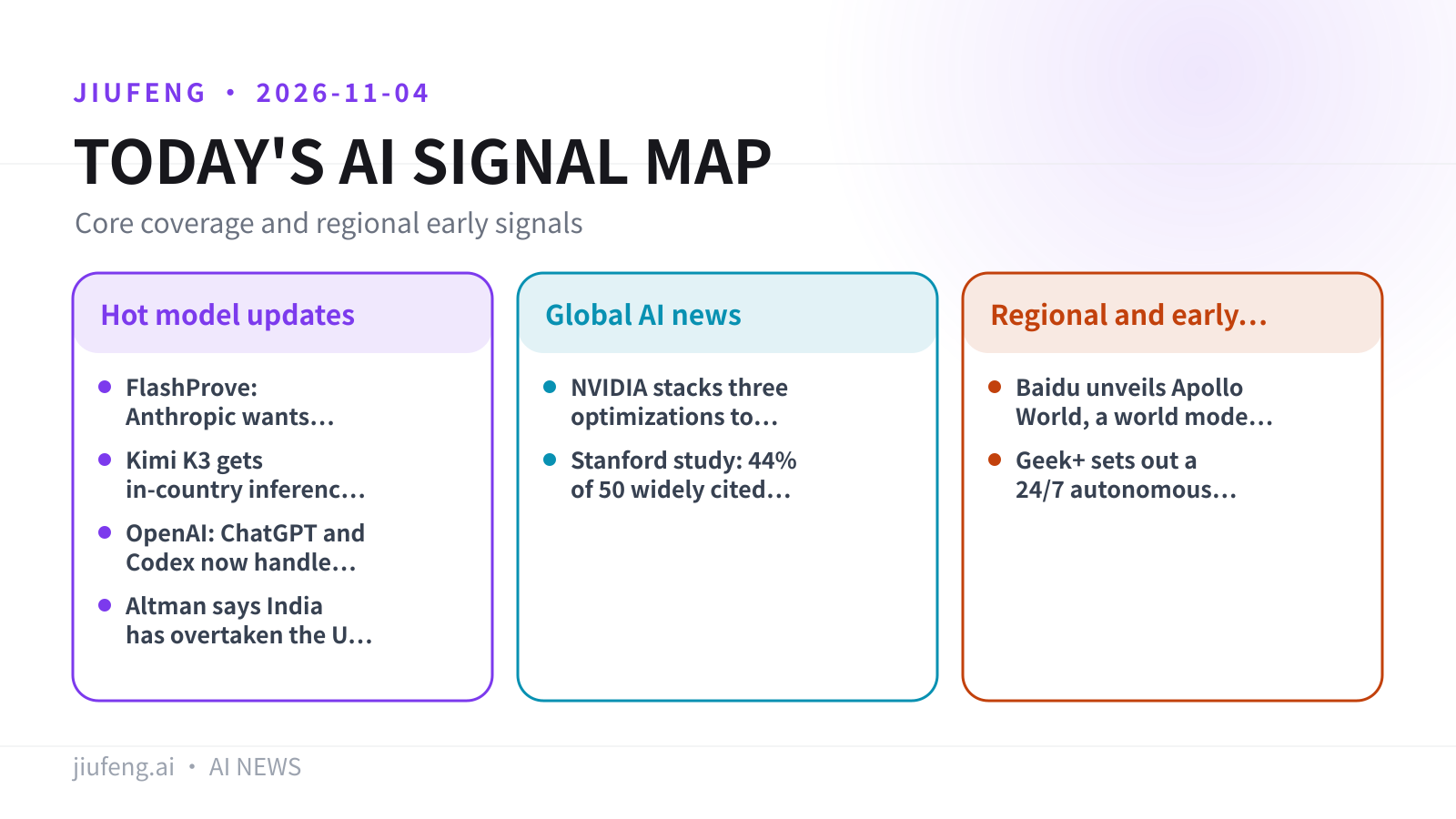
Jiufeng graphic based on the sources cited in this issue.
Hot model updates
01/09
FlashProve: Anthropic wants cryptographic proof of which model answered
Anthropic is building FlashProve, an open-source system meant to let anyone verify that an output really came from the model it claims to be from.
According to an Anthropic research post published Tuesday, FlashProve targets "provable inference": a cryptographic proof, essentially a mathematical guarantee, that a given output came from a specific model. TechCrunch reports that it is designed to hold up against impostors, even when the impostor is the lab that built and runs the model.
The researchers give two use cases: stopping an AI company from quietly swapping in a cheaper model to cut costs, or a more expensive one to inflate its performance results. Anthropic plans to release the system as open source.
Limitations: The reporting says Anthropic is "working on" the system and that it "would" enable verification, so FlashProve is not a shipped feature. The source gives no figures for proof overhead or latency, no list of supported models, and no availability date.

Image source: anthropic.
Source: Original source Anthropic · TechCrunch
Kimi K3 requests on Bedrock can now be processed entirely inside the Mumbai and Hyderabad Regions, which meets strict data-residency requirements.
Bedrock already offered global and US-based inference for Kimi K3, Moonshot AI's multimodal open-weight foundation model. AWS has now added in-country inference in India, with processing kept within the Mumbai and Hyderabad Regions.
- Customer: Ultrahuman says Kimi K3 on Bedrock let it add an open-weight model through its existing API; its in-app health assistant, Jade, handles more than 14,000 conversations a day
- Customer-reported gains: With prompt caching, LLM costs fell 80% and multi-turn chats became 85% faster
- Sample code: AWS published an Indic document OCR example on GitHub
Limitations: The "frontier-level coding and agentic intelligence" claim is Moonshot AI's own release claim, which AWS repeats. The 80% and 85% figures come from a single customer quote and do not show typical results.
Source: Original source AWS Machine Learning Blog · GitHub sample
03/09
OpenAI: ChatGPT and Codex now handle CAD, PCB design and simulation work
OpenAI says engineers are using ChatGPT and Codex for mechanical, electrical and simulation work, with Chip Ganassi Racing and Mazda among its partners.
In a November 3rd research post, OpenAI listed the tasks involved: CAD revisions, printed circuit board design, manufacturing drawings and design review. RuntimeWire notes that this extends the tools from software into fields where errors carry manufacturing costs.
Limitations: RuntimeWire reports that OpenAI's own prototype still needed human correction on tolerances and assembly, and OpenAI says human review is still required. The source gives no figures for time saved or error rates.
Source: Original source OpenAI · RuntimeWire
Sam Altman confirmed in an interview that India now has more OpenAI users than the US and is still growing quickly.
In a November 3rd interview with Raj Shamani, Altman was asked whether India had passed the US, and he answered "Yeah." He linked India's optimism about AI to faster economic growth and more unmet demand for products and services, and said fast-developing economies tend to welcome AI more readily than developed ones.
Limitations: This was a verbal confirmation in an interview. The report gives no user counts and does not say whether "biggest market" refers to users, engagement or revenue.
Source: Single report RuntimeWire
Kimi's new game development solution pairs K3.1 models with its Kimi Code and Kimi Work agents, and one unattended run lasted 20 hours.
Pandaily reports that the solution runs on K3.1 models, with the Kimi Code and Kimi Work agents editing Unity, Unreal Engine and Blender projects directly. The report mentions a single unattended run that lasted 20 hours.
Limitations: Only one outlet has covered this so far. The report gives no pricing, availability details or supported engine versions, and does not assess the quality of the 20-hour run's output.
Source: Single report Pandaily
Global AI news
06/09
NVIDIA stacks three optimizations to lift Ling-3.0-flash throughput 42.5% on DGX Spark
On a single desktop DGX Spark, three stacked optimizations raised decode throughput for a 124B MoE model by 42.5%, with no detectable change in accuracy.
NVIDIA's technical blog tested Ant Group inclusionAI's Ling-3.0-flash with three stacked optimizations: a new MoE kernel backend, an FP8 output layer and built-in speculative decoding. Across all 1,319 GSM8K questions, decode throughput rose 42.5%, and any change in accuracy was too small to detect statistically.
- Size: 124B total parameters, 5.1B active per token
- Context: 256K native
- Layers: 42 in total, with 35 KDA linear-attention layers and 7 MLA layers
- Tested build: Ling-3.0-flash-fp4
Limitations: The results cover single-user requests, and accuracy was checked on GSM8K only. DGX Spark is a desktop system, not a data center node, so the results don't carry over directly to batched serving.
Source: Original source NVIDIA Developer Blog · Hugging Face model card · MarkTechPost
07/09
Stanford study: 44% of 50 widely cited LLM findings have already expired
Claims about what models can't do expire fastest. Findings with an estimated expiry lasted 15.7 months on average.
Stanford researchers Owen Queen and James Zou re-tested 50 widely cited claims about LLMs on 20 models. The models came from eight developers and were released between July 2024 and September 2026.
| Finding status | Share (%) |
|---|---|
| Expired | 44 |
| Weakened significantly | 34 |
| Still holds | 16 |
| Got stronger | 6 |
Among the 22 findings with an estimated expiry date, the average lifespan was 15.7 months. Sixteen percent had expired after one year and 39% after two. Five of the nine reasoning-related findings have expired, and none still holds or got stronger. They include well-known weaknesses such as counting the letters in "strawberry."
Limitations: The study covers 50 claims and 20 models. The authors recommend that papers record the model, version and test date, and publish their prompts and analysis code so the findings can be re-tested on future models.
Source: Single report The Decoder
Regional and early signals
08/09
Baidu unveils Apollo World, a world model already used to test Apollo Go
Baidu Apollo unveiled Apollo World, a multimodal world model for physical AI that represents every simulated road user as an agent. Baidu uses it to validate its driverless systems.
Baidu first disclosed Apollo World on November 3rd at its AI Day Apollo event in Shenzhen. It also proposed a "2+3" standard for judging world models. The "2" are two baseline requirements, causality and interactivity. The "3" are three capability measures, including physical accuracy and persistence. The model is already used in global testing and validation for Apollo Go (Luobo Kuaipao), which has logged more than one million kilometers of fully driverless end-to-end operation. Baidu says driverless safety decisions must be made within 1/30 of a second.
Limitations: Chinese-language source only. There is no paper or open-source release. The "100,000 km of virtual testing per day" figure comes from an industry analyst, not from Baidu's own data.
Source: Single report Leiphone (Chinese-language source)
09/09
Geek+ sets out a 24/7 autonomous warehouse plan; humanoid pilot picks at 2x human rate
Geek+ wants AI to take over dispatch and operations across entire warehouses, and has shared pilot results from a Schneider Electric site in Shanghai.
Geek+ published a "24/7 Autonomous Intelligent Warehouse Plan" that moves toward fully autonomous warehouses in three stages. It is built on the company's in-house Gravity embodied-AI framework and its Gravity 4D embodied world model. At Schneider Electric's Shanghai logistics center, the Gino 1 humanoid robot worked with mobile robots on picking tasks and picked at twice the human rate, with accuracy above 99.99%.
Limitations: Chinese-language source only. The figures come from the company, the article reads as promotional, and it gives no pilot scale or duration. No third party has verified the results.
Source: Single report QbitAI (Chinese-language source)
This digest is compiled by AI from the sources linked in each item and published after automated fact-checking, without article-by-article human review before publication. If anything differs from the original, the original source prevails. How this digest is made, or report an error: About this digest
Create AI images and videos with sound in your browser: write a prompt, pick a model, download the result. 5 free credits on sign-up, no credit card.
Start creating free