Overview
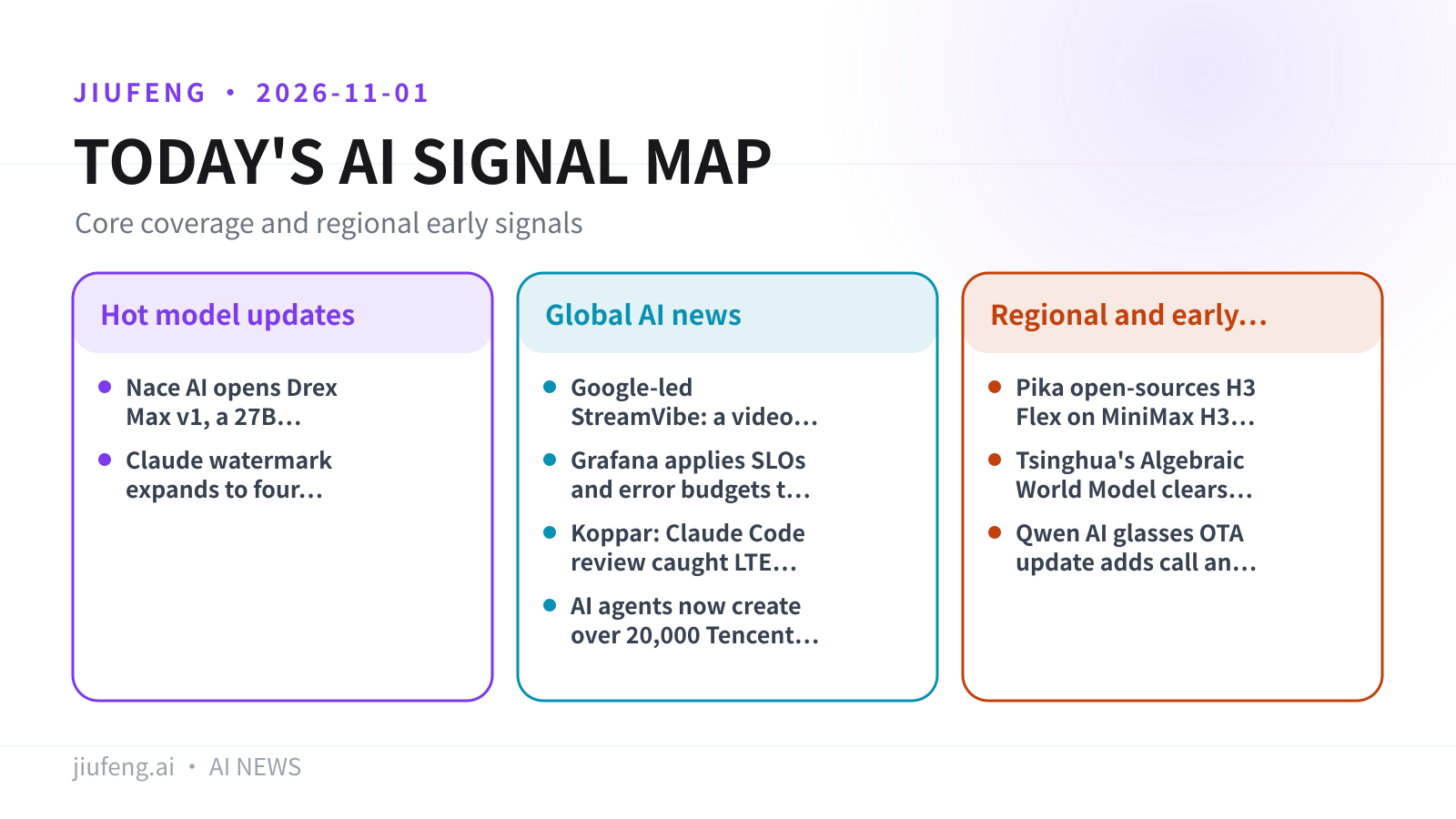
9 stories in this issue. The first 3 are today's priorities.
Hot model updates
- Top · Nace AI opens Drex Max v1, a 27B decision model that runs on a Mac
- Top · Claude watermark expands to four older models, two with a bypass
Global AI news
- Top · Google-led StreamVibe: a video agent that speaks up only when you need help
- Grafana applies SLOs and error budgets to AI agent hallucinations
- Koppar: Claude Code review caught LTE modem board errors that clean electrical checks missed
- AI agents now create over 20,000 Tencent Cloud TDSQL-C databases a day
Regional and early signals
- Pika open-sources H3 Flex on MiniMax H3: joint audio-video in six steps
- Tsinghua's Algebraic World Model clears all 183 ARC-AGI-3 levels
- Qwen AI glasses OTA update adds call and media translation
Jiufeng graphic based on the sources cited in this issue.
Hot model updates
01/09
Nace AI opens Drex Max v1, a 27B decision model that runs on a Mac
Nace AI released open weights for Drex Max, its most capable decision model, so routing, classification and policy checks can run on a local machine.
The release includes bf16 weights, a Q8_0 GGUF, an affine Q4 checkpoint, and forks of llama.cpp and Ollama.
- Size: dense 27B parameters, multimodal
- License: Nace.AI Open RAIL-M
- Context: 262,144 tokens (16,384 by default)
- Output: up to 255 options per question
- Hardware: an H100 for bf16, or a 48 GB L40S in 8-bit; Apple Silicon with 24 GB+ for affine Q4, or 48 GB for the Q8_0 GGUF; CPU via llama.cpp and Ollama
- Scores: 67.52 on Decision Index v0.4; 97.3 on InfographicVQA, 81.9 in the Tools area
Limitations: The Decision Index scores are self-reported. The 61.25 cited for Drex v2.0 is a score on index v0.3.1, not v0.4, so the two numbers aren't directly comparable.
Image source: huggingface.
Source: Original source Hugging Face: drex-max-v1-Q8_0 · MarkTechPost
02/09
Claude watermark expands to four older models, two with a bypass
Anthropic is watermarking Mythos 5, Opus 4.7, Opus 4.6 and Sonnet 4.6. On Opus 4.6 and Sonnet 4.6, though, the mark applies only at default settings.
In an email to API customers, Anthropic said it will watermark Claude Mythos 5, Claude Opus 4.7, Claude Opus 4.6 and Claude Sonnet 4.6 to meet the EU AI Act's December deadline. Newer models such as Claude Opus 5.5 already carry the mark. The rollout on Amazon Bedrock may take a few extra days.
Anthropic describes the watermark as an "imperceptible pattern in word choice" that leaves meaning, quality and readability unchanged. It says the watermark adds no characters or tokens, doesn't change pricing or request/response formats, barely affects output speed, and contains no information about users, organizations or conversations. The mark can be verified through a detection API that is in private testing.
Limitations: The Decoder reports that on Opus 4.6 and Sonnet 4.6 the watermark only applies at default sampling settings, so API users can avoid it by changing one sampling parameter.
Source: Single report The Decoder
Global AI news
03/09
Google-led StreamVibe: a video agent that speaks up only when you need help
The researchers want a video assistant that can act on vague requests like "help me if I run into difficulties." Their tests show how far today's models still are from that.
Researchers from Google, Stanford, Oxford and several U.S. universities introduced StreamVibe. The paper says current video assistants are built for explicit commands such as "tell me when the water boils." They rarely pick up on unspoken intentions and lose track of which steps are already done, so they repeat advice or respond too late. When users change their request midway, the assistants often stick to the original instruction. StreamVibe separates three kinds of intent during a task: stated, unspoken and changing.
Limitations: This is a research prototype, not a product. The Decoder's takeaway is that the tests mainly show how hard it still is to decide when to speak up, and none of the tested models handled it well.
Source: Original source arXiv paper · The Decoder
04/09
Grafana applies SLOs and error budgets to AI agent hallucinations
Grafana Labs uses SRE-style SLOs and error budgets to turn hallucination, task completion, toxicity and cost into metrics it can monitor over time.
The approach has two steps. First, evaluations check each interaction for grounding, task completion, toxic content, PII leaks and prompt injection, using either an LLM judge or deterministic checks such as regex. Then the results become SLIs measured against SLOs. In Grafana's example, the SLO is that 95% of conversations over 30 days are judged to have completed the user's request, which leaves a 5% error budget. Grafana argues against a single combined quality score and sets a separate target for each dimension.
Limitations: This is a proposed method, and the report gives no production results. An LLM judge can itself get evaluations wrong.
Source: Multiple outlets InfoQ · InfoQ China (Chinese-language source)
05/09
Koppar: Claude Code review caught LTE modem board errors that clean electrical checks missed
An AI-designed LTE modem board passed Koppar's electrical checks, but a one- to two-hour Claude Code review plus visual inspection still turned up antenna, component and layout problems.
Founder Abijah Kajabika says the board sent to fabrication is the corrected revision with every fix from the review applied, and the parts list has also been corrected. He expects the assembled boards and loose modem modules around November 5-6. Hand-soldering and bench testing follow, with results planned for the week after.
Limitations: The board hasn't been built or tested, so its real-world performance is unproven. RuntimeWire issued a correction on November 1: an earlier version of its story said the RF routing and SIM placement were unchanged, and the founder clarified that all fixes had been applied.
Source: Original source GitHub: koppar-lte-modem · RuntimeWire
06/09
AI agents now create over 20,000 Tencent Cloud TDSQL-C databases a day
Tencent Cloud says agents create more than 20,000 TDSQL-C instances a day, up more than 80x.
Tencent Cloud's figures: agents create over 20,000 TDSQL-C database instances per day, more than 80 times as many as before, and over 1 million instances are active. The report adds that WorkBuddy user Li Ning runs about 50 agents and plans to reach 200 within a year.
Limitations: The figures are self-reported by Tencent Cloud and haven't been independently verified.
Source: Single report Pandaily
Regional and early signals
07/09
Pika open-sources H3 Flex on MiniMax H3: joint audio-video in six steps
Pika released two LoRA adapters and inference code that cut MiniMax H3's 50 denoising steps down to 6.
- Inputs: text, first/last frames, multimodal references
- Output: native 480P and 768P, roughly 5-15 second clips with synced stereo audio
- Integration: ComfyUI workflows and Hugging Face Diffusers
- Training: supervised fine-tuning on in-house audio-video data, then projected distribution matching distillation (PDMD) from 50 steps to 6, then reward feedback learning and DPO to train the LoRAs
- Hosted inference: on 8 B300 GPUs, generating a 5-second 768P clip dropped from 3.409 s to 2.129 s, about 1.6x faster
- Leaderboard: 8th on DesignArena text-to-video, the highest-ranked open video model on that board
Limitations: 1080P/2K/4K enhancement and five-way audio stem separation (dialogue, music, effects, foley, ambience) are offered only through Pika's API service and are not open-sourced. The lead on five quality metrics comes from Pika's own comparison. Chinese-language source (Leiphone).
Source: Single report Leiphone (Chinese-language source)
08/09
Tsinghua's Algebraic World Model clears all 183 ARC-AGI-3 levels
AWM turns a game's objects, relations and rules into algebraic structure, so it can prove a level is impossible and say how many steps are missing.
A team led by Andrew Yao and Yuan Yang at Tsinghua University proposed the Algebraic World Model (AWM). The researchers changed ARC-AGI-3's sc25 level so it couldn't be completed in the allotted steps. Across 12 similar tests, GPT-6 Astra and Claude Opus 5.5 together identified the level as impossible only 5 times, and 4 of those answers gave the wrong minimum step count. AWM running on Opus 5.5 proved the level unsolvable in two attempts and showed that one more step would win. Running on Opus 5, AWM cleared all 183 levels, scoring 99.9%, with an average action count 43% of the human baseline.
Limitations: The impossibility test covers only 12 trials. Chinese-language source (QbitAI).
Source: Single report QbitAI (Chinese-language source)
09/09
Qwen AI glasses OTA update adds call and media translation
Qwen AI glasses can now translate phone calls and online meetings, as well as foreign-language podcasts, classes and films, in real time.
The November 1 OTA update adds call translation and media translation, with translations shown in the Qwen AI wearable app. It also improves speech recognition in noisy places. The Qwen AI Glasses G1 went on sale in March, followed by the flagship S1. The N1 series launched in October with swappable batteries; the Pro version adds eye-tracking control and all-day health monitoring and starts at 2,899 yuan.
Limitations: The report doesn't list supported languages or latency figures, and doesn't say which models get the update. Chinese-language source (IT Home).
Source: Single report IT Home (Chinese-language source)
This digest is compiled by AI from the sources linked in each item and published after automated fact-checking, without article-by-article human review before publication. If anything differs from the original, the original source prevails. How this digest is made, or report an error: About this digest
Generate short videos with sound in your browser — from a prompt or a first-frame image. 5 free credits on sign-up, no credit card.
Open MiniMax H3