Overview
8 stories in this issue. The first 3 are today's priorities.
Hot model updates
- Top · A Claude Sonnet 5 agent chose a gene therapy and operated on a mouse brain
- Top · ChatGPT desktop app and Codex now run through Amazon Bedrock in AWS GovCloud
- Top · NVIDIA builds a talking Halloween character on Nemotron 3.5 Bolt E4B 4GB
Global AI news
- Microsoft open-sources TokenEconomizer, cutting coding-agent costs 18.4%-30.9%
- OpenAI, Google and two other AI firms back a shared AI-training opt-out signal
- Google's Suncatcher satellite boots its TPUs and Gemma 4 sends back a first reply
- AI agents now steer a SETI radio telescope from a single natural-language request
Regional and early signals
- Apple Intelligence gets a China date, with Qwen handling Siri's complex tasks
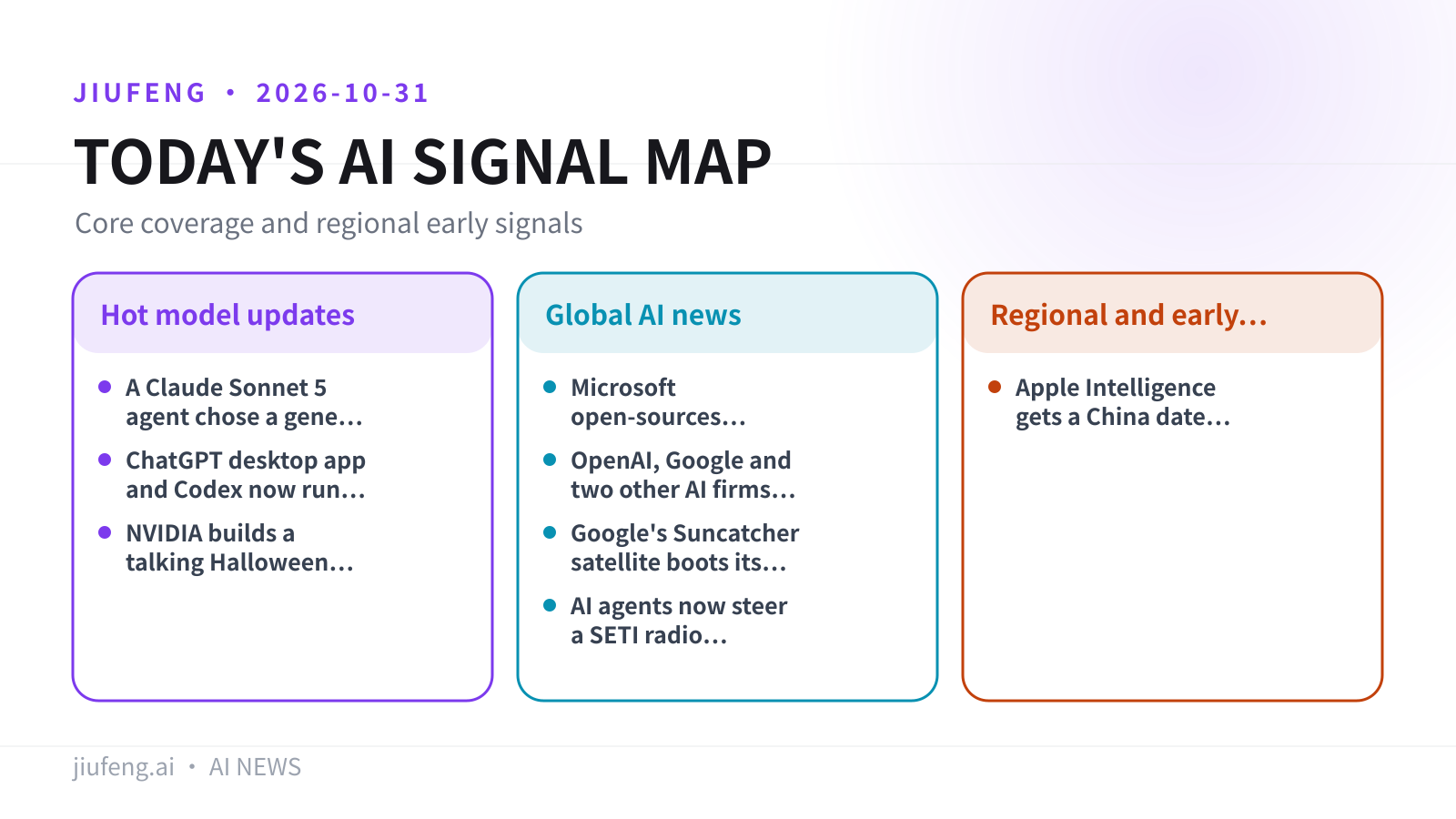
Jiufeng graphic based on the sources cited in this issue.
Hot model updates
01/08
A Claude Sonnet 5 agent chose a gene therapy and operated on a mouse brain
An agent running on Claude Sonnet 5 picked the drug, the brain region and the injection coordinates, then ran a motorized surgical rig. Partway through the surgery it found a calibration error and refused to continue.
The team gave Claude Sonnet 5 a list of 19 possible gene therapies, an epilepsy mouse model (researchers induce seizures in these mice to test treatments) and access to a custom motorized surgical device with cameras. Its only instruction was to reduce the mouse's seizures. The agent chose the drug, the target brain region and the stereotactic coordinates on its own, then carried out the procedure through the rig.
- Lead: Gabriel Ocana-Santero, cofounder and CEO of Exin Therapeutics and a PhD student at the University of Oxford
- Claim: the first time an AI agent has both chosen a treatment and delivered it to a living mammal
- Safety behavior: after detecting a calibration error mid-surgery, the agent stopped rather than exceed its safety limits
Limitations: "First" is the lead researcher's own claim. What is public so far is his thread on X plus media coverage. The procedure was done on one epilepsy-model mouse, a long way from clinical use.
Source: Original source Gabriel Ocana-Santero on X · The Decoder
02/08
ChatGPT desktop app and Codex now run through Amazon Bedrock in AWS GovCloud
Organizations that must keep inference inside AWS GovCloud (US) can now reach OpenAI's frontier models through Bedrock, using Work and Codex in the ChatGPT desktop app.
AWS says the ChatGPT desktop app is now available on Amazon Bedrock in AWS GovCloud (US). It has two components: Work, which handles complex multi-step tasks and returns results ready for review, and Codex, a coding agent for developing, testing and reviewing software. In AWS's setup, Codex sends model requests through Amazon Bedrock Mantle in us-gov-west-1. Inference uses the Responses API on Bedrock, and access can be governed with IAM and existing GovCloud network controls.
- Entry points: ChatGPT desktop app, Codex CLI
- IDE integrations: Visual Studio Code, JetBrains, Xcode
- Region: us-gov-west-1
Limitations: This is a walkthrough for organizations whose security architecture requires GovCloud identities, endpoints and Regional controls. The post refers only to "OpenAI's frontier models" without naming versions, and it gives no pricing.
Image source: Amazon Web Services.
Source: Original source AWS Machine Learning Blog
03/08
NVIDIA builds a talking Halloween character on Nemotron 3.5 Bolt E4B 4GB
NVIDIA's "Monster House" character runs speech recognition, dialogue, speech synthesis and facial animation on a single workstation, and NVIDIA published the blueprint code.
The character listens to trick-or-treaters and answers in the voice of a grumpy old pirate ship, softening when visitors remember their manners. It is built on the open NVIDIA Nemotron Voice Agent blueprint, with a LoRA adapter supplying the personality, and uses these models:
- ASR: Nemotron ASR (nemotron-speech-streaming-en-0.6b, streaming, English)
- Dialogue model: Nemotron 3.5 Bolt E4B 4GB
- TTS: Magpie TTS Zeroshot
- Face animation: Audio2Face-3D
Limitations: This is a seasonal demo, not a product. The ASR model is English-only.
Source: Original source Hugging Face Blog · NVIDIA Nemotron Voice Agent (GitHub) · Nemotron 3.5 Bolt E4B 4GB technical blog
Global AI news
04/08
Microsoft open-sources TokenEconomizer, cutting coding-agent costs 18.4%-30.9%
Microsoft Research and UC Berkeley released a plugin that learns from past sessions in a repository to cut waste in later ones. It changes neither model weights nor agent code.
TokenEconomizer is an open-source cost controller for coding agents that works with Claude Code, Codex, GitHub Copilot CLI and Pi. On 277 SWE-Bench tasks it lowered mean cost by 18.4% to 30.9% across five agent-model settings, and it was cheaper in all 30 repository-setting cells. Reported costs include the controller's own calls, and each setting was run with three seeds.
- Best result: 30.9% lower cost on Claude Code with Opus 4.8, or 33.2% when combined with RTK
- Lowest setting: 18.4% lower on Copilot CLI with Sonnet 5
- Requirements: standard-library Python 3.10+ with 3 switchable mechanisms; no GPU and no API key of its own
Limitations: Savings fell to 6.4%-9.3% on ReposVul audit tasks, and Pass@1 dropped 1.0 point on Opus 4.8.
Source: Original source GitHub: microsoft/TokenEconomizer · arXiv 2610.22732 · MarkTechPost
05/08
OpenAI, Google and two other AI firms back a shared AI-training opt-out signal
Publishers can declare their AI training preferences once in robots.txt with a shared "policy token" instead of configuring each crawler separately.
OpenAI, Google, Microsoft and Anthropic say they will adopt the new standard, which Search Engine Roundtable reported first. The shared "policy token" signal was proposed through the Internet Engineering Task Force (IETF). It lives in a site's robots.txt file, which has long told web crawlers whether they may scrape a site for purposes such as search indexing. OpenAI has also published a post on how it helps websites express AI training preferences.
Limitations: For now this is a proposal within the IETF process, and the reporting names only these four companies as adopters.
Source: Original source OpenAI · The Verge
06/08
Google's Suncatcher satellite boots its TPUs and Gemma 4 sends back a first reply
On Google's Project Suncatcher satellite, the onboard Gemma 4 model wrote a haiku about being in space and sent it back to Earth. It is the satellite's first response generated in orbit.
Google launched the satellite earlier this month. In a blog post on Friday, Google said it had booted the satellite's Tensor Processing Units, and the onboard Gemma 4 model then answered a prompt. Google also ran other space-themed limerick and telemetry prompts. Project Suncatcher is an experimental effort that could eventually put AI data centers in space.
Limitations: This is only a first inference test in orbit, and the project is still experimental. Google says the next tests include how TPUs perform under thermal stress.
Source: Original source Google blog · The Verge
07/08
AI agents now steer a SETI radio telescope from a single natural-language request
At the Allen Telescope Array, agents can steer the instrument, enhance and correct incoming data, and run AI models on the live stream from a single natural-language request.
Breakthrough Listen and the SETI Institute are bringing agentic AI into the daily search for extraterrestrial intelligence. At the Allen Telescope Array in Northern California, agents can steer the telescope, enhance and correct incoming data, and apply AI models to the live stream from one natural-language request. The NVIDIA Holoscan platform processes the large sensor-data streams so the agents have live data to act on.
Limitations: The account comes from NVIDIA's own blog, and no independent coverage was found. The post gives no detection-rate figures and reports no candidate signals.
Source: Original source NVIDIA AI Blog
Regional and early signals
08/08
Apple Intelligence gets a China date, with Qwen handling Siri's complex tasks
Apple says its first Apple Intelligence features for mainland China arrive in an iOS developer beta on November 4 and in the iOS 27.3 release in December. ifanr reports that complex requests go to Qwen once the user agrees. Chinese-language source.
According to ifanr, Apple's own on-device model handles the basic features. For complex tasks, such as asking Siri to plan a trip, the system decides whether to call Qwen and completes the request after the user consents. Qwen also extends Siri, Writing Tools and Visual Intelligence, and it runs server-side.
- Devices: iPhone only, covering the iPhone 15 Pro series, iPhone 16 and later, iPhone Air and iPhone Duo
- Languages: Simplified Chinese and English
- Features: Writing Tools, photo editing, Genmoji, Live Translation, notification management, Visual Intelligence and basic Siri upgrades
- On-device processing: Live Translation is built into Messages, Phone, FaceTime and AirPods and runs on-device; the photo Clean Up tool uses three dedicated machine-learning models and does not upload images to the cloud
Limitations: iPad and Mac support depends on further regulatory approval. ifanr says this first wave is still far from an all-capable assistant.
Source: Single report ifanr (Chinese-language source)
This digest is compiled by AI from the sources linked in each item and published after automated fact-checking, without article-by-article human review before publication. If anything differs from the original, the original source prevails. How this digest is made, or report an error: About this digest
Create AI images and videos with sound in your browser: write a prompt, pick a model, download the result. 5 free credits on sign-up, no credit card.
Start creating free