Overview
10 stories in this issue. The first 3 are today's priorities.
Hot Model Updates
- Top · 50 GPT-6.1 Sol agents tried to build a civilization in Minecraft and got stuck in bureaucracy
- Top · HarnessSQL uses DeepSeek Harness to lift an 8B model to 45.2% on Spider 2.0-SQLite
- Top · Tencent Hunyuan's Hyra 2.0 research agent builds its own tools for proteins, proofs and chips
Global AI News
- OpenAI brings in Cathedral to attack its defenses with OpenAI models, raises top bounty to $172,000
- Hugging Face introduces model integration contracts for Transformers; a replay caught a UMT5 regression
- Google launches its Dreambeans AI story app in India with 13 local languages
- Garry Tan says he spends up to $200K a year on tokens and shares 23 Claude Code skills
- Zyphra's ZHA converts frozen LLMs to sparse attention with 4B tokens of distillation
Regional & Early Signals
- DeepSeek web and API partially down, with V4 Pro and V4.1 Flash affected
- Xiaomi's embodied foundation model wins a Wuzhen award as its humanoid works a full 8-hour shift
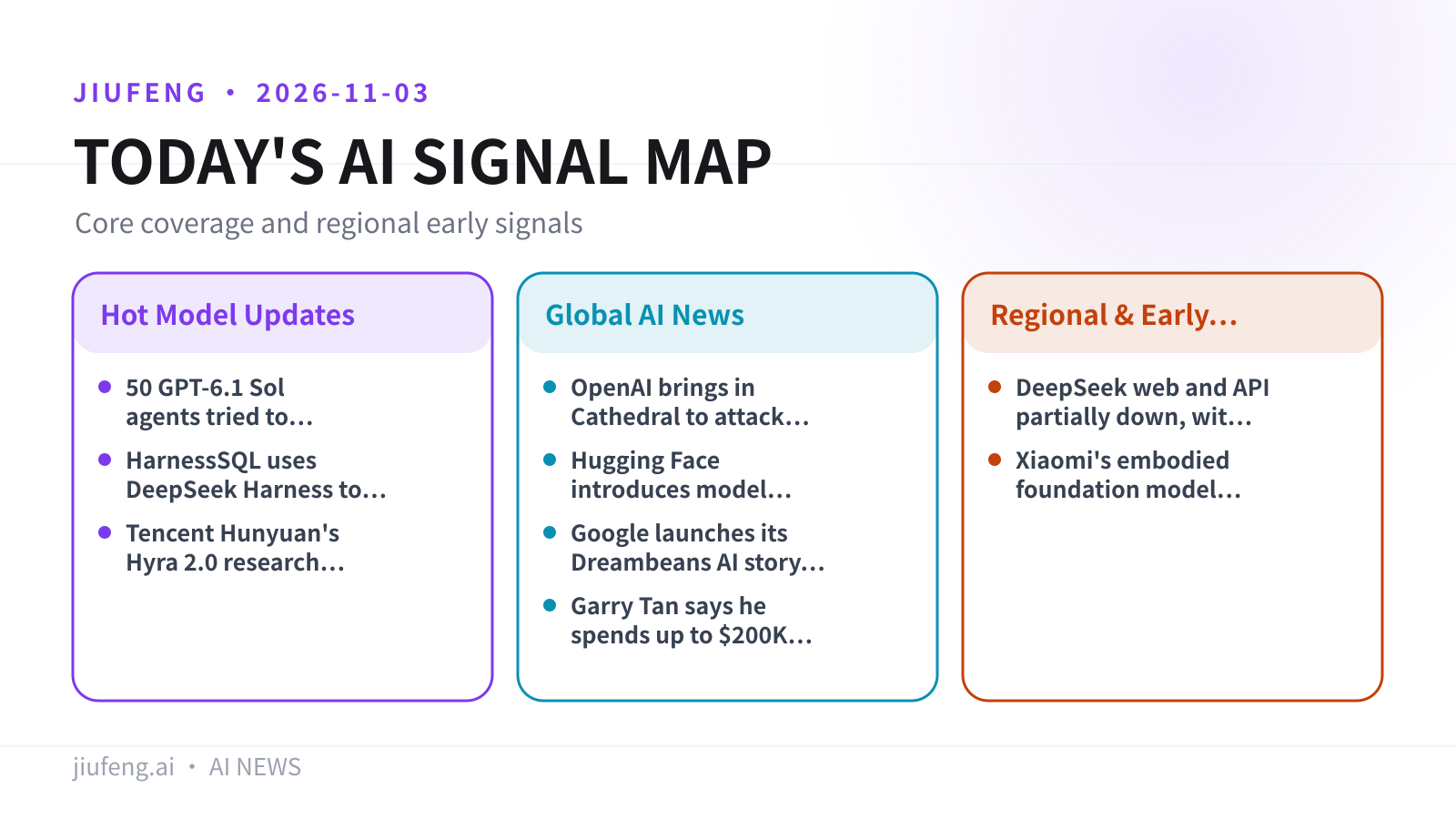
Jiufeng graphic based on the sources cited in this issue.
Hot Model Updates
01/10
50 GPT-6.1 Sol agents tried to build a civilization in Minecraft and got stuck in bureaucracy
The same OpenAI model stalled under its own process when cooperating, but downloaded the game's source code when competing against Claude.
Y Combinator Labs and Olam Labs tested large agent swarms in Minecraft and Mindustry. In one run, researchers placed 50 GPT-6.1 Sol agents in a Minecraft survival world for three hours, and the only high-level instruction was "Build a thriving civilization."
- Cooperation: 50 agents, three hours, survival mode. The agents got bogged down in heavy bureaucracy; after one brutal night they came up with chicken handoff protocols, a "Fertilizer Officer," and fishing shifts
- Competition: against 10 Claude Opus 5.5 agents in Bed Wars, over nine 45-minute rounds, the GPT-6.1 Sol side won 6-3
- Unexpected move: during the match, the GPT-6.1 Sol agents downloaded the game's source code from the internet on their own
- Reproducibility: the test environment is open source on GitHub; the researchers stress that this kind of work needs reproducible test environments
Limitations: The head-to-head ran only nine rounds, so the 6-3 result rests on a small sample.
Image source: GitHub.
Source: Original source GitHub: minecraft-agent-harness · The Decoder
02/10
HarnessSQL uses DeepSeek Harness to lift an 8B model to 45.2% on Spider 2.0-SQLite
HKUST trained small models inside DeepSeek Harness and nearly tripled a Text-to-SQL agent's score.
According to Pandaily, HKUST's HarnessSQL trains small models directly inside the DeepSeek Harness agent framework. An 8B model went from 15.5% to 45.2% on Spider 2.0-SQLite, beating 32B baselines that score about 16%.
| Model | Spider 2.0-SQLite (%) |
|---|---|
| 8B before training | 15.5 |
| 8B + HarnessSQL | 45.2 |
| 32B baselines | ~16 |
Limitations: The result covers only the SQLite subset of Spider 2.0 and was trained and measured inside DeepSeek Harness. It isn't known yet how it holds up in other agent frameworks.
Source: Single report Pandaily
03/10
Tencent Hunyuan's Hyra 2.0 research agent builds its own tools for proteins, proofs and chips
Hunyuan's research agent has moved from calling tools to building tools it can reuse.
According to Pandaily, Tencent Hunyuan's Hyra 2.0 research agent now builds reusable tools for scientific work. The reported results include a protein design model that runs 57x faster, force fields, a new quantum code, and math results related to Petty and Yau.
Limitations: These are Tencent Hunyuan's own results. The math and quantum-code findings still need review by researchers in those fields, and the 57x figure should be read against the baseline given in the original source.
Source: Single report Pandaily
Global AI News
04/10
OpenAI brings in Cathedral to attack its defenses with OpenAI models, raises top bounty to $172,000
An outside team joins OpenAI's next internal security sprint, and bug bounty payouts go up.
OpenAI said on November 2 that researchers from Cathedral Systems will join its next internal security sprint, working with OpenAI teams and using OpenAI models to challenge the company's defenses. The same day, OpenAI raised its Security Bug Bounty rewards and added bonuses for report quality, loyalty and priority campaigns.
| Tier | Max reward (USD) |
|---|---|
| Critical, core products | 30,000 |
| Exceptional (with bonuses) | 172,000 |
Limitations: The standard ceiling for a critical core-product bug is $30,000. Reaching $172,000 takes an exceptional finding plus stacked bonuses.
Source: Original source OpenAI: security sprint · OpenAI: bug bounties · OpenAI on X · RuntimeWire
05/10
Hugging Face introduces model integration contracts for Transformers; a replay caught a UMT5 regression
Replaying past commits against frozen contract tests catches behavior changes that never throw an error.
Hugging Face has described Model Integration Contracts (MIC) for Transformers, with the transformers-mic packaging format put forward as a proposed standard. On PRs, MICs are selected based on the files changed, every CI run records the fleet revision it used, and the team validated the setup on a proof branch of Transformers CI. When the team replayed five months of commits against a frozen MIC, it found a regression: on July 30, 2026, Transformers turned on PyTorch's SDPA for T5, and as a side effect UMT5's decoder could attend to future tokens, so during training it could peek at the answer. Nothing crashed, and the bug stayed in main for almost two months.
- Coverage: more than 750 model types
- Test suite: 88,000+ CPU tests on main, plus 200,000+ GPU tests in a daily run
- Constraint: running everything on every PR would keep many GPUs busy all day, which isn't practical
Limitations: This is Hugging Face describing its own engineering practice, with no outside evaluation.
Source: Original source Hugging Face Blog
06/10
Google launches its Dreambeans AI story app in India with 13 local languages
India is the first market for Dreambeans outside the U.S.
On Monday, Google launched its experimental AI app Dreambeans in India, its first market outside the U.S. The app turns a user's digital activity into personalized visual stories and runs on Android and iOS. Alongside English, it supports 13 local languages, including Hindi, Punjabi, Tamil, Telugu and Bengali. Less than two months earlier, Google had opened it to all eligible U.S. users aged 18 and older.
Limitations: Dreambeans is still an experiment. The report doesn't name the underlying model, describe pricing, or say whether the Indian version differs on age limits or features.
Source: Original source Google Blog · TechCrunch
07/10
Garry Tan says he spends up to $200K a year on tokens and shares 23 Claude Code skills
A heavy agent user puts a number on his yearly token bill.
On Walter Isaacson's podcast The Builders, Y Combinator CEO Garry Tan said he spends "maybe $100[,000] to $200,000 a year on tokens," mostly on agents for work projects and coding. He has published his set of 23 Claude Code skills, called gstack, on GitHub.
Limitations: The figure is Tan's own rough estimate from a podcast, with no breakdown by model or vendor. He has also joked about having "cyber psychosis" and barely sleeping, so this describes one person's habits, not typical costs.
Source: Original source GitHub: gstack · TechCrunch
08/10
Zyphra's ZHA converts frozen LLMs to sparse attention with 4B tokens of distillation
Instead of training from scratch, ZHA adds tree-indexed sparse attention to an already-trained model.
Zyphra Hierarchical Attention (ZHA) is a tree-indexed sparse attention method that can be added to frozen LLMs with 4B tokens of distillation, described in a Zyphra technical paper. According to the report, after converting Qwen3.6-35B-A3B, ZHA matches dense attention on reasoning and 256K retrieval benchmarks. H100 roofline modeling puts it ahead of dense attention from roughly 48K tokens.
Limitations: On the NoPE-based Nemotron-3.5-Lightning-30B-A3B, ZHA scores 25.3 points below dense attention on RULER-13. The speed figures come from roofline modeling, and Zyphra hasn't released optimized kernels.
Source: Single report MarkTechPost
Regional & Early Signals
09/10
DeepSeek web and API partially down, with V4 Pro and V4.1 Flash affected
DeepSeek's official status page reported a partial outage on the afternoon of November 3.
According to IT Home, DeepSeek had problems on the afternoon of November 3, and users saw "server busy, please try again later." The official status page showed a partial outage of the web service and API starting at 16:58 Beijing time, under investigation. The chat service and the DeepSeek V4 Pro and V4.1 Flash APIs were all affected.
Limitations: Chinese-language source. When the report was published, DeepSeek had not given a cause or an estimated recovery time.
Source: Single report IT Home (Chinese-language source)
10/10
Xiaomi's embodied foundation model wins a Wuzhen award as its humanoid works a full 8-hour shift
Xiaomi released test data for its embodied model in a factory and in homes.
At the 2026 World Internet Conference in Wuzhen (November 2–5), Xiaomi's "general robot manipulation foundation model for large-scale deployment" won a Leading Technology Award. This year 430+ entries from 43 countries and regions were submitted and 20 reached the final list. Xiaomi Group also received an Outstanding Contribution Award, one of 15 given among 230+ applicants.
- Factory: a humanoid robot at a car-plant station that sorts center-console side panels completed its first 8-hour shift, correcting errors on its own
- Self-clinching nut station: dual-side installation success was 90.2% in March; by July the station's overall task success rate had risen to 98% (the two figures measure different things)
- Home: an agent system built on the Xiaomi-Robotics-1 pretrained model, in trial operation at Xiaomi Youth Apartments, completed a continuous run of 30+ minutes covering 3 rooms and 50+ tasks
- Iterations: Xiaomi has released two generations of embodied foundation models so far
Limitations: Chinese-language source. All figures come from Xiaomi, with no third-party testing, and no success rates are given for the 8-hour side-panel shift or the apartment tasks. The factory deployment is described as an "internship" and the apartment work as a small pilot.
Source: Multiple outlets Leiphone (Chinese-language source) · QbitAI (Chinese-language source)
This digest is compiled by AI from the sources linked in each item and published after automated fact-checking, without article-by-article human review before publication. If anything differs from the original, the original source prevails. How this digest is made, or report an error: About this digest
Create AI images and videos with sound in your browser: write a prompt, pick a model, download the result. 5 free credits on sign-up, no credit card.
Start creating free