Overview
8 stories in this issue. The first 3 are today's priorities.
Popular Model Updates
- Top · Frontier model comparison: Sol and Argon list at one-fifth the price
- Top · Qwen3.8-max tops the VA-Bench robot-arm benchmark at only 53.93%
- Top · SSD streaming runs the 111GB Qwen3.8-Flash-Next on a 64GB Mac mini
Global AI News
- DHH has coding agents port Campfire to Rust
- Trump launches a "Super Intelligence Force" led by DNI Jay Clayton
- MIT report: AI is eroding office hours, study groups and faculty-student trust
Regional and Early Signals
- Huawei and Qualcomm sign their first 5G cross-license, which also covers AI
- Schneider Electric plans a $22.6 billion all-cash PTC acquisition
Popular Model Updates
01/08
Frontier model comparison: Sol and Argon list at one-fifth the price
MarkTechPost put GPT-6 Astra, GPT-6.1 Sol, Gemini 4 Argon and Claude Fable 5.1 side by side. Their benchmark scores are closer than the launch posts suggest, but price, access rules and cost per task differ sharply.
According to the article, Anthropic, OpenAI and Google DeepMind shipped these four frontier-class models within 30 days:
- Claude Fable 5.1: released September 1.
- GPT-6 Astra: released September 3. It is still OpenAI's top model.
- GPT-6.1 Sol: released September 29.
- Gemini 4 Argon: announced in late September.
- GPT-6.1 Astra: the article says OpenAI cancelled it on September 28 after it failed internal scope and authorization tests.
| Model | Input ($ per 1M tokens) | Output ($ per 1M tokens) |
|---|---|---|
| GPT-6 Astra | 10 | 50 |
| Claude Fable 5.1 | 10 | 50 |
| GPT-6.1 Sol | 2 | 10 |
| Gemini 4 Argon (intro) | 2 | 10 |
The article's verdict: Astra leads computer use, Argon leads legal and finance work, and Sol wins on price for coding agents.
Limitations: Argon's $2/$10 is an introductory price, and the article says it will double later. Some of the Argon figures come from Google DeepMind's own comparison table. Each vendor publishes its own benchmarks under different conditions, so this is not an independent head-to-head test.
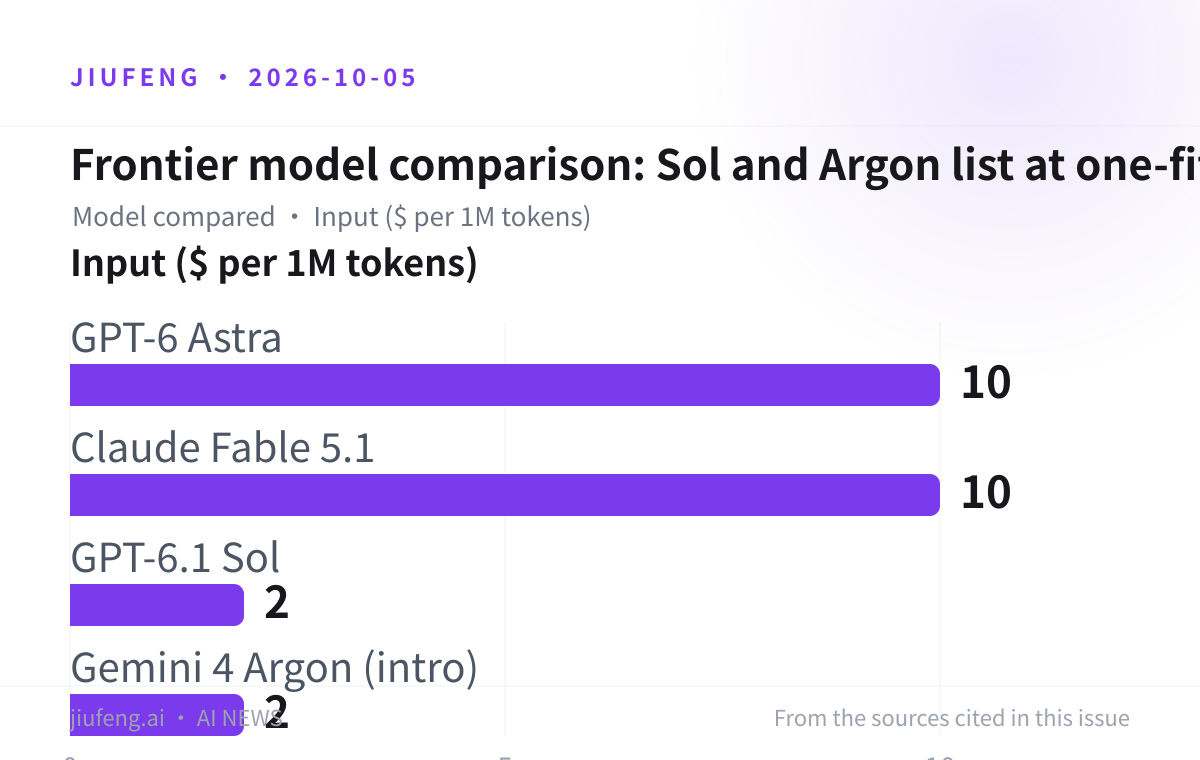
Jiufeng graphic based on the sources cited in this issue.
Image source: Google; mirrored on Jiufeng R2.
Source: MarkTechPost · Google DeepMind
02/08
Qwen3.8-max tops the VA-Bench robot-arm benchmark at only 53.93%
Dalian University of Technology's VA-Bench tested 12 multimodal model setups. Qwen3.8-max ranked first at 53.93%, and no setup completed the strict long-horizon task.
VA-Bench evaluates multimodal models on robot-arm tasks across 12 model setups. The top reported score is Qwen3.8-max's 53.93%, so even the leader completed only about half the tasks. None of the setups completed the strict long-horizon task.
Limitations: The report does not list every model tested, how many tasks there were or how they were scored. The 53.93% figure applies only to this benchmark and is not a real-world robot success rate.
Source: Pandaily
03/08
SSD streaming runs the 111GB Qwen3.8-Flash-Next on a 64GB Mac mini
A llama.cpp fork for Apple Silicon keeps MoE expert weights on SSD and loads them only when needed. With it, the 111GB Qwen3.8-Flash-Next decodes at 17.5 tokens/s on a Mac mini M5 Pro with 64GB of memory.
The model is a mixture of experts with 48 layers of 512 experts each, and each token uses only 10 experts per layer. The fork keeps the experts on SSD and reads in the ones each token needs. It holds the most-used experts in a RAM cache and keeps everything else on the GPU. Setup and results:
- Quantization: Unsloth UD-Q4_K_XL.
- Expert cache: 28 GiB.
- Storage: two SSDs, the second connected over Thunderbolt 5.
- Decode: 17.5 tokens/s over 120 real agent conversations replayed in order, 47% faster than the first setup's 11.9.
- Time to first token: 5.5 s median, down 52% from the earlier 11.4 s.
- Quality: 18 of 20 tasks passed on a fixed set.
| Prompt length (cold) | Prefill (tokens/s) |
|---|---|
| 4K | 523 |
| 32K | 430 |
| 100K | 391 |
Limitations: The author ran every test on one machine and tuned the settings for that hardware. The quality test has only 20 tasks. The author says timings affected by memory swap were discarded, so real-world use may be slower. The streaming, MTP draft head and Metal kernels build on an earlier project on Hugging Face.
Source: GitHub: Flash-next-ssd · Hugging Face: qwen38-flash-next-v3
Global AI News
04/08
DHH has coding agents port Campfire to Rust
David Heinemeier Hansson, the creator of Ruby on Rails, had coding agents port 37signals' chat app Campfire to Elixir, Go and Rust. The Rust version has much higher throughput in benchmarks, but Hansson says he never reviewed its code directly.
Hansson announced the Campfire Rust beta on September 29. In an October 4 thread on X, he said agents can now write and validate code well enough to change how people choose languages and frameworks. He said Ruby would still be his choice if he were writing code himself, but that he has not written code by hand for some time. His interest in Rust is as a "prompt compile target." The Rust repository is public.
Limitations: The throughput comparison comes from 37signals' own October benchmarks on a test machine, and the tests were small. RuntimeWire says much more evidence is needed before a fast port can be called ready for production.
Source: RuntimeWire · X: David Heinemeier Hansson
05/08
Trump launches a "Super Intelligence Force" led by DNI Jay Clayton
In a Truth Social post, Trump announced a Super Intelligence Force led by Director of National Intelligence Jay Clayton, who becomes the administration's second AI czar.
SiliconANGLE reported on October 4 that the name follows an executive order Trump signed the week before, which tells federal agencies to write "super intelligence" instead of "artificial intelligence" in official documents. Clayton told The Wall Street Journal that a report on the technology's risks and opportunities is due within 120 days. The report will also cover how the government handles disclosure of security breaches. Under its charter, the group must plan responses to "SI-enabled threats" while avoiding overregulation and regulatory capture.
Limitations: So far the only information comes from Trump's social media post and Clayton's comments to the press. The risks-and-opportunities report could take up to 120 days.
Source: SiliconANGLE
06/08
MIT report: AI is eroding office hours, study groups and faculty-student trust
A June 2026 report from an MIT expert committee says office hours, online discussions and study groups in dorms and libraries are all declining, and the school's flagship undergraduate research program is shrinking.
The committee says trust between faculty and students is breaking down. It recommends adding AI literacy to introductory courses right away and fundamentally rethinking how universities respond to AI.
Limitations: The coverage does not say how much each of these has declined. The report covers MIT only, and its findings may not apply to other universities.
Source: The Decoder
Regional and Early Signals
07/08
Huawei and Qualcomm sign their first 5G cross-license, which also covers AI
The two companies signed a long-term cross-license covering 5G, computing, AI and networking patents. Qualcomm will also buy some of Huawei's US patents in computing, AI and networking.
According to IT Home, this is the first patent license between Huawei and Qualcomm to cover 5G. Huawei says that once the deal closes, the combined value of all its patent licenses should exceed $6.9 billion. It also says its licensing business has had positive revenue since 2021. In August, Huawei announced a separate licensing deal with HP.
Limitations: Neither company disclosed this deal's value, its term or which patents are being transferred. The $6.9 billion is Huawei's expected total across all of its licenses, not the value of this deal. Chinese-language source.
Source: IT Home
08/08
Schneider Electric plans a $22.6 billion all-cash PTC acquisition
Schneider Electric will buy US industrial-software company PTC for $205 per share in cash to grow its industrial software and AI business. The deal is expected to close in Q3 2027.
- Price: about $22.6 billion in cash, or $205 per share, more than 40% above PTC's previous close.
- Financing: Morgan Stanley and Société Générale are providing bridge loans for about €22 billion of the cash price.
- Context: PTC shares fell about 30% over the past 12 months, to a market value of about $15.6 billion. In June, Schneider agreed to buy Cognite for $3.1 billion.
Limitations: The deal has not closed yet. The report does not say which regulatory approvals are needed or how much revenue PTC's AI tools generate. Chinese-language source.
Source: IT Home
Write a prompt in your browser and get an image — 1K, 2K or 4K output, up to 15 reference images. 50 free generations on sign-up, no credit card.
Generate free