Overview
8 stories in this issue. The first 3 are today's priorities.
Hot model updates
- Top · GPT-6.1 Sol Ultrafast remains pending
- Top · Gemini free users will get Flash-Lite only
- Top · Grok may enter a $200 X subscription bundle
- Claude Science creator joins OpenEvidence
- Study tests Chinese models on sensitive topics
Regional and early signals
- StartLux releases five decision-model sizes
- Google pauses OSS product-vulnerability reports
- COSMIC rejects AI-assisted code contributions
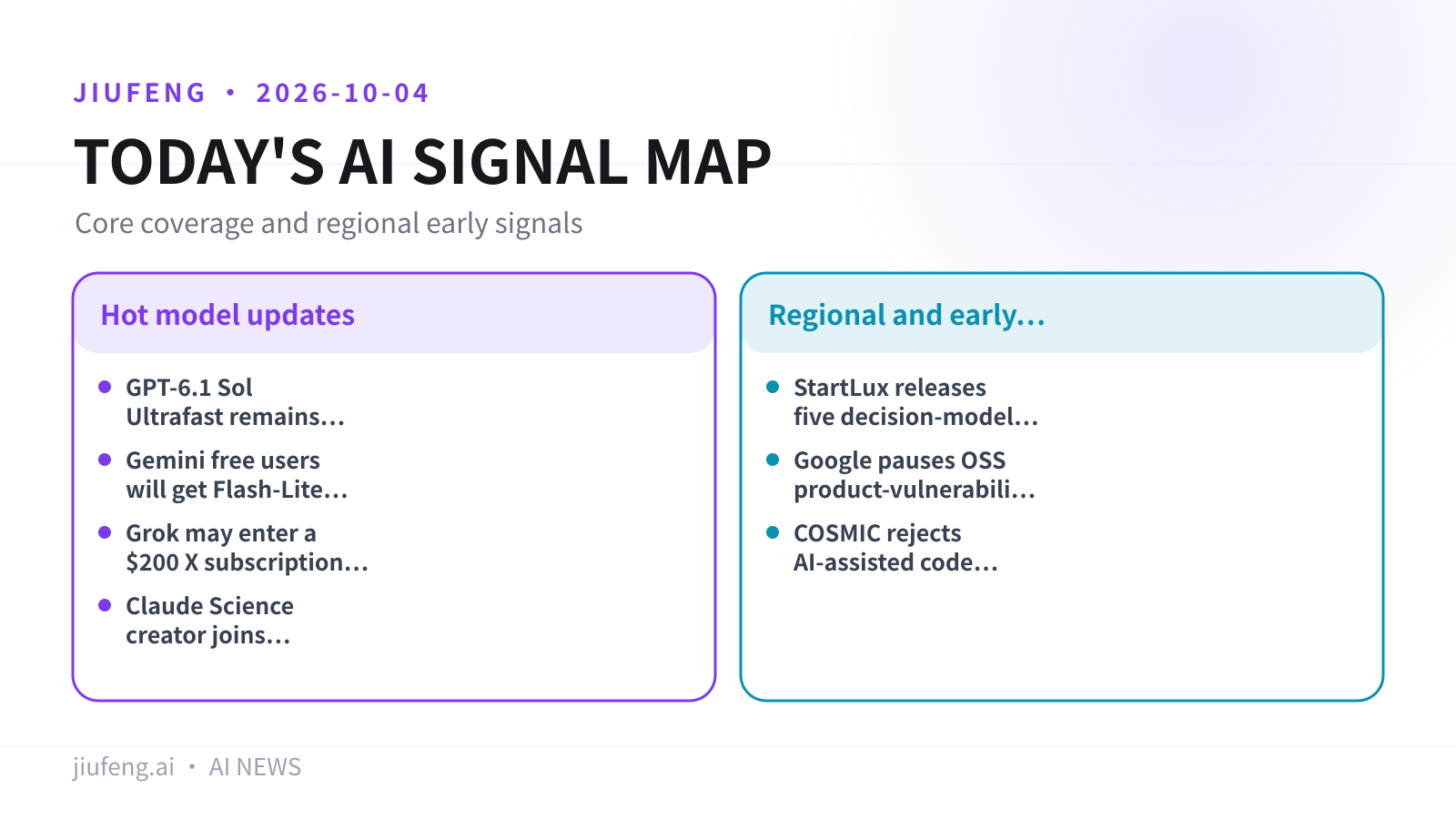
Jiufeng graphic based on the sources cited in this issue.
Hot model updates
01/08
GPT-6.1 Sol Ultrafast remains pending
OpenAI has again confirmed that GPT-6.1 Sol Ultrafast is coming, without a release date or price.
OpenAI product and engineering leader Tibo Sottiaux replied “6.1 coming soon” to a developer on October 4 in a discussion about GPT-6.1 Sol Ultrafast. GPT-6.1 Sol launched on September 29 for ChatGPT Work, Codex, and API users, with standard API pricing of $2 per million input tokens, $10 per million output tokens, and $0.10 per million cached input tokens.
Limitations: OpenAI previously said Ultrafast could generate tokens in Codex at up to eight times the standard speed, but has not published an actual release date or an Ultrafast API price.
Image source: OpenAI Developers; mirrored on Jiufeng R2.
Source: RuntimeWire · OpenAI launch post · OpenAI API documentation
02/08
Gemini free users will get Flash-Lite only
Google plans to limit free personal Gemini accounts to Flash-Lite, placing Flash and Pro behind paid plans.
The Decoder reports that Google will change its Gemini personal-account tiers from October 2026. Free users will receive Flash-Lite only; AI Plus subscribers at $4.99 per month will get Flash-Lite and Flash; Pro requires AI Pro or AI Ultra. The current free tier includes Gemini 3.6 Flash and variable access to Gemini 3.1 Pro.
| Plan | Monthly price (USD) | Models |
|---|---|---|
| No Plan | 0 | Flash-Lite |
| AI Plus | 4.99 | Flash-Lite, Flash |
| AI Pro | 19.99 | Flash-Lite, Flash, Pro |
| AI Ultra | 99.99 or 199.99 | Flash-Lite, Flash, Pro |
Limitations: The report says many casual users may not know which model they are using.
Source: The Decoder
03/08
Grok may enter a $200 X subscription bundle
A test screen recording shows X combining Grok, social subscriptions, and Cursor in a shared AI-usage pool.
RuntimeWire reports that the recorded page lists Premium, Plus, Super, and Ultra web plans from $8 to $200 per month. It also lists introductory discounts through October 9: $4 for Premium and $15 for Plus in the first month.
| Tier | Monthly web price (USD) | Annual web price (USD) |
|---|---|---|
| Premium | 8 | 80 |
| Plus | 30 | 300 |
| Super | 100 | 1,000 |
| Ultra | 200 | 2,000 |
Limitations: The recording’s author says the offer remains in development and can change. It does not specify the Cursor allowance in each tier, and app-store prices differ from web prices.
Source: RuntimeWire · X Premium FAQ
04/08
Claude Science creator joins OpenEvidence
Alec Tarashansky, a contributor to Claude Science, says he has joined OpenEvidence to work on medical AI.
Tarashansky announced the move on October 3. Claude Science, introduced by Anthropic on June 30 as a beta workbench, connects Claude with more than 60 scientific tools and data sources.
Limitations: This is a personnel move rather than a Claude Science release. The available reporting does not identify a product, launch date, or clinical validation result from Tarashansky’s new role.
Source: RuntimeWire · Anthropic Claude Science
05/08
Study tests Chinese models on sensitive topics
An Aleph Alpha benchmark rated 17% to 41% of sampled answers from several Chinese models as balanced.
The Decoder reports that the test covered 967 hand-picked topics including Tiananmen, Taiwan, and Xinjiang, and included Alibaba’s Qwen, DeepSeek, and Moonshot AI’s Kimi. Aleph Alpha’s own AI scoring system classified the remaining answers as state-doctrine repetition, deflection, or refusal; the report says DeepSeek V4 Pro refused roughly two-thirds of prompts.
Limitations: Aleph Alpha designed the benchmark and used its own AI system for scoring. The report also notes its commercial interest in sovereign AI, so the findings are not an independent comprehensive evaluation.
Source: The Decoder · Nemotron Cascade 2 paper
Regional and early signals
06/08
StartLux releases five decision-model sizes
StartLux has released open decision models from 0.8B to 27B parameters and published self-reported comparisons with Jev.
Material republished by TMTPost says StartLux-Decision is available in 0.8B, 2B, 4B, 9B, and 27B sizes, with original weights plus Q8_0, Q4_K_M, and BF16 variants. The company reports 63.88 on Decision Index 0.2.1 for its 27B model, versus 57.91 for Jev 1.13, and a 91.82% average accuracy across seven tests.
| Model size | Parameters | H200 short-request latency (ms) |
|---|---|---|
| StartLux-Decision | 0.8B | 12.2 |
| StartLux-Decision | 2B | 15.5 |
| StartLux-Decision | 9B | 35.7 |
| StartLux-Decision | 27B | 102.3 |
Limitations: Chinese-language source. The benchmark and latency figures are company-reported or self-tested, using a September 28 public leaderboard snapshot for comparison, with no independent validation in the available material.
Source: TMTPost
07/08
Google pauses OSS product-vulnerability reports
Google stopped accepting product-vulnerability reports through its OSS VRP on October 1, amid reporting about invalid AI-generated submissions.
ITHome says reports submitted before October 1 are unaffected. Product vulnerabilities in some Google Cloud repositories may still be accepted through Cloud VRP. The report, citing Tom’s Hardware, says maintainers had been overwhelmed by thousands of low-quality reports that proved to be non-exploitable AI hallucinations.
Limitations: Chinese-language source. The claimed scale of AI-generated invalid reports comes from sources cited by the report, not a quantified Google statement; Google plans to announce OSS VRP restructuring progress in the first quarter of 2027.
Source: ITHome
08/08
COSMIC rejects AI-assisted code contributions
System76 has updated the COSMIC PR template to require contributors to confirm that submissions contain no AI-generated code, comments, or descriptions.
ITHome reports that the rule applies to System76’s Rust-based COSMIC desktop environment. It says cosmic-flatpak is the only System76 repository exempted from the “No LLM contributions” rule.
Limitations: Chinese-language source. This is a contribution policy for one open-source project, not a general technical finding about AI-assisted code; the available material provides no submission, rejection, or maintenance-workload data.
Source: ITHome
Write a prompt in your browser and get an image — 1K, 2K or 4K output, up to 15 reference images. 50 free generations on sign-up, no credit card.
Generate free