Overview
9 stories in this issue. The first 3 are today's priorities.
Hot model updates
- Top · Claude generates ~180M lines of formal proofs for 123 open-source libraries
- Top · MiniMax opens M3.1 Flash weights, with day-0 vLLM support
- Top · Microsoft trains Qwen3.8-27B on 187 tasks, lifting average success 9.08 points
- Modder says OpenAI Codex helped build a Switch 2 jailbreak
Global AI news
- Google Cloud launches Agent Compute Engine: one microVM per AI agent
- Cerebras explains how it splits the ~3T-parameter Kimi K3 across wafers
- Amazon Polly upgrades its Generative engine and adds 14 voices
Regional and early signals
- Kimi teases K3.1, and code points to a new "medium" reasoning level
- Qwen says complex-task token use grew 1.6× in three months as Qwen Go! tests "My Apps"
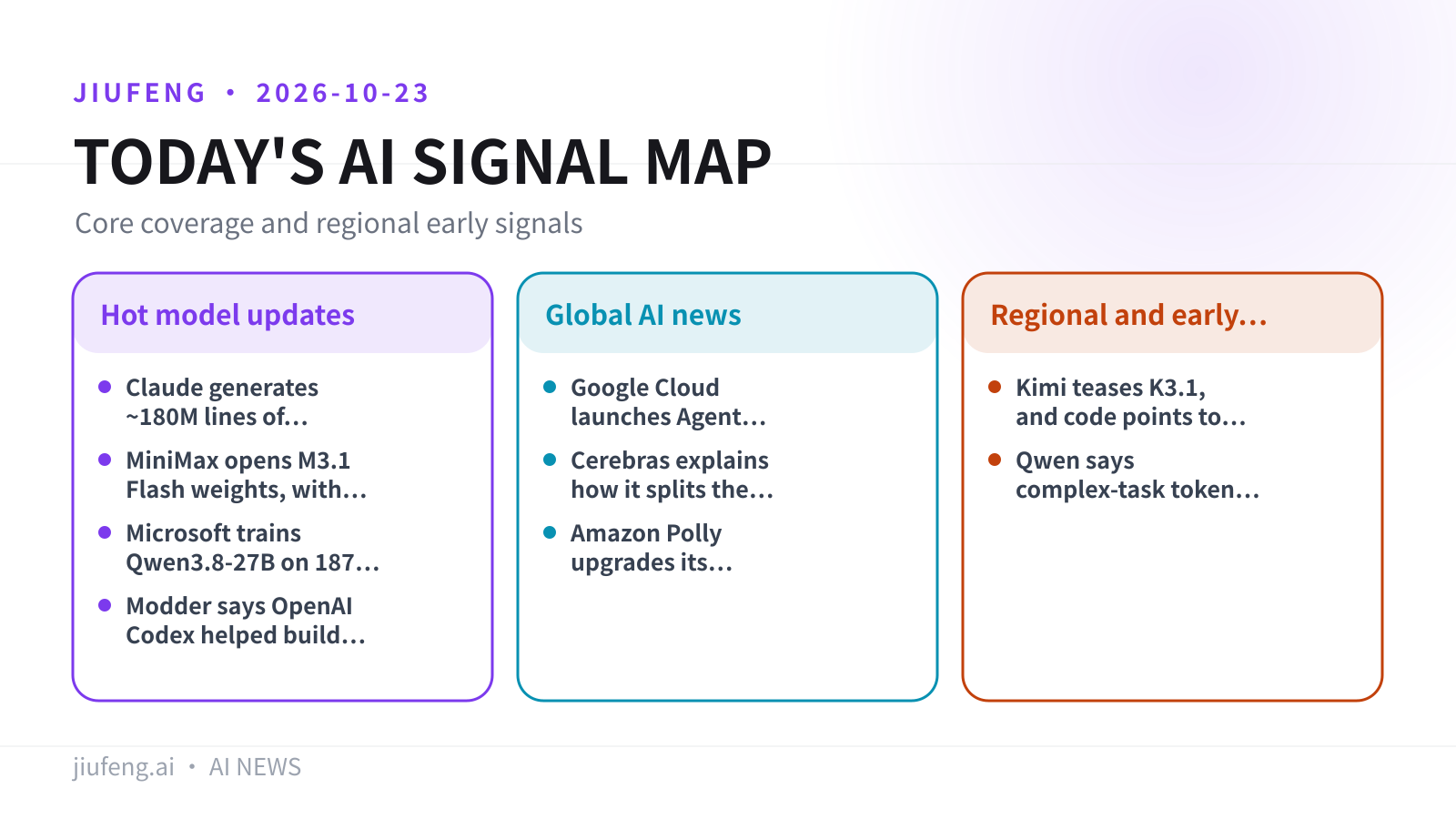
Jiufeng graphic based on the sources cited in this issue.
Hot model updates
01/09
Claude generates ~180M lines of formal proofs for 123 open-source libraries
Anthropic had Claude write formal proofs that existing code is correct. Over a few weeks it produced about 180 million lines of proof code and found hundreds of bugs that conventional testing had missed.
Anthropic's Frontier Red Team ran the project with partner Theorem. Claude did the proof writing, replacing human specialists.
- Scale: roughly 180 million lines of mathematical proof code across 123 open-source libraries
- Time: a few weeks
- Inputs: test programs for those libraries from Google's OSS-Fuzz
- By-product: hundreds of bugs that conventional testing had missed
- Context: per The Decoder, formally verifying the small seL4 kernel by hand took 20 person-years, which is why the method has been limited to extreme cases such as Airbus avionics software
Anthropic says it wants AI-driven formal verification to become as routine as standard testing.
Limitations: The project verified existing open-source code. The Decoder notes that the approach "comes with strict practical limits": compute costs are high, with a single proof consuming hundreds of millions of tokens, and total project costs were not reported. The report does not name the Claude version used.

Image source: anthropic; mirrored on Jiufeng R2.
Source: The Decoder · Anthropic Frontier Red Team · OSS-Fuzz
02/09
MiniMax opens M3.1 Flash weights, with day-0 vLLM support
M3.1 Flash launched on October 19 and its weights opened on October 23. Together AI is offering hosted inference, and vLLM shipped dedicated kernels for Blackwell, Rubin and MI350 on day 0.
Alongside the open weights, MiniMax added production inference through Together AI, so developers can use a hosted version instead of managing their own GPUs. Together AI's model page says the weights are released under the MiniMax Community License. According to vLLM, the model natively uses an NVFP4 KV cache and NVFP4-quantized MoE weights, and it ships with a DSpark draft model for speculative decoding.
Kernel-level speedups reported by vLLM:
| Optimization | Gain |
|---|---|
| Indexer QK decode | up to 1.7× |
| Sparse attention decode | 1.3× |
| MegaMoE prefill latency | 20% lower |
| MegaMoE prefill throughput | 7% higher |
| Indexer at 512K (4×GB300) | up to 3.3× |
| QKV fusion prefill (≥512) | 1.1–1.6× |
Limitations: These are vLLM's own measurements for individual kernels or pipeline stages, not end-to-end throughput. The weights use MiniMax's own community license rather than a general open-source license such as MIT or Apache.
Source: RuntimeWire · MiniMax on X · Together AI · vLLM Blog · vllm-project/MSA
03/09
Microsoft trains Qwen3.8-27B on 187 tasks, lifting average success 9.08 points
In an experiment with Hugging Face, Microsoft based reinforcement-learning rewards on the database state an agent leaves behind. Training Qwen3.8-27B this way raised average success by 9.08 percentage points.
The method turns database grading into RL rewards: after an agent finishes a task, executable checks verify the actual state it left in the database.
- Base model: Qwen3.8-27B
- Training: 187 tasks, rewarded by executable checks
- Evaluation: 507 benchmark tasks, average success up 9.08 percentage points
- Authors: Microsoft applied scientist Tuhin Kundu and collaborators
Limitations: The model became more consistent but covered less ground: it solved at least one attempt on 7 fewer tasks than before training.
Source: RuntimeWire · Hugging Face Blog
04/09
Modder says OpenAI Codex helped build a Switch 2 jailbreak
Sammy Hajhamid ("pepsipu") released "ns2jb," a Switch 2 jailbreak he says OpenAI's Codex helped make, and showed a modded Mario Kart World running on the console.
ns2jb is a software-only, tethered jailbreak: it has to be re-run from the game SmileBASIC 4 every time the console is turned on. The demo added playable characters to Mario Kart World, including Cinnamoroll, the red Angry Bird, Peter Griffin and Minecraft's Steve.
Limitations: The Verge says the Switch 2 has "apparently" been jailbroken, and Reddit users are still debating how significant the jailbreak is. Codex's exact contribution is described only by the author.
Source: The Verge · pepsipu on X
Global AI news
05/09
Google Cloud launches Agent Compute Engine: one microVM per AI agent
Each agent session gets its own hardware-isolated microVM, and the sandbox holds no credentials. The service already powers Gemini for work tasks.
Google unveiled Agent Compute Engine (ACE) at AGNTCon + MCPCon.
- Isolation unit: one microVM per session, with its own guest kernel, root access and Hyperdisk
- Hardware: Google-managed hosts using Titan silicon and the Titanium IPU
- Idle handling: idle agents are checkpointed down to zero active resources and resumed from snapshots
- Open-source sibling: Agent Substrate runs on any Kubernetes cluster and works with harnesses including Claude Code, OpenClaw and Hermes
Limitations: The ACE customer preview is still months away, and Google has not published boot-time or density figures.
Source: MarkTechPost · agent-substrate/substrate
06/09
Cerebras explains how it splits the ~3T-parameter Kimi K3 across wafers
A single WSE-3T wafer has only 44 GB of on-chip memory, so Cerebras splits trillion-parameter models across multiple wafers and runs them at 1,000–2,000+ tokens per second.
Cerebras uses the open-source Kimi K3 as its example. K3 has about 3T parameters, with 69 linear-attention layers and 24 dense layers. The post covers three things: fitting the full model into on-chip memory, mapping it across chips, and handling many concurrent requests. It lists these K3 scores:
| Benchmark (%) | Kimi K3 | GPT-5.6 Sol |
|---|---|---|
| Terminal-Bench 2.1 | 88.3 | 88.8 |
| BrowseComp | 91.2 | 90.4 |
Limitations: This is a Cerebras vendor blog, and the deployment speeds are the company's own figures.
Source: Cerebras · Kimi K3 blog
07/09
Amazon Polly upgrades its Generative engine and adds 14 voices
The upgraded Polly Generative engine is now generally available. Existing apps need no code changes because voice names and API calls stay the same.
The upgrade adds 14 new voices across 9 locales, and Generative voices in Hindi and Finnish are generally available for the first time. AWS positions Polly for contact centers, LLM-based agent applications, media and entertainment, e-learning and accessibility.
Limitations: AWS says the new voices are "more expressive, more accurate" with low latency, but it gives no quantified metrics. It only provides sample audio for listeners to compare.
Source: AWS Machine Learning Blog
Regional and early signals
08/09
Kimi teases K3.1, and code points to a new "medium" reasoning level
Kimi's official account posted a 24-second teaser on October 23 showing "Model: Kimi K3.1" in the Kimi Code interface. No release date has been announced. (Chinese-language source)
IT Home lists the earlier clues. In September, a "kimi-k3-1" identifier appeared in Moonshot's API registry, and the open platform previewed a model with a 1M-token context. On October 19, an SGLang commit added K3.1 chat-encoder support with 107 test cases. According to a compilation by Zhixingxing, K3.1 adds a medium level to the existing low, high and max reasoning levels, with max still the default. Its tokenizer is byte-identical to K3's and keeps the same 16 special tokens.
Limitations: The SGLang commit only tests encoding compatibility, not performance. Front-end markers such as "make3d" and "OK_COMPUTER_SWARM" have not been confirmed by Moonshot. These details come from third-party compilations, and the story so far has a single Chinese-language source.
Source: IT Home (Chinese-language source)
09/09
Qwen says complex-task token use grew 1.6× in three months as Qwen Go! tests "My Apps"
At the 2026 China National Computer Congress, Qwen AI algorithm lead Jiang Guanjun described Qwen's Personal Agent framework, built on models, memory and ecosystem. Qwen Go! has opened an invite-only test of no-code app building. (Chinese-language source)
Jiang said Qwen mapped user needs across more than 30 major industries and broke them down into more than 8,000 atomic model-capability requirements, with industry experts helping evaluate the model. Its memory system stores and retrieves information in tiers based on how strongly events are related. Over the past three months, average token use on complex tasks grew 1.6×. The new "My Apps" feature lets users build apps for daily life, work and study by describing what they need, with no coding.
Limitations: These figures come from Qwen's own conference talk and have not been independently verified. "My Apps" is invite-only for now.
Write a prompt in your browser and get an image — 1K, 2K or 4K output, up to 15 reference images. 50 free generations on sign-up, no credit card.
Generate free