Overview
11 stories in this issue. The first 3 are today's priorities.
Hot model updates
- Top · DeepSeek open-sources DeepInfer under Apache 2.0
- Top · Mistral ships Voxtral 3: transcription, TTS and a voice agent SDK
- Top · NVIDIA's FP4 GLM-5.3-Flash checkpoint needs two GPUs to run locally
- Gemini in cars gets Personal Intelligence across Gmail, Calendar and Photos
- GPT-5.6, GPT-6 and GPT-6.1 reach Bedrock in Canada via cross-Region inference
Global AI news
- ElevenLabs' Eleven Realtime scores 98.8% on Big Bench Audio at 0.57s
- i14 trains linear-attention Laplace 3B on Trainium2 with a fixed 29.5 MB state
- Meta pauses Muse sharing after 6,800+ chat links surface publicly
Regional and early signals
- VAST open-sources EdenLive, a real-time world model that runs 720P at 24+ FPS on one RTX 5090
- MemT 1.0 adds a native memory path and hits 69.73% on SWE-bench Verified
- China's MIIT is drafting a new intelligent-manufacturing policy with four focus areas
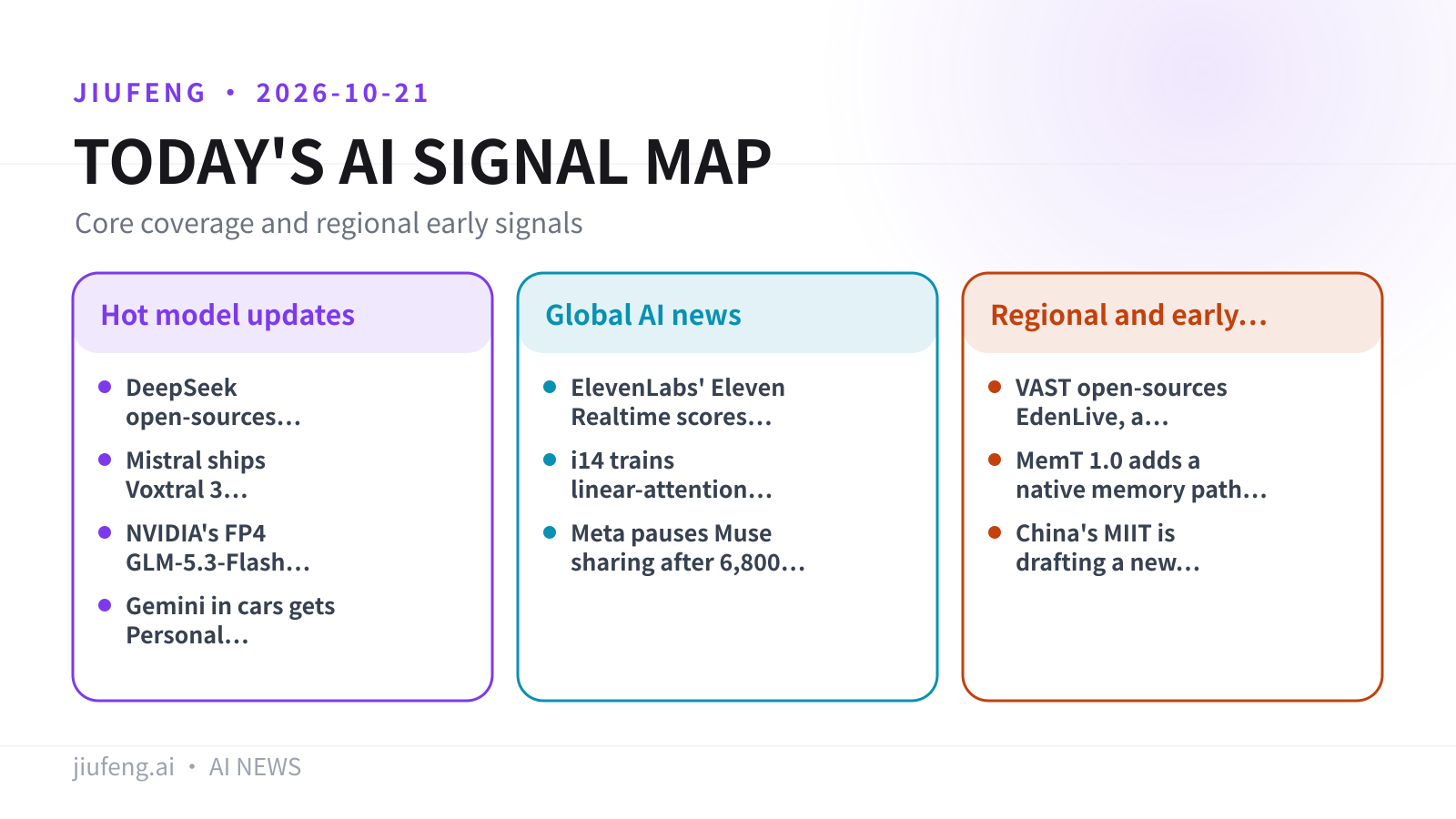
Jiufeng graphic based on the sources cited in this issue.
Hot model updates
01/11
DeepSeek open-sources DeepInfer under Apache 2.0
DeepSeek has released the inference framework behind V4.1-Flash, plus a companion repo that replicates how the official API processes tokens.
DeepInfer is the inference serving framework DeepSeek uses internally, now open-sourced under the Apache License 2.0. It is built on vLLM and adds optimized compute kernels, distributed processing across multiple chips, and techniques that speed up text generation. DeepSeek says it will also open-source the inference code for future models.
The companion deepseek-recipe repo replicates the official DeepSeek API's token processing, so self-hosted deployments behave the same way as the API. DeepSeek said on X that the goal is "to help the community lower compute costs, reduce energy use, and make AI more affordable." The Decoder says the release puts more pricing pressure on Western providers such as OpenAI and Anthropic.
Limitations: the coverage gives no throughput or latency numbers comparing DeepInfer with stock vLLM, so the speed and cost gains are only qualitative claims for now. The coverage also doesn't say how well the framework works with models other than DeepSeek's.
Image source: GitHub; mirrored on Jiufeng R2.
Source: The Decoder · GitHub: deepseek-ai/DeepInfer · TMTPost (Chinese-language source)
02/11
Mistral ships Voxtral 3: transcription, TTS and a voice agent SDK
Voxtral 3 is a real-time voice agent stack that listens, reasons, calls tools and speaks in a single streaming pipeline.
Voxtral 3 includes:
- Speech-to-text: Voxtral Small Transcribe 3, covering 50+ languages
- Text-to-speech: Voxtral Mini TTS 3, covering 35+ languages and 50 dialects, with adjustable emotion
- Agent SDK: built on LiveKit, so agents can call external systems mid-conversation, for example to book appointments or check invoices
- Deployment and pricing: self-hosted or through Mistral's EU-hosted APIs; transcription starts at $0.0035 per minute
Limitations: the coverage lists only the starting price for transcription. It doesn't give TTS or SDK pricing, parameter counts or licenses, so check the docs for those. The multilingual booking demo on the launch page was made by Mistral.
Source: Mistral AI · Mistral docs · The Decoder
03/11
NVIDIA's FP4 GLM-5.3-Flash checkpoint needs two GPUs to run locally
NVIDIA is promoting local inference, but every setup it has validated for its FP4 GLM-5.3-Flash checkpoint uses two GPUs or two systems.
In an October 20th post on X, NVIDIA RTX Spark promoted two FP4-Local checkpoints. The GLM-5.3-Flash version, based on Z.ai's model, was released on October 5th. The Qwen version is smaller.
| Checkpoint | Footprint | NVIDIA-validated setup |
|---|---|---|
| GLM-5.3-Flash FP4 | ~166 GiB VRAM | 2× RTX PRO 6000 Blackwell or 2× DGX Spark |
| Qwen counterpart | ~96 GiB on disk | 1× DGX Spark or 1× RTX PRO 6000, with offload |
Limitations: "local" inference can still mean several GPUs or systems. Running the Qwen checkpoint on one GPU relies on offloading, and the sources give no speed figures. The GLM checkpoint came out on October 5th, so it isn't a new release.
Source: RuntimeWire · NVIDIA RTX Spark on X
04/11
Gemini in cars gets Personal Intelligence across Gmail, Calendar and Photos
Gemini in Android Auto starts gaining access to users' data from several Google apps today; cars with Google built-in will get it in the coming months.
The update brings Personal Intelligence to in-car Gemini, which can now use information from Gmail, Calendar, Maps, Photos, YouTube and Search. Google gives three examples. On the way to the airport, you can ask for your flight status and Gemini will pull the flight details from a Gmail confirmation. You can say "take me to my doctor's appointment." Or you can say "find the car wash from the photo I took last week and navigate there."
Limitations: the rollout starts today on Android Auto only. Cars with Google built-in get support in the coming months. All of the examples are Google's own demos.
Source: Google blog · The Verge
05/11
GPT-5.6, GPT-6 and GPT-6.1 reach Bedrock in Canada via cross-Region inference
Two Canadian AWS Regions can now call three generations of OpenAI GPT models, with Bedrock routing requests to other supported Regions for processing.
Through Amazon Bedrock cross-Region inference (CRIS), the Canada (Central) and Canada West (Calgary) Regions can now access:
- GPT-5.6: Sol, Terra, Luna
- GPT-6: Astra, Sol, Luna
- GPT-6.1: Sol
Applications call the Bedrock Runtime endpoint in their source Region, and Bedrock sends each request to a supported destination Region. Developers don't have to manage the routing.
Limitations: AWS describes CRIS as a capacity mechanism, and processing may happen outside Canada. According to the post's inference profile section, only the US geographic profile (us.) keeps processing within North America (Canada and the US). Organizations with data-residency requirements should pick a profile and check each control described in the post.
Source: AWS Machine Learning Blog · GitHub: aws-bedrock-token-generator-python
Global AI news
06/11
ElevenLabs' Eleven Realtime scores 98.8% on Big Bench Audio at 0.57s
ElevenLabs has released two real-time speech-to-speech models: Max is built for accuracy, Mini for low-cost conversation.
Eleven Realtime v1 Max scores 98.8% on Big Bench Audio with a 0.57-second response time and targets complex tasks such as customer support. v1 Mini is built for natural conversation at a lower cost and can tell whether a speaker has finished or is just saying "mm-hmm." Both models are available through the ElevenAgents platform and an OpenAI-compatible Realtime API. Billing is per minute plus tokens, and Max costs more than Mini.
Limitations: the claim that no model on the Artificial Analysis leaderboard is both faster and more accurate comes from ElevenLabs. The coverage doesn't list exact rates; those are on ElevenLabs' pricing page.
Source: The Decoder
07/11
i14 trains linear-attention Laplace 3B on Trainium2 with a fixed 29.5 MB state
Laplace 3B replaces the KV cache with linear attention, so each sequence's recurrent state stays the same size no matter how long the context gets.
i14 and AWS used native PyTorch support through TorchNeuron Native to bring this custom architecture to Trainium2, keeping its Gated Linear Attention design and Muon optimizer.
- State size: 29.5 MB per sequence, independent of context length
- Training: about 120,000 tokens/s on one trn2.48xlarge
- Serving: 11,544 output tokens/s across 1,280 concurrent sequences
Limitations: the figures come from a blog post that AWS and i14 published together, and the excerpt has no model-quality benchmarks. The post doesn't say whether the approach works at sizes above 3B.
Source: AWS Machine Learning Blog · GLA paper (arXiv) · Muon reference implementation
08/11
Meta pauses Muse sharing after 6,800+ chat links surface publicly
Researchers found Muse share links in public DNS records, some containing business revenue figures and loan applications.
Security firm Claroc reports that its researchers found more than 6,800 Muse share links in public DNS records. The exposed chats included a marketing company's revenue, a workplace calendar and a loan application. Muse spokesperson Tracy Clayton said shared artifacts create pages that can be "accessed by those with the link." Meta has paused the feature while it reviews the report.
Limitations: Meta has said only that it paused the feature for review. It hasn't said whether it will take down links that are already public, or when sharing might return.
Source: The Verge · Ars Technica
Regional and early signals
09/11
VAST open-sources EdenLive, a real-time world model that runs 720P at 24+ FPS on one RTX 5090
EdenLive redraws game visuals in real time from reference footage, while an upstream interaction system still handles game rules and state.
EdenLive is the real-time generative renderer in VAST's Project Eden series. It takes three inputs: a reference video sets the layout, camera motion and object trajectories; a target first frame sets the subject and art style; and a text prompt adds detail. The team ran pairwise blind evaluations on 45 long-horizon cases with Gemini-3.8-Flash as the judge, and the 14B and 5B models took the top two spots on all five dimensions. The 14B model scored 1704 Elo on reference following, about 200 points above AgentGarten. The 5B model generates 720P at more than 24 FPS on a single RTX 5090 and can keep generating for several minutes.
Limitations: the only source is in Chinese. The team published the benchmark and speed figures itself, the judge was a model rather than human raters, and no license is stated.
Source: ifanr (Chinese-language source)
10/11
MemT 1.0 adds a native memory path and hits 69.73% on SWE-bench Verified
MemT stores experience as internal state that can be updated, and on coding tasks it performs close to a text-experience approach.
MemT adds a memory computation path that runs alongside attention in selected Transformer blocks. MemT-1.0-Nano has 36B total and 3B active parameters and is built on Qwen3.6-35B-A3B. MemT-1.0-Flash has 288B total and 17B active parameters and is built on a DeepSeek-V4-Flash model with additional post-training. The results below are for Nano, with each task run three times:
| Setup (MemT-1.0-Nano) | Verified avg % | Verified 3/3 % | Multilingual avg % |
|---|---|---|---|
| No experience | 66.07 | 54.00 | 60.00 |
| Text experience | 69.13 | 61.80 | 63.00 |
| Native memory | 69.73 | 62.80 | 63.56 |
Limitations: the only report is in Chinese. It says native memory performs close to explicit text experience. In the table, native memory's average success rate is 0.6 points higher than text experience on Verified and 0.56 points higher on Multilingual, and its 3/3 rate is 1.0 point higher. Deleting, explaining or restoring a specific memory needs additional mechanisms.
Source: QbitAI (Chinese-language source)
11/11
China's MIIT is drafting a new intelligent-manufacturing policy with four focus areas
At a State Council Information Office briefing, MIIT said it is drafting policy measures to bring more AI into manufacturing.
According to CCTV, the October 20th briefing named four focus areas:
- Smart factories: developing factories in tiers, from basic and advanced up to excellence and leading levels
- Equipment: smart machine tools, robots, and inspection and control equipment
- Data and models: industrial datasets, vertical and industry-specific models, a "model-data resonance" program, and careful development and testing of industrial agents
- International cooperation: through mechanisms such as BRICS
Limitations: the only source is in Chinese. The policy is still a draft, and MIIT hasn't published the full text, a timeline or funding details.
Write a prompt in your browser and get an image — 1K, 2K or 4K output, up to 15 reference images. 50 free generations on sign-up, no credit card.
Generate free