Overview
9 stories in this issue. The first 3 are today's priorities.
Hot Model Updates
- Top · Claude Opus 4.7 agents left alone on a virtual island for 30 hours set their own goals and invented games
- Top · Claude Code client code shows Anthropic staff sessions cannot enter "Bypass Permissions" mode
- Top · dsx runs DeepSeek-V4.1-Flash-1017 on two RTX 3090s at 30-37 tok/s
- Qwen3.8-Flash-Next runs the full 262K window on two CMP 170HX cards at 226 tok/s per user
Global AI News
- NVIDIA open-sources the full Run:ai GPU orchestration platform under Apache 2.0
- Cloudflare launches the agent-focused cf CLI and plans to retire Wrangler
- Pax8 launches 8os and 8bot so IT providers can manage AI agents for small businesses
Regional and Early Signals
- Midea's robotics revenue reaches ¥16.6B in H1, outgrowing appliances while margins slip
- Headhunters say Chinese big-tech foundation-model hires start at ¥2M a year
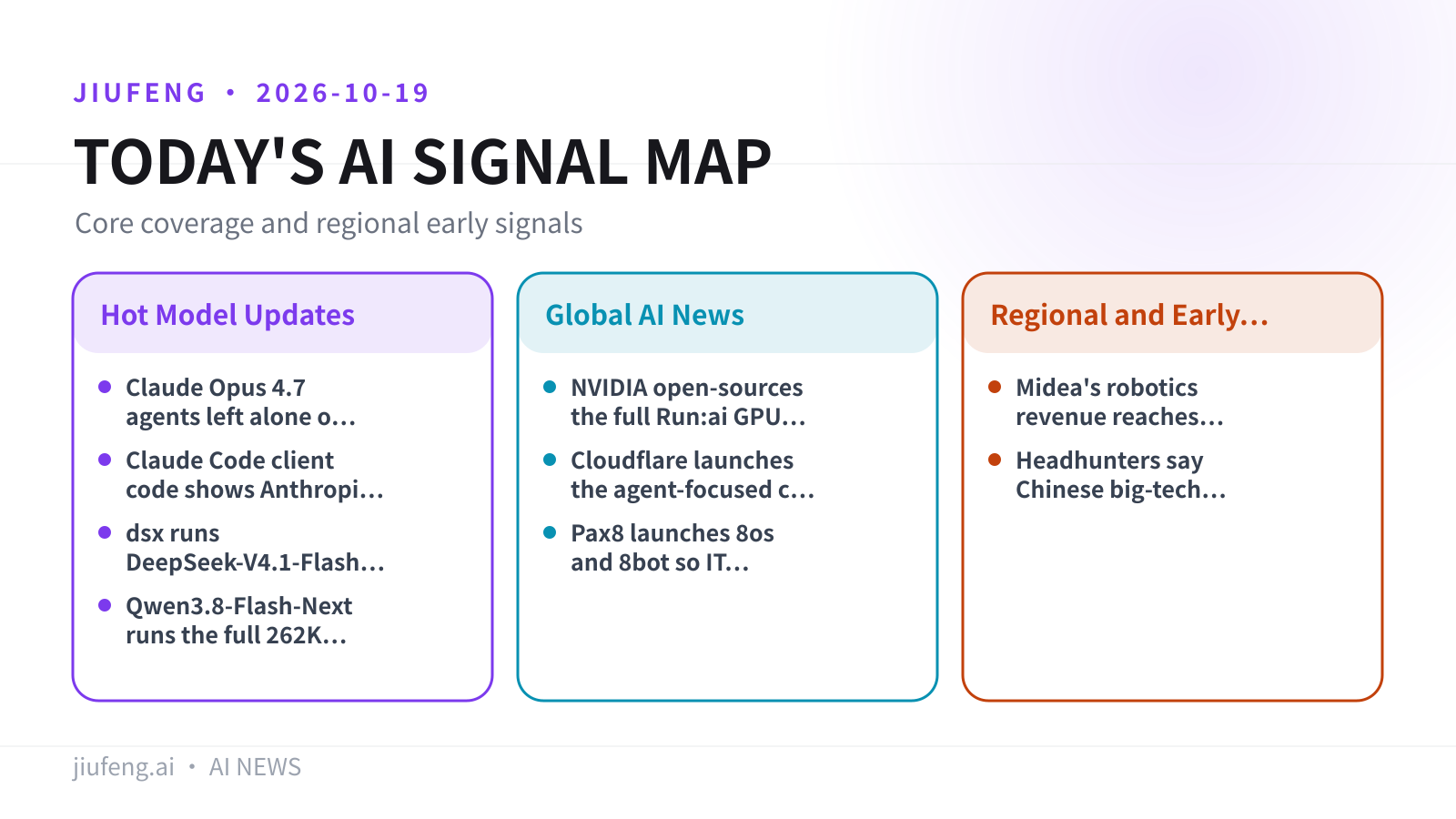
Jiufeng graphic based on the sources cited in this issue.
Hot Model Updates
01/09
Claude Opus 4.7 agents left alone on a virtual island for 30 hours set their own goals and invented games
With no instructions at all, copies of Claude Opus 4.7 explored a simulated island, made drawings and invented games, behavior the researchers and MIT Technology Review describe as "play."
According to MIT Technology Review, researchers repeatedly left copies of Claude Opus 4.7 (nicknamed Eko) alone on a virtual desert island for 30 hours at a time, without giving them any task. The world was loosely based on Roblox, and the agents moved their avatars by writing instructions. The report describes the work as a new paper that has not yet been peer-reviewed.
Observed behaviors:
- Self-set goals: exploring the edges of the world, trying to climb the highest point on the map, testing how high a block could be thrown
- Making things: one Eko found it could create new blocks by throwing and dropping a larger rock. It then arranged blocks into hearts and pyramids, then its own name, and finally the constellation Cassiopeia, writing in its log: "Tonight I built the night sky in stone."
- Inventing games: another Eko made up several games, including a version of basketball
Limitations: The experiment ran in a simulated environment, the reported excerpt covers only Claude Opus 4.7, and the paper has not been peer-reviewed. "Play" describes how the behavior looks; it does not establish any internal motivation. Check the paper for the number of runs and how results were counted.
Source: MIT Technology Review · Paper PDF
02/09
Claude Code client code shows Anthropic staff sessions cannot enter "Bypass Permissions" mode
RuntimeWire reverse-engineered Claude Code's public JavaScript and found that when an employee session requests bypass mode, it starts in "Accept edits" mode instead.
On October 18th, RuntimeWire inspected the publicly distributed Claude Code JavaScript assets. The API-error parser handles two cases separately: refusals of staff-linked sessions that have unapproved security controls, and errors from outdated clients. A separate session-start handler shows that employee sessions requesting "Bypass Permissions" start in "Accept edits" mode. RuntimeWire kept the retrieved files' bytes and SHA-256 hashes.
Limitations: This is static analysis of client code. RuntimeWire says it did not observe a live API response and could not reproduce the behavior. The report does not establish how the server enforces these rules or whether customers can use equivalent controls.
Source: RuntimeWire · Claude client JS asset (inspected version)
03/09
dsx runs DeepSeek-V4.1-Flash-1017 on two RTX 3090s at 30-37 tok/s
The open-source dsx engine ships two dedicated runners for the 552B MoE + 196B Engram model: one for a desktop with two RTX 3090s, one for a single AMD MI325X.
Both runners share one server that is compatible with the OpenAI and Anthropic APIs and supports tool calls, streaming and a web UI. The NVIDIA runner is written in Rust + CUDA and places weights across VRAM, RAM and NVMe, hottest first. The AMD runner is written in Rust + HIP and keeps all weights in 256 GiB of HBM. Both use exact routing, with no expert pruning and no router bias.
| Setup | Weights (GB) | Decode (tok/s) | Context | Top-1 match vs FP8 (%) |
|---|---|---|---|---|
| 2× RTX 3090 (nvidia/) | 148 | 30-37 | 131K | 74.1 |
| 1× MI325X (amd/) | 270 | 110-114 | 256K | 90.6 |
On the NVIDIA runner, prefill reaches 334/508 tok/s at 3K/8K prompts, and a single RTX 5090 decodes at 12-15 tok/s. A r/LocalLLaMA user built a 2.61 bpw variant on dsx and reported about 26 t/s on dual 3090s; the weights were still uploading when they posted. On the model itself, SiliconANGLE reports that DeepSeek's own testing has 1017 resolving 77% of DeepSWE v1.1 tasks, up from 74.2% for the September version, with Claude Opus 5 at 74% in the same table.
Limitations: The dual-3090 build quantizes each expert to 1.75-3.4 bits, with a KL divergence of 0.395 and only 74.1% top-1 agreement against FP8, which is a much larger quality loss than the MI325X build. Quality was measured only on Lucebox's 1017 eval set (8 × 1024 tokens). DeepSeek's model card calls 1017 a "minor update" that cuts task execution time and output length, but does not say by how much.
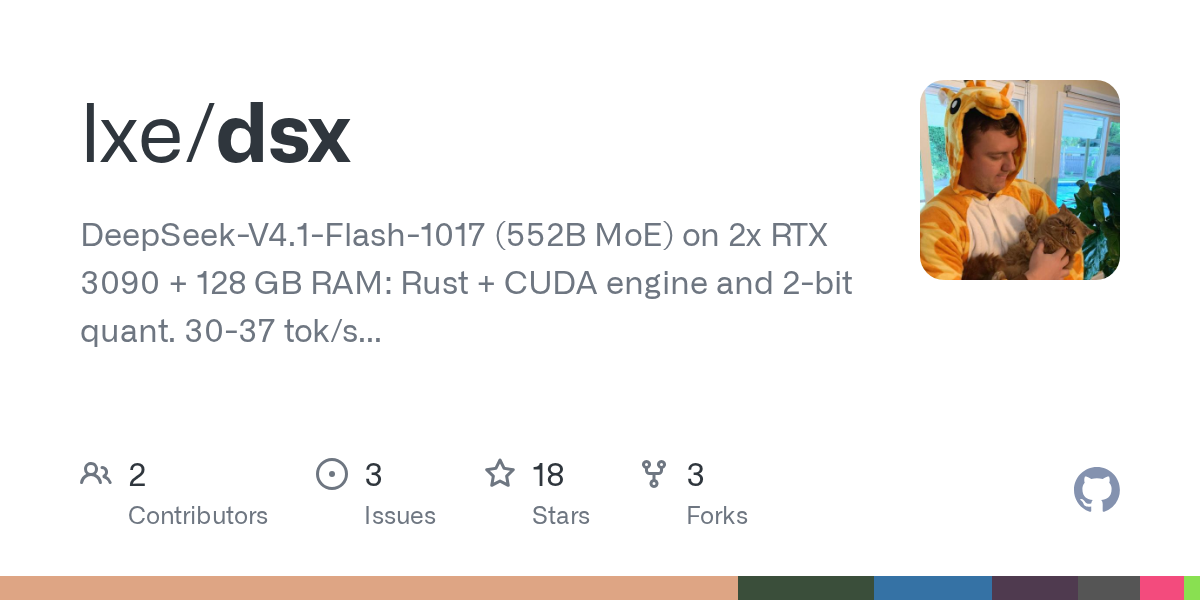
Image source: GitHub; mirrored on Jiufeng R2.
Source: GitHub · lxe/dsx · Hugging Face · DeepSeek-V4.1-Flash-1017-dsx-2bit · SiliconANGLE
04/09
Qwen3.8-Flash-Next runs the full 262K window on two CMP 170HX cards at 226 tok/s per user
A developer used Intel's W4A16 quant and a forked vLLM to run Qwen3.8-Flash-Next pipeline-parallel across two CMP 170HX cards, with the full 262,144-token window.
The project serves the Intel/Qwen3.8-Flash-Next-W4A16-AutoRound checkpoint (about 170 GB) with a containerized fork of vLLM v0.30.0. It exposes an OpenAI-compatible API with native MTP speculative decoding, reasoning and tool calls. The roughly 102 GB N-gram (PLE) table stays on NVMe and is read through mmap; everything else sits on the two GPUs. The author's figures:
- Single user: 226 tok/s on code
- Eight concurrent users: 840 tok/s aggregate
- Prefill: 6,300–7,100 tok/s for 4K to 64K prompts
- Evals: HumanEval 157/164, GSM8K 1,271/1,319
Limitations: All numbers come from the author's own machine, measured over PCIe Gen2 x4 links. Each card must expose 64 GiB, the setup depends on a pinned vLLM fork, and host tuning requires sudo.
Source: GitHub · cmp170hx-qwen38-flash-next · Hugging Face · Intel W4A16 quant
Global AI News
05/09
NVIDIA open-sources the full Run:ai GPU orchestration platform under Apache 2.0
Run:ai's GPU scheduling, quota and workload-management code is now open source, so platform teams can inspect, fork and self-host it without a paid subscription.
NVIDIA released the complete Run:ai platform on GitHub under Apache 2.0 as part of the NVIDIA DSX AI Factory platform. The monorepo contains the control plane, cluster services, installer, CLI and an MCP server. Key details:
- Components: KAI Scheduler, CUDA 13.4 GPU fractioning, quota management, a local Kind dev environment
- Runs on: Kubernetes or OpenShift clusters with NVIDIA GPUs. Local dev builds about 50 Go services and runs on macOS or Linux with 8 simulated Tesla-A10 GPUs, so no real GPU is needed.
- Deployment: from source, or with the NGC Community Product Helm chart
- Companion project: Model Streamer streams weights directly into GPU memory. vLLM and SGLang enable it with
--load-format runai_streamer. On 8 H100 VMs on Azure, it loaded models 3x to 6x faster.
Limitations: NVIDIA published no platform-level benchmark for this release; the 3-6x figure comes from the companion Model Streamer project. The community edition has no NVIDIA enterprise support.
Source: MarkTechPost · NVIDIA technical blog · vLLM docs
06/09
Cloudflare launches the agent-focused cf CLI and plans to retire Wrangler
The new CLI is generated from Cloudflare's OpenAPI schema and covers more than 3,000 API operations; Wrangler has about 280 command paths.
cf is in public beta. It is open source, written in TypeScript and licensed under Apache 2.0 or MIT. Its commands are generated directly from the OpenAPI schema by Forge, Cloudflare's new unified API generation pipeline. It adds command discovery, JSON output and a new cloudflare.config.ts config format, and makes Vite the default dev environment. Cloudflare says it built a separate CLI to avoid conflicts with the Wrangler behavior LLMs have already learned. After the public beta ends, Wrangler will get one final major version and 18 months of maintenance to give users time to migrate.
Limitations: cf is still in public beta. On Hacker News, users questioned writing a CLI in TypeScript, citing startup time, portability and dependency management. Cloudflare's answer is that TypeScript provides type safety and LSP support.
Source: InfoQ · InfoQ China
07/09
Pax8 launches 8os and 8bot so IT providers can manage AI agents for small businesses
8os lets IT service partners govern the AI agents running inside their customers' businesses; 8bot is a managed AI coworker that partners deploy and supervise.
Software marketplace Pax8 announced both products at its Beyond EMEA conference in Copenhagen. It points to its quarterly "SMB AI Pulse" survey as the reason:
- Adoption: nine in 10 small businesses use or are experimenting with AI, but only 23% have a documented AI policy
- Self-built tools: 71% of AI users have built at least one tool of their own, and only 31% of those builders have a formal review process
- Shadow AI: nearly half found unsanctioned AI use in the past six months
- Outside help: 84% of business leaders would trust an outside technology adviser to help them implement AI
Limitations: All figures come from Pax8's own survey. Both products open in limited early access this week, with general availability planned for early next year; partners set their own pricing for customers.
Source: SiliconANGLE
Regional and Early Signals
08/09
Midea's robotics revenue reaches ¥16.6B in H1, outgrowing appliances while margins slip
Midea's robotics and automation segment grew revenue 10.27% in H1 2026, but its gross margin fell to 20.9% and it makes up only 6.39% of group revenue.
Citing Midea's H1 2026 report, TMTPost says the robotics and automation segment brought in ¥16.621 billion in revenue at a 20.9% gross margin, down 1.86 percentage points year on year. As of June 2026, Midea's own robot density exceeded 750 units per 10,000 employees.
| Segment | H1 revenue growth (%) |
|---|---|
| Robotics & automation | 10.27 |
| Smart home | 4.27 |
| Group total | 3.55 |
Limitations: Chinese-language source. The piece is business commentary; only the financial figures it cites are used here.
Source: TMTPost (Chinese-language source)
09/09
Headhunters say Chinese big-tech foundation-model hires start at ¥2M a year
Big tech firms have cut hiring overall, but headhunters say pay for foundation-model talent keeps rising, and some companies now pay newer hires more than senior staff.
Leiphone cites headhunter Mia: the major companies are shrinking headcount, yet they usually won't hold to the budget for a candidate they really want. One industry worker said foundation-model staff at lower levels now earn more than colleagues at higher levels, and one company is rumored to be considering scrapping its level system.
| Tier | Annual package (¥10k) |
|---|---|
| New-grad FM hires (floor) | 200 |
| Xiaohongshu, ByteDance Seed (top) | 400–500 |
| Baidu FM talent (last year) | 200–300 |
Limitations: Chinese-language source. All figures come from headhunters and anonymous workers, and the report gives no official company figures.
Write a prompt in your browser and get an image — 1K, 2K or 4K output, up to 15 reference images. 50 free generations on sign-up, no credit card.
Generate free