Overview
8 stories in this issue. The first 3 are today's priorities.
Hot Model Updates
- Top · Four Gemini 4 Argon agents beat Minecraft without human help
Global AI News
- Top · togethercomputer open-sources HybridAgent, which reasons in latent space and acts through text
- Top · Anthropic proposes putting 5% of its shares in a public-benefit fund
- Anthropic's draft AI safety bill gives only Commerce the power to seek a release halt
- Disney recruits Character.AI staff, estimating $180M in retention costs
- A second German court holds Google liable for what AI Overviews say
Regional & Early Signals
- NVIDIA vLLM optimization pushes Kimi K3 to 423 tok/s per user
- Kimi K3 pre-training researcher Chen Guangyu leaves Moonshot for the Bay Area
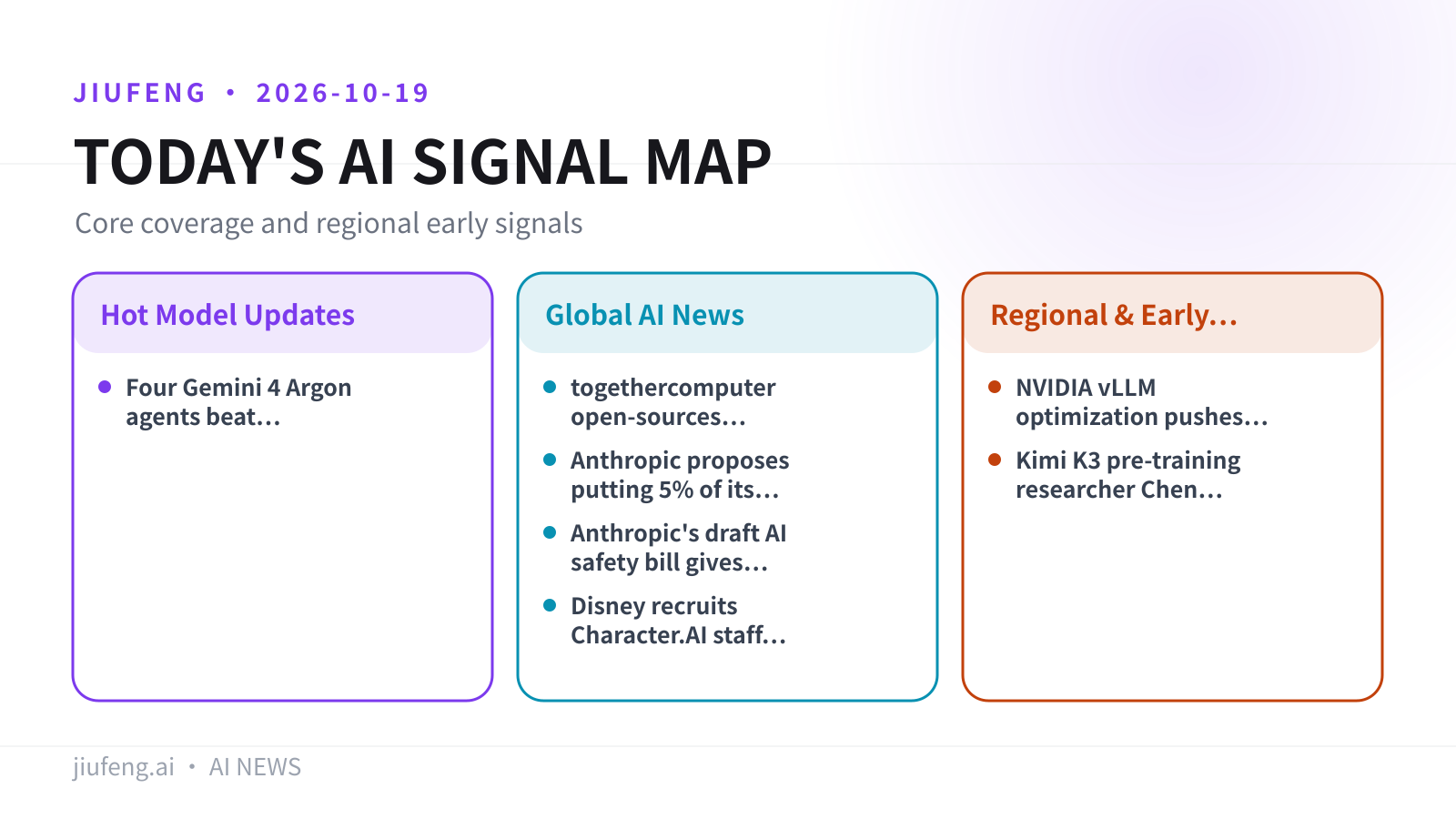
Jiufeng graphic based on the sources cited in this issue.
Hot Model Updates
01/08
Four Gemini 4 Argon agents beat Minecraft without human help
Four Gemini 4 Argon agents from a Google DeepMind team beat the Ender Dragon with no human input. The run would cost $1,620 at the Gemini 4 Argon standard price that takes effect in 2027.
According to The Decoder, the team put the agents in a randomly generated world. It gave them no assigned roles, no strategies and no game-specific tools. The agents divided the work themselves, warned each other about threats, recovered items from dead teammates and logged their mistakes in a shared memory.
- Duration: 27 hours 14 minutes
- Code: 2,783 JavaScript programs written across the four agents
- Coordination: 229 chat messages exchanged
- Deaths: 605
- Cost: $1,620, priced at the standard Gemini 4 Argon rate that takes effect in 2027
Limitations: The $1,620 figure uses a price that only takes effect in 2027, so it is not what the run actually cost. All figures come from the team's own paper (Faldor et al.), and the source does not mention independent replication.
Source: The Decoder · Paper
Global AI News
02/08
togethercomputer open-sources HybridAgent, which reasons in latent space and acts through text
The code, models and data for Hybrid Reasoning Agents are public, and community members are already running the 14B model in llama.cpp.
The work proposes LLM agents that do their reasoning in latent space but still act through text. The code is on GitHub at togethercomputer/HybridAgent, and the models and data are in a Hugging Face collection. Three hours after it was posted, the Hacker News thread had 154 points and 91 comments.
Limitations: One HN user ran the 14B model in llama.cpp using bartowski's 8-bit quantization. On a simple chat request, it looped on variations of the same paragraph for five minutes until it ran out of its turn budget. The source excerpts do not include any benchmark scores.
Image source: GitHub; mirrored on Jiufeng R2.
Source: GitHub · Hugging Face · Hacker News
03/08
Anthropic proposes putting 5% of its shares in a public-benefit fund
The new fund starts with 5% of Anthropic's shares. The board can add 2% more for every 50% rise in company value above a set baseline.
On October 18, Anthropic announced the Anthropic Public Benefit Fund. RuntimeWire reports that it is a new LLC wholly owned by Anthropic.
- Initial stake: 5% of shares, subject to stockholder approval
- Top-ups: the board may add 2% for every 50% increase in company value above a set baseline
- Combined total: Anthropic says this 5%, together with the co-founders' pledge to give away 80% of their equity and an employee equity-donation matching program, currently adds up to about 20% of its shares supporting public benefit, with more possible as valuation milestones are reached
- Possible uses: large donations to traditional nonprofits, or direct payments to specific groups, for example workers affected by AI
Anthropic says its safety and interpretability research, biomedical research and Claude discounts for nonprofits and scientific institutions will stay inside the company.
Limitations: Stockholders still have to approve the plan. RuntimeWire notes that the fund's governance rules have not been published, and its impact will depend on both.
Source: Anthropic · RuntimeWire
04/08
Anthropic's draft AI safety bill gives only Commerce the power to seek a release halt
Under the draft, Commerce could ask a court to halt a model release only above a threshold of more than 50 people killed or seriously injured, or more than $1 billion in damages.
RuntimeWire, citing a Tom's Hardware report from October 16, says Dario Amodei is asking lawmakers to set a narrow legal gate for the most dangerous AI releases. Under the draft, only the Commerce Department could ask a court to halt a model release. RuntimeWire reads this as an attempt to make outside model evaluations part of a formal government process.
Limitations: This is a draft known only through media reports, and the source does not include the bill text. RuntimeWire notes that the high harm thresholds and Commerce's exclusive role will decide which risks can trigger intervention.
Source: RuntimeWire
05/08
Disney recruits Character.AI staff, estimating $180M in retention costs
A court filing shows Disney is paying far more for Character.AI's people than for its technology.
Character.AI filed for bankruptcy earlier this week. TechCrunch reports that many Character.AI employees will have the chance to work at Disney. Character.AI's former CEO, Karandeep Anand, recently became Disney's first CTO.
| Item | Amount (USD) |
|---|---|
| Pay and retention, ~65 staff, 3 years | ~$180M |
| License to selected tech and IP | $20M |
Limitations: Disney's offer is a stalking-horse bid, so another company can still top it. The $180 million is Disney's own estimate, spread over three years.
Source: TechCrunch · RuntimeWire
06/08
A second German court holds Google liable for what AI Overviews say
The Aachen Regional Court followed Munich's reasoning and treated AI search summaries as Google's own statements.
In a preliminary injunction, the Aachen Regional Court barred Google from spreading false claims about a doctor through its AI search results. The system had attributed another person's criminal allegations and proceedings to him. The court relied on a Munich Regional Court I ruling from late May. It found that the AI-generated text is not just a link to third-party sites but Google's own statement, which makes Google directly liable.
Limitations: This is only a preliminary injunction. Google appealed the Munich case and then settled, so no higher court has issued a binding ruling.
Source: The Decoder
Regional & Early Signals
07/08
NVIDIA vLLM optimization pushes Kimi K3 to 423 tok/s per user
SemiAnalysis says that on the same GB300 NVL72 hardware, the optimized Kimi K3 runs 1.68 times as fast as before (Chinese-language source).
- Model: Kimi K3, 2.8 trillion parameters
- Hardware: GB300 NVL72
- Speed: 423 tok/s per user, 1.68 times the speed before the optimization
- Implementation: an upstream vLLM change by NVIDIA CentML engineer Benjamin. He wrote a decode-specific kernel in Cute DSL that fuses work into one large megakernel of about 12,000 lines
IT Home adds that NVIDIA is also building vLLM optimizations for other models, including DeepSeek V4.1.
Limitations: This comes from a single Chinese-language report by IT Home summarizing SemiAnalysis. It gives no link to the original analysis, no baseline configuration and no concurrency details.
Source: IT Home (Chinese-language source)
08/08
Kimi K3 pre-training researcher Chen Guangyu leaves Moonshot for the Bay Area
The co-first author of the Attention Residuals paper has left Moonshot AI and says he is not joining Anthropic (Chinese-language source).
On October 15, Chen Guangyu (Nathan Chen) announced on X that he had left Moonshot AI, and he confirmed he is moving to the San Francisco Bay Area. When someone in the replies asked whether he was joining Anthropic, he answered "no." His homepage says he worked on LLM scaling and pre-training at Kimi, including Kimi K3, with a focus on model architecture and optimizers. He is a co-first author of the Attention Residuals paper and the author of the MoMoE project. He joined Kimi as an intern in November 2025.
Limitations: His next employer, role and start date have not been made public. His homepage still describes his Kimi role, so his own latest announcement is the better guide to his current status.
Source: InfoQ China (Chinese-language source) · Attention Residuals paper
Write a prompt in your browser and get an image — 1K, 2K or 4K output, up to 15 reference images. 50 free generations on sign-up, no credit card.
Generate free