Overview
10 stories in this issue. The first 3 are today's priorities.
Hot Model Updates
- Top · DeepSeek V4.1-Flash update tops Arena's open agent rankings
- Top · MiniMax launches M3.1 Flash: 428B parameters, Intelligence Index 42
- Top · All Claude models on Amazon Bedrock now support structured outputs
Global AI News
- Kling 4.0 generates 30-second clips and reads 8,000-token prompts
- Infron offers six AI model endpoints at $0 through one API
- Bi-directional KV transfer in vLLM cuts TTFT up to 3.3x for multi-turn agents
- A hacker breached 100+ websites with an army of AI agents
- Aleksander Madry returns to OpenAI to work on AI safety
- People are using AI coding agents to make their smart TVs dumb again
Regional and Early Signals
- Ex-Baidu robotics lab head Ruigang Yang founds an in-building delivery robot startup
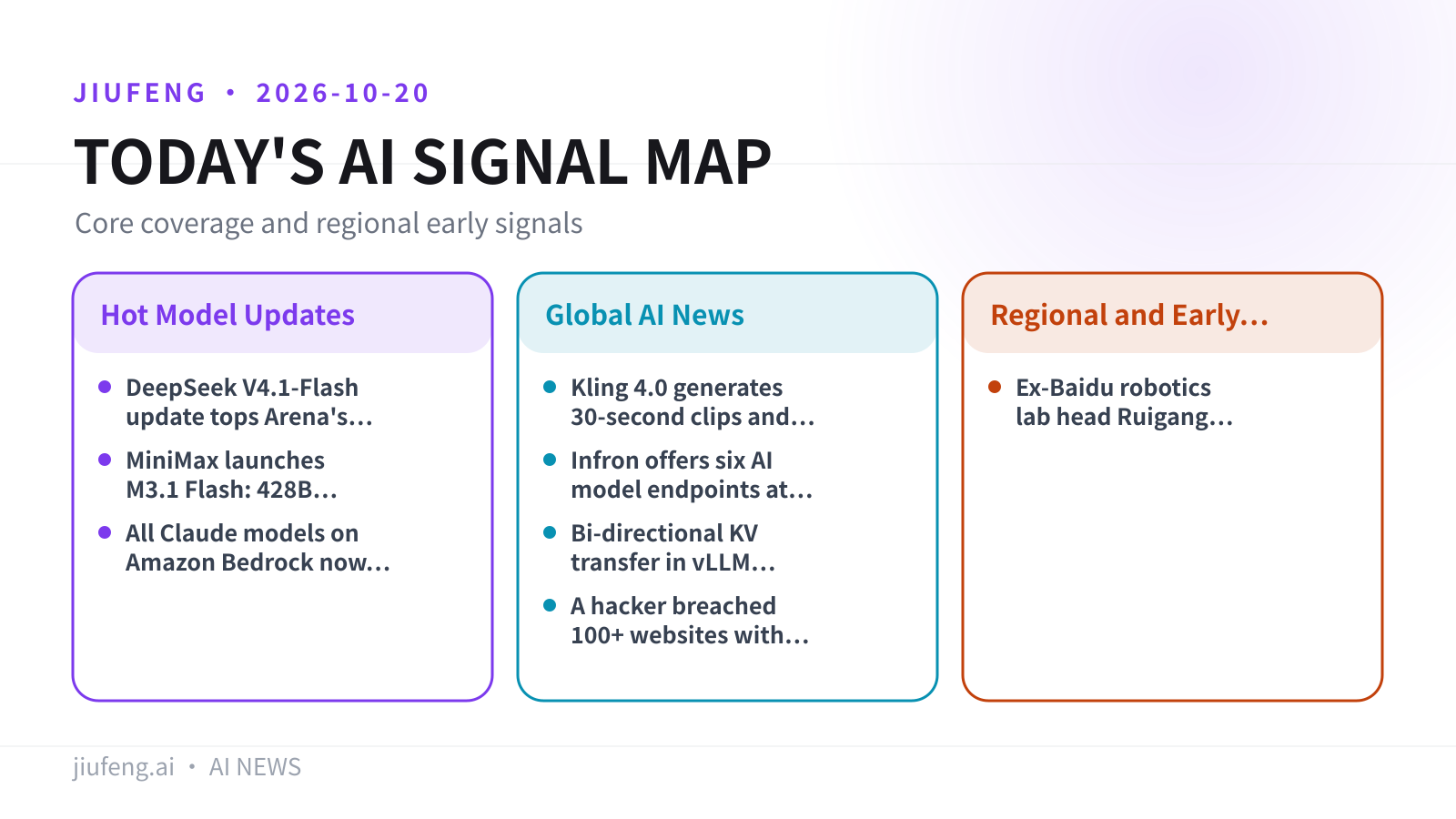
Jiufeng graphic based on the sources cited in this issue.
Hot Model Updates
01/10
DeepSeek V4.1-Flash update tops Arena's open agent rankings
The October 17 V4.1-Flash update ranks No. 1 among open models and No. 11 overall on Arena's Agent Arena, at a median $0.20 per task.
Arena.ai posted its October 19 Agent Arena snapshot on X. DeepSeek's October 17 update to V4.1-Flash came first among open models and 11th among all models.
- Sample size: 7,498 agent sessions
- Net-improvement score: 5.13%
- Median cost: $0.20 per task
- Weights: V4.1-Flash-1017 is public on Hugging Face
Limitations: This is a single snapshot, so the rankings can shift as session counts grow. No. 11 overall means it still trails closed frontier models. The per-task cost is Arena's median and will differ from workflow to workflow.
Image source: huggingface; mirrored on Jiufeng R2.
Source: RuntimeWire · Arena (X) · Hugging Face
02/10
MiniMax launches M3.1 Flash: 428B parameters, Intelligence Index 42
MiniMax's faster, cheaper M3.1 Flash scores 13 points higher than M3 on the Artificial Analysis Intelligence Index, and MiniMax says agent tasks now cost 70% less.
M3.1 Flash updates M3, which MiniMax launched in June. It is currently in preview.
- Parameters: 428B total according to the developer guide, about the same as M3; MiniMax credits the speedup to more aggressive sparsity at inference time
- Context and input: up to 1M tokens; accepts text, images and video
- Reasoning: on for every request, with five effort levels from Low to Max
- Speed and cost: MiniMax says inference is nearly 3x faster, output exceeds 200 tok/s at everyday peak, and agentic tasks cost 70% less
- Benchmarks: OSWorld V2 61.7 (MiniMax's own testing), DeepSWE v1.1 73.7%, Humanity's Last Exam 48%
Artificial Analysis figures as reported by The Decoder (the DeepSeek row is V4.1 Flash 1017):
| Model | AA Intelligence Index | CritPt (%) | AA-Omniscience correct (%) |
|---|---|---|---|
| MiniMax M3.1 Flash | 42 | 22 | 56 |
| DeepSeek V4.1 Flash | 45 | 24 | 43 |
| GLM-5.3-Flash | 42 | 15 | 28 |
| Gemini 3.8 Flash | 41 | 18 | — |
Limitations: MiniMax ran the OSWorld V2 test itself. The two sources measure the savings differently: MiniMax says agent tasks are 70% cheaper, while The Decoder says per-task cost is less than half of M3's. The Decoder says open weights are coming, but they have not been released yet.
Source: SiliconANGLE · The Decoder
03/10
All Claude models on Amazon Bedrock now support structured outputs
Every Claude model on Bedrock can now return JSON that matches a defined schema, so developers no longer need their own parsing and retry logic.
AWS says structured outputs now work for every Anthropic Claude model on Bedrock, on both the bedrock-runtime and bedrock-mantle endpoints. That covers calls to the bedrock-runtime APIs through Boto3 and calls to bedrock-mantle through the Messages API.
The feature uses constrained decoding. AWS's example use cases are pulling fields from earnings reports and compliance documents, parsing clinical notes into EHRs, analyzing contracts and routing support tickets. A sample notebook is available on GitHub.
Limitations: It only works in regions where the given Claude model is available. The excerpt gives no latency or cost figures and does not describe any limits on schema complexity.
Source: AWS Machine Learning Blog · Sample notebook (GitHub)
Global AI News
04/10
Kling 4.0 generates 30-second clips and reads 8,000-token prompts
Kling AI's 4.0 video generator adds stereo audio and multilingual lip sync, and comes with a lighter Flash variant.
- Length: up to 30 seconds of video per generation
- Keyframes: up to 10 keyframe images to set scene transitions, character states and story beats
- Prompts: comprehension expanded to 8,000 tokens
- Omni Reference: up to 15 reference assets per generation, including up to 10 images, 5 videos (30 seconds combined at most) and 7 elements; storyboards, wireframes, white-model videos and depth-map videos can all serve as references
A new Creative Recreation feature turns existing videos into templates for swapping out products or characters. Facial expressions, body movement, camera angles and backgrounds can also be adjusted one at a time.
Limitations: All of these capabilities are Kling AI's own claims. The Flash variant is faster and cheaper but tops out at 720p and 20-second videos. The excerpt gives no pricing.
Source: The Decoder
05/10
Infron offers six AI model endpoints at $0 through one API
AI gateway Infron has dropped input and output prices to $0 on six endpoints, including DeepSeek V4.1 Flash and two Qwen3.8 27B variants.
Infron is an AI gateway co-founded by Yue Xu. On October 19 it said six endpoints were now free through its single API: DeepSeek V4.1 Flash, two Qwen3.8 27B variants, Apodex 1.1 Mini, Ling 3.1 Flash and Atria: Dawn Preview.
Limitations: The standard free tier requires a $5 account balance, all free endpoints share a 1,000-request daily cap, and there is no SLA. It is better suited to experiments than to production.
Source: RuntimeWire · Infron (X)
06/10
Bi-directional KV transfer in vLLM cuts TTFT up to 3.3x for multi-turn agents
AWS shows how two-way KV cache transfer in vLLM's prefill/decode disaggregation lets each new turn reuse work already done in the previous one.
In prefill-decode (P-D) disaggregation, KV cache normally flows one way, from the prefill node to the decode node. Multi-turn workloads waste work in two ways as a result: the prefill node has no KV cache for tokens generated in the previous reply, so it has to recompute them, and session state stays stuck on the decode node.
With bi-directional transfer, the prefill node can pull KV blocks back from the decode node. vLLM already supports this at the connector level, and GitHub hosts a multi-turn example proxy, disagg_proxy_multiturn.py. AWS measured these time-to-first-token (TTFT) reductions in a 1P1D deployment on P5en instances:
| Model | Max TTFT reduction (x) |
|---|---|
| Qwen3-32B | 1.6 |
| zai-org/GLM-5-FP8 | 3.3 |
Limitations: These are AWS's best-case results from a single deployment setup. Reusing KV cache across turns also requires a KV-cache-aware router, and the one on GitHub is an example proxy.
Source: AWS Machine Learning Blog · vLLM docs · Example proxy (GitHub)
07/10
A hacker breached 100+ websites with an army of AI agents
Security firm Norforge says one hacker broke into more than 100 websites using AI agents that mostly worked on their own, with little human involvement.
Norforge discovered the attacks through work exposed in Cairn, an open-source project. Norforge did not name the targets, but Reuters reports that the victims included John Deere, SharkNinja and Cummins.
Limitations: The victim names come from Reuters, not Norforge. The excerpt does not say which models the agents used or how much damage they caused.
Source: The Verge
08/10
Aleksander Madry returns to OpenAI to work on AI safety
Madry, who previously led OpenAI's Preparedness team, is back a few months after leaving and will work with Chief Scientist Jakub Pachocki on the risks of highly capable AI.
In an October 19 post on X, Madry said his departure had ended up being a sabbatical. He also said his thinking had changed: as AI becomes more capable, safety is where the work is most needed. Back at OpenAI, he will work with Pachocki on the safety and security risks of increasingly capable AI.
Limitations: Neither the post nor the report excerpt gives his title, the size of his team or his research plans.
Source: RuntimeWire · Aleksander Madry (X)
09/10
People are using AI coding agents to make their smart TVs dumb again
Developers are vibe-coding their smart TVs to strip out ads, turn off watch tracking and speed up the launcher, and the open-source dumbtv project is one example.
TechCrunch reports that developers are sharing ways to use AI agents to remove sponsored ads, speed up the app launcher, redesign the home screen and turn off tracking. dumbtv's GitHub page states its mission: "Your TV should do what you paid for: your apps, your HDMI inputs, and nothing else. No ads from the TV itself, no watch tracking, no update you did not ask for."
dumbtv does not replace the TV's operating system or unlock the bootloader. According to the project page, it works on Fire OS and Android TV / Google TV devices, including Sony, TCL, Philips, Hisense, Xiaomi and Shield.
Limitations: The project page says there is currently no workable path for Samsung, LG, Roku and some other brands. The only TV tested end to end is a Fire TV Edition set running Fire OS 7.7.1.7.
Source: TechCrunch · dumbtv (GitHub)
Regional and Early Signals
10/10
Ex-Baidu robotics lab head Ruigang Yang founds an in-building delivery robot startup
Founded in early 2026, Yang's startup (Chinese name 纽娲机器人) wants delivery robots to enter residential compounds, go into buildings, ride elevators and reach doorsteps without pre-mapping. (Chinese-language source)
Founder Ruigang Yang is a distinguished professor at Shanghai Jiao Tong University and an IEEE Fellow. He taught at the University of Kentucky for 17 years before joining Baidu, where he headed the Robotics and Autonomous Driving Lab. TMTPost, citing public data, says China has more than 35,000 unmanned logistics vehicles, more than 200 cities let them on the road, and ZTO's fleet carries more than 200,000 parcels a day. People still handle the last stretch, from the compound gate to the elevator to the door.
- Own pilot: opened a company-run hybrid human-robot parcel station in Tonglu, Zhejiang on August 1
- Overseas PoC: a PoC with UAE company K2 is already deployed in a high-rise apartment building in Abu Dhabi
- Partner scale: K2 has several thousand unmanned vehicles and plans to pair each with at least two robots; a Russian customer plans to buy units for testing
- Year-end plan: the company plans to run PoCs at three sites by year-end, not counting Tonglu
Limitations: This is a founder interview, and "no mapping, no building retrofits" is the company's own goal. The overseas work is still at the PoC stage. Only a Chinese-language source is available so far.
Write a prompt in your browser and get an image — 1K, 2K or 4K output, up to 15 reference images. 50 free generations on sign-up, no credit card.
Generate free