Overview
10 stories in this issue. The first 3 are today's priorities.
Hot model updates
- Top · GPT-6.1 Sol hits 97.9% on OpenAI's COBOL migration test
- Top · DHS bans DeepSeek across US federal civilian agencies
- Top · Unsloth fits DeepSeek V4.1-Flash-1017 into a 250GB download
- Mercury 3 diffusion LLM hits 1,068 tok/s and leads Haiku 5.5 on 8 of 12 self-reported tests
Global AI news
- PyTorch 2.15 brings FP8 and faster decoding to Mac's MPS backend
- New SageMaker Studio users can sign in with GitHub
Regional and early signals
- Xiaomi MiMo-V2.6-Pro launches on WorkBuddy
- Early tester impressions of new Claude and Gemini Carbon models
- Peking University and Qiyuan Robotics' HIL-UMI removes the real-robot step from correction in post-training
- Stars Micro System unveils C82-4G PCIe 6.0 switch chip
Hot model updates
01/10
GPT-6.1 Sol hits 97.9% on OpenAI's COBOL migration test
OpenAI published coding evaluations for legacy languages such as COBOL, Fortran and Visual Basic, and its new models far outscore the previous generation on its own tests.
OpenAI announced the work in an October 19 post on X. It described it as a capability update, not a standalone product, and its technical account says developers can try the models on coding tasks through the OpenAI API. Figures cited by QbitAI say COBOL supports more than 40% of banking systems, 80% of in-person card transactions and 95% of ATM transactions.
| Model and reasoning setting | COBOL migration accuracy (%) |
|---|---|
| GPT-6.1 Sol (low) | 86.6 |
| GPT-6.1 Sol (higher) | 97.9 |
| GPT-5.6 Sol | 5.4 |
RuntimeWire separately reports that GPT-6 Astra passed 72.1% of COBOL tests in OpenAI's SQLite-building evaluation.
Limitations: The migration results come from hidden tests that OpenAI designed itself. RuntimeWire notes they show progress on OpenAI's own evaluations, while production safety and enterprise adoption remain unresolved.
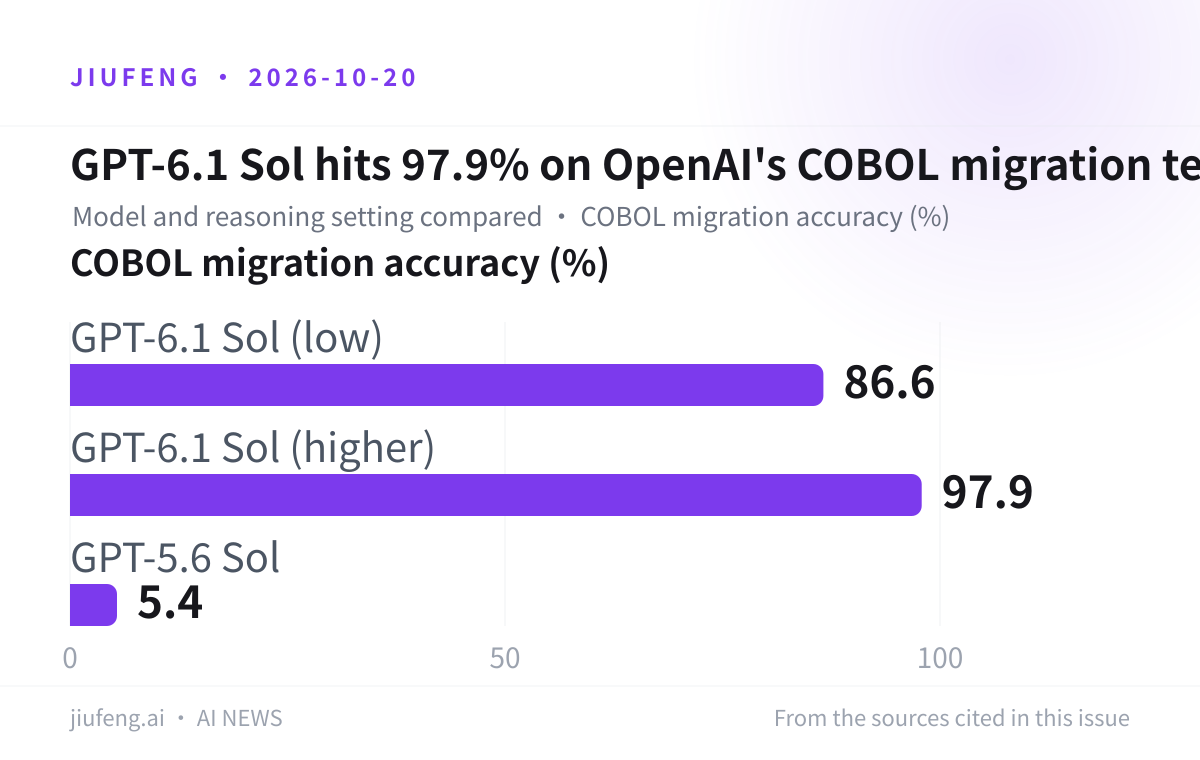
Jiufeng graphic based on the sources cited in this issue.
Source: OpenAI · RuntimeWire · QbitAI (Chinese-language source)
02/10
DHS bans DeepSeek across US federal civilian agencies
US federal civilian agencies must remove existing DeepSeek products and stop buying new ones, and the ban also covers third-party services built with DeepSeek.
The Decoder, citing the Wall Street Journal, reports that the Department of Homeland Security has banned federal civilian agencies from using DeepSeek's AI technology. The order covers products from affiliated companies and third-party services built with DeepSeek implementations. It is based on a 2018 US law on supply-chain security in federal procurement.
According to an earlier New York Times report, the US government considered action against Chinese open-weight models over the summer. The options included sanctions, a trade blacklist and rules on which models federal agencies may use.
Limitations: The notice sets no removal deadline and names no specific security concerns. It is unclear what "built with" means and whether AI gateways such as OpenRouter fall under the ban.
Source: The Decoder
03/10
Unsloth fits DeepSeek V4.1-Flash-1017 into a 250GB download
Unsloth released a 1-bit GGUF of DeepSeek's 552B model that runs locally on machines with at least 128GB of memory.
Unsloth AI published GGUF builds of DeepSeek V4.1-Flash-1017 on October 19.
- Smallest build: 1-bit, 250.4GB download
- 8-bit build: 508.4GB
- Memory: at least 128GB
- 88.2%: Unsloth's reported agreement figure
Limitations: The 88.2% figure measures token agreement with the original model on one test set, not general benchmark accuracy. The 250GB download and 128GB-plus memory requirement keep local use limited to high-end systems.
Source: RuntimeWire · Unsloth on X
04/10
Mercury 3 diffusion LLM hits 1,068 tok/s and leads Haiku 5.5 on 8 of 12 self-reported tests
Inception's new diffusion model generates answers in parallel. It is built for speed and leads GPT-6 Luna and Claude Haiku 5.5 on most tests in Inception's own table.
Mercury 3 writes answers in parallel rather than one token at a time.
- Speed: 1,068 tokens per second on NVIDIA GPUs, per Inception (exact GPU not disclosed)
- Context: 1M tokens
- Size: parameters not disclosed; Inception says it is more than 40x larger than Mercury 1
- Benchmarks: leads GPT-6 Luna and Claude Haiku 5.5 on 8 of 12 tests (medium settings); scores 51.08 on SWE-Bench Atlas, about 18 points ahead of both
| Model | DeepSWE v1 |
|---|---|
| Claude Haiku 5.5 | 51.62 |
| Mercury 3 | 46.31 |
Limitations: All scores are self-reported by Inception. The model is API-only, with no open weights or quantized builds. DeepSWE v1 is its weakest result, 5.31 points behind Haiku 5.5.
Source: MarkTechPost
Global AI news
05/10
PyTorch 2.15 brings FP8 and faster decoding to Mac's MPS backend
Hugging Face's PyTorch team outlined MPS backend improvements in version 2.15, including FP8 support and faster language-model decoding paths.
PyTorch 2.15 adds FP8 on MPS. Language-model decoding gets faster paths through linear layers and softmax, and new Metal kernels target unexpectedly expensive parts of audio, video and training workloads.
The team runs language, image and video models from the Hugging Face Hub on MPS, finds where it falls short and fixes it upstream in PyTorch. More and more often, the fix replaces MPSGraph with dedicated Metal kernels.
Limitations: The changes apply only to the MPS backend on Macs. The post says that in early 2026, running even small models on MPS often hit unsupported operations, performance cliffs and unexpected memory growth. Actual gains depend on the model and operators used.
Image source: huggingface; mirrored on Jiufeng R2.
Source: Hugging Face Blog · GitHub
06/10
New SageMaker Studio users can sign in with GitHub
AWS simplified onboarding for new SageMaker AI customers, who now reach a preconfigured Studio environment in a few steps after signing up.
New customers can sign in with an existing Amazon, Apple, GitHub or Google account, or an email address. They do not need to set up an advanced AWS account, and most do not need a credit card. AWS Free Tier credits go up to $200: new customers get $100 up front and can earn another $100, usable for model customization, training jobs, Studio notebooks and endpoint deployments.
AWS says it cut Studio environment creation time earlier this year from 2 minutes to about 20 seconds and added one-click links from Hugging Face model pages into Studio.
Limitations: The new flow is for new customers only. The no-credit-card path applies to most customers, not all.
Source: AWS Machine Learning Blog
Regional and early signals
07/10
Xiaomi MiMo-V2.6-Pro launches on WorkBuddy
Xiaomi's MiMo-V2.6-Pro, which Xiaomi says is the top open-weight model on the AA Intelligence Index, launched on WorkBuddy today.
Xiaomi announced on October 20 that MiMo-V2.6-Pro is now available on WorkBuddy, with 1M-token context, multi-agent task splitting and joint understanding of images, video, audio and text. These are the Artificial Analysis Intelligence Index v4.3.2 scores published at the September 22 release:
| Model | AA Intelligence Index |
|---|---|
| Claude Fable 5.1 | 53 |
| GPT-6 Astra | 53 |
| MiMo-V2.6-Pro | 46 |
| GLM-5.3 | 45 |
| Kimi K3 | 44 |
| MiMo-V2.5-Pro | 26 |
Xiaomi also reported that the Pro model rose from 48.8 to 65.7 on DeepSWE v1.1, and that its RL training took under 6 days at a cost of about $2.62M.
Limitations: The launch notice does not give WorkBuddy pricing or availability scope. The benchmark figures are Xiaomi's own from September, and Xiaomi acknowledges the model still trails top closed models. Chinese-language source.
Source: IT Home (Chinese-language source)
08/10
Early tester impressions of new Claude and Gemini Carbon models
Social-media accounts say Anthropic and Google are both testing new models internally.
QbitAI compiled claims from X. Testers reportedly say the new Claude is better at reasoning and intuition, and that when asked to fix a bug it identifies the underlying class of problems and asks whether to fix them all. Google has tested a series of Gemini 4 models codenamed Argon, Barium and Carbon. Carbon was reportedly available to employees for several days on Google's internal coding platform Jetski, where testers said it beat Argon at coding and "felt comparable to Opus 5.5".
Limitations: The details come from anonymous testers relayed on X; the report does not mention any company statement and gives no benchmark scores. Testers themselves say Carbon needs more testing. Single Chinese-language source.
Source: QbitAI (Chinese-language source)
09/10
Peking University and Qiyuan Robotics' HIL-UMI removes the real-robot step from correction in post-training
Dong Hao's team moves the human-correction step of embodied post-training onto robot-free data-collection devices.
Leiphone reports that the conventional HG-DAgger approach needs a robot arm running while an operator watches and takes over before it fails, which is costly and slow. HIL-UMI targets that correction step without needing the robot body.
Limitations: This item relies on a single Chinese-language media report. We have not verified quantitative results such as success rates. The report's claim that no team had a workable approach before is its own assessment.
Source: Leiphone (Chinese-language source)
10/10
Stars Micro System unveils C82-4G PCIe 6.0 switch chip
A Wuxi chipmaker launched what it calls China's first PCIe 6.0 switch, alongside an 800G AI NIC and a multi-mode RAID chip.
Pandaily reports that Stars Micro System's C82-4G supports up to 144 lanes at 64 GT/s. The company also launched an 800G multi-protocol AI NIC and a multi-mode RAID chip.
Limitations: "China's first" is the company's own claim. The report gives no third-party testing, pricing or mass-production timeline.
Source: Pandaily
Write a prompt in your browser and get an image — 1K, 2K or 4K output, up to 15 reference images. 50 free generations on sign-up, no credit card.
Generate free