Overview
10 stories in this issue. The first 3 are today's priorities.
Hot model updates
- Top · Claude Duet opens a research preview, built on Opus 5.5
- Top · Anthropic's public-benefit report says interpretability can't yet catch every dangerous behavior
- Top · Mistral Large 4 and NVIDIA team up on AI-native engineering simulation
- Gemini conversational navigation comes to Apple CarPlay, starting in the US
Global AI news
- NVIDIA DSX POD puts AI clusters in containers and cuts deployment from six months to 14 days
- NVIDIA Kumo Relational beats supervised ML on 41 relational tasks with no training
- AWS tutorial shows how to train Qwen3 on a single Trainium instance with torchtitan
- VocabX: a custom vocabulary cut a small model's production inference cost by 77%
Regional and early signals
- MiniMax shares a guide to SGLang-Omni for live multimodal serving
- Tsinghua AIR spin-off Zijing Zhikang launches multi-specialty "doctor AI avatars"
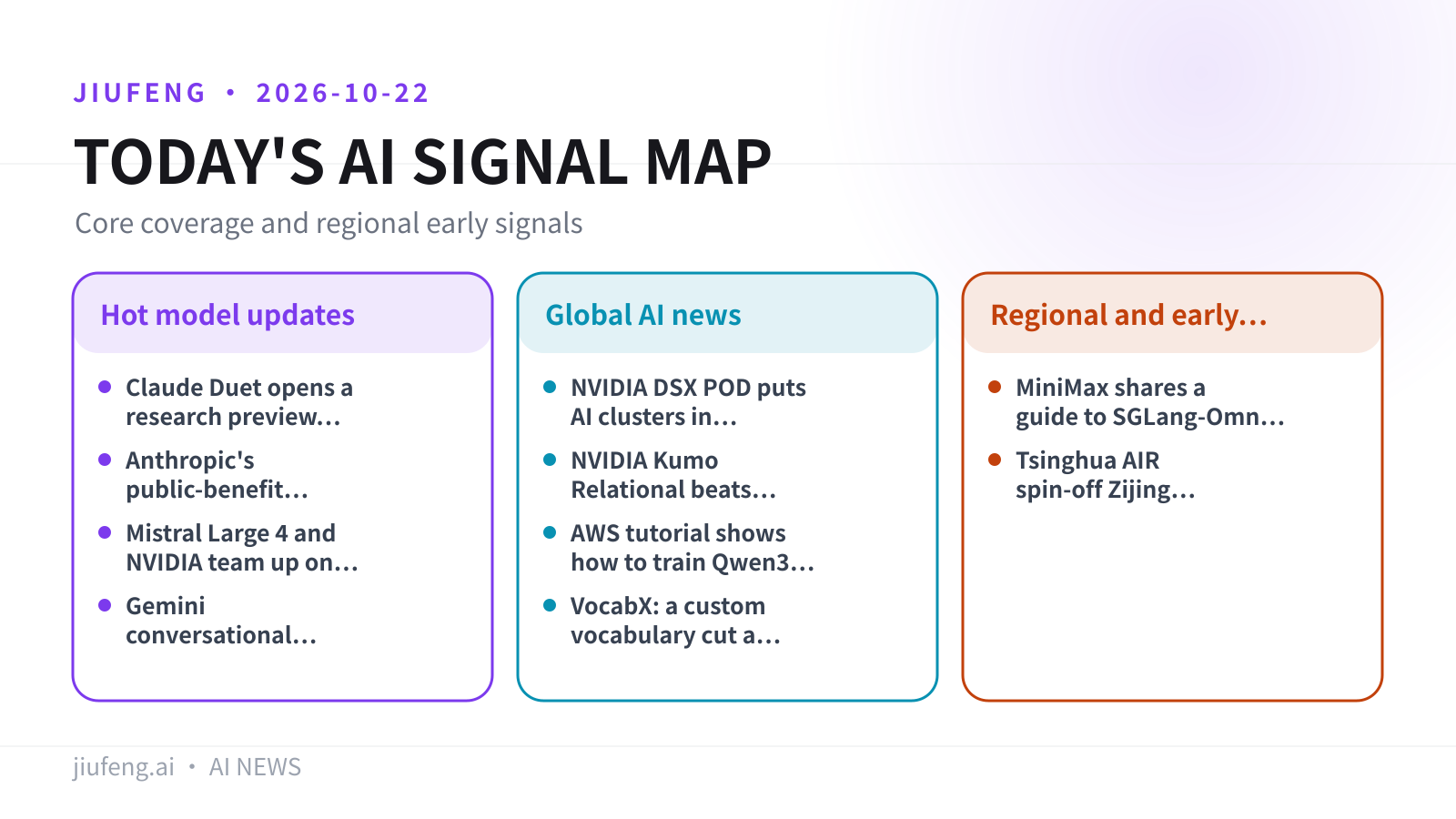
Jiufeng graphic based on the sources cited in this issue.
Hot model updates
01/10
Claude Duet opens a research preview, built on Opus 5.5
Anthropic is admitting some waitlisted users to a research preview of Claude Duet, a personal assistant built on Opus 5.5 that works across devices.
- Model: Claude Opus 5.5
- Platforms: iPhone, Android and the web
- Access: research preview for waitlisted users
- Carries over: account memory, skills and connected apps
Duet decides which things need the user's attention and which can wait. It also decides when it should check with the user first.
Limitations: Duet is a waitlisted research preview, not a general release.
Source: Claude on X · RuntimeWire
02/10
Anthropic's public-benefit report says interpretability can't yet catch every dangerous behavior
Anthropic's 2026 Public Benefit Report says core safety work is unfinished. A separate assessment looks back at cyber incidents the company disclosed earlier.
The report says current interpretability methods are not dependable enough to catch every dangerous behavior. Anthropic also says safety gaps remain and independent oversight is limited. The report sets these shortfalls against Anthropic's public-benefit commitments, and it can be found through the company's charter page. A separate assessment, published September 9th, adds detail to cyber incidents Anthropic had already disclosed.
Limitations: According to the report, the cyber tests ran without the safeguards that come with released models, so behavior in the tests does not equal behavior in production. The report is Anthropic's own assessment and has not been verified by a third party.
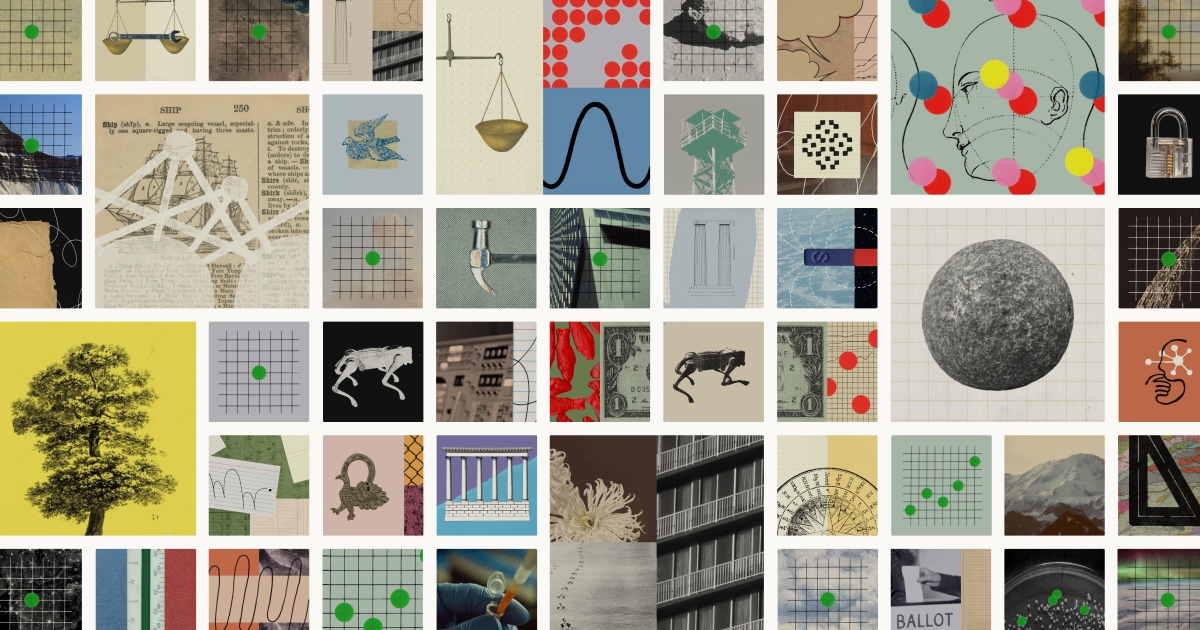
Image source: anthropic; mirrored on Jiufeng R2.
Source: Anthropic public-benefit charter · RuntimeWire
03/10
Mistral Large 4 and NVIDIA team up on AI-native engineering simulation
Mistral is connecting Large 4 and its data-generation and physics-modeling pipelines to NVIDIA accelerated computing, and plans to release public benchmarks and open datasets.
- Model: Mistral Large 4, plus Mistral's data-generation and physics-modeling pipelines
- Acceleration: NVIDIA CUDA-X libraries and NVIDIA Warp, with Omniverse for 3D simulation and asset creation
- Evaluation: public benchmarks and open datasets to standardize how physics AI and agentic AI are evaluated in computer-aided engineering (CAE)
- Target industries: aerospace, automotive and semiconductors
Mistral says the goal is faster simulation and closed-loop, AI-driven design.
Limitations: This announcement covers the direction of the partnership. The source gives no benchmark scores, no simulation speedups and no release date for the datasets.
Source: Mistral AI · NVIDIA Warp
04/10
Gemini conversational navigation comes to Apple CarPlay, starting in the US
Conversational Gemini launched on Android Auto last year, and Google Maps is now bringing it to CarPlay.
Starting today, CarPlay users in the US can tap the Gemini icon in Google Maps and talk to Gemini by voice. It handles multi-step requests. For example, a driver can ask for places to visit, then ask for directions there that avoid toll roads. Google launched the assistant on Android Auto last year.
Limitations: Google says only that the "rollout is happening globally too." The Verge has asked Google which regions are included and has not yet received an answer.
Source: The Verge
Global AI news
05/10
NVIDIA DSX POD puts AI clusters in containers and cuts deployment from six months to 14 days
At GTC Berlin, NVIDIA unveiled DSX POD, a reference architecture in which GPUs, CPUs, networking, cooling and power are all installed at the factory.
DSX POD is a reference architecture that partners can follow to build AI clusters inside shipping containers. Each container holds Rubin GPUs, Vera CPUs, networking equipment, cooling gear and power distribution modules. Everything is integrated and tested at the factory, so customers don't have to put the systems together themselves. NVIDIA estimates that hardware deployment time drops from six months to 14 days. Dell and HPE are among the more than a dozen partners.
Limitations: The six-months-to-14-days figure is NVIDIA's own estimate. No customer has reported real deployment data yet.
Source: SiliconANGLE
06/10
NVIDIA Kumo Relational beats supervised ML on 41 relational tasks with no training
This pre-trained relational foundation model makes predictions directly on enterprise databases in a single forward pass.
When Kumo Relational gets a predictive query, it gathers up to 10,000 historical examples as context and uses them to predict outcomes such as churn, demand or fraud. It needs no task-specific training and no feature engineering, and it doesn't require merging multiple tables into one. Across 41 tasks on 15 databases, it outperformed both supervised relational deep learning models and gradient-boosted tree pipelines built by experts. NVIDIA says it scales to more than 500B rows. It is available through the open-source structured-data-models library or as an NVIDIA NIM.
Limitations: The benchmark results come from NVIDIA's own blog post and paper. They have not been independently reproduced.
Source: Hugging Face blog · Paper · Docs
07/10
AWS tutorial shows how to train Qwen3 on a single Trainium instance with torchtitan
TorchNeuron registers Trainium as a native PyTorch device, so torchtitan works mostly as it normally does.
The tutorial trains Qwen3 in three ways on a single trn2.48xlarge:
- Method 1: Transformers v5 as torchtitan's modeling backend, running Hub models through AutoModelForCausalLM and reading and writing published safetensors directly
- Method 2: torchtitan's native Qwen3 implementation, selected by changing config.model_spec
- Method 3: NKI mixture-of-experts (MoE) kernels from the torchtitan-neuron recipes, plus an override registry for plugging in your own kernels
All three methods launch with the same torchrun command and config structure. They can be used to pre-train from random initialization or to fine-tune published weights.
Limitations: This is an AWS getting-started tutorial, and the excerpt gives no throughput or cost figures. It requires the Deep Learning AMI for Neuron or a Neuron PyTorch training container.
Source: AWS Machine Learning Blog · torchtitan-neuron
08/10
VocabX: a custom vocabulary cut a small model's production inference cost by 77%
Dharma-AI rebuilt its vocabulary around what each token costs rather than how often it appears. The base model stayed the same, and measured inference cost fell by 77%.
The team runs a Portuguese essay grader in production, built on Qwen3-4B. The general-purpose vocabulary the model came with split the text it writes most often into many tokens. VocabX rebuilt the vocabulary around the cost of each token, which cut measured inference cost by 77% with the same base model. The authors argue that for a model serving a single domain, the tokenizer can be one of the largest cost levers, and it is fixed before training even starts.
Limitations: This is a preview of results from the VocabX paper, which has not been published yet. The numbers come from a single production application, so it is not yet clear how much other tasks would save.
Source: Hugging Face blog
Regional and early signals
09/10
MiniMax shares a guide to SGLang-Omni for live multimodal serving
The tutorial covers using one runtime to coordinate several models in live voice conversations. MiniMax does not say it uses SGLang-Omni.
On October 21st, MiniMax shared a tutorial and code for SGLang-Omni. SGLang-Omni is a runtime that coordinates models during ongoing voice conversations, handling voice models, interruptions and persistent sessions.
Limitations: The report stresses that the post only points to SGLang's technical work. It does not say that MiniMax adopted the runtime, contributed to it or connected its own models to it.
Source: MiniMax on X · RuntimeWire
10/10
Tsinghua AIR spin-off Zijing Zhikang launches multi-specialty "doctor AI avatars"
Zijing Zhikang introduced collaboration between multiple agent avatars and upgraded its Agent Hospital (Chinese-language source).
The system gives each doctor a dedicated AI avatar. During pre-consultation and first visits, if the system detects that a patient needs other specialties involved, it sends the relevant specialist avatars' input to the doctor as prompts. For example, if a hyperthyroidism patient also has a history of asthma, the system shows input from the relevant specialties. Each avatar's suggestions appear separately, any disagreements are highlighted, and the human doctor makes the final call. The approach comes from Professor Liu Yang's team at Tsinghua AIR.
- Clinic testing: 18 clinical departments at Beijing Tsinghua Changgung Hospital are testing it in outpatient clinics, and more than 40 doctors use it routinely
- Efficiency: overall diagnosis and treatment efficiency up 30%
- Evaluation: AI doctors score above 96% accuracy on MedQA
- Scale: 54 AI doctors built as of July 2026
Limitations: Only one Chinese-language outlet has reported this so far. All of the figures above come from that report and have not been cross-checked against other sources.
Source: QbitAI (Chinese-language source)
Write a prompt in your browser and get an image — 1K, 2K or 4K output, up to 15 reference images. 50 free generations on sign-up, no credit card.
Generate free