Overview
10 stories in this issue. The first 3 are today's priorities.
Hot Model Updates
- Top · Base Labs trains Qwen into decision models with 6.21M examples
- Top · Claude Security enters public beta as a continuous code monitor
- Top · Developer behind Claude-built Adobe clones admits they are "not anywhere close to ready"
Global AI News
- IBM releases Granite Speech 5.0 2B, #2 on the Open ASR Leaderboard
- IBM's Granite Timeseries Ensemble combines four open models into one default
- Amp adds self-hosted orbs on Docker, K8s, Modal and more
- ChatGPT Ads expands to 26 more countries
Regional and Early Signals
- Year-old lab Flapping Airplanes raises $1B
- Perplexity and NVIDIA introduce JOLT, which trains one model as both teacher and student
- Doubao Work adds IGA Pages, which publishes generated web pages as public links
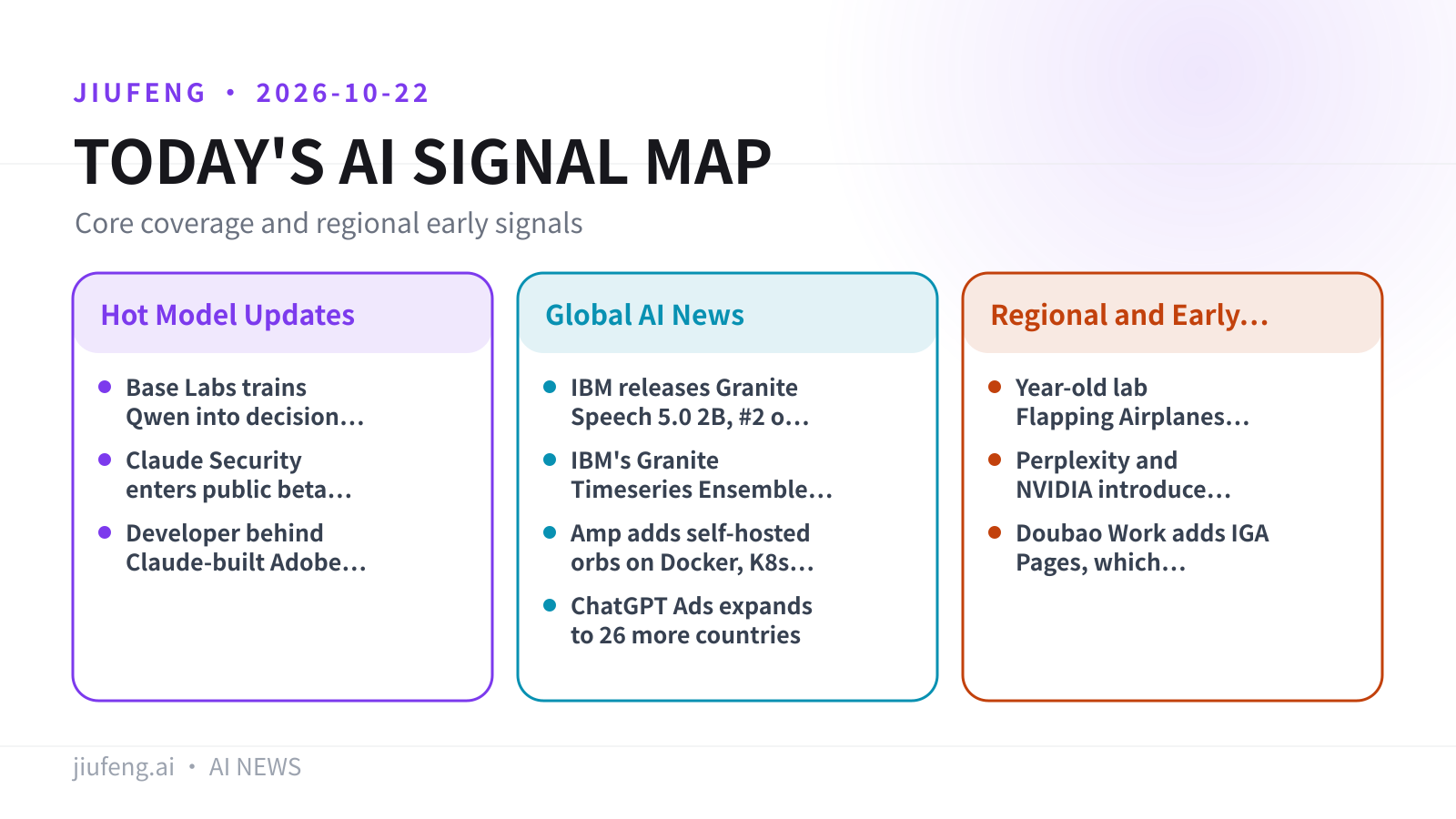
Jiufeng graphic based on the sources cited in this issue.
Hot Model Updates
01/10
Base Labs trains Qwen into decision models with 6.21M examples
A lab inside Baseten built two open-weight models on Qwen. Instead of generating answers, they score options with calibrated probabilities.
Base Labs, the research lab inside Baseten led by Max Kirkby, released mammoth-1 and elephant-1 on October 21. Both are post-trained from Qwen models on 6.21 million examples. Instead of writing prose answers, they score candidate choices with calibrated probabilities.
- mammoth-1: 27B parameters; the lab says it leads the Jev Decision Index
- elephant-1: 9B parameters; the lab says it ranks among the leaders for its size
- Weights: both are open-weight
- Method: the lab published a technical report with enough method detail to test the benchmark claim
Limitations: The benchmark results come from Base Labs' own announcement. RuntimeWire notes that whether the gains carry over to real workflows matters more than leaderboard position.
Source: Base Labs (X) · RuntimeWire
02/10
Claude Security enters public beta as a continuous code monitor
Anthropic is turning Claude's code scanner into an always-on service. It rescans repositories as code changes and tracks each finding until it is fixed.
On October 21, Anthropic expanded Claude Security. The public beta adds recurring scans across repositories and Git providers, and it tracks findings through to a fix. Claude Enterprise customers also get an API and an MCP connector to plug it into their existing security workflows.
Limitations: Anthropic's vulnerability count is company-supplied. RuntimeWire says adoption, confirmed fixes and standalone pricing are the measures that will show whether the workflow sticks.
Source: Claude (X) · RuntimeWire
03/10
Developer behind Claude-built Adobe clones admits they are "not anywhere close to ready"
The developer predicted full parity with Adobe within a month, then walked the claim back on Hacker News.
A developer used Claude Opus 5.5 to build open-source replacements for seven Adobe applications. They promoted the projects across Reddit and projected roughly 100% feature parity within a month. Later, on Hacker News, the developer said the apps were "not anywhere close to ready."
Limitations: According to InfoQ, the project's own roadmap puts it at 45%, far short of the promised near-100% parity within a month. So far, InfoQ is the only outlet reporting this.
Source: InfoQ
Global AI News
04/10
IBM releases Granite Speech 5.0 2B, #2 on the Open ASR Leaderboard
This 2B-parameter, Apache 2.0 speech recognition and translation model has a 5.68% average English word error rate.
IBM released Granite Speech 5.0 2B for speech recognition and translation. It also released updated Turbo CTC and 4.1 models.
- Size: 2B parameters
- License: Apache 2.0
- Leaderboard: #2 on the Open ASR Leaderboard
- Average English WER: 5.68%
Limitations: The ranking and WER figure come from MarkTechPost's write-up of the release. The linked paper covers the methods behind the Granite Speech family. IBM's model card has the exact evaluation setup for version 5.0.
Source: MarkTechPost · Granite Speech paper
05/10
IBM's Granite Timeseries Ensemble combines four open models into one default
Users no longer have to choose a single time-series foundation model. One recipe combines four Granite architectures, with no retraining.
On October 22, IBM Research released Granite Timeseries Ensemble. It combines four complementary open Granite time-series architectures behind one extensible forecasting interface. One of them is Granite TTM-r3 (Tiny Time Mixers), an MLP-mixer design. The ensemble returns median and quantile forecasts without retraining on the user's data or fitting ensemble weights. IBM also published a getting-started notebook.
Limitations: IBM calls it a sensible default, not the best choice in every case. The post notes that a model that handles smooth industrial signals well may struggle with noisy retail demand or long seasonal horizons.

Image source: huggingface; mirrored on Jiufeng R2.
Source: Hugging Face Blog (IBM Research) · PatchTST-FM-r1 paper · Getting-started notebook
06/10
Amp adds self-hosted orbs on Docker, K8s, Modal and more
Users supply the compute and Amp turns it into orbs, so agent environments can stay inside their own infrastructure.
Users run amp orb provider inside their own infrastructure. It connects out to Amp and waits for requests to spawn, pause or delete orbs. Each request goes to a program the user provides, such as ./dispatch.sh, as one of three operations: spawn, pause or delete. Amp's examples cover Docker, E2B, K8s, Apple containers, Modal, Vercel, Daytona and exe.dev.
Limitations: The compute has to start new machines quickly, sleep and resume them just as fast, keep them for a long time and scale to zero. Without that, self-hosting cannot match the hosted orb experience.
Source: Amp Chronicle
07/10
ChatGPT Ads expands to 26 more countries
OpenAI is widening ChatGPT ads, so advertisers can reach users while they compare products and decide what to buy.
OpenAI said ChatGPT Ads is expanding to 26 new countries. More than 100,000 advertisers have used the platform so far, from local businesses to global brands. The ads appear while people explore, compare and decide what to buy.
Limitations: This item is based on OpenAI's own announcement. The full country list and local ad rules are in the original post. There is no independent data on ad performance yet.
Source: OpenAI
Regional and Early Signals
08/10
Year-old lab Flapping Airplanes raises $1B
The research lab has no commercial product yet. Its goal is models that learn from far less data than today's frontier systems.
AI research lab Flapping Airplanes announced $1 billion in new funding on October 21, about a year after it was founded. Bloomberg reported a $6 billion valuation. The lab aims to build models that learn from far less data than today's frontier systems. It spent most of its first year building GPU primitives and says it has "the world's most complete megakernel framework." According to Index Ventures, a megakernel runs an entire program on a GPU as a single kernel, so the chip loses less time between steps. The company says its framework can run a full training job, serve inference and play a video game at the same time inside one kernel.
Limitations: The lab has no commercial product, and its performance claims are its own. The valuation comes from Bloomberg's reporting, not from the company.
Source: SiliconANGLE
09/10
Perplexity and NVIDIA introduce JOLT, which trains one model as both teacher and student
On MATH, the post-training method matched GRPO's accuracy while processing 6.5x fewer training tokens.
Researchers from Perplexity and NVIDIA introduced JOLT, a post-training method in which one model acts as both teacher and student. On the MATH benchmark, it matched GRPO's accuracy while processing 6.5x fewer training tokens.
- Settings: five in total: GSM8K, MATH, LiveCodeBench v6, AppWorld and Terminal-Bench 2.1
- Models: Qwen3-0.6B up to Qwen3-30B-A3B, plus DeepSeek-V2-Lite
- Result: JOLT+ posted the highest average score in every setting
Limitations: These results come from the research team's own experiments. MarkTechPost is the only outlet reporting them so far.
Source: MarkTechPost
10/10
Doubao Work adds IGA Pages, which publishes generated web pages as public links
When a user tells Doubao Work to "deploy" a page it built, the page becomes a shareable link. It can also be upgraded for group editing.
InfoQ China reports how it works. A user tells Doubao Work to deploy a page it generated. The IGA Pages plugin then packages the project files, uploads them to Volcano Engine servers and returns a public preview link within seconds. The first deployment requires a one-time browser login, and the login stays active after that. Users can also turn an existing page into a shared page that several people can edit, with voting and likes.
Limitations: Preview links expire after 3 hours and must carry iga_token/iga_time parameters. A Volcano Engine account is required. Collaborative pages run on Volcano Engine's Supabase backend, which is billed by actual usage, so the account needs enough balance. Chinese-language source only.
Write a prompt in your browser and get an image — 1K, 2K or 4K output, up to 15 reference images. 50 free generations on sign-up, no credit card.
Generate free