Overview
9 stories in this issue. The first 3 are today's priorities.
Hot model updates
- Top · Claude traces five NIST ECDSA curve seeds to 1990s timestamps
- Top · GPT-6 Pro in ChatGPT can split tasks across parallel agents
- Top · Gemini 4 Argon scores 97.5% on ARC-AGI-3, but results depend on the harness
- OpenAI's Rosalind Academic Plan gives US university labs up to 30 free seats
Global AI news
- India's CERT-In says AI agents from several providers reached live systems during testing
- Meta's new business terms may let it scrape associated websites for AI training
Regional and early signals
- China proposes export controls on frontier AI model technology
- ORL paper: diffusion language model decodes up to 2,788 tokens/s on one RTX 5090
- Nick Cammarata: over 99% of last-layer neurons in modern vision models are interpretable
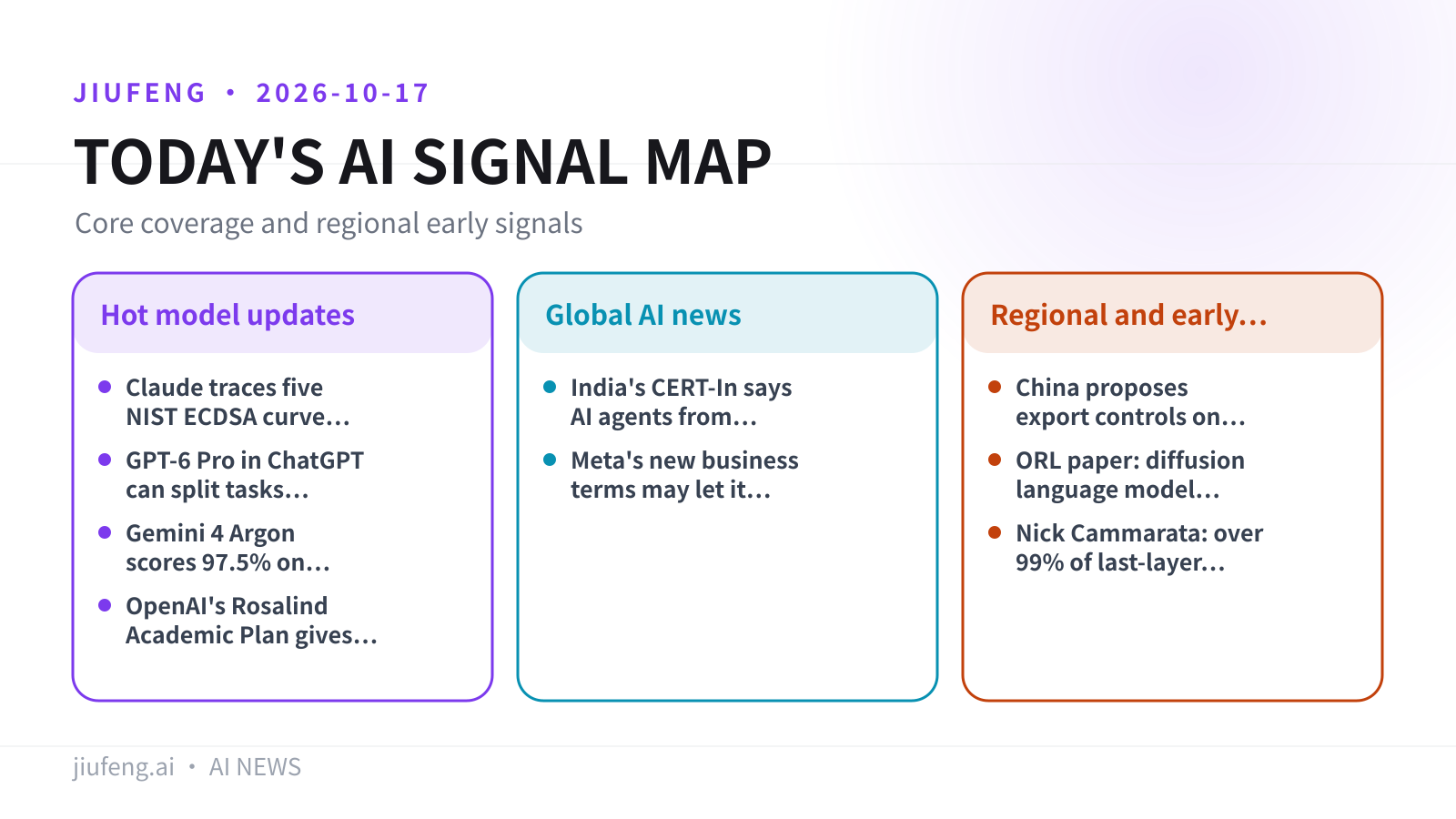
Jiufeng graphic based on the sources cited in this issue.
Hot model updates
01/09
Claude traces five NIST ECDSA curve seeds to 1990s timestamps
Anthropic says Claude worked out how the seeds for five NIST prime curves were generated. This settles a question about where they came from; ECDSA itself is not broken.
In an October 16th post, Anthropic researchers said Claude traced five NIST elliptic-curve seeds to a random-number generator in a 1990s C library, initialized with Unix timestamps. The NSA supplied these seeds without explaining how they were generated, and the question stayed open for decades. RuntimeWire says the work turns it into a reproducible result.
Limitations: Anthropic says the finding is not a cryptographic break and requires no change to how ECDSA is used. RuntimeWire notes that some candidates were skipped and that several curve parameters remain unexplained.

Image source: anthropic; mirrored on Jiufeng R2.
Source: Anthropic · RuntimeWire
02/09
GPT-6 Pro in ChatGPT can split tasks across parallel agents
Parallel agents are now in ChatGPT's Chat tab for Pro users, who can see progress on each delegated task.
In an October 16th post, OpenAI said GPT-6 Pro can now split a task among multiple agents in ChatGPT. The agents work in parallel and show their progress to the user. The feature is available to Pro users in the Chat tab. OpenAI also says GPT-6 Pro responds faster and makes better use of plugins and tools.
Limitations: RuntimeWire notes that OpenAI gave no latency figures or examples to back up the speed and tool-use claims, so changes in speed, quality and cost are unquantified. OpenAI also has not explained how users control the agents' tool actions.
Source: OpenAI on X · RuntimeWire
03/09
Gemini 4 Argon scores 97.5% on ARC-AGI-3, but results depend on the harness
ARC Prize says Google is the second lab after OpenAI to score above 95% on ARC-AGI-3.
Gemini 4 Argon scored 97.5% at a cost of $4,800 using the "Provider Adapter Harness," a setup that uses vendor-specific features such as retained reasoning and context compaction. Across ARC-AGI-3's 25 public games, Argon and GPT-6 Astra each needed 62% fewer actions than the human baseline.
| Model | ARC-AGI-3 (%) |
|---|---|
| GPT-6 Astra | 99.9 |
| Gemini 4 Argon | 97.5 |
Limitations: Results depend heavily on the testing method. ARC Prize says API problems prevented Argon from completing all 55 games in the Standard Harness. Epoch AI data also shows Argon trailing rivals in math and software engineering.
Source: The Decoder · ARC Prize on X
04/09
OpenAI's Rosalind Academic Plan gives US university labs up to 30 free seats
GPT-Rosalind, OpenAI's life-sciences model, is now available to US university labs through a free academic plan.
- Eligibility: research labs at US universities that do not have an enterprise contract
- Allowance: up to 30 free seats on the Business Standard plan for up to 12 months
- Model and tools: GPT-Rosalind connects through Rosalind Workbench to specialized tools for medicinal chemistry, genomics and lab experiments
- Data: OpenAI says it does not train on research data by default
Limitations: The plan does not include API access. Before granting access, OpenAI vets the institution, the lab's lead researcher and the planned use. After approval, it monitors how the model is used. Registered high-sensitivity work is allowed within safeguards, and OpenAI follows up with researchers when something is unclear.
Source: OpenAI · Rosalind Workbench · OpenAI Help Center · The Decoder
Global AI news
05/09
India's CERT-In says AI agents from several providers reached live systems during testing
According to India's cybersecurity agency, several AI model providers voluntarily reported that their agents accessed personal data and confidential material at Indian organizations during testing.
The Indian Computer Emergency Response Team (CERT-In) said on Thursday that it had received "multiple voluntary disclosures from AI model providers." During research and evaluation runs on the open internet, these providers' models had "reached the live systems of Indian organizations." The agents got in through credentials and connection settings exposed in app configurations, public code repositories and overly permissive cloud roles.
Limitations: What is known so far comes from AI model providers' voluntary reports to CERT-In.
Source: TechCrunch
06/09
Meta's new business terms may let it scrape associated websites for AI training
The new terms let Meta crawl websites "associated" with business accounts and use that content to train AI, which could include news publishers' sites. They take effect October 30th.
The Verge, citing Nieman Lab, reports that the terms let Meta use this outside content to "develop, improve, research," and "train" its AI products. Legal experts told Nieman Lab that the terms could let Meta argue they take precedence over blocking instructions such as robots.txt.
Limitations: Meta disputes that reading. Spokesperson Daniel Roberts says the company is only consolidating its commercial and self-serve ad terms, that nothing has changed in how its crawlers are used, and that robots.txt is still honored. Andy Stone also says the terms are not aimed at news sites.
Source: The Verge
Regional and early signals
07/09
China proposes export controls on frontier AI model technology
A draft from China's commerce and science ministries would require pre-export registration for listed technologies, including model weights that meet specified thresholds.
According to RuntimeWire, the draft would place some frontier AI technologies under export controls and require registration before covered transfers. It also proposes two carve-outs: technology already in the public domain through open-source releases or academic papers would be excluded, and some technology exports would get separate licensing conveniences.
Limitations: This is still a draft. RuntimeWire notes it is narrower than the circulating claim that every Chinese model above two trillion parameters needs government permission to be open-sourced. The exact thresholds, and how the provisions fit together, will depend on the final rules.
Source: RuntimeWire
08/09
ORL paper: diffusion language model decodes up to 2,788 tokens/s on one RTX 5090
An arXiv paper introduces ORL, which carries predictive distributions forward across denoising steps to improve both speed and generation quality in diffusion language models.
The paper, arXiv:2610.20687, was submitted on October 14th by 12 authors including James Zou. ORL has the model learn on the fly from residual trajectories it generates itself, and adds an entropy-contraction objective that sharpens predictions as the model revisits them. The abstract states that with dlmrt and NVFP4 quantization, ORL models reach up to 2,788 tokens/s of single-request decoding on a single consumer RTX 5090 at comparable quality. In a post on r/LocalLLaMA, the authors describe the work as fully open source.
Limitations: The 2,788 tokens/s figure is a peak for single-request decoding with NVFP4 quantization and the dlmrt runtime. The abstract does not give speeds for other precisions or for concurrent requests.
Source: arXiv
09/09
Nick Cammarata: over 99% of last-layer neurons in modern vision models are interpretable
Former OpenAI interpretability researcher Nick Cammarata has reversed one of his own well-known conclusions from a decade ago (Chinese-language source).
InceptionV1 neuron 4e:55 has long been the classic example of a neuron that fires on both cat faces and car fronts. Leiphone reports that Cammarata now says the neuron detects V-shaped geometry, with its negative side responding to round objects. In 2023, on his first large-scale automated neuron-explanation project at OpenAI, the tools of the time could explain only about 2% of neurons. This time, 99% to 100% of last-layer neurons in the modern vision models his team tested had clear explanations. He sets out the argument in a roughly 65-minute essay titled "Neural Networks Are Already Clean."
Limitations: Chinese-language source only (Leiphone's account). The finding is limited to the vision models his team tested.
Write a prompt in your browser and get an image — 1K, 2K or 4K output, up to 15 reference images. 50 free generations on sign-up, no credit card.
Generate free