Overview
8 stories in this issue. The first 3 are today's priorities.
Hot Model Updates
- Top · Meta releases two Muse Wonder models, with the Full version scoring 56
- Top · GPT-6 Sol, Luna and Astra get global cross-Region inference on Bedrock in Southeast Asia and Taiwan
Global AI News
- Top · Microsoft Research: clearing chat history helps agents escape "idea basins"
- AWS Ray LLM containers support multi-node inference with separate prefill and decode nodes
- SageMaker deploys decision models with llama.cpp and returns option probabilities directly
- Deepgram wants to run voice AI on offline laptops
Regional & Early Signals
- Qwen releases QwenGyre, an online RL framework for training on very long-horizon agent tasks
- CodeScene used Claude Opus to refactor 300,000 lines of C in three weeks
Hot Model Updates
01/08
Meta releases two Muse Wonder models, with the Full version scoring 56
Meta's new frontier model Muse Wonder Full moves into the top tier, with its biggest gains on agentic tasks, but each call costs nearly three times as much as its predecessor.
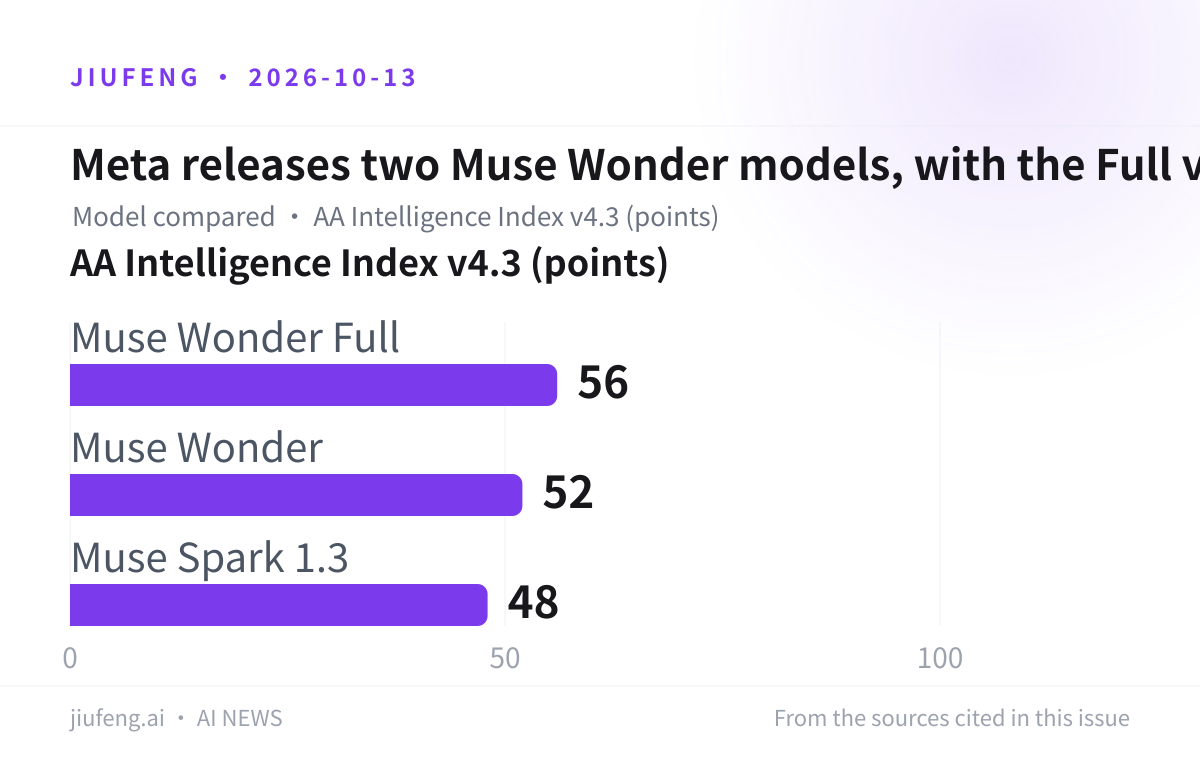
Meta has released its frontier model Muse Wonder in two versions: Muse Wonder and Muse Wonder Full. According to The Decoder, they score 52 and 56 on the Artificial Analysis Intelligence Index v4.3. The previous model, Muse Spark 1.3, scored 48.
| Model | AA Intelligence Index v4.3 (points) |
|---|---|
| Muse Wonder Full | 56 |
| Muse Wonder | 52 |
| Muse Spark 1.3 | 48 |
The largest gains are on agentic evaluations: Terminal-Bench 4.0 rose from 33% to 57%. Muse Wonder Full ranks in the top three on 6 of 10 benchmarks. Vals AI has also published Muse Wonder results on its index.
Limitations: Each API call to either version costs nearly three times as much as a call to Muse Spark 1.3. The report's conclusion that Meta has caught up with leading frontier models relies partly on Meta's own benchmark results.
Jiufeng graphic based on the sources cited in this issue.
Source: The Decoder · Vals AI Index
02/08
GPT-6 Sol, Luna and Astra get global cross-Region inference on Bedrock in Southeast Asia and Taiwan
Five AWS Regions (Singapore, Jakarta, Thailand, Malaysia and Taipei) can now call OpenAI's GPT-6 models through global cross-Region inference.
AWS says single-Region inference gets throttled when demand exceeds local capacity. Global cross-Region inference sends requests elsewhere to get past that limit. Availability by model:
| Model | Source Regions that can make calls |
|---|---|
| GPT-6 Sol | Singapore, Jakarta, Thailand, Malaysia, Taipei |
| GPT-6 Luna | Singapore, Jakarta, Thailand, Malaysia, Taipei |
| GPT-6 Astra | Asia Pacific (Singapore) only |
All calls go through the bedrock-runtime endpoint, using the Converse API, OpenAI-compatible APIs or coding clients. The post also covers IAM permissions and how to monitor inference from the source Region.
Limitations: Global cross-Region inference sends requests to be processed outside the source Region, so organizations that restrict access by Region with SCPs need to adjust their policies. aws-samples provides an example SCP for Bedrock cross-Region inference that exempts Bedrock invoke actions and uses an inference-profile ARN condition.
Image source: Amazon Web Services; mirrored on Jiufeng R2.
Source: AWS Machine Learning Blog · aws-samples SCP example
Global AI News
03/08
Microsoft Research: clearing chat history helps agents escape "idea basins"
Long-running research agents get locked into a narrow set of solutions by their growing context, and more compute doesn't get them out.
Microsoft Research studied "Autoresearch agents," AI systems that repeatedly propose solutions, evaluate them and improve them based on feedback. The same agent ran 8 times on the same task and ended with scores ranging from 68.3 to 100.0. The paper says the gaps remained even with substantially more compute.
The researchers plotted the solutions from all runs on a 2D map. Solutions from a single run almost always stayed in one small region, which the authors call an "idea basin." Their Fork-and-Flush method clears the chat history so the agent can explore again.
Limitations: The study was published as an arXiv paper. The 68.3–100.0 spread comes from 8 runs on one task, which is a small sample.
Source: The Decoder · arXiv paper
04/08
AWS Ray LLM containers support multi-node inference with separate prefill and decode nodes
AWS shows how to use its multi-node Ray LLM Deep Learning Containers to split one large model across two GPU nodes.
The tutorial deploys one LLM across two GPU nodes on Amazon EKS: one node handles prefill and the other handles decode, behind a single OpenAI-compatible endpoint. The container comes with:
- Ray Serve LLM: the distributed serving layer
- NVIDIA Inference Transfer Library (NIXL): moves inference data between nodes
- Elastic Fabric Adapter (EFA): AWS's high-speed networking stack
AWS lists three reasons to go multi-node: foundation or open-weight models too large for one GPU, needing more throughput than one replica can deliver, and splitting the two phases of inference to improve performance.
Limitations: This is a deployment tutorial, and readers need to set up their own EKS cluster and GPU nodes. The example covers only a two-node prefill/decode split.
Source: AWS Machine Learning Blog · NIXL on GitHub
05/08
SageMaker deploys decision models with llama.cpp and returns option probabilities directly
The same quantized model can either generate text or skip decoding and output probabilities over a fixed set of options.
AWS uses its llama.cpp Deep Learning Container to deploy decision models on SageMaker AI, with two deployment paths:
- Text generation: serves OpenAI-compatible chat completions through InvokeEndpoint
- Structured decisions: builds a child image that replaces the default runtime with SemIf (formerly OpenJev), which returns a probability for each declared option without decoding an answer token
- Hardware: the sample code includes both CPU and GPU deployment options
These models suit tasks that score a fixed set of choices, such as routing requests, picking agent actions or assigning policy outcomes. The post is part of AWS's series on specialized inference containers, following earlier posts on WhisperX and vLLM-Omni.
Limitations: The structured-decision path requires users to build and maintain their own child image instead of using the default DLC image.
Source: AWS Machine Learning Blog · llama.cpp on GitHub
06/08
Deepgram wants to run voice AI on offline laptops
Deepgram says it is working to run voice AI on personal devices, including air-gapped laptops.
Deepgram expanded its Flux model to 10 languages earlier this year. Staff technical program manager Nick Mann said the company has 45 researchers and tens of thousands of external customers, and both its research and its service need large amounts of compute and data.
Limitations: This was an interview recorded during Dell's AI Leadership Symposium, and the original article includes a disclosure. It gives no release date, hardware requirements or model specs for an offline laptop version.
Source: SiliconANGLE
Regional & Early Signals
07/08
Qwen releases QwenGyre, an online RL framework for training on very long-horizon agent tasks
QwenGyre lets agent tasks that run for hours and use millions of tokens serve as training data for online reinforcement learning.
QwenGyre splits GPUs into compute units. When a batch of tasks finishes, the freed units move to training right away, while tasks still running keep their progress and state. The framework uses Token-in Token-out to record the actual context each output was generated from and organizes the records into trajectory trees by shared prefix. Tasks that time out partway through can still give feedback through Partial Scoring.
- NL2RepoBench: with about 700K tokens per rollout, the pass rate rose from 52.5% to 58.5% after 48 training steps
- Training speed: on the same GPU budget, it runs 1.78x faster end to end than the Async approach, with training scores close to Async and Colocate
- Cross-task validation: on Qwen3.6-122B, NL2RepoBench, DeepSWE and TerminalBench all trained faster end to end
Limitations: All figures come from Qwen. The report doesn't say whether the framework is open source and doesn't link a paper or code.
Source: IT之家 (Chinese-language source)
08/08
CodeScene used Claude Opus to refactor 300,000 lines of C in three weeks
Coding agents spent about $4,000 in tokens and raised an open-source decompilation project's Code Health score from 5.6 to 10.0.
CodeScene published a case study on an open-source decompilation project of Street Fighter III: 3rd Strike, about 300,000 lines of C. Over three weeks, agents made 2,903 commits across 726 files and changed 252,055 lines of code.
A CodeHealth MCP Server gave the agents a deterministic quality score. To check correctness, a replay-trajectory test harness compared rollback state hashes frame by frame after every change. Along the way, the agents built their own refactoring playbook with 22 recipes and 82 supporting notes. The team did most of the work with Claude Opus and said Claude Code with Opus was clearly better than Codex with Sol at spotting and recording patterns. When smaller models were used, file scores often stopped improving.
Limitations: Some practitioners questioned how far the result applies. They asked whether the changes have been merged, whether they went in as one large merge or several, and whether an experiment on open-source code says anything about production code that earns revenue.
Source: InfoQ China (Chinese-language source)
Write a prompt in your browser and get an image — 1K, 2K or 4K output, up to 15 reference images. 50 free generations on sign-up, no credit card.
Generate free