Overview
9 stories in this issue. The first 3 are today's priorities.
Hot model updates
- Top · OpenAI publishes 372 AI-generated math results on GitHub
- Top · Mistral Large 4 enters public preview as a 1.05T MoE with 1M context
- Top · Musk says Grok Bot will route tasks to outside models
- Anthropic expands its Cyber Verification Program to three tiers, including Mythos 5.1
Global AI news
- Meta open-sources Rebalancer, a solver that handles about 40M assignment problems a day
- Musubi releases PolicyLM-1.7B, an open-weight moderation model
Regional and early signals
- Shanghai AI Lab open-sources Intern-Decision small decision models
- Gmail code points to a Gemini agent that drafts email replies
- Meshy ranks No. 31 on a16z's first consumer AI revenue Top 50
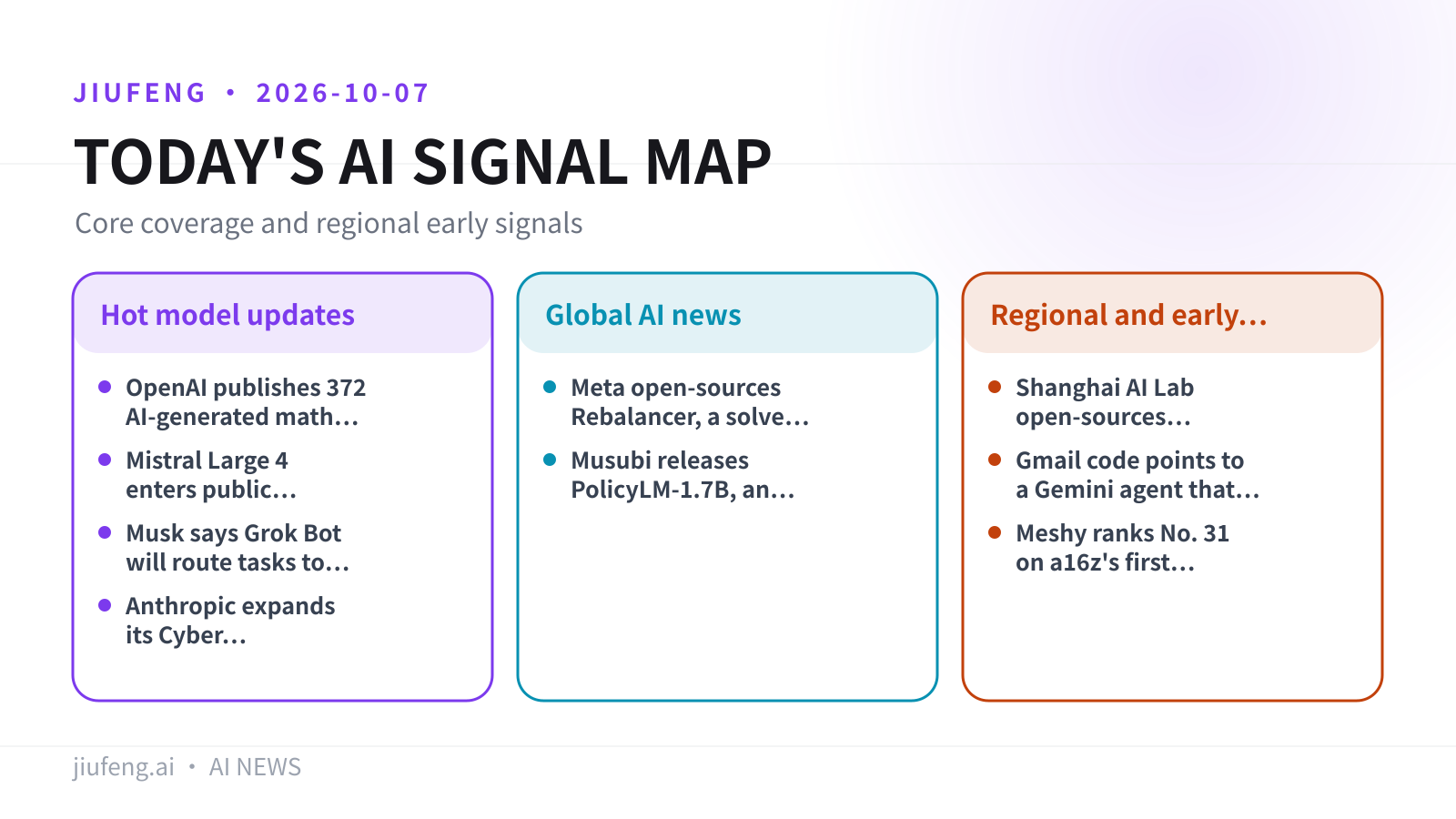
Jiufeng graphic based on the sources cited in this issue.
Hot model updates
01/09
OpenAI publishes 372 AI-generated math results on GitHub
OpenAI has posted 372 mathematical results from an internal frontier model on GitHub instead of submitting them to journals. Some include Lean formalizations for machine verification.
OpenAI says each result is meant to solve an open problem or make substantial progress toward one. The collection includes improvements to major computer algorithms and advances related to the Riemann hypothesis. The results are in the openai/math GitHub repository with revision logs and citations, and The Decoder reports that they include Lean formalizations for machine verification.
- How they were produced: most came from a single prompt to a single agent
- Compute: about three hours of ChatGPT Pro compute per result on average
- Venue: a GitHub repository, not academic journals
Limitations: The results come from an internal model that isn't publicly available, and the reporting doesn't name it. For now they are OpenAI's own claims and haven't been peer-reviewed in journals. OpenAI is relying on formal verification to make review more practical, but it isn't yet clear how mathematicians will check the collection.
Image source: GitHub; mirrored on Jiufeng R2.
Source: OpenAI · GitHub openai/math · The Decoder
02/09
Mistral Large 4 enters public preview as a 1.05T MoE with 1M context
Mistral opened API access to Mistral Large 4 ("Le Chonk") on October 6th and plans to release the weights after safety testing.
Mistral's official model documentation lists 1.05T total parameters and 52B active parameters. MarkTechPost reports 49B active per token. According to MarkTechPost, ML4 is a granular Mixture of Experts model trained from scratch on 3,800 NVIDIA Grace Blackwell GPUs in Mistral's own European datacenters.
- Multimodal: native image input with a 1.6B vision encoder
- Context: 1M tokens
- API price: $1.36 per 1M input tokens, $4.18 per 1M output tokens
- Safety: resists 93.3% of attacks on Lakera's B3 benchmark and scores 1.691 of 2.0 on KORABench
Limitations: The weights aren't out yet, so the model can't be self-hosted. TechCrunch says the weights will be released in about three weeks, once safety testing is complete. MarkTechPost puts the release at the end of October. TechCrunch also says that until then, the model is only available through a public guardrail endpoint.
Source: Mistral docs · TechCrunch · MarkTechPost
03/09
Musk says Grok Bot will route tasks to outside models
Elon Musk said Grok Bot will pick the "best back end model for any given task" and named Claude Opus 5.5, Midjourney and Suno.
On October 7th, Musk posted that SpaceX will let Grok Bot use outside AI services to give users a better result. SpaceXAI launched Grok Bot in beta on August 11th. Users can delegate work to it, and it acts inside their connected apps.
Limitations: RuntimeWire notes that the post describes a direction, not a technical launch. It doesn't say which tasks go to which provider or how the selection works. It also doesn't say whether users can choose a model, see which service handled a task, control the data sent to third-party APIs or turn off outside routing. It gives no pricing either.
Source: Musk on X · xAI: Introducing Grok Bot · RuntimeWire
04/09
Anthropic expands its Cyber Verification Program to three tiers, including Mythos 5.1
Qualifying security professionals can now apply for advanced cyber capabilities and less restrictive blocking classifiers.
On October 6th, Anthropic launched an expanded Cyber Verification Program with three access tiers. Every tier includes Claude Opus 5.5, Claude Sonnet 5.5, Claude Mythos 5.1 and future models. Anthropic says its generally available models, such as Opus 5.5, Fable 5.1 and Sonnet 5.5, have conservative cyber safeguards that block most cyber work.
- Defense Access: for defensive work, with a response within days of applying
- Red Team Access: adds authorized penetration testing, open only to organizations, with a review that takes weeks
- Specialized Access: the least blocking, with each applicant reviewed together with the US government. Glasswing members move into this tier
Limitations: Users have to apply and qualify before they get access. Anthropic acknowledges that its general models still flag some legitimate secure-coding work and says it is working to reduce these false positives.
Source: Anthropic
Global AI news
05/09
Meta open-sources Rebalancer, a solver that handles about 40M assignment problems a day
Meta has released Rebalancer under Apache 2.0. It's the assignment solver Meta has used for more than nine years to place shards, servers and traffic.
Rebalancer is a C++ library with a Python interface that decides which objects go into which bins under given constraints and objectives. At Meta, that means placing racks in datacenters, tasks on servers and user traffic in datacenters.
- Scale: about 40 million assignment problems a day
- Install:
pip install rebalancer(v1.0.4, Python 3.12+) - Platforms: prebuilt wheels for Linux x86-64 and macOS 14+ ARM64, plus .deb, .rpm and Homebrew packages
- Tooling: documentation and a debugging UI called Rebalancer Explorer
Limitations: PyPI still lists the project as Alpha.
Source: GitHub facebook/rebalancer · MarkTechPost
06/09
Musubi releases PolicyLM-1.7B, an open-weight moderation model
Musubi's 1.7B open-weight decision model checks messages against a content policy written in plain English, with a target latency under 50 ms.
PolicyLM-1.7B is built for real-time content moderation. Musubi says its cost and speed are similar to those of the AI classifiers most social platforms use for moderation. The company also says the model doesn't need retraining when a policy changes, so policy teams can revise their rules as often as they need to.
Limitations: The report doesn't give a license, accuracy figures or benchmarks. So far, the no-retraining claim comes only from the company.
Source: TechCrunch
Regional and early signals
07/09
Shanghai AI Lab open-sources Intern-Decision small decision models
Intern-Decision comes in 0.8B, 2B and 4B sizes. Instead of free text, it returns choices, scores and yes/no answers with probabilities.
According to Pandaily, MetaX shipped Day-0 support for the models.
Limitations: So far there's only a short news summary. The license, benchmark results and download location haven't been verified.
Source: Pandaily
08/09
Gmail code points to a Gemini agent that drafts email replies
An APK teardown suggests Gmail may add a Gemini agent that reviews the inbox and drafts replies, with user confirmation required before some emails are sent. (Chinese-language source)
IT之家 cites Android Authority as reporting that Gmail v2026.09.28 contains strings for a "Use Gemini" button next to to-do items in the AI inbox and a "Draft reply" option. When Gemini can't decide what to do next, the strings show a "Needs your input" status and a "Provide input" button.
Limitations: These are hidden strings in an app package. The feature hasn't launched, Google hasn't announced it, and the final version may look different.
Source: IT之家 (Chinese-language source)
09/09
Meshy ranks No. 31 on a16z's first consumer AI revenue Top 50
AI 3D model company Meshy ranks No. 31 on a16z's first monthly revenue ranking of consumer AI apps and is the only AI 3D company on the list. (Chinese-language source)
Meshy builds its own multimodal models for 3D generation, which turn text and images into 3D assets for games, film and 3D printing. The company says its ARR has passed $100 million and it has more than 15 million registered users. It also says it raised a Series B of nearly $400 million at a $1.5 billion valuation in July 2026.
Limitations: These figures come from Meshy's press release. Neither Chinese report links to the a16z list itself, and the revenue numbers haven't been independently verified.
Source: Leiphone (Chinese-language source) · QbitAI (Chinese-language source)
Write a prompt in your browser and get an image — 1K, 2K or 4K output, up to 15 reference images. 50 free generations on sign-up, no credit card.
Generate free