Overview
8 stories in this issue. The first 3 are today's priorities.
Major model updates
- Top · Qwen3.8-27B arrives on Nebius Token Factory
- Top · GPT-6 Astra Ultrafast offers up to 8× token generation speed
- Top · Claude research workflows get the open-source BootLoops toolkit
- Writing study identifies about 13,000 phrases favored by AI
Global AI news
- Tavus introduces Griffin with a limited research preview
- Ataraxos wins 15 games in a 20-game Stratego match
Regional and early signals
- Tesla plans to reduce AI6 memory from 216GB to 144GB
- Ai2 releases Olmo-core 3 for large-scale MoE training
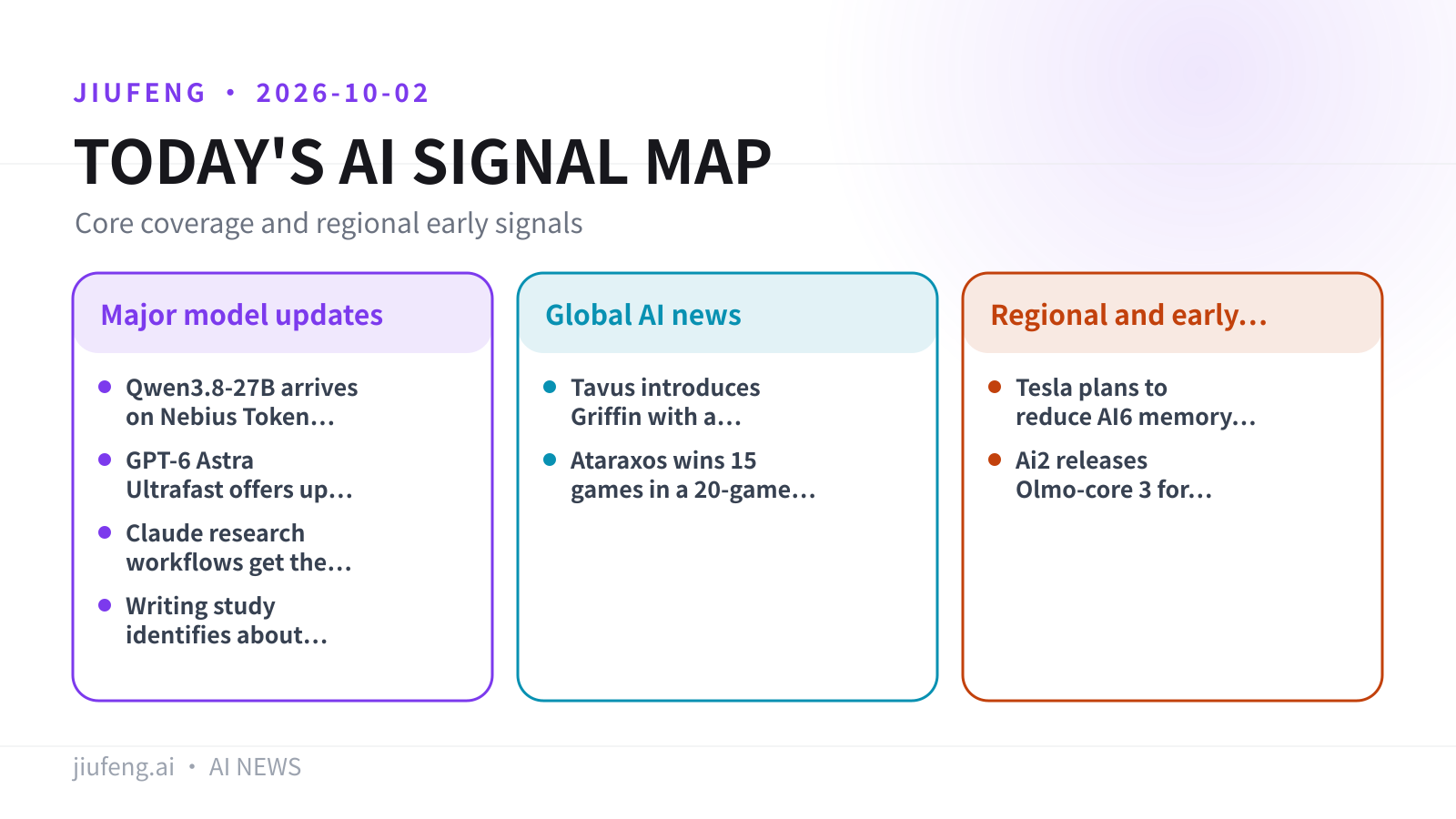
Jiufeng graphic based on the sources cited in this issue.
Major model updates
01/08
Qwen3.8-27B arrives on Nebius Token Factory
The 27-billion-parameter Qwen model gains a hosted inference route, with the shared API designated for testing.
Nebius announced Qwen3.8-27B availability on Token Factory on September 28, followed by a Qwen team post on September 30. The weights have been available since August; this update adds managed access without requiring users to operate their own inference stack.
Limitations: Nebius labels the shared endpoint as suitable for tests, not production, and warns that availability may change; the supplied material does not establish comparative pricing, speed or customer adoption.
Image source: huggingface; mirrored on Jiufeng R2.
Source: RuntimeWire · Nebius announcement · Qwen model card
02/08
GPT-6 Astra Ultrafast offers up to 8× token generation speed
NVIDIA says Ultrafast is available through the OpenAI API and to eligible ChatGPT Work and Codex users.
NVIDIA's October 1 post describes inference optimizations that use its Blackwell GPU architecture, with token generation speed as the comparison metric. Its published relative figures are:
| Astra mode | Relative token generation speed (×) |
|---|---|
| Standard | 1 (baseline) |
| Ultrafast | Up to 8 |
Limitations: The 8× figure is a vendor-reported maximum for token generation, not total coding-task completion time; ChatGPT Work and Codex access requires eligibility, with access and pricing details covered in OpenAI's guide.
Source: NVIDIA AI Blog · OpenAI Ultrafast guide
03/08
Claude research workflows get the open-source BootLoops toolkit
Physicist Matthew Schwartz has published tools for exact scientific calculations, with Anthropic describing Claude-based examples.
Anthropic's October 1 article introduces BootLoops, which Harvard physicist Matthew Schwartz assembled from software and protocols used in research calculations. Schwartz says Claude used the toolkit to connect mathematical physics techniques with problems in ecology, genetics and other fields, and the code is available on GitHub.
Limitations: BootLoops is Schwartz's project, supports different models and is not an Anthropic product; he stresses that technically correct calculations can lack scientific importance, leaving question selection and evaluation to experts.
Source: RuntimeWire · Anthropic research article · BootLoops code
04/08
Writing study identifies about 13,000 phrases favored by AI
A Graphite study identifies measurable word and phrase preferences in frontier-model writing.
According to TechCrunch, marketing firm Graphite identified about 13,000 phrases appearing at least twice as frequently in AI text as in human text, its definition of a writing “tell.” The report also describes persistent preferences for contrast-heavy constructions.
Limitations: These frequency differences describe patterns within the study's samples; the supplied excerpt does not provide sample size, corpus composition or accuracy for identifying an individual article.
Source: TechCrunch
Global AI news
05/08
Tavus introduces Griffin with a limited research preview
Tavus says 48% of study participants mistook Griffin for a person after a one-minute video call.
Griffin processes speech, facial expressions, tone, gestures and pauses while receiving and generating video in real time, under Tavus's “Human Interaction Model” label. The Decoder reports the following scores from what Tavus describes as an independent NVIDIA test of human likeness in direct audiovisual conversation:
| Test subject | Human-likeness score (points) |
|---|---|
| Humans | 3.92 |
| Griffin | 3.83 |
| Previous best AI model | 2.80 |
Limitations: The 48% result comes from Tavus's own study, and the characterization of the NVIDIA test as independent also comes from Tavus; Griffin-Lite is available only to selected research testers, with a stronger version awaiting resolution of safety concerns.
Source: The Decoder
06/08
Ataraxos wins 15 games in a 20-game Stratego match
Researchers report 15 wins, one loss and four draws against four-time world champion Pim Niemeijer.
A team from Carnegie Mellon, NYU, Stanford and MIT introduced Ataraxos in a Nature paper, with training reportedly costing less than $8,000. Stratego hides each player's piece identities from their opponent, and the result comes from an official 20-game series; the team has released its code.
Limitations: The authors qualify their claim of the first superhuman Stratego system as being to their knowledge.
Source: The Decoder · Ataraxos code
Regional and early signals
07/08
Tesla plans to reduce AI6 memory from 216GB to 144GB
IT Home reports that Elon Musk plans lower chip memory capacity to reserve supply for Optimus production.
Musk said Tesla would adjust memory configurations for AI5 and AI6, with the report specifying these AI6 figures:
| AI6 configuration | RAM capacity (GB) |
|---|---|
| Original plan | 216 |
| Revised plan | 144 |
Limitations: The reduction is approximately 33%, but Musk says bandwidth will remain unchanged and predicts a “negligible” effect on Optimus performance; this is his assessment of a planned configuration, supported here only by a Chinese-language source without operating test results.
Source: IT Home — Chinese-language source
08/08
Ai2 releases Olmo-core 3 for large-scale MoE training
Olmo-core 3 redesigns an open mixture-of-experts training framework with trillion-parameter scaling as its goal.
Ai2 introduced Olmo-core 3 on October 1, describing a system designed to extend MoE training into the trillion-parameter range while preserving computational efficiency. It is one of the core systems behind the next generation of Olmo, with code available on GitHub.
Limitations: Trillion-parameter scale is a stated design target, and the supplied excerpt does not report training throughput or cost at that scale; Ai2 also notes that MoE training still requires storing the full model across GPU memory and updating its parameters.
Source: Ai2 release article · Olmo-core code
Write a prompt in your browser and get an image — 1K, 2K or 4K output, up to 15 reference images. 50 free generations on sign-up, no credit card.
Generate free