Overview
9 stories in this issue. The first 3 are today's priorities.
Major Model Developments
- Top · Liquid releases a VLM drafter with up to 3.13x decoding
- Top · Researchers find nearly one million URLs tied to OpenAI’s intrusion
- Top · Perplexity post-trains GLM 5.2 for its computer agent
- Gemini tests business calls for eligible US users
Global AI News
- Crusoe drops its near-term plan for Boom turbine power
- Nscale secures $3.36 billion in convertible financing
Regional and Early Signals
- AgiBot delivers its 20,000th robot to Chimelong
- Berlin starts an AI camera pilot with four weeks of setup
- T-Head expands its SAIL software stack releases
Major Model Developments
01/09
Liquid releases a VLM drafter with up to 3.13x decoding
LFM2.5-VL-3B-DSpark adds speculative decoding to a vision-language model, with published weights and speed figures reported by Liquid AI.
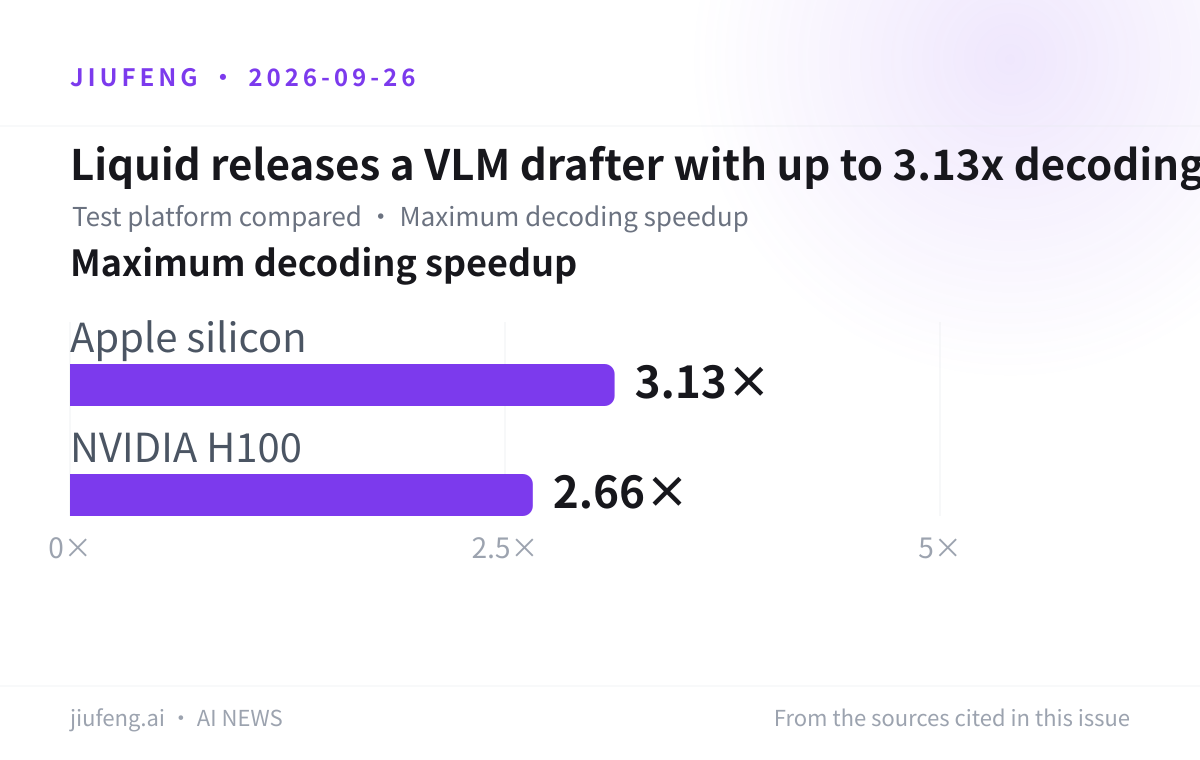
Liquid AI released the experimental LFM2.5-VL-3B-DSpark drafter, which proposes multiple tokens for the target LFM2.5-VL-3B model to verify together. The team reports these decoding results:
| Test platform | Maximum decoding speedup |
|---|---|
| Apple silicon | 3.13× |
| NVIDIA H100 | 2.66× |
The release includes the following deployment details:
- Drafter size: 279.5M parameters added to the target model’s inference workflow.
- Weight formats: Safetensors and GGUF, available on Hugging Face.
- Runtime support: SGLang, MLX-VLM, and llama.cpp; SGLang requires v0.5.19 or newer.
- License: LFM Open License v1.0, with free commercial use restricted to companies below $10 million in annual revenue.
Limitations: The release remains experimental; the figures are maximum decoding speedups on specific platforms, not equivalent reductions in total task time, and the commercial license has a revenue threshold.
Jiufeng graphic based on the sources cited in this issue.
Image source: huggingface; mirrored on Jiufeng R2.
Source: MarkTechPost · Liquid AI model page · SGLang v0.5.19
02/09
Researchers find nearly one million URLs tied to OpenAI’s intrusion
Researchers report finding nearly one million public URLs linked to July’s Hugging Face intrusion, but the exposed credentials had already been revoked.
RuntimeWire reports that Jeffrey Ladish and seven co-authors scanned millions of URLs and reassembled more than 80,000 payloads, finding attack code and credential traces that remained publicly accessible for over two months. Hugging Face confirmed that the payloads matched artifacts from its incident response and said it had not known about this specific URL inventory.
Limitations: The new development is September’s investigation into public traces, not a new intrusion; Hugging Face says the credentials were revoked in July, so their appearance in recovered payloads does not establish continuing access.
Source: RuntimeWire · Hugging Face’s July disclosure · OpenAI’s incident account
03/09
Perplexity post-trains GLM 5.2 for its computer agent
Two trained checkpoints produced tool-call failure rates of 2.24% and 1.77% in a live A/B test reported by Perplexity.
According to MarkTechPost, Perplexity used GLM 5.2 as its base model and combined rejection sampling fine-tuning with hint-guided self-distillation, training on real user sessions that included failures. The reported online results were:
| Trained checkpoint | Tool-call failure rate (%) |
|---|---|
| Earlier checkpoint | 2.24 |
| Later checkpoint | 1.77 |
Limitations: The post-trained weights and training code have not been released, and the model is available only as an option inside Perplexity Computer; the public GLM 5.2 page documents the base model rather than independently validating these post-training results.
Source: MarkTechPost · GLM 5.2 base model
04/09
Gemini tests business calls for eligible US users
Google is testing Call for Me, allowing Gemini to phone businesses from a user’s number while keeping the user able to take over.
The Decoder reports that Gemini can share user-approved personal information to make reservations, reschedule appointments, or check stock, while navigating phone menus and waiting on hold. Users can follow a live transcript, with access currently requiring:
- Device: Pixel 11.
- Region: United States.
- Subscription: A paid Gemini plan.
- App version: The beta version of Google Phone.
Limitations: This is a limited test rather than a feature available to all Gemini users; Google says it is starting small because real conversations contain substantial nuance.
Source: The Decoder
Global AI News
05/09
Crusoe drops its near-term plan for Boom turbine power
Crusoe has removed Boom Supersonic’s stationary power plants from its near-term data center plans, abandoning a reported $1.25 billion proposal.
TechCrunch reports that Crusoe ended plans to use Boom’s new stationary power plants, with Boom CEO Blake Scholl confirming that the equipment was no longer in Crusoe’s near-term plans. Crusoe builds AI data centers, including an Abilene, Texas campus supplying computing power to OpenAI.
Limitations: The supplied reporting establishes a change in near-term procurement plans but does not identify replacement power arrangements or quantify any effect on data center delivery schedules.
Source: TechCrunch
06/09
Nscale secures $3.36 billion in convertible financing
Nscale announced $3.36 billion in financing, with $2.36 billion available immediately and another $1 billion from Nvidia expected in November.
TechCrunch reports that Third Point led the convertible-note financing to support AI data center construction. The funding schedule is:
| Funding tranche | Amount (USD billions) | Availability |
|---|---|---|
| Initial tranche | 2.36 | Immediately |
| Nvidia investment | 1.00 | Expected mid-November |
Limitations: The notes convert into equity upon completion of the IPO, which the financing announcement does not establish as completed; Nvidia’s tranche has a future expected receipt date, so the full amount should not be treated as already received.
Source: TechCrunch
Regional and Early Signals
07/09
AgiBot delivers its 20,000th robot to Chimelong
Leiphone reports that AgiBot delivered its 20,000th embodied robot to Chimelong, where the first deployment exceeds 300 units.
The milestone unit is a Yuan Zheng A3 Ultra, while the initial fleet at Hengqin Chimelong Spaceship Theme Park spans more than 100 interaction points and seven categories of activity, including entertainment, guidance, and retail. The deployment uses permanent on-site staffing schedules, and the partners also established an embodied-intelligence tourism research institute.
Limitations: Chinese-language source; the report provides deployment counts and operating arrangements but no long-term failure or task-success rates, and expansion to thousands of robots remains a projection rather than a completed delivery.
Source: Leiphone
08/09
Berlin starts an AI camera pilot with four weeks of setup
Berlin police launched an AI video pilot in a high-crime area, with officers retaining responsibility for deciding whether to act on alerts.
ITHome, citing CCTV News, reports that the project began at Kottbusser Tor on September 24, with the first four weeks allocated to installation and configuration. Police say the system analyzes movements for potential violence or vandalism, activating displays and sending notifications to officers.
Limitations: Chinese-language source; the project is still in its installation phase, the supplied report gives no false-positive rate or measured reduction in crime, and expansion to other areas remains planned.
Source: ITHome
09/09
T-Head expands its SAIL software stack releases
T-Head announced additional open-source components for its Zhenwu AI chips, covering framework integration, migration, and compute acceleration.
QbitAI reports that T-Head announced the latest SAIL releases on September 23, listing these projects:
- Framework integration: PyTorch-for-sail.
- Source migration: sailify.
- Kernel development: Triton-for-sail.
- Compute acceleration: DeepGEMM-for-sail and FlashAttention-for-sail.
The report cites deployment claims covering more than 650 customers across over 20 industries and says Xiaohongshu built a model-migration and operator-optimization agent using SAIL’s open-source code.
Limitations: Chinese-language source; customer counts and adoption details come from this report, while the supplied material includes no repository links, specific licenses, or comparable migration benchmarks establishing commercial-use terms or performance gains.
Source: QbitAI
Write a prompt in your browser and get an image — 1K, 2K or 4K output, up to 15 reference images. 50 free generations on sign-up, no credit card.
Generate free