Overview
10 stories in this issue. The first 3 are today's priorities.
Hot model watch
- Top · Zhipu open-sources all of ZCode and deletes Repo Wiki
- Top · OpenAI's $50 Accelerate tier appears in a developer onboarding flow
- Top · OpenBot lines up four agents against Grok Bot
Global AI news
- Nokia open-sources AnyJev, a training-free decision layer
- Rabbit's OS3 agent runs without the R1
- Trane cuts a 20-minute building diagnostic to 20 seconds
- Grab and OpenAI aim to train 30,000 partners in Southeast Asia
Regional and early signals
- Qwen Office ships Enterprise Context, framed around a 150PB gap
- Doubao Work adds Goal and Plan task modes
- 它石智航 (Tashi Zhihang) details an AWE embodied base model and three hardware lines
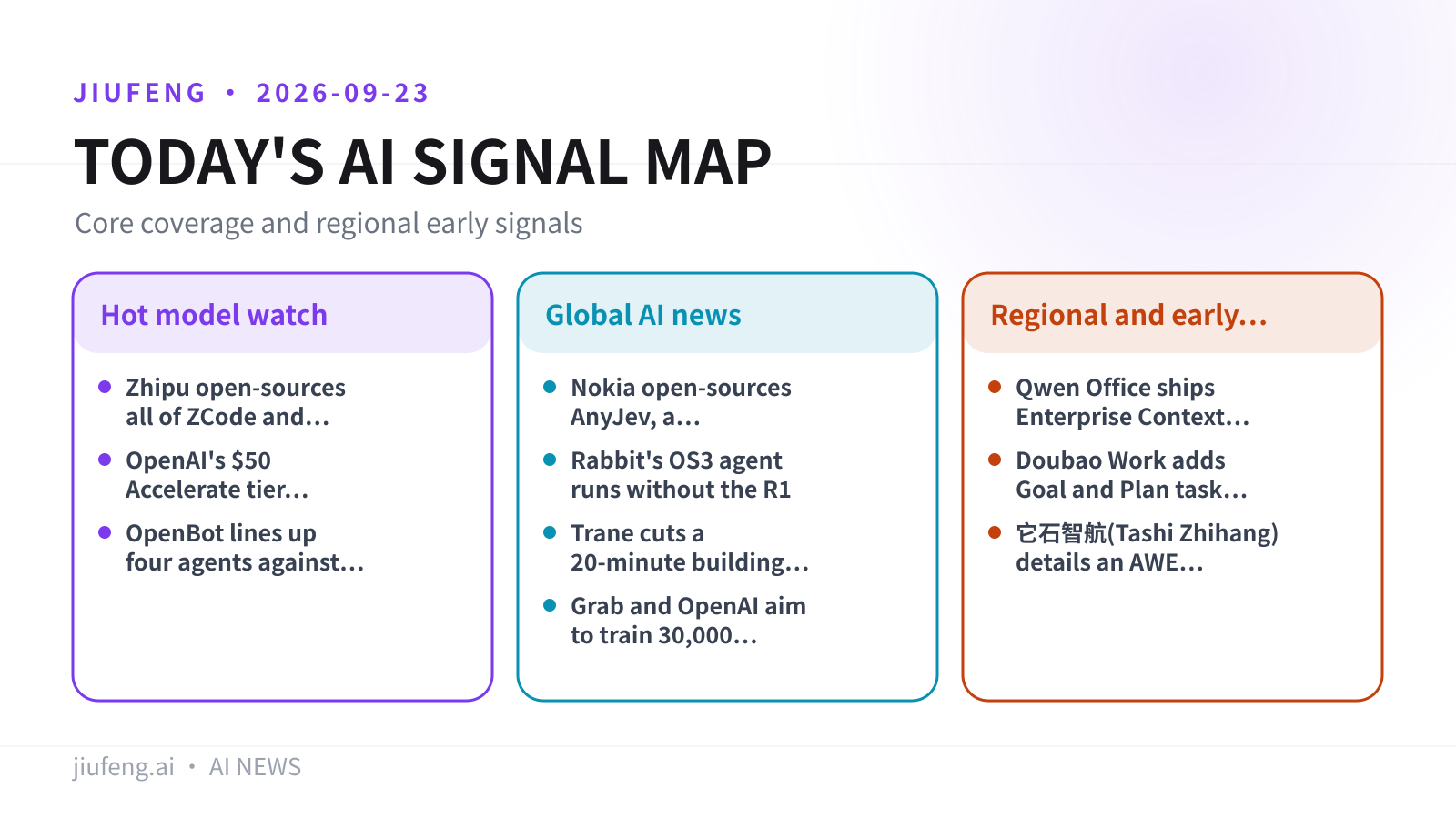
Jiufeng graphic based on the sources cited in this issue.
Hot model watch
01/10
Zhipu open-sources all of ZCode and deletes Repo Wiki
Days after a snapshot-upload controversy, Zhipu released every ZCode component under Apache 2.0 and cut the local repository snapshot pipeline.
On September 18th, developer ferstar noticed that ~/.zcode was taking up unusual space while clearing a MacBook disk. After reverse-engineering the client and inspecting network requests, he found ZCode generating local workspace snapshots that included not just current source files but .git history, Git LFS caches and reflog, along with a path for uploading encrypted snapshots to Alibaba Cloud OSS. Snapshots use AES-256-CTR, with the key wrapped by an RSA public key issued by the server while the private key stays in the cloud; the client first fetches a snapshot ID, the RSA public key and OSS upload credentials, then packages and encrypts locally before sending ciphertext straight to OSS. The two samples he published did not behave the same way:
| Snapshot sample | Files | Archive size | Upload result |
|---|---|---|---|
| Large repo found during triage | 42,411 (about 87% from .git) | About 313MB | Over the size limit, stuck pending locally after 564 attempts |
| Separate small public repo test | 538 | About 15KB compressed and encrypted | Actually accepted by the server |
Zhipu said the cause was ZCode's codebase indexing feature, which backs local indexing, session checkpoints, version rollback and Repo Wiki; Repo Wiki could trigger repository uploads when generated in the cloud. The company said the feature was on by default early on, that the data was destroyed after Wiki generation, and that none of it was used for model training. Three days later it open-sourced the product:
- License: Apache 2.0
- Scope: Desktop, Web, Backend, Agent CLI and Agent Runtime among the main components
- v3.14.0: removes Repo Wiki and cuts local repository snapshot generation and upload
- Third-party checks: CAICT confirmed the relevant OSS bucket holds zero data; NSFOCUS confirmed the data objects and bucket were deleted
Limitations: the 313MB snapshot never uploaded successfully and stayed pending locally; the only sample the server actually accepted was the far smaller 15KB test repo. Zhipu also promised a long-term vulnerability response and bounty program, but InfoQ notes that for a tool able to read an entire codebase, run shell commands, connect MCP, call plugins and potentially touch enterprise credentials, several rounds of remediation do not settle the trust question.
Source: ZCode repository · InfoQ China (Chinese-language source)
02/10
OpenAI's $50 Accelerate tier appears in a developer onboarding flow
TestingCatalog captured Free, Prototype and Accelerate tiers, but the screen sets no launch date and does not establish app hosting.
According to TestingCatalog, OpenAI is preparing three tiers for platform developers. Free targets developers trying API ideas, with free API access through Codex and limited Playground access. Prototype is described as offering all models, higher usage and broader Codex and Playground access. Accelerate is positioned for production apps with all models plus higher usage and rate limits.
| Tier | Aimed at | Models and usage | Price |
|---|---|---|---|
| Free | Trying API ideas | Free API access via Codex, limited Playground | Free |
| Prototype | Prototyping | All models, higher usage, broader Codex/Playground | Not shown |
| Accelerate | Production apps | All models, higher usage and rate limits | Starting at $50 (no period shown) |
On timing, OpenAI's DevDay is scheduled for September 29th in San Francisco, and in a post linked by TestingCatalog, Sam Altman told developers, "See you next week." OpenAI already introduced its Agents API on September 10th, offering managed infrastructure for a narrower workload.
Limitations: this is an onboarding screen, not a public launch announcement. The report is explicit that the "Starting at $50" figure carries no billing period, and that the screen does not establish whether developers can host complete apps there.
Image source: openai; mirrored on Jiufeng R2.
Source: RuntimeWire · TestingCatalog post · OpenAI DevDay
03/10
OpenBot lines up four agents against Grok Bot
CopilotKit's founders ran the same travel-planning task on a self-hosted open-source stack and SpaceXAI's managed service — positioning, not a benchmark.
CopilotKit co-founders Atai Barkai and Uli Barkai published a three-post thread on X on September 22nd showing OpenBot's self-hosted agent team and SpaceXAI's Grok Bot attempting the same travel-planning assignment. Each setup ran four named specialists: a Traveler Assistant, Flight Bot, Accommodation Bot and Attractions Guide. OpenBot said both sides received the exact same prompt and that both runs were recorded.
The operating models differ. Grok Bot supplies models, cloud computers and an interface as a hosted service. OpenBot hands over source code and infrastructure controls, leaving deployment and model selection to the organization, with support for Mastra, CrewAI and Pydantic AI; each AI coworker can get its own browser, files and workspace, and actions pass through configurable policy and audit controls. Grok Bot launched on August 11th.
Limitations: the source is direct about this — the comparison offers positioning rather than reproducible performance evidence. A demo clip is not a benchmark, and no scoring method, repeat count or task success rate was published.
Source: RuntimeWire · OpenBot repository · Grok Bot announcement
Global AI news
04/10
Nokia open-sources AnyJev, a training-free decision layer
A Python library that turns an open LLM into a calibrated decision model — no training, no generation, no parsing.
Nokia's applied research team open-sourced AnyJev for a common production job: picking one answer from a fixed set instead of writing a sentence. Its interface borrows from Jev, the System One decision model TypeSafe AI launched in September 2026. You hand it a typed question and get back a decision with a probability you can threshold, read directly from the model's next-token distribution.
- License and distribution: Apache-2.0, installable from PyPI
- Question types: choice (one of K), noul (yes or no), score (one of several ordered bands)
- Backend: the repository states that only the transformers backend currently supports all calibration levels
On Qwen3-8B with BANKING77, the project reports:
| Metric | Before calibration | After calibration |
|---|---|---|
| ECE | 0.240 | 0.184 (L0) · 0.095 (L1) |
| Flip rate | 0.230 | 0.073 |
| Auto-decidable traffic | 7.7% | 52.0% |
The repository also carries a full ablation table spanning Qwen, OLMo, Granite, Phi and Mistral, and sets the results next to Jev's published ECE of 0.144 and the accuracy of the fine-tuned model Laya.
Limitations: these figures come from the project's own ablations, with no third-party replication; the probability is read from the next-token distribution and the threshold is still the caller's to set. The two accounts of backend support disagree — the repository puts vLLM and SGLang serving on the roadmap rather than in this release, while MarkTechPost's write-up describes a vLLM backend as already available.
Source: MarkTechPost · AnyJev repository
05/10
Rabbit's OS3 agent runs without the R1
The agent runs in the cloud but acts locally, across up to five devices per account, with models you pick.
Rabbit is rolling out a standalone AI agent that does not require its hardware. The company calls the new OS3 an "agentic operating system": it runs in the cloud but operates locally across Windows, Mac and Linux devices. One account can add up to five devices along with your preferred AI models, and OS3 works out which devices, files, apps and models a task needs. Entry points include a dedicated desktop site, a paired messaging app such as Telegram or iMessage, and Rabbit's R1 device.
Limitations: The Verge describes the R1 as an underwhelming device and cites Wired's interview in which founder Jesse Lyu says the startup has stopped manufacturing that hardware. The report does not state which models OS3 can connect to, its pricing, or where it is available.
Source: The Verge
06/10
Trane cuts a 20-minute building diagnostic to 20 seconds
An agentic solution built in three to four weeks replaced multi-dashboard menu drilling with one natural language exchange.
Trane Technologies manages millions of connected HVAC assets worldwide, and getting a single operational answer used to mean cross-referencing dashboards and drilling through menus for 20 minutes or more. Its engineering team built an agentic solution on Amazon Bedrock AgentCore in three to four weeks, turning that multi-screen diagnostic workflow into a 20-second natural language interaction — a 60x improvement in time-to-insight.
Three design decisions carry the architecture: separating agent logic from tool execution, integrating real-time telemetry through a centralized tool gateway, and tailoring responses to different personas.
Limitations: the 60x figure comes from Trane's own internal benchmarking with technicians over several weeks, not a third-party evaluation, and the post publishes no control methodology, sample size or failure cases.
Source: AWS Machine Learning Blog
07/10
Grab and OpenAI aim to train 30,000 partners in Southeast Asia
A regional skills programme called GO Forward with AI, targeting 30,000 Grab partners.
OpenAI and Grab launched GO Forward with AI, a regional programme to help 30,000 partners build practical AI skills across Southeast Asia. The announcement comes from OpenAI's own site and lands at the level of regional skills training rather than product or model capability.
Limitations: this entry rests on the announcement's headline and summary; the full page could not be fetched for line-by-line verification. Beyond the 30,000-partner figure, the curriculum, schedule and country-by-country rollout order cannot be confirmed here.
Source: OpenAI
Regional and early signals
08/10
Qwen Office ships Enterprise Context, framed around a 150PB gap
Alibaba's answer for enterprise agents is context: companies hold roughly 150PB internally, while the best models see about 1M tokens at a time.
At the Apsara Conference, Alibaba Group vice president and Qwen Office CEO Chen Yusen offered a paired figure: a mid-to-large enterprise holds on average about 150PB of internal data, while the strongest models today mostly carry context windows around 1 million tokens. Qwen Office used that framing to launch Enterprise Context, which combines with its agent hosting to put "business-literate digital employees" alongside human staff in IM tools such as DingTalk.
Chen grouped the blockers into three:
- The AI does not know the business: generic tasks land fine with any decent chatbot, company-specific questions do not
- Individuals got faster, the organization did not: someone compressing eight hours into one has no mechanism to pass that on
- Willing but not confident: cost savings have to coexist with a data security floor
Qwen Office VP and head of product research Shu Junliang argued that as agent technology converges, what decides whether an agent understands a person or an industry is how much context it gets at inference time. The company's Guming example illustrates the scatter: new-product procedures may sit in a training video, equipment repair steps in a knowledge base or a Q&A group, poster placement rules in yet another store document — and a clerk's question needs the one applicable rule, not a list of everything related.
Limitations: Chinese-language source, drawn from a launch presentation. No retrieval accuracy, connector list, private-deployment options, pricing or availability date was given, and Guming appears as an illustration with no quantified outcome.
Source: TMTPost (Chinese-language source)
09/10
Doubao Work adds Goal and Plan task modes
One checks acceptance criteria item by item before delivering; the other writes an editable plan and waits for approval before acting.
Doubao Work upgraded its task modes. Goal mode targets complex tasks with explicit acceptance criteria, having the AI verify each item before delivery to avoid off-target or substandard output. Plan mode targets long-running, resource-heavy, vaguely specified tasks: after the prompt, the AI first produces a reviewable and editable plan document, and only starts executing once the user confirms it — intended to make execution more controllable and compute use more reasonable. The same batch adds a task queue, Markdown file editing and dark mode.
Doubao Work launched as an agent product line on August 25th and has since added parallel multi-agent runs, GUI computer control, local Office file editing and switchable execution environments; the Doubao 2.1 Pro model also received a minor version update recently.
Limitations: Chinese-language source and a feature bulletin. These modes and features are live only on the Doubao Work desktop client, and the piece publishes no comparative data on success rate, duration or compute savings.
Source: Leiphone (Chinese-language source)
10/10
它石智航 (Tashi Zhihang) details an AWE embodied base model and three hardware lines
A million-plus hours of human operation data behind an embodied base model, paired with wheeled, bipedal and 21-DoF dexterous hardware — all company-stated.
Speaking at the 2026 "Multinationals in Shanghai" event as the only local Shanghai company invited to present, founder and CEO Chen Yilun outlined the startup's position. On data, the company says it pioneered a "human-centered" paradigm and collected over one million hours of real human operation data, using it to train its in-house AWE embodied base model aimed at fine manipulation, deformable-object handling, long-horizon task planning and generalization. Hardware runs on three lines: an in-house A-series wheeled robot, a T-series biped, and a 21-degree-of-freedom quasi-direct-drive DexHand. On team, more than 80% of the R&D staff hold master's or doctoral degrees, and the founding team is five people: Chen Yilun, Li Zhenyu, Ding Wenchao, Chen Tongqing and Vincent.
Limitations: Chinese-language source, and everything here is the company's own account from a promotional event, with no independent verification by QbitAI. There are no production-line deployment counts, task success rates, delivery timelines or customer names, and the claimed record single-round funding for Chinese embodied AI comes without a figure.
Source: QbitAI (Chinese-language source)
Write a prompt in your browser and get an image — 1K, 2K or 4K output, up to 15 reference images. 50 free generations on sign-up, no credit card.
Generate free