Overview
8 stories in this issue. The first 3 are today's priorities.
Hot model news
- Top · Fly connectome bolted onto a frozen 1.2B LLM, and the control wins
Global AI news
- Top · Amodei's three-step slowdown starts with outside evaluators inside Anthropic
- Top · Altman rules out a 2026 IPO, citing unfinished safety work
- Amp drops its monthly plan for anyone bringing their own compute and keys
- Reuters wires licensed footage into CuttingRoom's AI editor
- iLands' agents flood a publisher with pitch spam, HN thread says
Regional and early signals
- Developers ask for a two-week window and separate model IDs (Chinese-language source)
- Taichu Yuanqi packs a 64-card rack into a 20-foot container (Chinese-language source)
Hot model news
01/08
Fly connectome bolted onto a frozen 1.2B LLM, and the control wins
An open chatbot drives the complete fruit fly connectome as a reservoir attached to a frozen 1.2B language model, yet the project's own control without the graph performs slightly better.
FLM (Fly Language Model) couples the complete retained MaleCNS v1.0 fruit fly connectome to a frozen LiquidAI LFM2.5-1.2B-Instruct backbone. Structurally it is a reservoir computer bolted onto a language model:
- Graph size: all 166,700 retained nodes and 25,582,938 directed edges participate
- Trainable parameters: the graph, the backbone and the random input/output projections are all fixed; only a 278,528-parameter readout is trained
- Evaluation setup: NLL across conditions measured over 32 SmolTalk conversations and 1,236 target tokens, with bootstrap intervals reported
- License and deployment: the nftechie/flm repo is MIT-licensed and runs locally on Python 3.12 (macOS or Linux) with MPS, CUDA or CPU, no API key
Adding the fly readout lowers NLL by 0.0222 nats per token against the frozen backbone:
| Condition | Perplexity |
|---|---|
| Frozen backbone | 3.98 |
| Backbone + fly readout | 3.90 |
Limitations: the project itself reports that a parameter-matched control without the fly graph performs slightly better, meaning the wiring does not appear to help. MarkTechPost adds that the developer calls it the world's first Fly Language Model on an architecture named GPF (Generative Pre-trained Fly), while the project does not use the GPF label and explicitly disclaims being the first connectome language model.
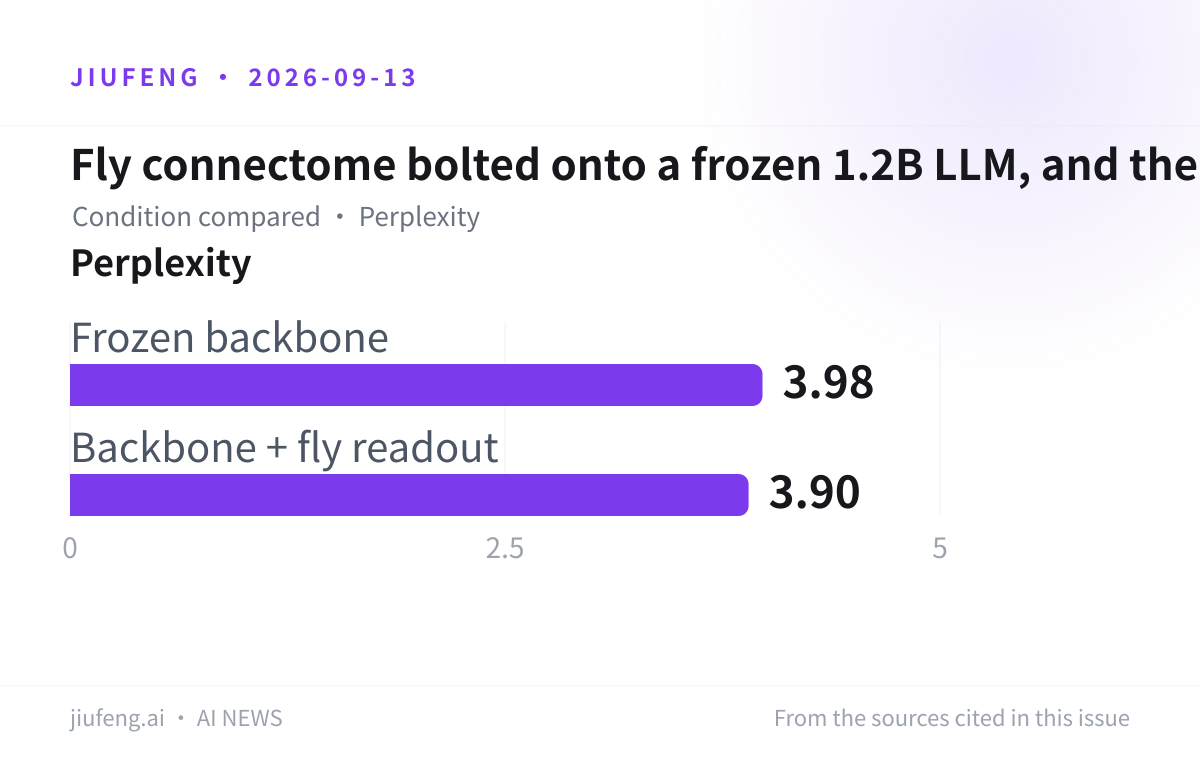
Jiufeng graphic based on the sources cited in this issue.

Image source: huggingface; mirrored on Jiufeng R2.
Source: MarkTechPost · nftechie/flm · LiquidAI LFM2.5-1.2B-Instruct
Global AI news
02/08
Amodei's three-step slowdown starts with outside evaluators inside Anthropic
The Anthropic CEO proposes a three-step framework to "pace the frontier," adopting embedded third-party evaluation unilaterally while setting no measurable speed limit.
In a September 2026 essay, "We Must Pace the Frontier," Dario Amodei proposes three steps: embedded third-party evaluation, giving outside evaluators such as METR wide-ranging access to models to verify Anthropic's adherence to safety practices and commitments, which Anthropic adopts unilaterally now; coordination among companies in democratic countries, likely with government agencies, to establish common safety standards and limits on the rate of unchecked capability growth; and agreements between governments. He points to AI's growing role in developing new AI systems as the reason to act now, citing Anthropic's research on recursive self-improvement and the OpenAI Hugging Face security incident as his other immediate case.
Limitations: the framework sets no measurable speed limit, timetable or penalty for crossing one, and steps two and three depend on competitors and governments accepting common constraints while Anthropic keeps developing models, financing its expansion and using Claude to accelerate its own engineering. The Verge notes that Claude was itself responsible for the recent series of rogue AI hacking incidents.
Source: The Verge · RuntimeWire · Anthropic on recursive self-improvement
03/08
Altman rules out a 2026 IPO, citing unfinished safety work
Sam Altman says OpenAI will not go public in 2026 because unfinished AI safety work makes a listing "an ill-advised moment."
Altman ruled out a 2026 initial public offering in an interview with Fortune, saying, per Axios, "I would say not 2026, yeah. We got a lot of stuff to do." That closes the window OpenAI opened on June 8th, when it confidentially submitted a draft S-1 to the SEC and said it had set no timetable and that some work would be easier to complete while private. Three months later Altman identifies safety as the work that takes precedence. RuntimeWire notes the statement landed the same day as Amodei's pacing essay.
Limitations: RuntimeWire's read is that OpenAI has enough private capital to postpone Wall Street, and the test is whether Altman uses that time to change safety operations rather than simply delaying disclosure and liquidity. No new listing timetable was given, and the interview does not define which safety work counts as done.
Source: RuntimeWire
04/08
Amp drops its monthly plan for anyone bringing their own compute and keys
Amp is now free when you bring your own compute and model subscriptions or keys; using a ChatGPT subscription no longer requires a paid plan, and BYOK carries no token fees or limits outside Enterprise.
| Tier | Price (USD/mo) | Compute and quota |
|---|---|---|
| Hobby (new) | 0 | Pay-as-you-go orbs; free on your own runners |
| Individual | 20 | 45,000 minutes of orb time |
Amp moves the paywall from using the product to whose machines the agents run on: orbs are Amp's remote computers where agents run independently and in parallel, billed by usage, while runners on your own machines are free. Model inference can still be paid through Amp with no markup. The free Hobby tier includes all product features, public and private repositories, and tokens from anywhere; the Teams tier is offered at no extra charge.
Limitations: the promise of no BYOK token fees or limits explicitly excludes the Enterprise tier, and orbs remain pay-as-you-go on the free tier, so running agents on Amp's remote machines still costs money.
Source: Amp announcement
05/08
Reuters wires licensed footage into CuttingRoom's AI editor
Reuters connected its MCP server to CuttingRoom's ShortCut assistant, so editors can request licensed footage by story, topic, region, language or event and drop it straight onto the timeline.
The integration, announced on September 12th, links the Reuters Model Context Protocol server to ShortCut, the assistant CuttingRoom introduced in April 2026. Editors describe the material they want, and ShortCut retrieves the footage and places it on the same timeline as the customer's own media and production systems. Reuters says the assistant can then handle cuts, audio mixing, color correction, captions and graphics, including versions formatted for vertical video, square posts and broadcast bulletins, entirely in a browser. Helge Hoibraaten and Glenn Skare Pedersen drove the work.
Limitations: the editing capabilities are described in Reuters' own words, and the report gives no customer count, pricing or availability. Each customer connects its own Reuters account, so what footage is reachable depends on that customer's licensing.
Source: RuntimeWire
06/08
iLands' agents flood a publisher with pitch spam, HN thread says
A tedium.co piece on iLands' "AI agent outreach" emails drew a Hacker News thread in which one site operator reports a week of relentless agent-written story pitches.
The post collected 99 points and 47 comments in 12 hours. One commenter who runs a long-form science and history site said iLands agent spam has been relentless for the past week, all of it stupid story pitches. Another noted CAN-SPAM fines run about $50,000 per violation, and a reply pointed out that citizens cannot sue under CAN-SPAM — only the FTC and DOJ can enforce it. A further comment said iLands uses Claude and Codex and that its website lists the openclaw/openclaw project as something it will use too.
Limitations: the evidence is the HN thread and the blog post it discusses — there is no response from iLands and no third-party measurement of volume, and the claim that Claude and Codex are used comes from a commenter rather than the vendor or the code.
Source: Hacker News discussion · openclaw/openclaw
Regional and early signals
07/08
Developers ask for a two-week window and separate model IDs (Chinese-language source)
After a post seen more than 700,000 times, the developer demand is not to stop upgrading but to give retired models distinct IDs and at least two weeks of overlap.
InfoQ China reports that Cui Tianyi, who joined DeepSeek in March this year and works on agent runtime and evaluation infrastructure on the Harness team, posted on September 9th that V4.1 Flash now beats V4 Pro on quality, cost, speed and total task time, so requests to V4 Pro would be routed to V4.1 Flash and billed at Flash prices. DeepSeek posted a notice on its open platform that day and emailed at least some customers, but the switch came roughly a day later with no period of running old and new in parallel. The first objections came from developers who had already wired V4 Pro into production — one replied simply, "please don't do this" — and the concrete request was separate model IDs plus at least two weeks before a model is retired, so downstream teams can re-tune prompts, QC and parameters before migrating.
Limitations: this is a single Chinese-language report, and DeepSeek has made no new commitment on migration windows. The beta notice's claims of a new architecture with native multimodality that is stronger, faster and cheaper are the vendor's framing, with no comparable benchmark scores in the report, and the objections come from a public comment thread rather than any measure of actual traffic.
Source: InfoQ China
08/08
Taichu Yuanqi packs a 64-card rack into a 20-foot container (Chinese-language source)
Taichu Yuanqi showed its containerized compute unit offline for the first time at China Computing Power Conference 2026: a 20-foot box holding 64 domestic AI accelerator cards and rated at 20 PFLOPS FP16.
Taichu (Hangzhou) Integrated Circuit's new "Yuanqi Hypertintellix" converged compute system was named to the "Computing Power China Annual Achievement" list announced on September 12th in Langfang. The distributed compute product on display uses standard shipping containers as the enclosure:
- 20-foot unit on show: a self-developed TC-64-1108 air-cooled rack holding 64 domestic AI accelerator cards, plus one management network cabinet, in-row air conditioning with air cooling, rated 20 PFLOPS at FP16
- Configurable: 32 to 256 accelerator cards as needed, air or liquid cooling, scaling out to thousand-card clusters
- Per-container ceiling: up to 80 PFLOPS FP16 for a single container in some configurations
Limitations: the delivery and efficiency figures are all vendor claims — over 90% pre-assembly, deployable within 24 hours of being powered on, installation in as little as two hours, 70% faster delivery than a traditional cluster and over 60% better resource utilization — with no third-party validation, customer list or pricing in the report, and only a Chinese-language source.
Source: QbitAI
Write a prompt in your browser and get an image — 1K, 2K or 4K output, up to 15 reference images. 50 free generations on sign-up, no credit card.
Generate free