Overview
9 stories in this issue. The first 3 are today's priorities.
Hot model updates
- Top · Small models win OpenAI's Codex "Build Small" hackathon
- Top · DeepSeek V4-Flash tops OpenRouter's weekly token ranking
- Top · Kimi K3 leans on native multimodality (Chinese-language source)
Global AI news
- Amp lets you attach any file for its agent to read
- Amazon Bedrock adds automatic Automated Reasoning policy refinement
- Valar Atomics raises $1B to mass-produce small nuclear reactors
- AI-proctored exam collapses; 58,000 students must retake it
Regional & early signals
- Tencent Cloud open-sources Agent Memory to bank team know-how (Chinese-language source)
- A billion-DAU app cut its GPU cluster ~75% via multi-cloud (Chinese-language source)
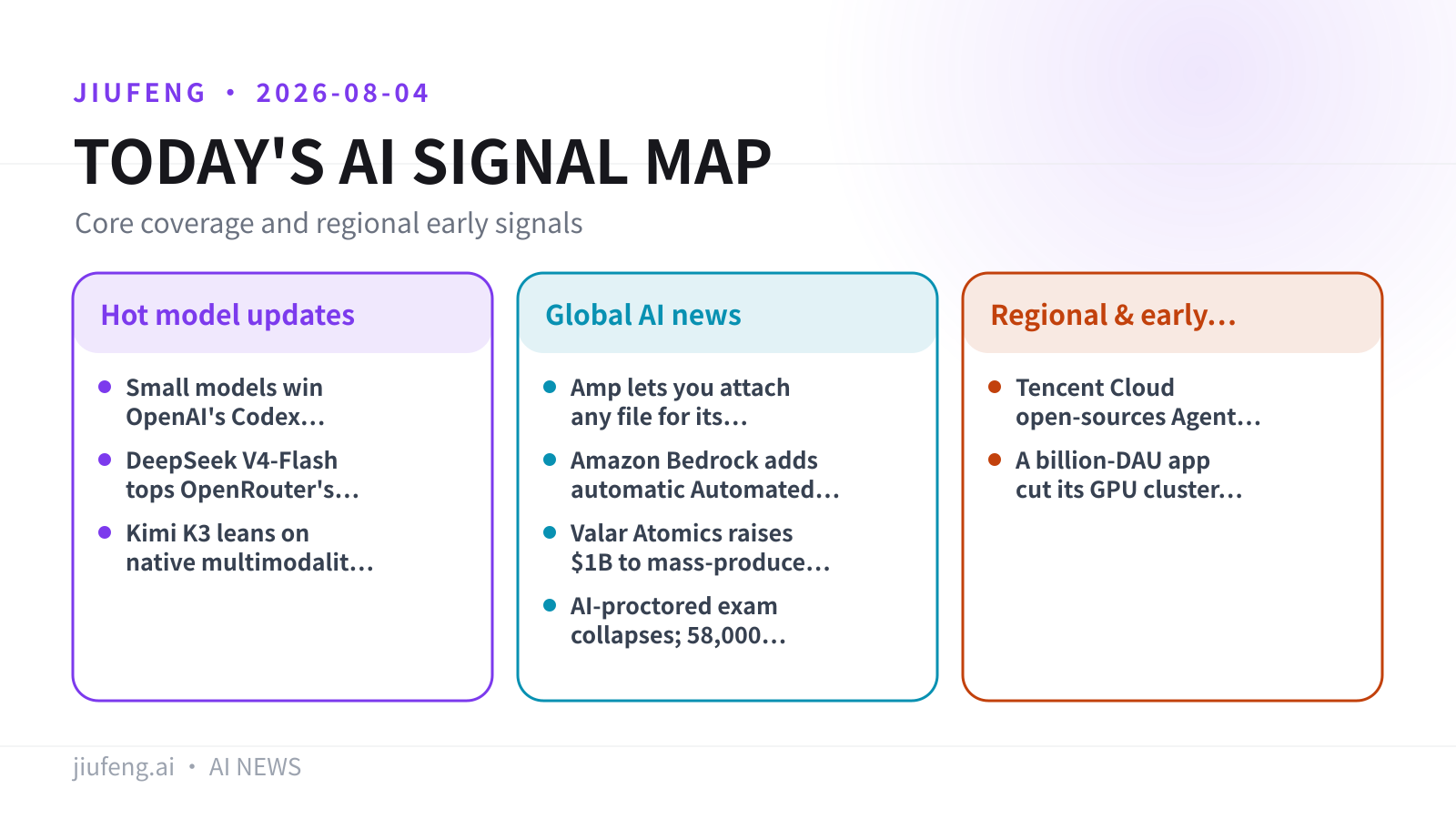
Jiufeng graphic based on the sources cited in this issue.
Hot model updates
01/09
Small models win OpenAI's Codex "Build Small" hackathon
Takeaway: Gradio's "Build Small" hackathon capped entries at 32 billion parameters, and three small-model apps split a $10,000 OpenAI Codex prize.
Hugging Face-owned Gradio announced the results of its "Build Small" hackathon in a five-post thread on X on August 3rd, awarding a $10,000 prize sponsored by OpenAI Codex to entries capped at 32 billion parameters. First place and $5,000 went to Tiny Narrator, submitted by GitHub user cvpfus — a screen-reader prototype that combines compact language, vision and text-to-speech models to narrate web content — followed by Blood Test Explainer and Uta Sensei.
RuntimeWire frames the winners as evidence that coding agents and local small models are converging into a practical build stack, letting small teams ship private, inspectable AI tools without calling a large hosted model for every request. Judging criteria and any further prize details are per the official announcement.
Image source: GitHub; mirrored on Jiufeng R2.
Source: RuntimeWire · Tiny Narrator (Hugging Face) · Repository (GitHub)
02/09
DeepSeek V4-Flash tops OpenRouter's weekly token ranking
Takeaway: DeepSeek V4-Flash led OpenRouter's weekly ranking with 7.1 trillion tokens, and Chinese models took nine of the global top ten slots.
Per Pandaily, DeepSeek V4-Flash topped OpenRouter's weekly ranking with 7.1 trillion tokens; Chinese models claimed nine of the global top ten slots, and global weekly AI token usage crossed 56.8 trillion. The chart reflects each model's actual call volume on OpenRouter.
OpenRouter's ranking measures usage, not capability; the figures come from Pandaily's report without an official leaderboard snapshot, and the exact methodology and time window are per the platform.
Source: Pandaily
03/09
Kimi K3 leans on native multimodality (Chinese-language source)
Takeaway: Per 36Kr, Moonshot's Kimi K3 — a 2.8-trillion-parameter MoE with a 1M-token context — makes native multimodality its key differentiator from DeepSeek V4.
According to 36Kr, Kimi K3, released in July, is a mixture-of-experts model with 2.8 trillion total parameters and a 1M-token context whose standout trait, beyond coding and long-horizon agent skills, is native multimodality: image and text data jointly shape the base model from pre-/continued-pretraining and are further optimized in post-training, feeding the agent's perception and feedback loop. The piece quotes a multimodal researcher arguing that long-chain tasks relying only on code-level feedback accumulate errors, whereas vision is a more accurate signal closer to user intent.
The article is 36Kr's comparative analysis (titled "Between Kimi K3 and DeepSeek V4 lies a native-multimodal time gap"); the "time gap" is the author's assessment rather than vendor benchmark data, and no verifiable multimodal leaderboard scores are given. No global English reporting corroborates it yet.
Source: 36Kr (Chinese-language source)
Global AI news
04/09
Amp lets you attach any file for its agent to read
Takeaway: Coding agent Amp now accepts any uploaded file — videos, logs, PDFs, spreadsheets, datasets — for the agent to see and use.
In an official post, Amp says users can now upload any file to their orbs for Amp to read and use, including videos, logs, PDFs, spreadsheets and datasets. Suggested uses include screen-recording an app and asking Amp to fix or improve what it sees, debugging from log files, turning presentations and spreadsheets into interactive websites, generating videos and CAD files from media inputs, and transcribing video and audio.
The post is a capability announcement and does not list file-size caps, a full supported-format list, or processing latency; results depend on the quality of the uploaded material.
Source: Amp Chronicle (official)
05/09
Amazon Bedrock adds automatic Automated Reasoning policy refinement
Takeaway: Amazon Bedrock now automatically refines Automated Reasoning policies, diagnosing failing tests and proposing formal-logic fixes.
Per the AWS Machine Learning Blog, Amazon Bedrock now supports automatic Automated Reasoning policy refinement: the refinement engine diagnoses failing test cases and proposes formal-logic fixes for both rule issues and language issues, which users can apply to update their policies.
This is an official product post with thin detail; it gives no verifiable accuracy gains, coverage scenarios or pricing. Capabilities and limits are per AWS documentation.
Source: AWS Machine Learning Blog (official)
06/09
Valar Atomics raises $1B to mass-produce small nuclear reactors
Takeaway: Nuclear startup Valar Atomics closed a $1B Series B to move from prototype small reactors to production-line manufacturing for the AI industry.
Per SiliconANGLE, Valar Atomics said it raised a $1 billion Series B led by Sequoia Capital with nine other venture firms participating, to move from building prototype small nuclear reactors to manufacturing them at scale on a production line, aimed at the AI industry's power demand.
The report does not disclose reactor output, a production timeline, or regulatory-approval status; small modular reactor commercialization remains gated by nuclear-safety review cycles.
Source: SiliconANGLE
07/09
AI-proctored exam collapses; 58,000 students must retake it
Takeaway: An AI-supervised remote exam failed so badly that 58,000 students must retake it, with top scores having jumped fivefold.
Per Ars Technica, an AI-supervised remote exam went badly enough that 58,000 students must retake it; the report says top scores increased 5×.
Detail is thin: the summary does not name the exam, its administrator, or the AI-proctoring vendor, nor does it pin down whether the 5× jump reflects cheating or system failure — that is per the original article.
Source: Ars Technica
Regional & early signals
08/09
Tencent Cloud open-sources Agent Memory to bank team know-how (Chinese-language source)
Takeaway: TencentDB Agent Memory, now open-sourced, tries to turn past chats, project docs, code and team SOPs into reusable, governable "memory assets" rather than a bigger knowledge base.
Per InfoQ China, Tencent Cloud released and open-sourced TencentDB Agent Memory, arguing the bottleneck in moving agents from "usable" to "good" is memory, not single-shot inference. It frames the approach in four layers — what is worth remembering, how team experience becomes assets, how those assets are governed, and validating the capability via open source and evaluation — and stresses distilling task context and judgments into assemblable memory assets rather than a larger knowledge base. The project is on GitHub.
The InfoQ piece is largely methodological; the excerpt gives no verifiable evaluation scores, recall rates or latency. It is single-source Chinese reporting; the first-hand evidence is the official GitHub repo.
Source: InfoQ China (Chinese-language source) · TencentDB-Agent-Memory (GitHub)
09/09
A billion-DAU app cut its GPU cluster ~75% via multi-cloud (Chinese-language source)
Takeaway: QbitAI reports a billion-DAU overseas AI app, squeezed by inverted inference costs, cut its GPU cluster by about 75% with a multi-cloud architecture.
Per QbitAI, an overseas "AI outfit + shopping recommendation" app reached a billion daily actives — users upload a selfie and it generates a composited lock-screen scene with shopping links in real time — but with emerging-market ARPU of only about $2 and prior rental of a top-two cloud's NVIDIA L4 GPUs (priced $0.7–8/hour by configuration, ~12 seconds to generate one HD image, ~3 equivalent inferences per user per day), it faced a "the more it runs, the more it loses" cost inversion. After switching to a multi-cloud architecture, it cut its GPU cluster size by roughly 75%.
The report names neither the app nor the cloud providers; the cost and reduction figures come from the interviewed team's own account, unaudited, and per-region/per-instance pricing may differ. Single-source Chinese media.
Source: QbitAI (Chinese-language source)
Write a prompt in your browser and get an image — 1K, 2K or 4K output, up to 15 reference images. 50 free generations on sign-up, no credit card.
Generate free