Overview
9 stories in this issue. The first 3 are today's priorities.
Hot models & AI agents
- Top · Unity opens a CLI for AI agents to operate live game projects
- Top · Google releases Gemini 3.6 Flash, 3.5 Flash-Lite and 3.5 Flash Cyber
- Top · Skyfall plans to buy a small business and hand it to an "AI CEO"
- Anthropic opens "AI for Science" grants for rare-disease research
- pi 0.81.0 integrates the llama.cpp router
Global AI news
- Deezer says more than half of daily uploads are now AI-generated
- Grabette: an open system to record robot-manipulation data
Regional & early signals
- Zhipu signals a 1GW all-domestic compute cluster and in-house chip plans
- XPower pushes distributed inference with small "RPP" chips
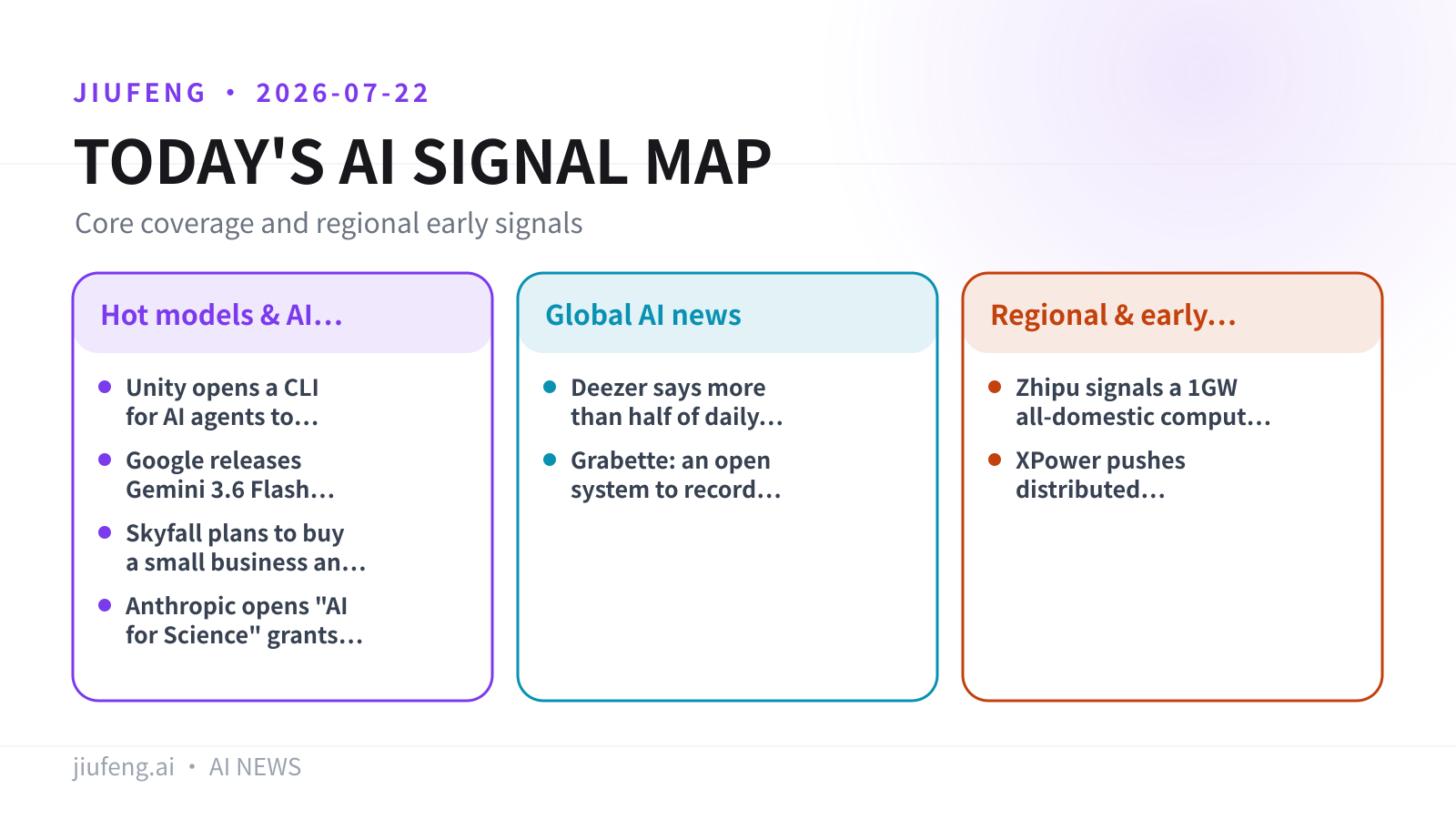
Jiufeng graphic based on the sources cited in this issue.
Hot models & AI agents
01/09
Unity opens a CLI for AI agents to operate live game projects
Unity turns the Editor into a programmable endpoint that teams and AI agents can drive from outside it.
Unity opened a closed beta on July 21 that lets game-production teams and AI agents work with Unity projects through a web dashboard, a REST API and a command-line interface (CLI) — without every participant (producers, artists, QA staff and agents) having to operate inside the Editor. General availability is planned for November.
RuntimeWire notes Unity is turning the Editor into a "programmable endpoint" for whole production teams and agents, and that a planned subscription-and-consumption model could expand Create revenue beyond traditional Editor seats — but it remains a closed beta, and both GA and the pricing details are still "planned," not shipped.
Source: RuntimeWire · Unity (X)
02/09
Google releases Gemini 3.6 Flash, 3.5 Flash-Lite and 3.5 Flash Cyber
Three new Flash-tier Gemini models aimed at building AI agents at scale.
Google DeepMind announced three new models on July 21: Gemini 3.6 Flash, Gemini 3.5 Flash-Lite and Gemini 3.5 Flash Cyber. Tulsee Doshi, Senior Director of Product Management on the Gemini team, framed them around the efficiency, latency and reliability needed to "build AI agents at scale."
The announcement does include benchmarks and pricing: versus 3.5 Flash, Gemini 3.6 Flash posts DeepSWE 49% vs 37%, MLE Bench 63.9% vs 49.7%, OSWorld-Verified 83.0% vs 78.4% and GDPval-AA v2 1421 vs 1349, with about 17% lower output-token usage, priced at $1.50/$7.50 per 1M input/output tokens; Gemini 3.5 Flash-Lite emphasizes throughput (~350 output tokens/s) at $0.3/$2.5; Flash Cyber cites the CyberGym benchmark but gives no specific scores or price. On Hacker News (171 points, 100+ comments), some developers criticized Google's product churn — e.g., phasing out AI Ultra subscriptions and pushing them off Antigravity. That is community feedback, not an official statement.
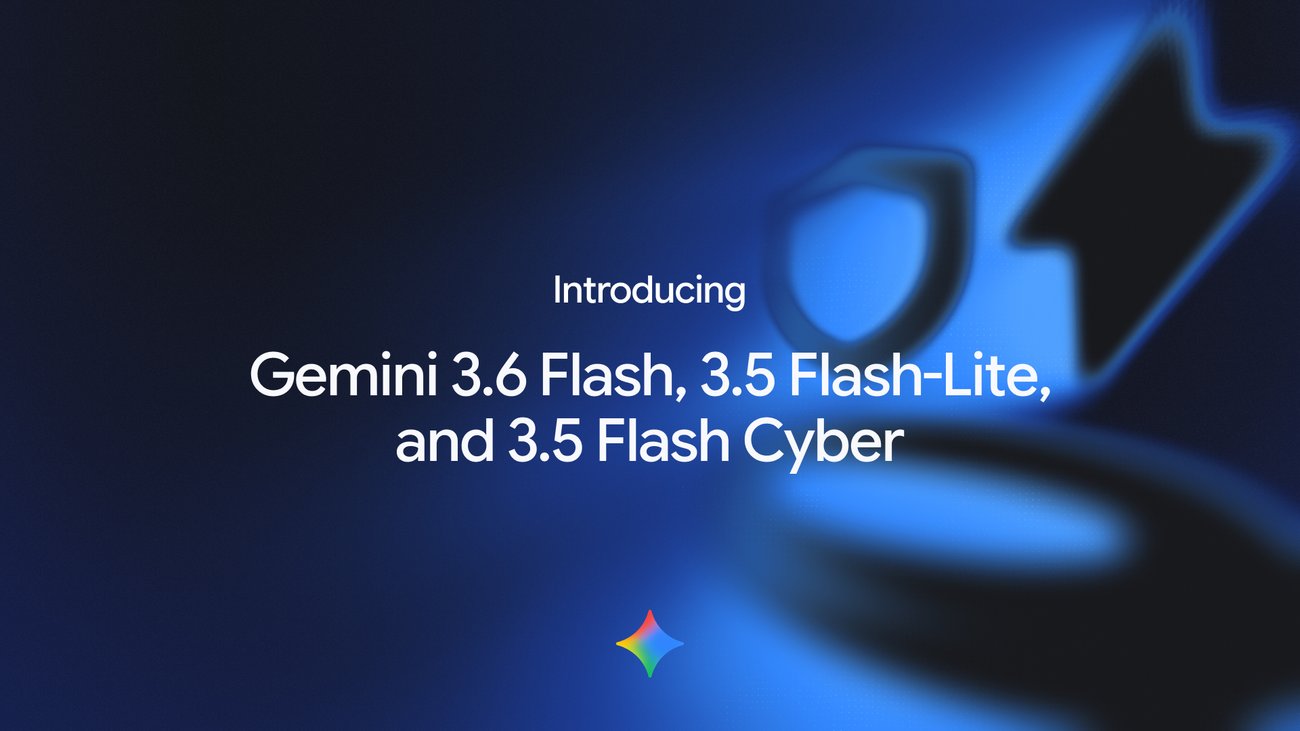
Image source: Google; mirrored on Jiufeng R2.
Source: Google DeepMind · blog.google · Hacker News
03/09
Skyfall plans to buy a small business and hand it to an "AI CEO"
Maluuba's founders will spend up to $1M on an "AI CEO" test and publish the wins and failures.
Maluuba founders Sam Pasupalak and Kaheer Suleman plan to have Skyfall AI acquire a small B2B SaaS or e-commerce business for up to $1 million, then hand pricing, marketing, customer support, finance and operations to an AI system designed to act as chief executive; they say they will publish the experiment's wins and failures.
RuntimeWire stresses that Skyfall is putting capital and a real operating business behind the "AI CEO" claim, but that the target, the baseline and human overrides will decide whether the test proves autonomy or "merely showcases automation." The piece notes the largest developers are taking a different path: OpenAI's Frontier platform aims to deploy AI coworkers inside existing organizations, while Anthropic has tested Project Vend.
Source: RuntimeWire · OpenAI Frontier · Anthropic Project Vend
04/09
Anthropic opens "AI for Science" grants for rare-disease research
Selected researchers get up to $50,000 in Claude credits over six months for rare genetic disease work.
Under its "AI for Science" program, Anthropic issued a focused call for applications on rare genetic diseases; accepted researchers will receive up to $50,000 in Claude credits over six months. Since launching last spring the program has backed projects ranging from drug repurposing to quantum simulation. The announcement points to Monarch Initiative contributors building an agent-friendly mechanistic disease-classification library, DisMech.
Limitations: this is a compute/credits grant (API access), not a research result, and the credits are explicitly capped (six months, $50,000).
Source: Anthropic · DisMech (GitHub)
05/09
pi 0.81.0 integrates the llama.cpp router
pi 0.81.0 adds llama.cpp router support, discovering and loading multiple GGUF models on demand.
pi 0.81.0 adds integrated support for the llama.cpp router server (llama-server router): the router discovers multiple GGUF models in a models directory and loads or unloads them on demand. It requires a current, router-capable llama.cpp build, and you start llama-server without --model (passing one drops it into single-model mode). Surfaced via r/LocalLLaMA, the poster says it can replace the earlier huggingface/pi-llama extension or manual model management.
Limitations: this comes from the community, with the poster hedging it "seems to be able to replace" the older setup; it depends on a router-capable llama.cpp build, with the llama.cpp GitHub repo as the primary reference.
Source: pi docs · llama.cpp (GitHub)
Global AI news
06/09
Deezer says more than half of daily uploads are now AI-generated
Deezer reports ~90,000 AI tracks uploaded per day in June, with AI now over half of daily uploads.
Music streamer Deezer says the share of AI-generated track uploads has kept climbing and now exceeds 50% of daily uploads. The company said June 2026 was a peak, with AI-generated tracks averaging about 90,000 per day that month. Deezer has tracked the metric since last year, and the number has steadily risen.
Limitations: these are Deezer's own platform figures (a single company's numbers), and "AI-generated" depends on Deezer's own detection; the announcement does not detail its detection method.
Source: TechCrunch
07/09
Grabette: an open system to record robot-manipulation data
Pollen Robotics open-sources a system on Hugging Face to record manipulation data and build a shared dataset.
The Pollen Robotics team published Grabette on Hugging Face on July 21: an open system to record robot-manipulation data and to build a shared community dataset together; the project is maintained on GitHub. The hardware is spelled out: the handheld Grabette has a ~€490 BOM (a cheap wide fisheye plus an RGBD camera, an IMU and a gripper), the companion Gripette gripper is ~€120 (a camera plus two servomotors), and it also uses a Raspberry Pi, a Pi camera, an off-the-shelf OAK-D depth camera and magnetic encoders.
Limitations: this is an early data-collection tool and dataset effort, not a trained model; the page gives no overall dataset size or license (only an example dataset with 200 recorded demonstrations).
Source: Hugging Face · GitHub
Regional & early signals
08/09
Zhipu signals a 1GW all-domestic compute cluster and in-house chip plans
Per Pandaily, Zhipu is building a 1GW all-domestic-chip data center, acquiring compiler startup Zhongke Jiahe, and exploring custom AI chips.
Per Pandaily, Zhipu AI is building a 1GW data center using all-domestic chips, acquiring compiler startup Zhongke Jiahe, and exploring custom AI chip development to accelerate its decoupling from the Nvidia ecosystem.
Evidence boundary: this rests on a single Tier-2 report (Pandaily; thin sourcing) with no first-party announcement; the data center's timeline, scale and "custom chip" progress are unspecified, and the "exploring" stage is an unconfirmed plan that can't yet be cross-verified.
Source: Pandaily
09/09
XPower pushes distributed inference with small "RPP" chips
Per Pandaily, XPower showed RPP-architecture AE7100E chips at WAIC — 12 per card, claimed to run 400B–1.6TB-parameter models.
Per Pandaily, XPower Technology showed its RPP-architecture AE7100E chips at WAIC: each fingernail-sized, 12 to a card, using distributed computing to support 400-billion-to-1.6-trillion-parameter models at what it calls the lowest token cost.
Evidence boundary: a single Tier-2 report (Pandaily; thin sourcing) built on vendor claims from a WAIC demo; "lowest token cost" is the vendor's framing, with no independent benchmarks or measured data, and remains unverified.
Source: Pandaily
Write a prompt in your browser and get an image — 1K, 2K or 4K output, up to 15 reference images. 50 free generations on sign-up, no credit card.
Generate free