Overview
9 stories in this issue. The first 3 are today's priorities.
Hot Model Updates
- Top · OpenAI folds its robotics team again, betting on general models like GPT-6 Astra
- Top · Ex-researcher Coxon says Anthropic could retrain Mythos with a fraction of the original compute
- Top · DeepSeek opens its app's search, file, OCR and voice tools as APIs
Global AI News
- llama.cpp and ggml reach v1.0.0 and adopt semantic versioning
- Vercel open-sources UI SDK, with 50+ UI behaviors for coding agents
- Inkitt details its automated PR system: the model is the easy part
- Grok Bot can now join video meetings and take on work
- Claude Code on desktop adds custom themes built as mods
Regional and Early Signals
- The Endless Frontier opens Fx-Bio-1031 weights, a Qwen-based bioinformatics model
Hot Model Updates
01/09
OpenAI folds its robotics team again, betting on general models like GPT-6 Astra
In an Nvidia simulation study, a general-purpose model beat specialized robotics models, and OpenAI no longer keeps a standalone robotics team.
The Decoder, citing Fortune, reports that OpenAI is breaking up its standalone robotics team for the second time. The aim is to move faster on robotics, not to drop it. Robotics researchers move to the main research team under Chief Research Officer Mark Chen. The applied robotics and hardware teams join Greg Brockman's Applied organization. The decision came so suddenly that the booth OpenAI had already booked at the Conference on Robot Learning (CoRL) in Austin sat empty.
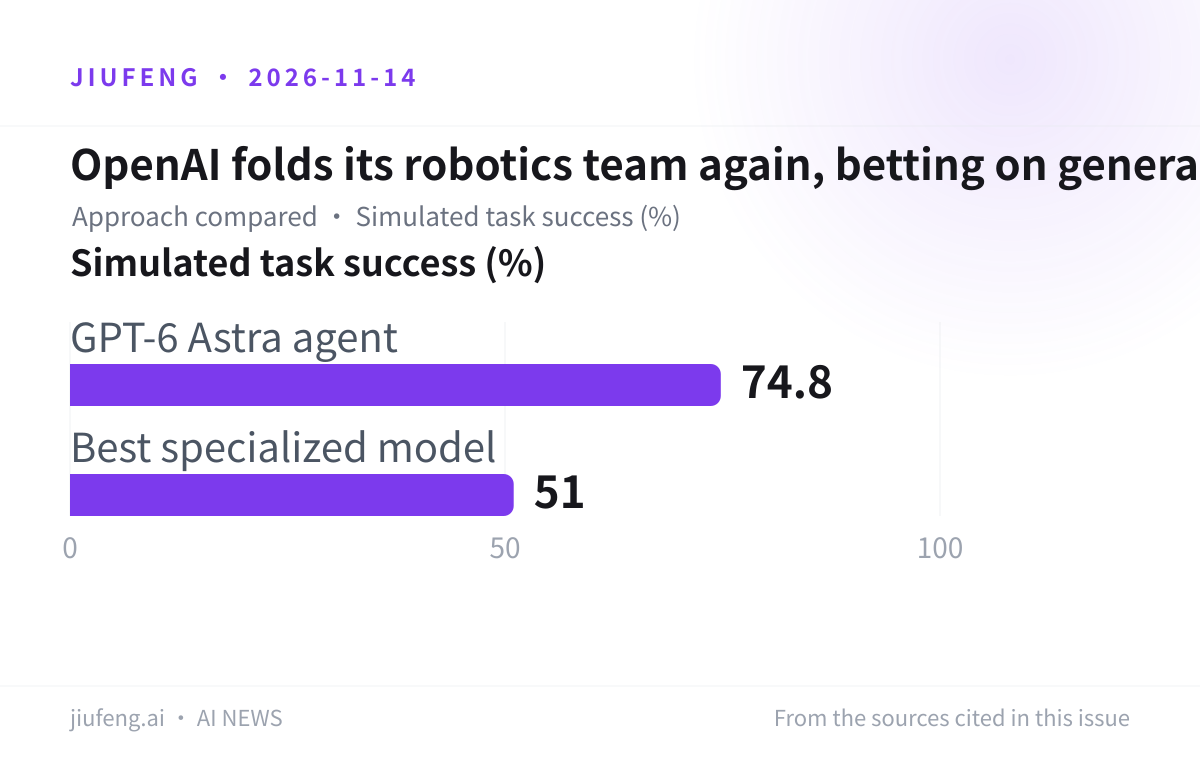
According to the report, OpenAI apparently believes general-purpose models like GPT-6 Astra can control robots directly, so dedicated robotics models matter less. An Nvidia study tested agents on a simulated DROID robot:
| Approach | Simulated task success (%) |
|---|---|
| GPT-6 Astra agent | 74.8 |
| Best specialized model | 51 |
Limitations: These results come from simulation, not physical robots. The report notes it is unclear how much robotics data OpenAI and others used in training. Specialized robotics models may still win on cost, reliability, speed and energy use, even if they generalize worse.
Jiufeng graphic based on the sources cited in this issue.
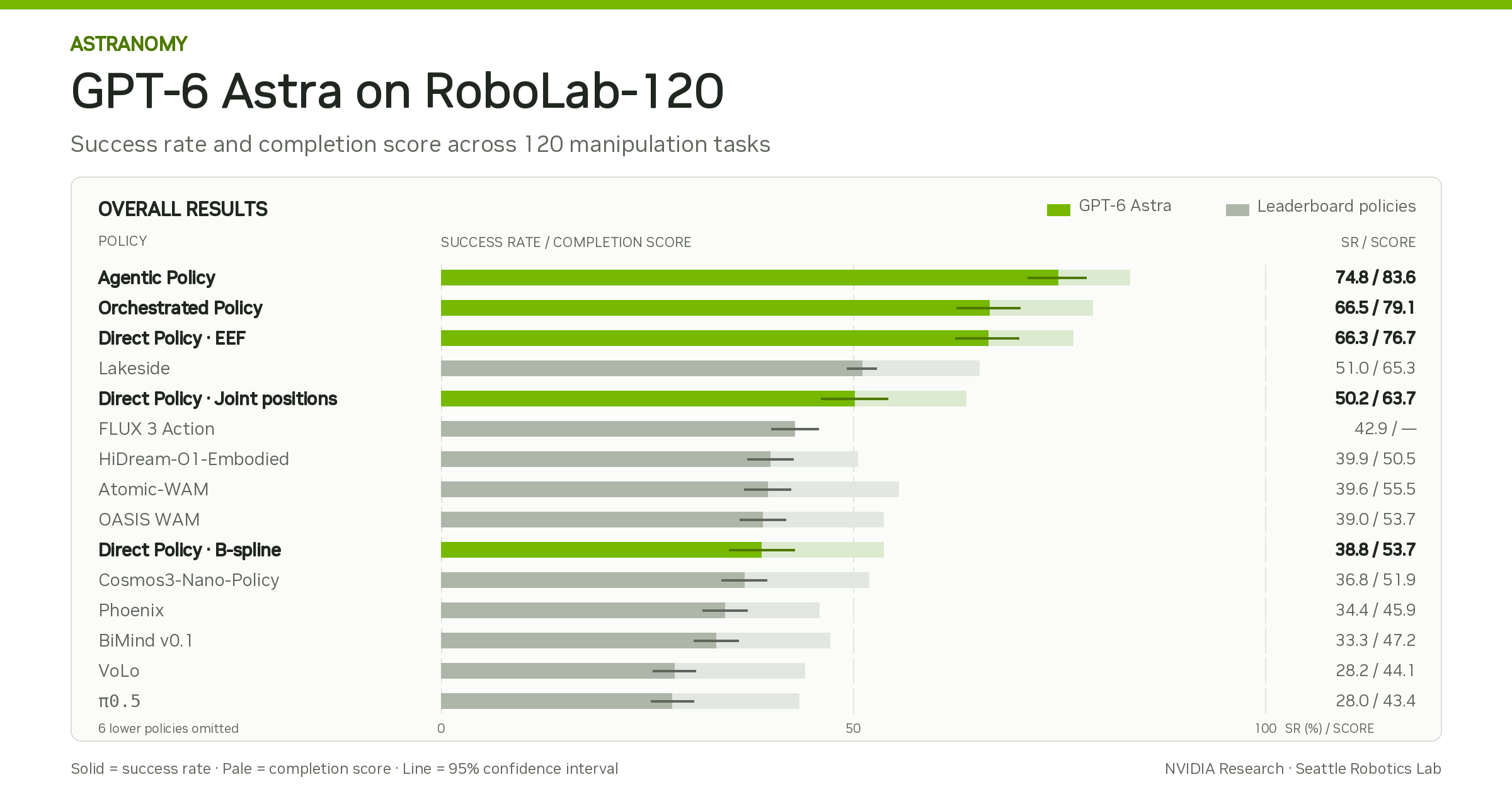
Image source: nvidia.
Source: Original source Nvidia research page · arXiv: speed and energy comparison · The Decoder
02/09
Ex-researcher Coxon says Anthropic could retrain Mythos with a fraction of the original compute
A departing researcher points to a slide from Anthropic's IPO roadshow as evidence that algorithmic efficiency gains are speeding up.
Jacob Coxon has worked at both OpenAI and Anthropic. He says a slide Anthropic released for its IPO roadshow was a key reason he left the company after about four months. The chart shows how much compute Anthropic needs over time to train its models. The axis is so compressed that 10x and 100x look almost the same, yet the curve still climbs steeply.
Coxon reads this as algorithmic efficiency improving at an accelerating rate. "Mythos was not a one-time deviation, but a point on a superexponential," he writes. "They could already retrain Mythos with a fraction of the compute originally needed."
Limitations: This is one person's reading of a single chart. The report gives no compute figures and includes no response from Anthropic.
Source: Original source Coxon on X · The Decoder
Developers can now use official APIs to build something close to the DeepSeek app.
According to Pandaily, DeepSeek has opened two sets of capabilities:
- Inside its APIs: web search, deep-thinking search, file input, URL reading and safety checks
- As standalone APIs: Search, Fetch, OCR, ASR (speech recognition) and TTS (text-to-speech)
The report says this lets developers rebuild the DeepSeek app.
Limitations: Pandaily is the only source for this item. Check DeepSeek's official documentation for usage details such as pricing and rate limits.
Source: Single report Pandaily
Global AI News
04/09
llama.cpp and ggml reach v1.0.0 and adopt semantic versioning
After 3.5 years, the core libraries behind local AI inference have a formal versioning policy.
Georgi Gerganov released llama.cpp and ggml v1.0.0 on November 13. Much of local AI is built on these C/C++ inference libraries. This is the first time in the project's 3.5 years that it has used formal semantic versioning. From now on, breaking API and ABI changes to libllama and libggml will only come with major releases.
Limitations: Projects built on these libraries should watch for API and ABI changes when they move to a new major version.
Source: Original source Hugging Face Blog (ggml-org) · RuntimeWire
05/09
Vercel open-sources UI SDK, with 50+ UI behaviors for coding agents
Instead of writing components from scratch, agents combine ready-made behaviors into accessible components.
Vercel Labs released UI SDK in beta. It is a headless library that ships interaction behaviors, not finished components:
- Size: 50+ behaviors, 51 component modules in the repo, 6 npm packages at 0.1.0-beta.1
- License: Apache-2.0
- Frameworks: React 19+, Vue 3.5+, Svelte 5.33+, Solid 2 RC, or plain Web Components
- Runtime: any modern browser, no GPU needed
Vercel compared two approaches on a settings-page task:
| Approach | Task time (seconds) |
|---|---|
| Browser tools (other library) | 41 |
| UI SDK + agent bridge | 16 |
The UI SDK + bridge setup also made 69% fewer tool calls than the browser-tools setup.
Limitations: Vercel ran this benchmark itself, with one task and three runs. The browser-tools run used a different component library, so the two setups are not identical. The beta APIs may still change.
Source: Original source GitHub: vercel-labs/ui · MarkTechPost
06/09
Inkitt details its automated PR system: the model is the easy part
A coding-agent system that opens PRs automatically puts most of its engineering into orchestration.
Inkitt built a "one-shot PR creator." Tasks arrive from Slack, Linear or another agent's API call and run on remote infrastructure. Separate stages handle the spec, implementation, verification, CI-failure fixes and merge-conflict resolution, and the output is a draft PR. Principal engineer Agi Letkiewicz Tanner describes it as an event-driven orchestrator rather than a fixed pipeline. The orchestrator saves each run's state to a database, so a run can pick up where it stopped. Agent containers get only short-lived repo tokens and model credentials. They never get Slack or Linear credentials or cloud identities. A separate check reads the actual Git diff to make sure no restricted paths were touched.
Verification, CI fixes and conflict resolution each get at most two attempts. Duplicate webhook deliveries are handled with deduplication and conditional database writes. The system rejects any task that touches database migrations, schema or shared-contract changes, CI and container build config, authentication, payment code, or package additions and updates. As Tanner put it: "The model is the easiest part."
Limitations: The system only handles small, low-risk changes. It can only open draft PRs, cannot bypass branch protection and cannot merge on its own. People still do review and approval. For larger tasks, Inkitt uses a local version that keeps a human in the loop.
Source: Multiple outlets InfoQ · InfoQ China
The Grok Bot AI teammate has moved from chat into the meeting room.
RuntimeWire, citing a November 13 post on X, reports that shared Grok Bots can now join video meetings. In a call, a bot can answer questions, take on assigned work and keep track of what the team decides. Follow-up work can continue across Slack, Teams, Gmail, Calendar and GitHub. The feature is available on Super, Ultra, all Team and Enterprise plans, and their legacy equivalents.
Limitations: RuntimeWire is the only reporting source for this item, and there is no independent test of how the bot performs in real meetings yet.
Source: Single report RuntimeWire
Users describe the look they want, and Claude builds it as a mod.
Anthropic's developer account, ClaudeDevs, announced custom themes for the Code tab in Claude Code on desktop. Users describe the look they want and Claude builds it as a mod. They can change colors, add an animated background, or start from the theme-examples plugin. TestingCatalog amplified the announcement on November 14.
Limitations: Themes work in local sessions only for now. Support for cloud sessions will come later.
Source: Single report RuntimeWire
Regional and Early Signals
09/09
The Endless Frontier opens Fx-Bio-1031 weights, a Qwen-based bioinformatics model
An open-weight model that can run multi-step bioinformatics analyses.
According to Pandaily, The Endless Frontier has released open weights for Fx-Bio-1031. The model is built on Qwen and runs multi-step bioinformatics work. The developer reports a score of 70.59% on the hardest subset of BioMysteryBench. On BixBench3, the model trails GPT-6-Astra.
Limitations: The 70.59% figure is self-reported by the developer and covers only the hardest subset. On BixBench3, the model still trails GPT-6-Astra. Pandaily is the only source for this item.
Source: Single report Pandaily
This digest is compiled by AI from the sources linked in each item and published after automated fact-checking, without article-by-article human review before publication. If anything differs from the original, the original source prevails. How this digest is made, or report an error: About this digest
Create AI images and videos with sound in your browser: write a prompt, pick a model, download the result. 5 free credits on sign-up, no credit card.
Start creating free