Overview
10 stories in this issue. The first 3 are today's priorities.
Hot Model Updates
- Top · ChatGPT Wallet lets Dots agents make purchases for you
- Top · Researcher says six DeepSeek, Kimi and MiniMax models show Blackwell fingerprints
- Top · SpaceXSI hires designers to critique and rebuild Grok's weak outputs
- The Verge tests Claude Duet, Anthropic's work-focused consumer agent
Global AI News
- Meta's Muse now calls businesses for you, with over 10 million users
- Ai2's XYBench: 8,000+ questions testing whether AI spots the real problem
- NVIDIA shows a robot pick-and-place simulation built from SimReady assets
- Mirendil raises a $1B Series A to automate model training with hundreds of agents
Regional & Early Signals
- World Labs opens its Atlas world model to everyone, with an API
- Zhejiang University lab splits robot navigation into a "brain" (SuperNav) and a "cerebellum" (ScaleNav)
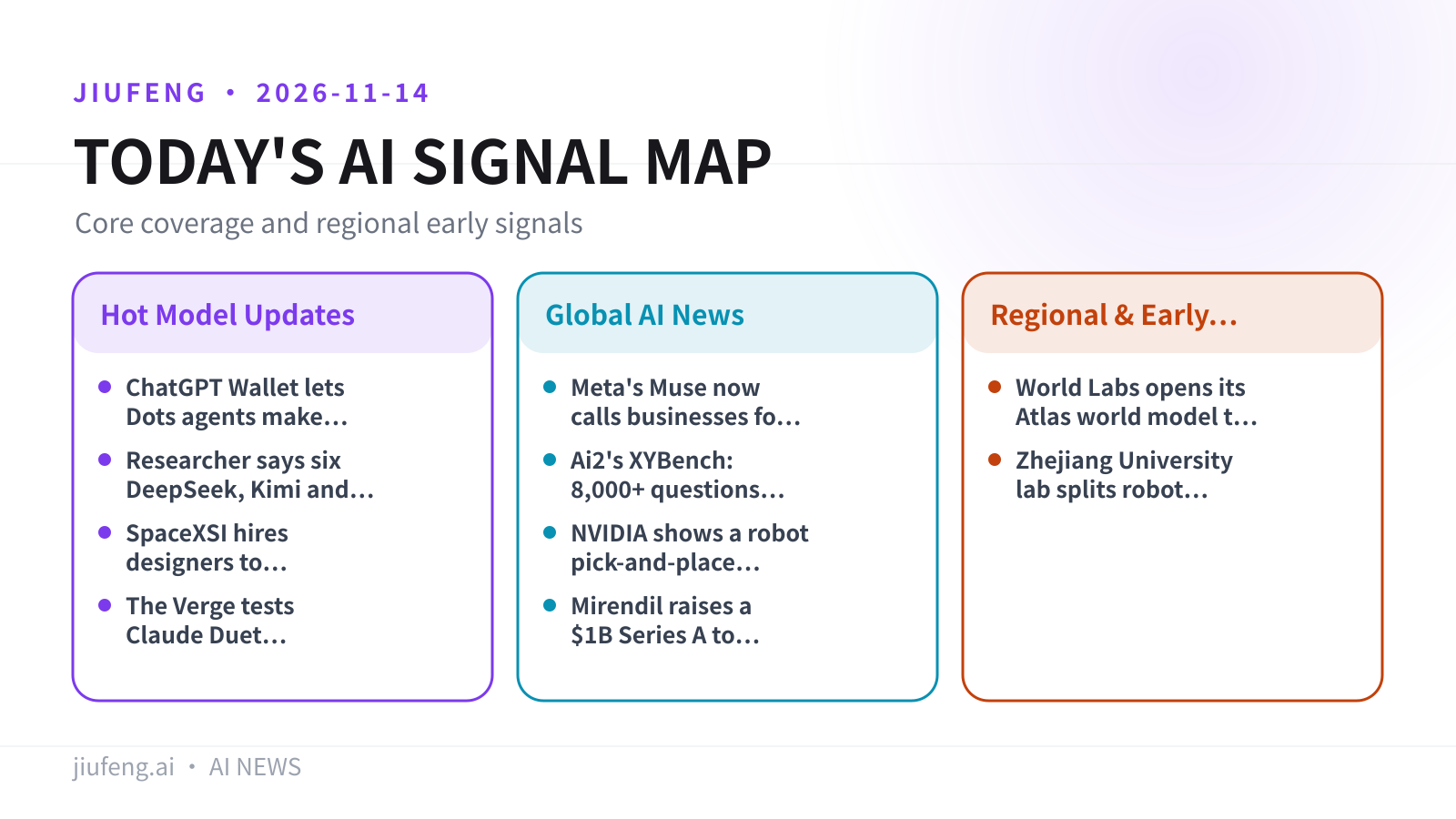
Jiufeng graphic based on the sources cited in this issue.
Hot Model Updates
OpenAI has given its agents a wallet: US ChatGPT Pro users can have Dots shop for them, but every purchase still needs the user's sign-off.
OpenAI launched its Dots agents platform earlier this year and is now rolling out ChatGPT Wallet so those agents can complete purchases on a user's behalf. The Verge and OpenAI's help page list these launch terms:
- Who gets it: ChatGPT Pro subscribers in the US who are 18 or older and have a US billing address
- Supported cards: eligible US-issued American Express, Chase, Mastercard and Visa cards
- Approval flow: agents check in with the user before checkout, and every purchase needs a biometric check such as Face ID or a fingerprint scan
- Card privacy: OpenAI says the wallet won't share the user's actual credit card details with its agents
Limitations: For now it is limited to US Pro subscribers and specific card issuers. Each purchase needs manual approval plus a biometric check, so agents can't pay for anything unless the user confirms it.
Source: Original source OpenAI · OpenAI Help Center · The Verge
02/10
Researcher says six DeepSeek, Kimi and MiniMax models show Blackwell fingerprints
Will DePue, who helped build Sora at OpenAI, analyzed published weights and says the starting-weight patterns of six Chinese models match Nvidia Blackwell layouts.
DePue published his analysis on November 12. It covers six models from DeepSeek, Moonshot AI, MiniMax and Ant Group. His evidence is the starting-weight patterns in the published weights: they match Blackwell hardware layouts, and earlier models from the same labs don't show them. On his personal site, DePue says he helped create Sora and Sora 2 at OpenAI and helped post-train 4o, o3 and GPT-5. He posted the claim on X, and Unemployment Labs, one of his current projects, published the full analysis.
Limitations: The conclusion is DePue's own inference from public weights. RuntimeWire's report is based on his thread and analysis. Other researchers would need to check independently whether weight patterns can establish what hardware the labs actually used.
Source: Single report RuntimeWire
SpaceXSI is offering a six-month contract at $35 to $75 an hour for professional designers to diagnose where Grok's design work falls short and then make a corrected version themselves.
According to RuntimeWire, the posting runs for six months and pays $35 to $75 an hour. Designers first judge what is weak in a Grok design output and explain why it fails, then build a corrected version. The report says this paired critique-and-repair setup is meant to teach the model why an output that looks attractive can still fail in use.
Limitations: This comes from a job posting. The report doesn't say which Grok version the data will feed into, or when.
Source: Single report RuntimeWire
In a hands-on review, Claude Duet, Anthropic's agent for ordinary users, comes across as "a little neurotic and surprisingly helpful."
The Verge senior reviewer Allison Johnson worked with Duet for a week. She places it this way: Duet is more consumer-friendly than Claude Cowork, which in turn is more consumer-friendly than Claude Code. Compared with other consumer agents, Duet is more focused on work. One detail from the test: Duet offered to help her write up her review.
Limitations: The reviewer found Duet "a little jumpy at times." Duet is a research preview, open only to Pro, Max and Ultra subscribers in the US, and there is a waitlist.
Source: Single report The Verge
Global AI News
05/10
Meta's Muse now calls businesses for you, with over 10 million users
Muse can now phone businesses for every paying US subscriber, but many businesses hang up once they realize it's an AI.
Meta tested the calling feature in September and has now opened it to all paying Muse subscribers in the US. Meta AI chief Alexandr Wang said Muse has more than 10 million users. It can handle calls to cable companies, the DMV and restaurants, and Muse itself will soon get a free email address. The Decoder notes that Google's Gemini, the startup Instinct and xAI's Grok Bot can already place calls, while OpenAI's ChatGPT Dots and Anthropic's Claude Duet can't yet.
Limitations: Many businesses hang up as soon as they detect an AI on the line. That problem led Meta to temporarily test human operators for Muse in September.
Source: Original source Alexandr Wang (X) · The Decoder
06/10
Ai2's XYBench: 8,000+ questions testing whether AI spots the real problem
XYBench targets the "XY problem": a user wants to achieve X, assumes method Y will work, and asks only about Y.
Ai2 built XYBench with researchers from Carnegie Mellon, NVIDIA and Johns Hopkins. It contains more than 8,000 questions, each built on a user's misconception. Ai2's example: someone asks how to thicken frosting that keeps sliding off cupcakes, when the real problem is that the cupcakes are still too warm. The benchmark won the Best Resource Paper Award at EMNLP 2026, and the paper, data and code are public.
Limitations: Ai2's announcement focuses on the problem definition and the dataset. Readers looking for per-model scores will need to check the paper.
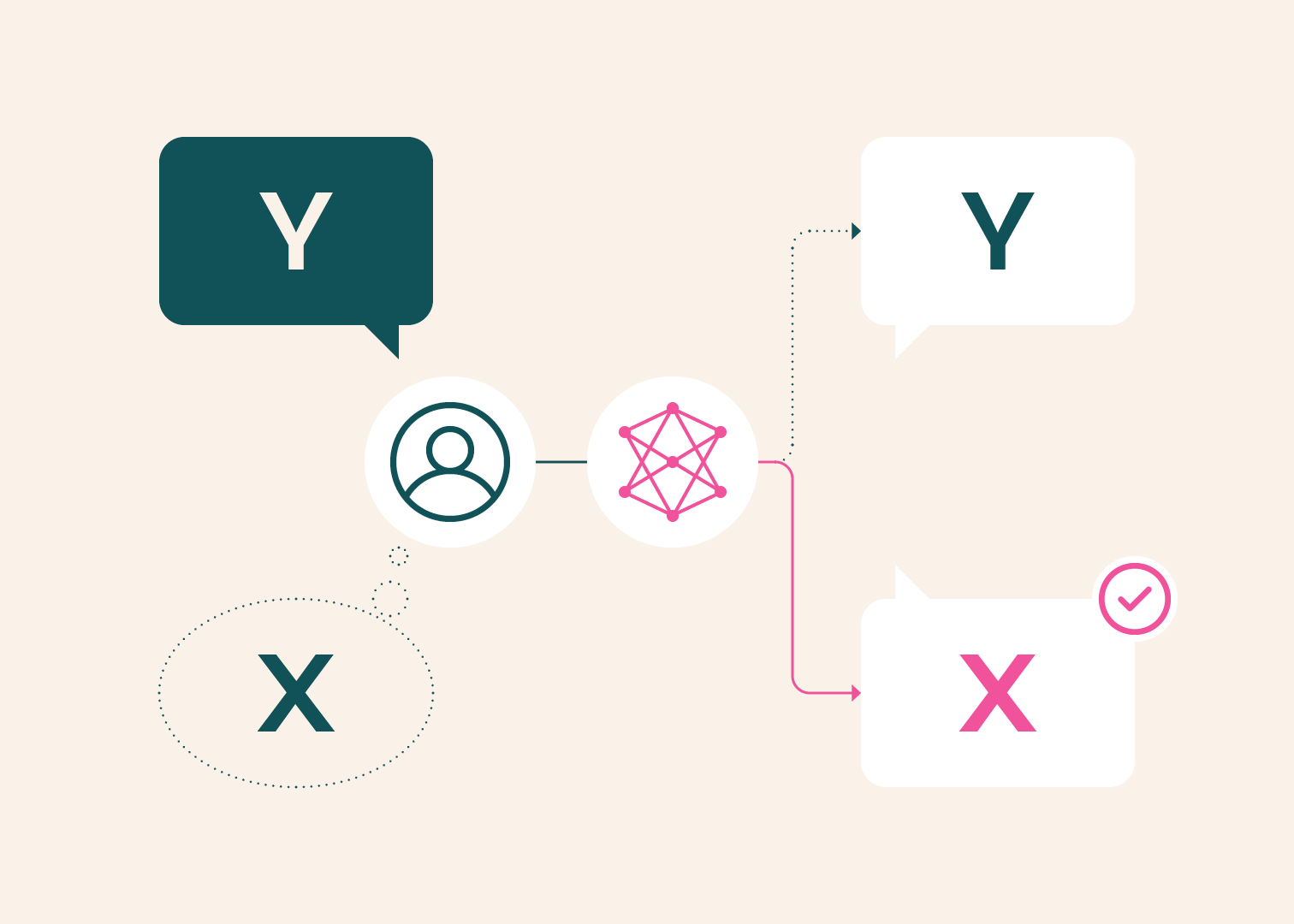
Image source: huggingface.
Source: Original source Hugging Face Blog (Ai2) · arXiv · GitHub
07/10
NVIDIA shows a robot pick-and-place simulation built from SimReady assets
SimReady Central, NVIDIA's open asset library on Hugging Face, offers robot and object models with simulation properties already authored, ready to assemble into Isaac Sim scenes.
The walkthrough has a robot pick up and place a beverage can, using a UR17G arm, a Robotiq 2F-140 gripper and a can asset, with controls generated by an agent. In this tutorial, "SimReady" means an OpenUSD asset already carries the properties a specific simulation use needs, such as collisions, mass, joints and joint drives. SimReady Foundation defines the required properties for each use case through levels such as "Profiles," and assets come with evidence that they passed profile validation. The tutorial uses Isaac Sim 6.2.
Limitations: NVIDIA notes that the agent-generated controls are only a starting point, and users should inspect the code and the resulting behavior before adapting it to their own task. Contributing your own assets means validating, packaging and uploading them locally per the submission guide, then opening a PR.
Source: Original source Hugging Face Blog (NVIDIA) · Isaac Sim docs · SimReady Central submission guide
08/10
Mirendil raises a $1B Series A to automate model training with hundreds of agents
Founded by former DeepMind and Anthropic researchers, Mirendil has raised $1 billion, and its first product, Lor, automates training-run work.
Kleiner Perkins and Clearlake Capital co-led the round, joined by more than six other investors including Google. Mirendil launched last year. CEO Behnam Neyshabur co-invented SAM, an algorithm that helps models do better on tasks they weren't specifically trained for. CTO Harsh Mehta worked on pretraining projects at both Google DeepMind and Anthropic. Lor splits much of the work in a model training run among hundreds of AI agents. The company says one researcher used this automation to build Mirendil-Base alone, spending $10 million over about 3.5 months, with agents writing more than 99% of the code.
Limitations: The cost, timeline and code-share figures are Mirendil's own claims.
Source: Single report SiliconANGLE
Regional & Early Signals
World Labs, founded by Fei-Fei Li, has opened its Atlas world model to all users through a web app and a developer API, and new accounts get 10,000 credits.
In iFanr's hands-on test, the Atlas home page has four tools: Viewfinder, Chisel, Relight and Splat to mesh. Viewfinder and Chisel are the new web apps in this release. Viewfinder can expand a scene from a single image or reconstruct a real environment from up to 64 inputs. Chisel lets users lay out a scene with simple 3D shapes first, then has the model generate the visuals. Results can be exported to Blender or game engines for further work. (Chinese-language source)
Limitations: Sign-up requires phone verification. iFanr says a +86 number received the code, but users had to select the US or Canada as their region for the app to work properly. The report doesn't say how much it costs once the credits run out.
Source: Single report iFanr (Chinese-language source)
10/10
Zhejiang University lab splits robot navigation into a "brain" (SuperNav) and a "cerebellum" (ScaleNav)
A Zhejiang University 3D vision team released two navigation projects in October, arguing that fine-tuning a VLM to output actions directly degrades its other abilities.
In an interview with Leiphone's AI Tech Review, Peng Sida, a "Hundred Talents" researcher at Zhejiang University's School of Software, explained the reasoning. He said fine-tuning a VLM to predict actions directly causes two problems: it degrades tasks the VLM could already do, such as recognition, and the 3B and 4B models small enough to fine-tune have poor spatial reasoning to begin with. The team's earlier work includes Neural Body, a CVPR 2021 best paper candidate; 4K4D, which renders dynamic scenes in real time at 4K; and Street Gaussians, which Li Auto uses in its self-driving simulation system. Over eight years, the lab's projects have collected more than 60,000 GitHub stars. (Chinese-language source)
Limitations: This is a profile interview, and it doesn't go into benchmark results for SuperNav or ScaleNav.
Source: Single report Leiphone (Chinese-language source)
This digest is compiled by AI from the sources linked in each item and published after automated fact-checking, without article-by-article human review before publication. If anything differs from the original, the original source prevails. How this digest is made, or report an error: About this digest
Generate short videos with sound in your browser — from a prompt or a first-frame image. 5 free credits on sign-up, no credit card.
Open MiniMax H3