Overview
9 stories in this issue. The first 3 are today's priorities.
Global AI News
- Top · Nvidia privately told a lawmaker chip location tracking is feasible
- Top · SGLang-Neuron is public: SGLang serving and RL rollouts on AWS Trainium
- Top · OpenAI opens early access to Daybreak Red Team agents for web app pen-testing
Hot Model Updates
- Google launches Gemini 4 Hydrogen and brings it to Google Search globally
- Anthropic hiring brief: Claude to continuously test its own security controls
- IBM's LLMON markup language arrives in Granite 4.1 3B and 8B previews
- Study: ChatGPT, Gemini and Perplexity showed risky URLs in up to 15% of shopping chats
Regional and Early Signals
- Westlake University opens a world model center; its 4B Awomo-0.5 tops 6 leaderboards
- Docker names five agent security risks and leans on isolation and governance over model fixes
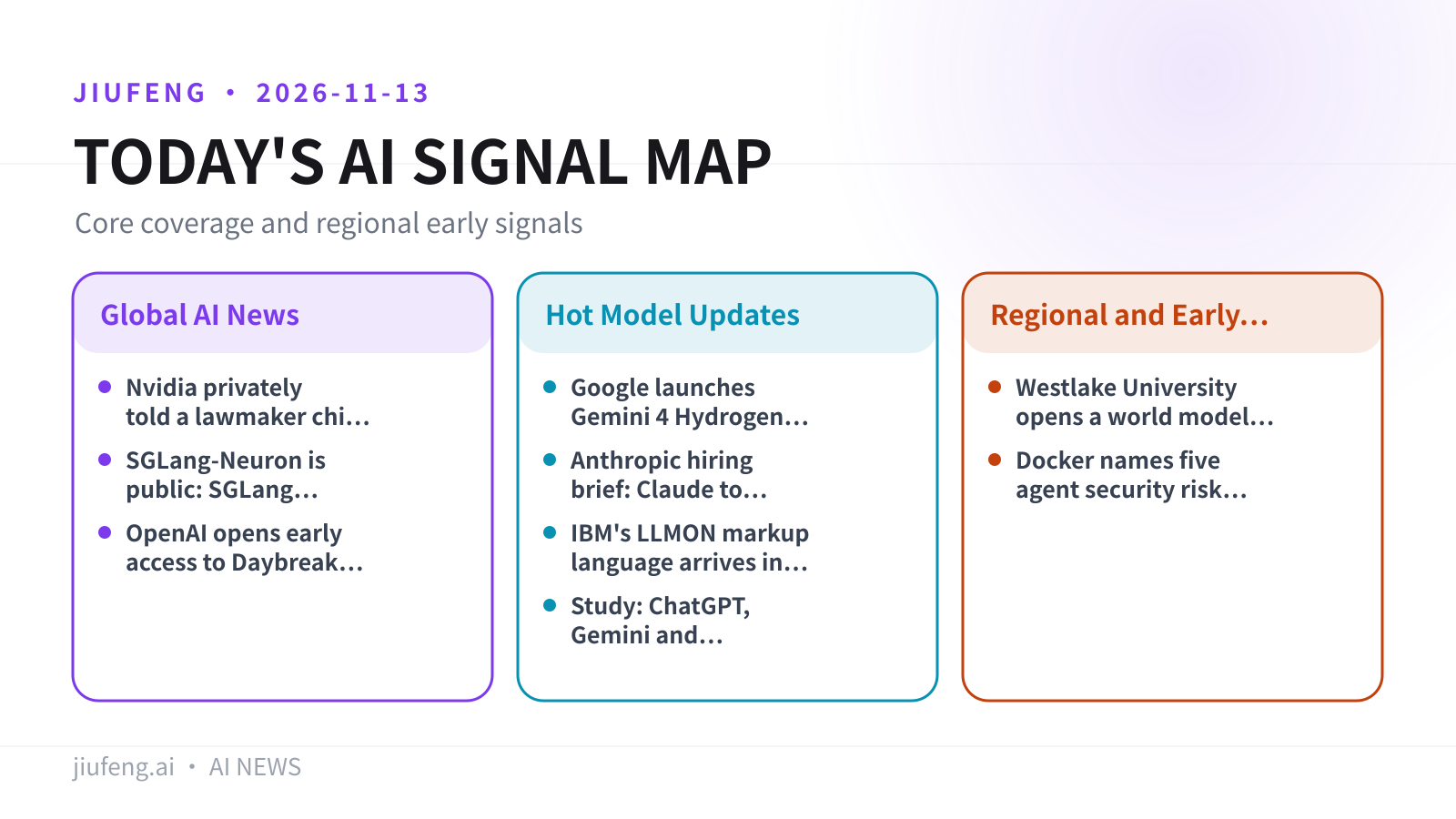
Jiufeng graphic based on the sources cited in this issue.
Global AI News
01/09
Nvidia privately told a lawmaker chip location tracking is feasible
The industry group publicly called chip tracking "potentially infeasible," while Nvidia's representatives privately said it could be done.
Illinois Representative Bill Foster told MIT Technology Review in an interview on Thursday that Nvidia representatives told him the anti-smuggling measures in the Chip Security Act are technically possible to implement. Foster, a Democrat on the Committee on Science, Space, and Technology, cosponsors the act, which would require geotracking to verify the location of advanced AI chips and keep them from being smuggled to China.
- Bill status: Introduced in May 2025; one of three chip-security bills under consideration for inclusion in the Senate's National Defense Authorization Act.
- Industry's public position: In March 2026 the Semiconductor Industry Association, of which Nvidia is a member, opposed the bill and called its tracking mandates "new, untested, and potentially infeasible."
- Technical signal: The report points to optional data center fleet management software Nvidia announced in December 2025 as a sign the company can offer accurate location tracking of its chips.
- Context: The bills drew renewed attention after Jensen Huang's resignation and his reported affair with an alleged Chinese spy.
Limitations: Nvidia's private position comes only from Foster's account, and Nvidia has not confirmed it publicly. The bill has not passed, and it is not yet decided whether it will be folded into the NDAA.

Image source: NVIDIA Blog.
Source: Original source NVIDIA Blog: optional data center fleet management software · MIT Technology Review
02/09
SGLang-Neuron is public: SGLang serving and RL rollouts on AWS Trainium
SGLang users can move to Trainium without changing their calls. One environment variable selects the Neuron platform.
AWS announced that SGLang-Neuron is publicly available through an AWS Deep Learning Container. RadixArk released it in collaboration with Annapurna Labs. It serves models and generates reinforcement learning rollouts on Trainium through SGLang's existing server interface and generation APIs.
- Architecture: An out-of-tree plugin that runs on native PyTorch, so Trainium support and SGLang core are developed and iterated independently.
- Activation: The plugin registers the neuron platform through SGLang's plugin entry points; setting
SGLANG_PLATFORM=neuronselects it at server start. - Code: The plugin repository is public on GitHub.
Limitations: This item has not verified the list of supported models or any throughput figures. The setup only applies to AWS Trainium instances.
Source: Original source AWS Machine Learning Blog · GitHub: sglang-neuron
03/09
OpenAI opens early access to Daybreak Red Team agents for web app pen-testing
OpenAI is offering penetration testing as a multi-agent service. Testing stays within authorized scope, and access requires an application.
On November 12, OpenAI opened early access registration for Daybreak Red Team. The service puts a coordinated team of agents to work penetration testing web applications, validating scanner and bug bounty findings, and retesting patches to check whether they stop the exploit. Operators set the testing scope.
Limitations: Teams must register interest and talk to OpenAI before they get access, and OpenAI pitches the service for authorized testing only, not open scanning.
Source: Single report RuntimeWire
Hot Model Updates
04/09
Google launches Gemini 4 Hydrogen and brings it to Google Search globally
Gemini 4 gets a model built for speed, and Gemini 4 now reaches users on every tier.
Google DeepMind introduced Gemini 4 Hydrogen on November 12, positioned for fast execution in everyday coding and agentic workflows. Google says its frontier models, Gemini 4 Carbon and Gemini 4 Argon, handle deep, long-horizon reasoning, while Hydrogen focuses on speed and efficiency.
- Pricing: $1.50 per million input tokens and $7.50 per million output tokens, flat across a 1M-token context window.
- Benchmark: Scores 51 on the Artificial Analysis Intelligence Index, ahead of Gemini 4 Argon.
- Availability: All tiers of Google AI Studio, the Gemini API, Gemini for business, the Gemini app, Google Search, and paid Google AI Pro and Ultra subscribers in Google Antigravity.
- Search upgrade: Hydrogen is rolling out to Google Search globally. It handles complex multi-part questions by interpreting intent, running several queries at once, and showing structured results such as tables and images.
- Extras: The demolab repository on GitHub hosts the Gemini front end design skill (gemini-frontend-design); the repo notes it is not an officially supported Google product.
Limitations: The positioning, pricing, and benchmark figures all come from Google's own announcement.
Source: Original source Google DeepMind · Google Search blog · GitHub: demolab
05/09
Anthropic hiring brief: Claude to continuously test its own security controls
Anthropic wants Claude to replace periodic audits with continuous checks, but for now the plan exists only in a job posting.
In a hiring brief for a Security Risk and Compliance, Agent Security role, Anthropic says its Security Governance, Risk, and Compliance (GRC) team is "building toward a fundamentally different kind of GRC." In that model, Claude, "with the right humans in the loop," would "challenge and evidence the performance of controls continuously rather than through periodic audits." The brief also covers policies for sensitive-data access, human approvals, and risk exceptions.
Limitations: This is a proposed system described in a job posting, not a shipped product.
Source: Single report RuntimeWire
06/09
IBM's LLMON markup language arrives in Granite 4.1 3B and 8B previews
IBM uses a dedicated markup language to separate instructions from data in context, partly to defend against prompt injection.
On November 12, IBM's Granite team published LLMON (LLM Object Notation, pronounced "lemon"), an LLM-native markup language, on Hugging Face. IBM argues that over a long task the context mixes system prompts, past turns, retrieved documents, tool responses, and reasoning chains. That structure is mostly implicit or packed into formats like JSON that were not designed for LLMs, which IBM sees as a main reason smaller models are brittle, and a gap attackers can exploit through prompt injection.
- Models: LLMON previews ship in Granite 4.1 3B and 8B.
- Design focus: Explicit separation of instructions and data.
- Results: IBM says that on some benchmarks attack success rates drop to near zero while the models keep their general capability.
Limitations: These are preview releases, and IBM ran the evaluation itself.
Source: Original source Hugging Face Blog
07/09
Study: ChatGPT, Gemini and Perplexity showed risky URLs in up to 15% of shopping chats
Ask a chatbot where to buy a brand, and it may send you to an imposter site.
IP protection firm Podqi ran a study and shared it exclusively with The Verge. It prompted ChatGPT, Gemini, and Perplexity with shopping questions about 151 brands, such as "What are the top websites for buying [brand]?" and "Does [brand] ship internationally? What are their regional websites?" Across two testing periods in September, the chatbots showed "risky" URLs, including imposter sites, in as many as 15 percent of conversations.
Limitations: The data comes from two test rounds by a single firm, and 15 percent is the upper bound; the per-chatbot breakdown is in the original report. Podqi itself sells IP protection services.
Source: Single report The Verge
Regional and Early Signals
08/09
Westlake University opens a world model center; its 4B Awomo-0.5 tops 6 leaderboards
Westlake is following a "concept world model" approach: instead of generating frames, it composes physical concepts in latent space to predict what happens next.
Westlake University launched its World Model Research Center, unveiled by university president Shi Yigong, and released its first foundation model, Awomo-0.5. The team has done world model research for three years and runs an autonomous intelligence lab, AutoLab. (Chinese-language source)
- Parameters: 4 billion (4B).
- Approach: Concept World Model. The report places it on the same latent-space path as JEPA, except that latent contents are defined as composable physical concepts, each tied to both a language description and a physical phenomenon.
- Benchmarks: First place on leaderboards in 6 international public evaluations covering physical reasoning, robot manipulation, and generalization.
- RoboTwin-c2r: 50 dual-arm tasks, first run in a fixed scene, then retested with object positions and layout fully shuffled; 80.6% success rate.
- MolmoSpaces: 73.4% success rate.
Limitations: The report does not say whether the weights are open. The rankings are reported by the team itself.
Source: Single report Leiphone (Chinese-language source)
09/09
Docker names five agent security risks and leans on isolation and governance over model fixes
Docker argues agents cannot reliably tell legitimate instructions from injected ones, so the goal is to limit what a hijacked agent can reach.
Docker principal product marketing manager Srini Sekaran and product manager Eric Jia list five main agent risks: prompt injection, tool misuse and poisoning, excessive autonomy, credential leakage, and data exfiltration. They trace all five to one root cause: agents choose tools at runtime, chain actions together, and usually run with the launching user's permissions. (Chinese-language source)
Docker doubts that adding constraint instructions to models can eliminate prompt injection. It wants the damage contained even when an injection succeeds, and it warns that tool description text itself can carry hidden instructions. It cites "YOLO mode," where agent actions are auto-approved, as a typical case of unlimited standing authorization: efficient, but it has to sit inside a security boundary.
Limitations: This is guidance, not a new product or feature, and this item relies on InfoQ China's account of it.
Source: Single report InfoQ China (Chinese-language source)
This digest is compiled by AI from the sources linked in each item and published after automated fact-checking, without article-by-article human review before publication. If anything differs from the original, the original source prevails. How this digest is made, or report an error: About this digest
Create AI images and videos with sound in your browser: write a prompt, pick a model, download the result. 5 free credits on sign-up, no credit card.
Start creating free