Overview
11 stories in this issue. The first 3 are today's priorities.
Hot Model Updates
- Top · Gemini Decisions API launches: Gemini Decision 1 scores up to 1,000 choices in one pass
- Top · Anthropic says Mythos ported Claude to AMD GPUs in three days
- Top · Mistral's internal agent RL system is named Orchestral
- ChatGPT Finances reaches the desktop app, including for US free users
Global AI News
- Google DeepMind releases AlphaGenome 2 for cell-type-level variant effects
- AWS publishes an enterprise guide to running Codex on Bedrock, with GPT-5.6 Sol as the example
- Ramp AI Index: US corporate AI spending hits a new high in October, but grows only 1.65%
- ChinaTalk: US data brokers sold about $500M in RL training environments to Chinese labs
- United won't let personal AI agents book flights
Regional & Early Signals
- Yueqian Innovation brings professional camera moves to a desktop robot
- Bloomberg: Grok allegedly used to make child sexual abuse images; xAI faces several lawsuits
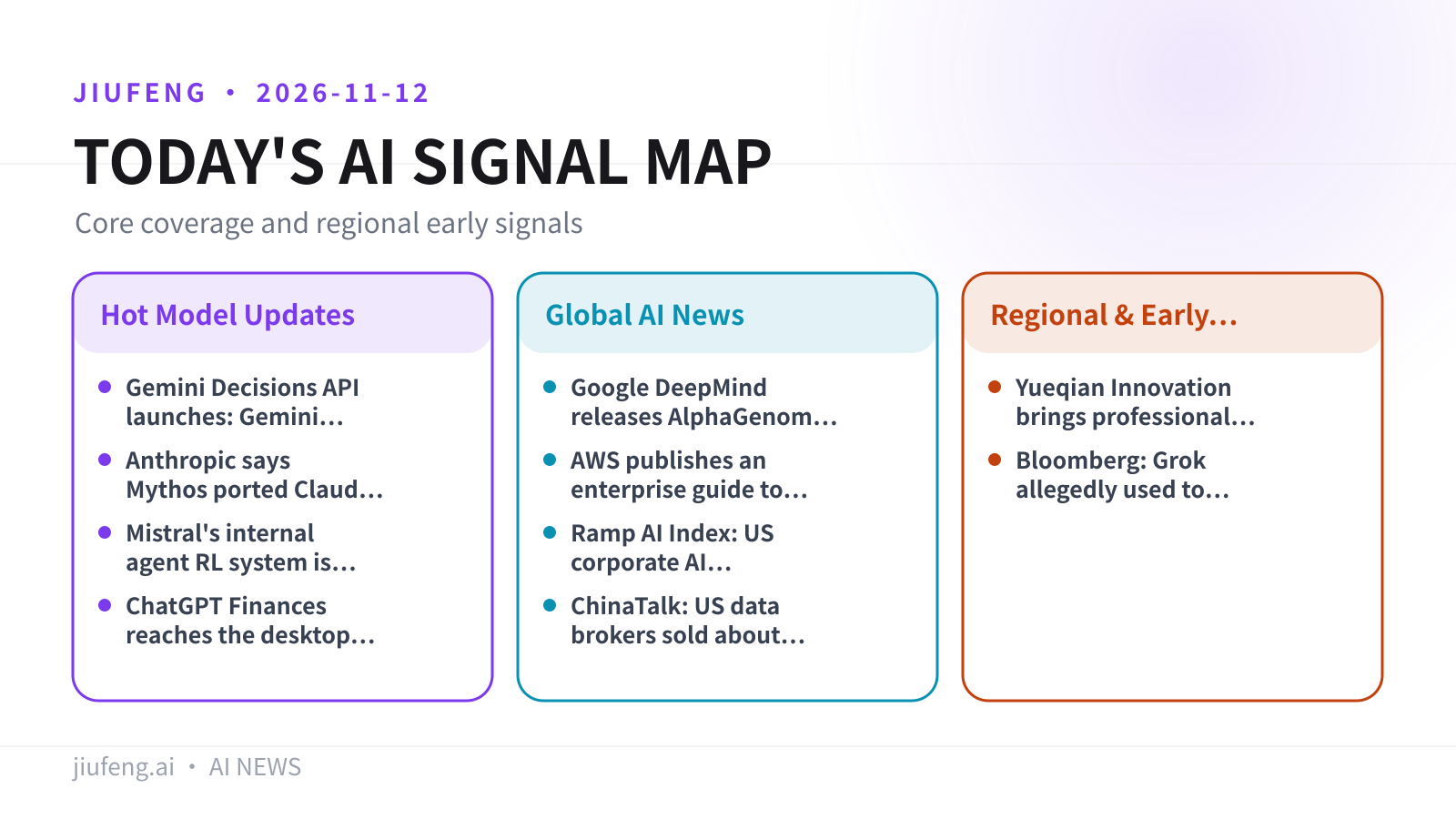
Jiufeng graphic based on the sources cited in this issue.
Hot Model Updates
01/11
Gemini Decisions API launches: Gemini Decision 1 scores up to 1,000 choices in one pass
Google's new Gemini Decision 1 scores answers instead of generating text. It bills only for input and is aimed at routing, grading and policy checks.
On November 11, Google CEO Sundar Pichai announced the Gemini Decisions API, powered by a new model, Gemini Decision 1. It scores closed-set choices rather than generating text token by token. The announcement was written by Min Choi, a product manager at Google DeepMind, and Felix Yu, a principal scientist at Google DeepMind.
- Batch size: up to 1,000 yes/no, choice and rubric-scoring questions in one pass
- Modalities: text, images, audio, video and PDFs
- Output: a calibrated confidence score for each question
- Pricing: $0.10 per 1M input tokens, with no output charge
- Benchmarks: Google says it leads across agent routing, reasoning, ranking and multimodal understanding benchmarks, with the lowest calibration error
- Use cases: Google's examples are query routing, content grading and policy-rule checks; developers can start with an API key today
Limitations: It only handles closed-set questions, so open-ended generation still needs another model. The benchmark lead and lowest calibration error are Google's own claims, and there is no third-party evaluation yet.
Image source: Google.
Source: Original source Google blog · Sundar Pichai on X · RuntimeWire
According to Anthropic's investor presentation, its frontier model Mythos wrote or ported nearly all the kernels, cutting a 6–12 month migration to 3 days.
Co-founder Tom Brown said Anthropic now trains and runs Claude on all four major chip families and treats them as one interchangeable compute pool. For the move to AMD GPUs, the in-house model Mythos wrote or ported nearly 100% of the kernels with almost no human intervention. The work reportedly took three days, against the usual six to twelve months. The Decoder includes an Anthropic chart of prompt processing on AMD MI355X; its caption says the new hardware reached usable performance in about three days.
Limitations: The figures and chart come from Anthropic's investor presentation and are the company's own claims, with no independent verification.
Source: Original source Anthropic investor presentation · The Decoder
03/11
Mistral's internal agent RL system is named Orchestral
A Mistral Research Engineer job listing describes Orchestral as the distributed RL system its researchers rely on to train and evaluate models.
According to RuntimeWire, Mistral put a name to this internal platform in the listing, describing it as the system its researchers depend on for training and evaluation. New work on it includes long-running tasks, subagents and more reinforcement-learning features.
Limitations: The only public description so far is the job listing. Orchestral is an internal platform for Mistral's researchers, not an external product.
Source: Single report RuntimeWire
ChatGPT's Plaid-linked finance dashboard arrived on the desktop app on November 11 for US Free, Go, Plus and Pro users.
OpenAI said on X that, after updating the desktop app, US users can find ways to save, understand their spending and investments, and build custom financial tools. The feature reads connected bank, card, investment and credit data. It launched on web and mobile on May 15, so the desktop version comes nearly six months later; RuntimeWire notes this is six days after Claude's rival beta.
Limitations: Access is read-only and limited to US users. The report also points out that users have to hand their most sensitive financial records to an AI system.
Source: Original source ChatGPT on X · RuntimeWire
Global AI News
05/11
Google DeepMind releases AlphaGenome 2 for cell-type-level variant effects
AlphaGenome 2 connects single-cell biology with human genetics, predicting how DNA variants affect hundreds of human cell types, and is now available via API for non-commercial research.
AlphaGenome 2 is Google DeepMind's next-generation DNA sequence model, authored by Adam Gayoso, Natasha Latysheva, Pushmeet Kohli and Žiga Avsec, and comes with a paper. The original AlphaGenome, released last year, predicted variant effects on molecular activity across broad tissues. The new version works at the level of specific cell types and states, to help find the cellular drivers of disease. Google DeepMind says it identifies nearly twice as many expression-affecting variants as its predecessor.
Limitations: Access through the AlphaGenome API starting today covers non-commercial research only; commercial research is in a non-public preview. The "nearly twice" figure is Google DeepMind's own comparison.
Source: Original source Google DeepMind
06/11
AWS publishes an enterprise guide to running Codex on Bedrock, with GPT-5.6 Sol as the example
AWS shows platform teams how to route developers' Codex requests to OpenAI models on Amazon Bedrock while keeping their existing IAM, Regional and observability practices.
In this setup, Codex still runs on the developer's workstation and sends inference requests to supported OpenAI models on Amazon Bedrock. The guide's examples use GPT-5.6 Sol, and it covers the access, governance and cost decisions platform and security teams face. AWS recommends starting with Native AWS Access for a small, least-privilege pilot; the full procedure is in a GitHub quick start. Later paths depend on needs:
- AgentCore Gateway: when you want AWS-managed gateway routing or Bedrock Guardrails
- LLM Gateway: when the platform team must enforce controls on the request path
Limitations: Whether Sol, Terra or Luna is available depends on the AWS Region and inference path, so check the Regional support table before starting a pilot.
Source: Original source AWS Machine Learning Blog · Native AWS Access quick start (GitHub)
07/11
Ramp AI Index: US corporate AI spending hits a new high in October, but grows only 1.65%
The top 1% of companies by AI spend paid a median $10,200 per employee per month; the typical company paid $16.32.
The Ramp AI Index tracks AI spending among Ramp's business customers. Spending rose 1.65% month over month in October 2026 to a new high. One percent of companies still drive 80% of revenue for OpenAI and Anthropic, and software development teams accounted for 72% of all tracked AI spending.
| Company group | Median monthly spend per employee (USD) | MoM change |
|---|---|---|
| Top 1% by AI spend | 10,200 | +9% |
| Typical company | 16.32 | under $1 increase |
Limitations: The data covers only Ramp's own customers and does not represent all US companies.
Source: Single report The Decoder
08/11
ChinaTalk: US data brokers sold about $500M in RL training environments to Chinese labs
At least nine US firms sell training data to Chinese AI labs, including reinforcement-learning environments originally built for OpenAI or Anthropic.
According to a ChinaTalk investigation, US data firms including Mercor, Surge AI, AfterQuery and Turing have sold roughly $500 million worth of training data to Chinese AI labs. Part of it is reinforcement-learning environments, the simulated worlds models practice tasks in. Chinese buyers use the same environments built for OpenAI or Anthropic, which saves them compute and development time.
Limitations: This data trade remains largely unregulated. The investigation's authors call for export controls, citing risks in cybersecurity and biology; the report includes no responses from the companies named.
Source: Single report The Decoder
09/11
United won't let personal AI agents book flights
United blocks AI agents from booking tickets on privacy and regulatory grounds; one reason is that an agent can't attest that a passenger's bags contain no explosives.
United told The Wall Street Journal that few people have tried to book flights through AI agents so far, in line with what DoorDash has seen; DoorDash said earlier it had received only several hundred orders from AI agents. United is concerned that agents could expose customer information, make purchases users didn't intend, and skirt federal rules on what airlines must disclose to passengers and have them confirm.
Limitations: The report doesn't say how United will detect or block agents, or when the policy takes effect.
Source: Multiple outlets The Verge · TechCrunch (DoorDash figures)
Regional & Early Signals
10/11
Yueqian Innovation brings professional camera moves to a desktop robot
Yueqian Innovation, a 30-person startup, has shrunk a large film-set camera robot into a 5 kg-class desktop product for creators. (Chinese-language source)
According to a Leiphone interview, Yueqian Innovation was founded in 2023 by Zeng Cheng, whose master's research was robot trajectory optimization. The company started with large camera robots for film crews, where it once cut a 6-hour workflow to 1 hour, and later moved to 5 kg-class desktop products. Its core technique is zero-gravity direct drive: the camera's weight is constant, so once the rig is balanced the motors only need to move it. The first generation targets professional creators; a second, consumer-grade generation is planned.
Limitations: This comes from a single Chinese-language interview, and the technical and market claims are the founder's own. The report gives no price and no third-party testing.
Source: Single report Leiphone (Chinese-language source)
11/11
Bloomberg: Grok allegedly used to make child sexual abuse images; xAI faces several lawsuits
According to IT Home, citing Bloomberg, Grok was allegedly used to generate sexual images of minors, and xAI faces multiple lawsuits, including a nationwide class action. (Chinese-language source)
The report describes one plaintiff, identified as Jane Doe. A law-enforcement investigator showed her a photo from her middle-school graduation, taken when she was 14, and told her that a classmate's adult brother had used Elon Musk's Grok on such photos. On the litigation: in March this year, several minors from Tennessee sued xAI, later amending the complaint to add more victims, including Jane Doe 5 from Wisconsin; a California survivor filed a nationwide class action in August and requested a jury trial; several plaintiffs are seeking damages under Masha's Law. xAI said it strictly prohibits such content and has taken technical measures.
Limitations: This is a Chinese-language summary; we have not checked the original Bloomberg article directly.
Source: Single report IT Home (Chinese-language source)
This digest is compiled by AI from the sources linked in each item and published after automated fact-checking, without article-by-article human review before publication. If anything differs from the original, the original source prevails. How this digest is made, or report an error: About this digest
Create AI images and videos with sound in your browser: write a prompt, pick a model, download the result. 5 free credits on sign-up, no credit card.
Start creating free