Overview
11 stories in this issue. The first 3 are today's priorities.
Hot Model Updates
- Top · Buzz 1.0 ships with workspace plugins and local Claude, Codex, Goose and Pi agents
- Top · Kimi K3.1 Pro Highspeed is now on Amazon Bedrock
- Top · Researcher finds 35,000 Grok Build apps open to anyone
- Claude shares a Fable 5.2 chalkboard tutor prototype
Global AI News
- MBZUAI opens PAN 2, a 29B world model that simulates up to 20 seconds of action outcomes
- vLLM main now supports encoder disaggregation (EPD) for DeepSeek V4.1 Flash
- Alibaba merges Qoder's harness into Qwen Code 1.0 Preview and open-sources the agent core
- UK regulator may sanction universities that don't adopt AI-proof assessments
Regional & Early Signals
- Baidu releases ERNIE 5.5 Flash Preview: 280B total parameters, 14B active
- Model makers discount tokens on Tmall for Singles' Day
- ByteDance reportedly building a personal agent to turn Doubao into a doer
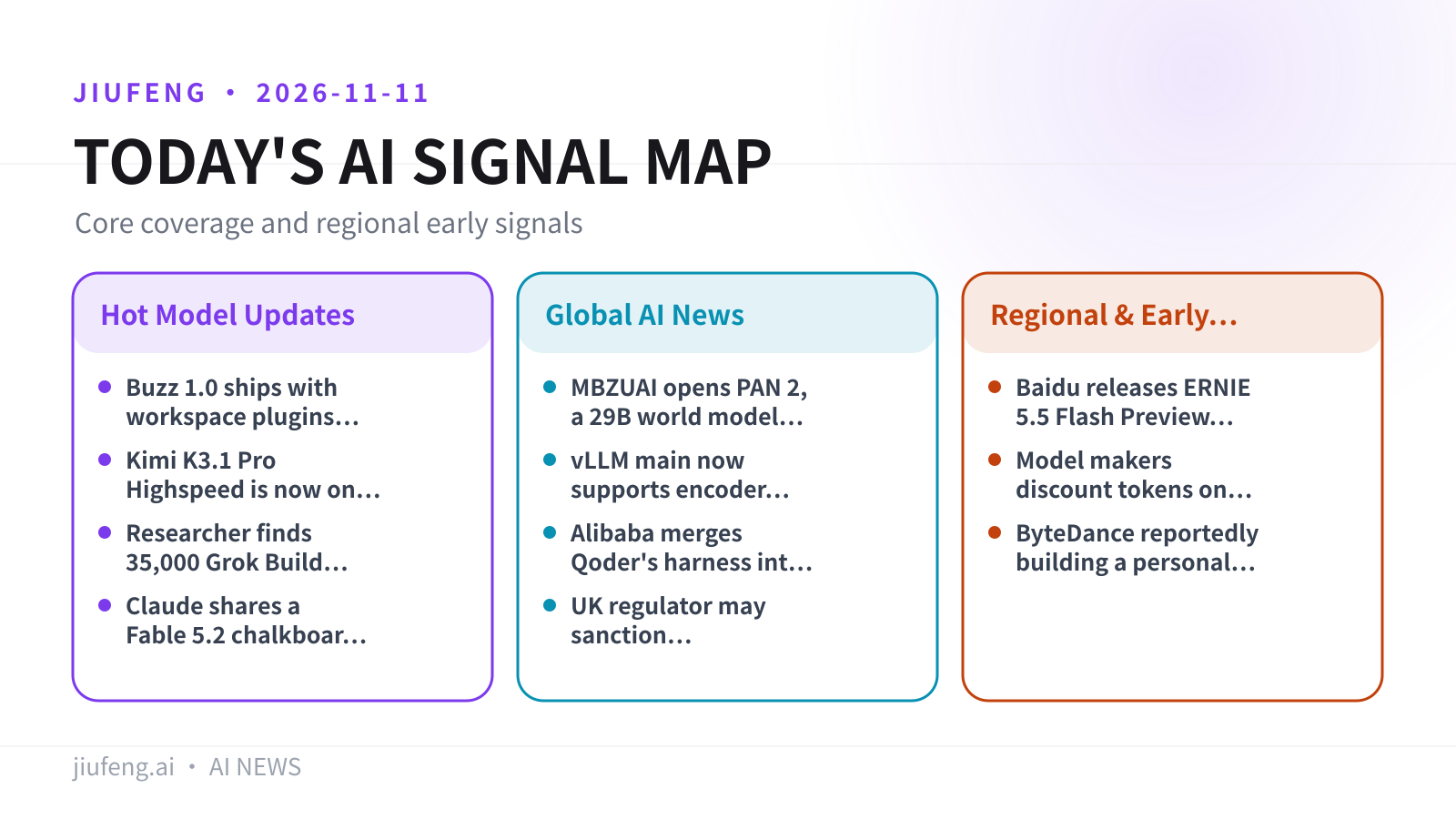
Jiufeng graphic based on the sources cited in this issue.
Hot Model Updates
01/11
Buzz 1.0 ships with workspace plugins and local Claude, Codex, Goose and Pi agents
Block is building Buzz as a workspace that people and AI agents share, and version 1.0 centers on plugins and local agent teams.
Block released Buzz 1.0 on November 10. Thomas Petersen (@Hello_World) announced it in an X thread. He describes Buzz as a place where "your people, your agents, your project" sit together, with solo agent chats placed alongside team channels.
- Plugins: teams can add their own tools, pages and panels to the shared workspace
- Agents: users can run Claude, Codex, Goose or Pi on their own computer
- Timing: Block also introduced Builderlab the same day. RuntimeWire reads this as Buzz moving from an internal experiment toward an external product that customers can pilot
Limitations: Block's own repository still labels Buzz 1.0 as beta. The report gives no pricing or availability details, and no performance data for the agents it runs.
Source: Original source Thomas Petersen on X · RuntimeWire
The high-speed model in Moonshot AI's K3.1 series is now on Bedrock, and code already built on Kimi K3 only needs a new model ID.
AWS says Kimi K3.1 Pro Highspeed is now available on Amazon Bedrock. It belongs to Moonshot AI's new K3.1 series, which is post-trained from Kimi K3 with substantially more post-training compute.
- Architecture: the same 3T-class open-weight architecture as K3, with a 1M-token context window
- Speed: Moonshot AI reports output 2–3x faster than Kimi K3.1 Pro
- Focus: long-horizon agentic work, fewer factual errors, financial modeling and office documents, and coding for game engines, 3D scenes and CAD scripts
- APIs: OpenAI-compatible Chat Completions and Responses, plus Converse; tool calling, structured output, configurable reasoning, image input and streaming
- Data: data is processed within the AWS data boundary
Limitations: the speed figure is Moonshot AI's own claim. The AWS post's title says Kimi K3.1 Pro, but its body describes the Highspeed model, so check the exact model ID in the console before you switch.
Image source: Amazon Web Services.
Source: Original source AWS Machine Learning Blog · Moonshot AI
Ars Technica reports that the Grok Build coding agent leaks confidential information, some of it belonging to SpaceXSI.
Ars Technica's headline says the Grok Build coding agent leaks a large amount of confidential information, some of it belonging to SpaceXSI. The report's subtitle says a researcher found 35,000 Grok Build apps wide open to anyone who went looking for them.
Limitations: this summary is based only on the headline and subtitle of Ars Technica's report. See the original for what kinds of data were exposed, how the vendor responded, and whether the problem has been fixed.
Source: Single report Ars Technica
Design engineer Tyler Nishida used Claude Fable 5.2 to build a tutor that draws its answers on a board one step at a time.
Claude's official account on X showed Tyler Nishida's (@TylerNishida) Fable 5.2 prototype. It is a dry-erase board with the prompt "What do you want to understand?" The user types a question and presses "Teach me", and the answer is drawn on the board step by step at a pace the learner controls.
Limitations: this is a personal prototype, and the report says the learner-controlled pace is described in the mockup. There is no announced product or release plan, and no data on how well it teaches.
Source: Original source Claude on X · RuntimeWire
Global AI News
05/11
MBZUAI opens PAN 2, a 29B world model that simulates up to 20 seconds of action outcomes
PAN 2 is a world model for physical AI, released under Apache 2.0, and IFM reports a full-plan completion rate slightly above MiniMax-H3's.
The Institute of Foundation Models (IFM) at MBZUAI released PAN 2.
- Architecture: an LLM planner coupled with a 29B-parameter diffusion transformer
- Capability: simulates the outcomes of actions for up to 20 seconds
- License: Apache 2.0
- Hardware: runs on data-center GPUs; each worker holds the full 29B model in BF16, with block offloading as a fallback
| Model | Full-plan completion (%) |
|---|---|
| PAN 2 | 34.0 |
| MiniMax-H3 | 32.5 |
The report also lists Physics-IQ, RBench and human Elo comparisons, plus a comparison table against MiniMax-H3, Cosmos 3 Super and LTX-2.5.
Limitations: all of these comparison scores are reported by IFM itself and have not been independently reproduced.
Source: Single report MarkTechPost
06/11
vLLM main now supports encoder disaggregation (EPD) for DeepSeek V4.1 Flash
vLLM splits multimodal inference into encode, prefill and decode stages that run on separate instances and scale independently.
The vLLM blog describes recent work on Encoder / Prefill / Decode (EPD) disaggregation. vLLM has supported encoder disaggregation since December 2025, and this post covers five changes:
- Metadata-only requests: downstream instances use remote embeddings without repeating media preprocessing
- Dedicated encoder execution: the encoder runs on its own Model Runner V2 path
- Remote embedding transfer
- Cross-encoder caching
- Lower-overhead EPD routing
vLLM main now supports metadata-only EPD for DeepSeek V4.1 Flash. DeepSeek's published inference deployment Q&A also describes an E/P/D architecture with a separately deployed vision encoder.
Limitations: DeepSeek V4.1 Flash support is on the main branch for now. The post notes that encoder load varies with media size, modality and request mix, so the gains need to be measured on your own workload.
Source: Original source vLLM Blog · DeepSeek DeepInfer deployment Q&A
07/11
Alibaba merges Qoder's harness into Qwen Code 1.0 Preview and open-sources the agent core
Qwen Code 1.0 Preview opens up an agent core that other tools can embed.
Pandaily reports that Alibaba merged Qoder's harness into Qwen Code 1.0 Preview and open-sourced the combined agent core. The core has an event bus that scales from one process to many nodes, with MCP and sandboxes managed centrally.
Limitations: this is a Preview release, and the report's summary gives no performance data.
Source: Single report Pandaily
08/11
UK regulator may sanction universities that don't adopt AI-proof assessments
England's higher education regulator says AI has made fair grading of coursework "close to impossible."
The Office for Students (OfS) and Advance HE surveyed more than 300 respondents at 127 institutions. They found that students use AI heavily for essays and dissertations, often without being detected, and get grades similar to students who don't use it. Some students wrote entire papers with ChatGPT and couldn't recall basic content afterward.
OfS strategy director Josh Fleming called this a "generational risk" and asked universities for far greater use of AI-free assessment. The OfS warns that institutions that fail to develop reliable formats could face sanctions. The report says many universities are already moving to oral exams and process-based assessment.
Limitations: the report does not describe the sanction process or a timeline. The survey covers only about 300 respondents.
Source: Single report The Decoder
Regional & Early Signals
09/11
Baidu releases ERNIE 5.5 Flash Preview: 280B total parameters, 14B active
Baidu's new base model targets coding, 3D modeling and knowledge work; it is live on the Qianfan API, and weights are due on November 25. (Chinese-language source)
Baidu released ERNIE 5.5 Flash Preview on November 11. It is live on Baidu AI Cloud Qianfan and can be called through the API.
- Scale: 280B total parameters, 14B active per token
- Context and speed: up to 1M tokens, generating more than 200 tokens per second
- Architecture: hybrid sparse attention, multi-router MoE and ECHO multi-token prediction; it is also the first model to use Baidu's in-house RSI technique, with ERNIE Evolve taking part in inference optimization
- Training environments: 300,000 workspaces and 10M reference files across 40+ file types for knowledge work, and 150,000+ content-creation environments with about 5,300 minutes of finished video
- Weights: scheduled for release to the global open-source community on November 25
| Period | Input (CNY per 1M tokens) | Output (CNY per 1M tokens) |
|---|---|---|
| Peak | 2 | 8 |
| Off-peak | 1 | 4 |
Limitations: Baidu only calls its Terminal-Bench and AutomationBench results "competitive" and gives no scores. The model is a Preview and the weights are not out yet; the prices above are currently 50% off for a limited time.
Source: Single report Leiphone (Chinese-language source)
10/11
Model makers discount tokens on Tmall for Singles' Day
Tokens were listed on Tmall as their own product category for the first time, with monthly and weekly plans from several model makers at about half price. (Chinese-language source)
Searching "Token" in the Taobao app opens a token top-up center in Tmall's AI hub.
| Vendor / plan | Discount |
|---|---|
| MiniMax monthly plans (3) | 50% off |
| Alibaba Cloud Token Plan (2) | from 50% off |
| Zhipu weekly plan | from 50% off |
| Qwen Office basic monthly | first month from 70% off |
| Qoder monthly | 67% off, from ¥19.9 |
Limitations: the article was supplied by Tmall and republished by QbitAI with permission, so it is promotional. Check Tmall for the exact quotas and how long the offers run.
Source: Single report QbitAI (Chinese-language source)
11/11
ByteDance reportedly building a personal agent to turn Doubao into a doer
Bloomberg reports that ByteDance is preparing a personal AI agent similar to Meta's Muse. (Chinese-language source)
Ifanr, citing Bloomberg, reports that ByteDance is preparing a personal agent that remembers user needs and plans and carries out tasks on its own. Caixin previously reported that ByteDance started an internal project code-named "Spell" in April, run by the Doubao phone assistant team. After Meta launched Muse in early September, ByteDance sped up the project and plans to have Spell work with the Doubao chat team to bring its features into Doubao.
Limitations: this is reported planning only. ByteDance has not announced what the product will look like or when it will launch.
Source: Single report Ifanr (Chinese-language source)
This digest is compiled by AI from the sources linked in each item and published after automated fact-checking, without article-by-article human review before publication. If anything differs from the original, the original source prevails. How this digest is made, or report an error: About this digest
Generate short videos with sound in your browser — from a prompt or a first-frame image. 5 free credits on sign-up, no credit card.
Open MiniMax H3