Overview
11 stories in this issue. The first 3 are today's priorities.
Hot model updates
- Top · Fable 5.2 completes 41.3% of real freelance projects on the Remote Labor Index
- Top · Gemini 4 Carbon reaches the API and Google AI Ultra subscribers
- Top · MiniMax releases H3-Image weights with 4K generation in under 10 seconds
Global AI news
- Nvidia's GR00T 2 learns from videos of humans, then imagines itself as the robot
- AlphaProof Code formally verifies Signal's encryption code in Lean
- Claude adds Whiteboards, Sheets and Data for shared team work
- OpenAI lets businesses claim their ChatGPT listing and build their own agent
- Amazon Bedrock AgentCore launches a Web Search API
Regional and early signals
- OpenAI acquires Odessia, a 9-person AI travel agent startup
- Mercor raises $750M at a $20B valuation to sell agent evaluation to enterprises
- Security operations startup Daylight raises $80M and reports 40-fold revenue growth
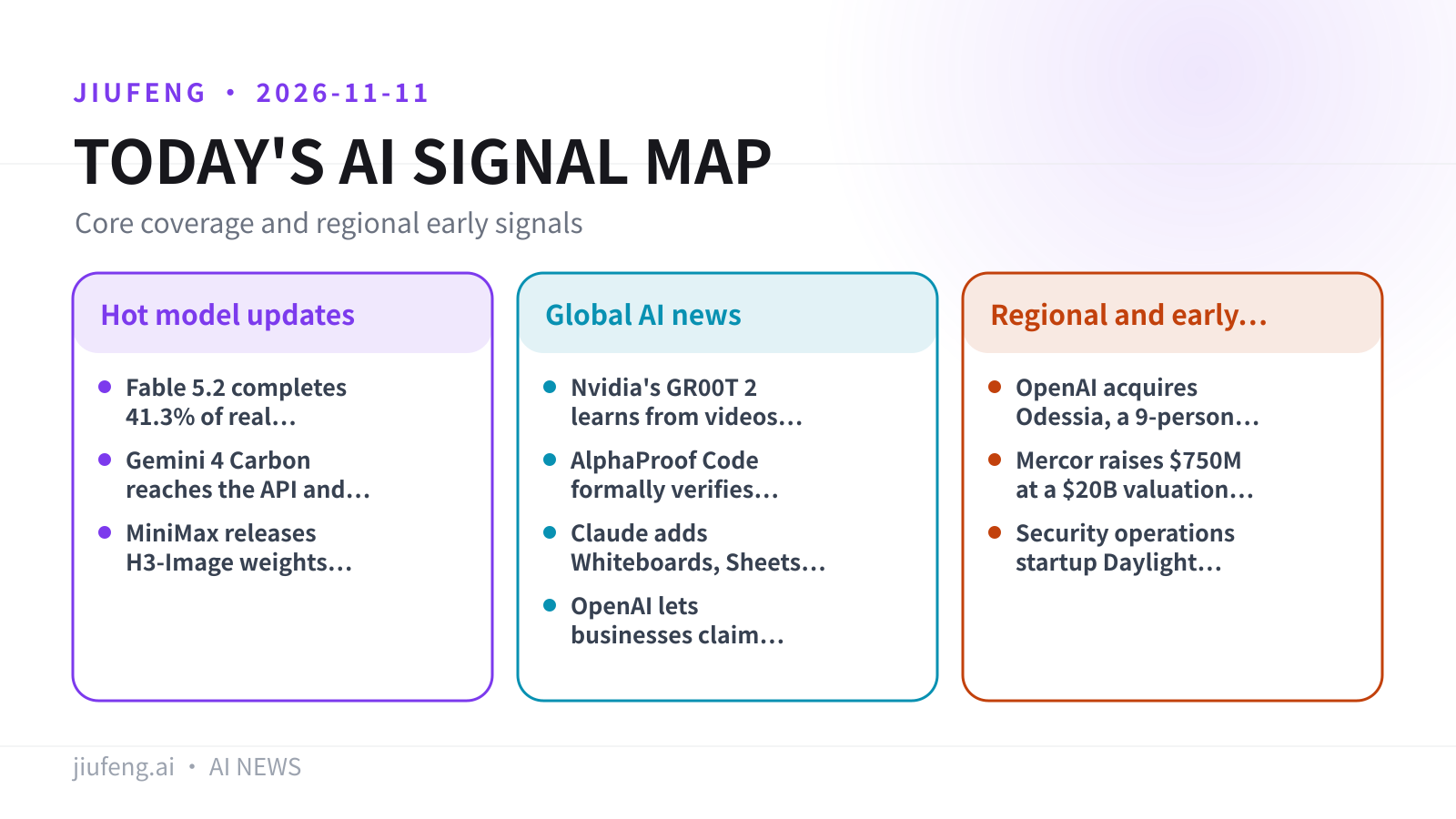
Jiufeng graphic based on the sources cited in this issue.
Hot model updates
01/11
Fable 5.2 completes 41.3% of real freelance projects on the Remote Labor Index
Anthropic's Fable 5.2 leads RLI at 41.3%. A year ago, the top score on the same benchmark was 2.5%.
The Remote Labor Index (RLI), run by Scale Labs and the Center for AI Safety (CAIS), measures how often AI agents finish real freelance jobs well enough for a paying client to accept the work. Fable 5.2 scored 41.3%, almost twice the 21.25% of the runner-up, Opus 5.5. Scale Labs pointed to 3D models, audio and architecture as the areas where Fable 5.2 improved most.
| System | RLI completion (%) |
|---|---|
| Fable 5.2 | 41.3 |
| Opus 5.5 | 21.25 |
| GPT-6 Astra | 20.83 |
| Gemini Argon 4 | 17.08 |
| Fable 5 (Jul 2026) | ~16 |
| Manus (~1 yr ago) | 2.5 |
Older models such as GPT-5.2 and Gemini 3 Pro score below 3%.
Limitations: A 41.3% score means close to 60% of projects still fail to meet client standards. The results were published by Scale Labs, which runs the benchmark, and relayed by media coverage.
Source: Original source Scale Labs on X · The Decoder
Two weeks after a limited release to cybersecurity defenders, Gemini 4 Carbon is available to paid developers and enterprises through the API, and is gradually rolling out to Google AI Ultra subscribers on the consumer side.
Google DeepMind calls Carbon its strongest model. It targets cybersecurity and long-horizon agentic workflows in complex knowledge work, software engineering and scientific reasoning. Two weeks ago, Carbon went to a group of cybersecurity defenders through the Fairwind Program. Google says Gemini 4 Argon is still the right choice for most uses, with Carbon aimed at harder tasks.
- Availability: API for paid developers and enterprises; a gradual consumer rollout to Google AI Ultra subscribers in Antigravity, the Gemini app and AI Mode in Search
- Leaderboards: No. 1 on CursorBench 4.0, WANDR and AutomationBench; No. 2 on MKA
- API pricing: $2 per million input tokens and $10 per million output tokens, the same launch price as Argon
Limitations: Consumers without an Ultra subscription cannot use it yet, and the consumer rollout is gradual. This is launch pricing, and the rankings above are all published by Google.
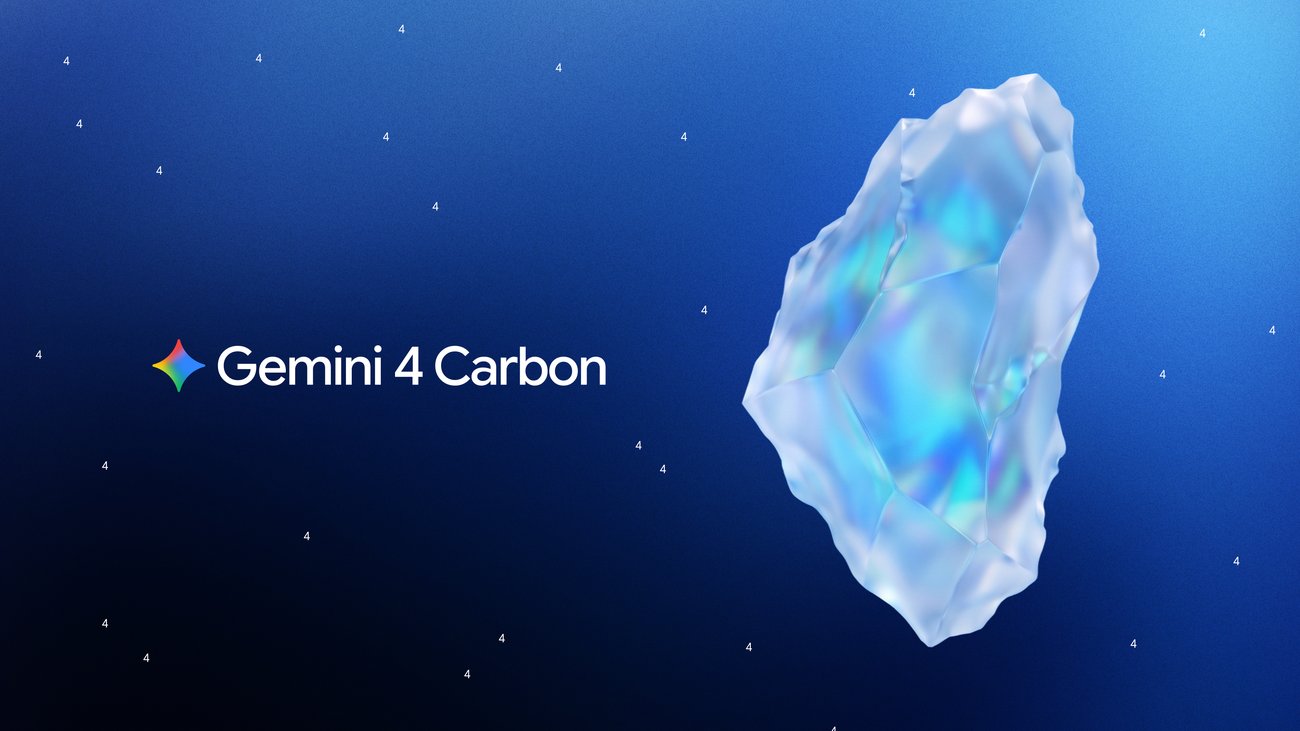
Image source: Google.
Source: Original source Google DeepMind
03/11
MiniMax releases H3-Image weights with 4K generation in under 10 seconds
MiniMax launched H3-Image, an image generation and editing model built on H3, and released the weights on launch day.
- Capabilities: text-to-image, reference-based generation, image editing
- Resolution and speed: a 4096×4096 image in under 10 seconds, which MiniMax says is up to 5× faster than mainstream alternatives
- References: works with up to 16 reference images at once
- Access: Hugging Face weights, API, MiniMax Open Platform, MCode, Hailuo
MiniMax says the gains come from changes across the whole post-training pipeline: data, reinforcement learning, fewer sampling steps and deployment optimization.
Limitations: In Chinese tech outlet ifanr's tests, a 4K image took 10–20 seconds, slower than the official "under 10 seconds". The "5× faster" figure is MiniMax's own claim and does not name the models it was compared with. The announcement does not state a license.
Source: Original source MiniMax · Hugging Face · ifanr (Chinese-language source)
Global AI news
04/11
Nvidia's GR00T 2 learns from videos of humans, then imagines itself as the robot
GR00T 2 is meant to teach robots new tasks from videos of human hand movements, cutting back on slow and expensive teleoperation.
Nvidia described the robot foundation model GR00T 2 in a new research report. The previous version, GR00T 1, turned camera images and language commands directly into motor actions. GR00T 2 is what Nvidia calls a world-action model: it predicts the next movement and a short video of what comes next, such as how the camera view should change as an arm picks up an object. During training, it maps human hand movements from video onto robot arms.
Limitations: The media coverage does not say whether the weights will be released or when the model will be available.
Source: Original source NVIDIA Research · The Decoder
05/11
AlphaProof Code formally verifies Signal's encryption code in Lean
Google DeepMind used its agentic framework AlphaProof Code to prove key security properties of the actual code behind the Signal protocol.
Formal verification means proving mathematically that code works as intended. It is the highest standard of security assurance, but it usually takes a lot of manual work. This effort covered the Signal protocol's underlying code, which protects messages in Signal and Google Messages. DeepMind calls this the first time AI has formally verified a widely deployed cryptographic protocol at this depth, and it published a technical paper alongside the announcement.
DeepMind's announcement gives two figures for scale: the summary says the agents wrote about 3 million lines of proofs, while the body says agents powered by Gemini Carbon generated over 6 million lines of Lean. Human experts and AI decided together what to prove, and humans reviewed every formal specification; the agents then proved the properties autonomously. About 1% of the code, flagged by the agents, went to human review, and Lean checked the rest automatically.
Limitations: The proofs cover "key security properties", not the entire codebase. The two line counts appear to measure different things, and the announcement does not explain the gap.
Source: Original source Google DeepMind
Anthropic wants to bring the way people work with Claude Code to non-engineering teams, adding whiteboards, spreadsheets and data dashboards that several people can edit.
On November 10, Anthropic began rolling out Claude Whiteboards, Claude Sheets and Claude Data. Whiteboards and Sheets are in beta on paid plans, and Claude Data is generally available. Partner apps from Adobe, Atlassian and Box can now be opened directly inside the chat.
Limitations: Whiteboards and Sheets are still in beta and limited to paid plans. The report does not mention extra charges or usage limits.
Source: Original source Claude on X · RuntimeWire
07/11
OpenAI lets businesses claim their ChatGPT listing and build their own agent
In the Businesses in ChatGPT beta, verified companies can correct the information ChatGPT uses about them, add product feeds and launch a labeled agent.
OpenAI opened the Businesses in ChatGPT beta on November 10. After claiming a profile in Business Hub, a company can correct the information ChatGPT uses about it, add product feeds and see aggregated data on how often it is mentioned. Companies can also build a free agent, which can serve as the landing page for sponsored ads. OpenAI says 1.2 billion people use ChatGPT each week.
Limitations: The beta is limited to U.S. ecommerce and online services businesses for now.
Source: Original source OpenAI · RuntimeWire
08/11
Amazon Bedrock AgentCore launches a Web Search API
The AgentCore Web Search API is now available. It answers every query from a web index Amazon runs itself, without sending it to a third-party search engine.
Agents get current web results with a single API call, signed with the AWS credentials they already use. Each result includes the page title, URL, publication date and a query-relevant extract. Requests can include or exclude domains and limit results to a publication date range. On Lambda, ECS and AgentCore runtime, agents call the API with their execution role.
Limitations: This is AWS's own tutorial. The daily dependency watcher is a sample built in LangGraph that makes at most 12 searches per run, with the full code in a notebook.
Source: Original source AWS Machine Learning Blog · Sample notebook on GitHub
Regional and early signals
Odessia relaunched publicly on October 14, and OpenAI bought it on November 10.
According to The Information, OpenAI has acquired Odessia, an AI travel concierge founded by former Sonder CEO Francis Davidson. The company has 9 people and was backed by Sequoia. Davidson has joined OpenAI.
Limitations: Financial terms were not disclosed. The report does not say whether or how Odessia's product will become part of ChatGPT.
Source: Original source Francis Davidson on X · RuntimeWire
10/11
Mercor raises $750M at a $20B valuation to sell agent evaluation to enterprises
Mercor, which supplies human experts to train and evaluate AI models for frontier labs, is taking that business to companies in every industry.
Mercor's network has more than 5 million domain experts, and most of its work so far has been for frontier AI labs. Investors in the round include Nvidia, Salesforce, Zoom, Benchmark, Felicis, General Catalyst and Sapphire. Co-CEO Brendan Foody said on X in July that annualized revenue passed $2 billion in June. Co-CEO Adarsh Hiremath said a model can score well on a public benchmark and still fail on a company's own systems, policies and edge cases.
Limitations: Only one outlet has reported this, and no lead investor was disclosed. The revenue figure is self-reported.
Source: Single report SiliconANGLE
11/11
Security operations startup Daylight raises $80M and reports 40-fold revenue growth
Daylight uses AI agents for most routine managed detection and response (MDR) work and leaves decisions that need human judgment to its security engineers.
Each customer gets a set of agents that Daylight's security engineers tailor to its systems and workflows. Customers can hand over security operations entirely, run them jointly with an internal team, or have Daylight engineers work on-site. The report also cites a July ISC2 survey of 856 security professionals: 65% said they spend more time than a year ago deciding whether to trust AI output.
Limitations: The 40-fold revenue growth is the company's own claim, and the report gives no absolute revenue figure. Only one outlet has reported this.
Source: Single report SiliconANGLE
This digest is compiled by AI from the sources linked in each item and published after automated fact-checking, without article-by-article human review before publication. If anything differs from the original, the original source prevails. How this digest is made, or report an error: About this digest
Generate short videos with sound in your browser — from a prompt or a first-frame image. 5 free credits on sign-up, no credit card.
Open MiniMax H3