Overview
8 stories in this issue. The first 3 are today's priorities.
Hot model updates
- Top · Claude Fable 5.2 and Mythos 5.2: $8 per million input tokens, up to 30% faster than 5.1
- Top · Meta launches Muse Ember at $0.10 per million input tokens for agent volume work
Global AI news
- Top · OpenAI dots can now spread tasks across multiple local computers
- Bedrock Managed Knowledge Base adds single-shot RAG and retrieval-only modes
- Amazon open-sources HOPE, an expert-pruning method for MoE models that needs no retraining
- Scott Wiener, author of California's AI risk bill, wins Pelosi's House seat
Regional and early signals
- Tencent's chief AI scientist Yao Shunyu: mix open and closed models; biology risk is harder to contain
- Elith and NVIDIA release Nemotron-Personas-Finance-Japan, a synthetic persona dataset for Japanese finance
Hot model updates
01/08
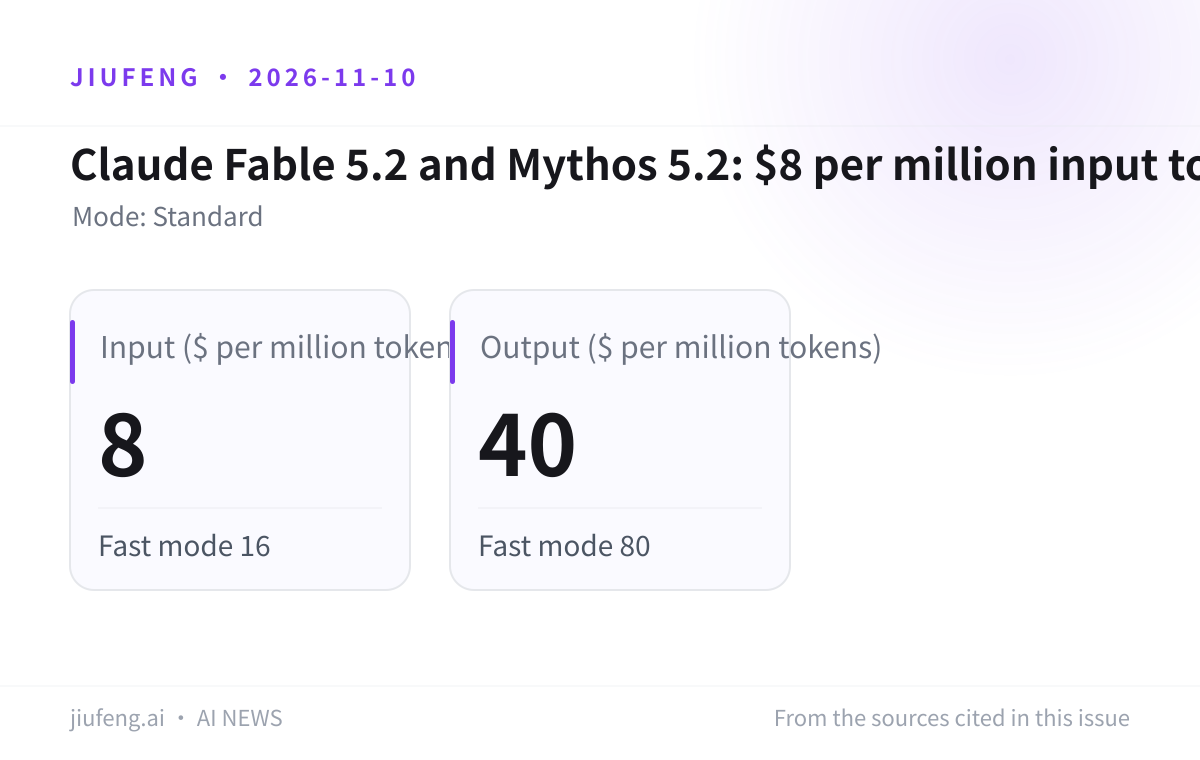
Claude Fable 5.2 and Mythos 5.2: $8 per million input tokens, up to 30% faster than 5.1
Anthropic released Claude Fable 5.2 and Claude Mythos 5.2. It says they beat Opus 5.5 on most tests and cost less than the previous generation, and AWS listed them the same day.
Anthropic said on November 9 that Claude Fable 5.2 and Claude Mythos 5.2 are available now. It positions them as its strongest models for difficult technical work across coding, reasoning and vision. According to RuntimeWire, Anthropic says the new models beat Opus 5.5 on most tests and run up to 30% faster than the 5.1 models.
| Mode | Input ($ per million tokens) | Output ($ per million tokens) |
|---|---|---|
| Standard | 8 | 40 |
| Fast mode | 16 | 80 |
- Long tasks: AWS says Fable 5.2 checks its own output and can run unattended for hours to days
- Alignment testing: in Anthropic's tests, Mythos 5.2 hallucinates less and reports problems more honestly than Opus 5.5, Sonnet 5.5 and Mythos 5.1; Anthropic expects Fable 5.2 to behave similarly
- Availability: both models are on Amazon Bedrock and Claude Platform on AWS; Mythos 5.2 is available only through Anthropic's verification programs, for authorized cyber security and life sciences work
Limitations: All performance and speed figures come from Anthropic's own tests, and no third party has reproduced them yet. Fable 5.2's alignment behavior is Anthropic's projection from the Mythos 5.2 results, not a separate measurement.
Jiufeng graphic based on the sources cited in this issue.

Image source: anthropic.
Source: Original source Anthropic · AWS Machine Learning Blog · AWS getting-started notebook · RuntimeWire
02/08
Meta launches Muse Ember at $0.10 per million input tokens for agent volume work
Meta's new Muse Ember costs $0.10 per million input tokens and targets the repetitive, high-volume calls inside agents.
According to RuntimeWire, Meta positions Muse Ember as the execution model for agent volume work: Muse Wonder does the planning while Ember handles the bulk of repetitive execution. Mark Zuckerberg announced the model on X.
Citing Artificial Analysis data, the report says Ember comes out cheaper and smarter than Haiku and Luna on a cost-per-task basis.
Limitations: "Cheaper and smarter" is Meta's pitch, which the report supports with Artificial Analysis cost-per-task data. Winning on cost per task does not mean Ember performs better in absolute terms on every kind of task.
Source: Original source Mark Zuckerberg on X · RuntimeWire
Global AI news
A single dot can now connect to several local computers and choose which machine runs each task.
OpenAI's developer account announced the change on X on November 9, and the official documentation was updated to match. Dots are OpenAI's persistent agents. OpenAI's example: the developer keeps coding on a laptop while the dot builds and tests the app on a separate dedicated machine.
According to RuntimeWire, this lets dots take on work that depends on specific local toolchains, such as Xcode builds and testing against older SDKs.
Limitations: The report does not say how many computers one dot can connect to, which plans include the feature, or whether it costs extra.
Source: Original source OpenAI Developers on X · RuntimeWire
04/08
Bedrock Managed Knowledge Base adds single-shot RAG and retrieval-only modes
Amazon Bedrock Managed Knowledge Base's AgenticRetrieveStream API now offers single-shot RAG and retrieval-only modes alongside the existing agentic retrieval.
Single-shot RAG searches the knowledge bases once, then a foundation model writes an answer from the passages it finds. Retrieval-only returns the matching passages without generating an answer, so the application or user can work with the source text directly.
AWS's idea: within one assistant, simple questions take the fast, cheap single search, while complex questions that span several documents use multi-step agentic retrieval, with no need to build two separate systems. The post also explains how to use the maxAgentIteration parameter.
Limitations: The post uses a banking scenario as its example and publishes no numbers comparing the modes' latency or cost.
Source: Original source AWS Machine Learning Blog
05/08
Amazon open-sources HOPE, an expert-pruning method for MoE models that needs no retraining
HOPE (Higher-Order Pruning of Experts) permanently deletes the least useful experts in MoE models to cut inference memory.
Writing on the Hugging Face blog, Amazon researchers give an example: Qwen3.5-122B has 256 experts in each of its 48 MoE layers. Expert MLPs make up 95% of its roughly 250 GB parameter footprint, yet each token uses only 8 experts per layer.
Compared with loading and unloading experts on the fly, pruning adds no latency and needs no training. The code is released as a Python package on GitHub.
Limitations: Pruned experts are removed for good. Accuracy loss at different pruning ratios is covered in the source's experiments and the repository, and is not summarized here.
Source: Original source Hugging Face Blog · GitHub: awslabs/HOPE
06/08
Scott Wiener, author of California's AI risk bill, wins Pelosi's House seat
Scott Wiener, who wrote frontier-AI risk legislation in the California state senate, won San Francisco's congressional race and could help shape federal AI policy.
According to MIT Technology Review, Wiener narrowly won the San Francisco seat left open by former House Speaker Nancy Pelosi. He gave an interview a few hours after being declared the winner and said "recursive self-improvement" half a dozen times in 20 minutes.
He cited a METR report released the day before. That report was widely read as evidence that Anthropic had achieved recursive self-improvement, and Wiener called it "very concerning." He said he had hoped Congress would act decisively before the end of the year, but that this does not appear to be happening.
Limitations: This comes from a single interview and reflects Wiener's personal views right after his election.
Source: Single report MIT Technology Review
Regional and early signals
07/08
Tencent's chief AI scientist Yao Shunyu: mix open and closed models; biology risk is harder to contain
Yao Shunyu says AI will soon be able to help develop bioweapons, and that neither fully open nor fully closed models can solve this on their own.
According to The Decoder, citing the South China Morning Post, Yao, who previously worked at OpenAI, argues for a mix of open and closed models so everyone can use the technology for defense. He says offense and defense are harder to separate in biology than in cybersecurity. He also says the gap between Chinese and US models is small, so the whole industry should proceed carefully.
He gave a Hugging Face security incident as an example: closed models such as Claude refused to analyze attack commands because of their safety filters, so Hugging Face used GLM-5.2 to parse the logs instead.
Limitations: These are personal views relayed second-hand through media reports, with no concrete policy or product plan attached. The Decoder also has a section on what the Hugging Face case does and does not show.
Source: Original source Hugging Face security incident report · The Decoder
08/08
Elith and NVIDIA release Nemotron-Personas-Finance-Japan, a synthetic persona dataset for Japanese finance
The dataset combines Japan's official demographic statistics with household finance and financial literacy data to generate synthetic personas for financial AI in Japan.
Elith and NVIDIA jointly released the dataset on Hugging Face. It was generated with NeMo SDG-PGMs and is built on Japanese government statistics. The publishers say it serves Japanese developers who need to meet local and industry requirements, and the GitHub project ties it to sovereign AI development.
Limitations: All personas are synthetic and do not correspond to real people. Check the dataset's size and license on its Hugging Face card; they were not verified here.
Source: Original source Hugging Face Blog · GitHub: NeMo SDG-PGMs
This digest is compiled by AI from the sources linked in each item and published after automated fact-checking, without article-by-article human review before publication. If anything differs from the original, the original source prevails. How this digest is made, or report an error: About this digest
Create AI images and videos with sound in your browser: write a prompt, pick a model, download the result. 5 free credits on sign-up, no credit card.
Start creating free