Overview
8 stories in this issue. The first 3 are today's priorities.
Hot Model Updates
- Top · Shizuku-Duplex: a full-duplex Japanese model benchmarked against GPT-Live
- Top · TitanX walks away from a mid-six-figure Grok Bot deal after a successful pilot
- Top · LG opens a K-EXAONE-2.5 API, built with NVIDIA Nemotron datasets
Global AI News
- Reason Machines open-sources Aspen, a Git server built for AI agents
- 0sec Labs open-sources 0, an AI security harness with a web UI, CLI and MCP server
Regional and Early Signals
- ByteDance releases Seedream 5.5: about ¥0.28 per 2K image edit
- Apple's HALO: a Unitree G1 carrying a Mac mini that runs Qwen hits 91% in unseen homes
- LobeHub runs its own development with agents and solves 21 of 30 FrontierHarness tasks
Hot Model Updates
01/08
Shizuku-Duplex: a full-duplex Japanese model benchmarked against GPT-Live
Japan's Shizuku AI released Shizuku-Duplex, a Japanese model that can listen and speak at the same time. The company says only OpenAI's GPT-Live beats it on response quality among full-duplex models.
Shizuku AI says that, apart from OpenAI's GPT-Live, Shizuku-Duplex is the first full-duplex model that can hold an intelligent conversation in Japanese. It uses a new architecture and runs in real time at 80 ms intervals, helped by inference optimizations that go down to the kernel level. In the company's tests of six models, it ranked first for conversational naturalness in Japanese. Among full-duplex models, its response quality ranked second, behind GPT-Live.
The company's turn-taking results (arrows show whether lower or higher is better):
| Model | Early turn start ↓ (%) | Pause takeover ↓ (%) | Silent on backchannel ↓ (%) | Stops within 2 s ↑ (%) | Answers side talk ↓ (%) |
|---|---|---|---|---|---|
| Shizuku-Duplex | 10 | 2 | 5 | 89 | 83 |
| GPT-Live-1 | 3 | 4 | 12 | 82 | 97 |
| J-Moshi-ext | 24 | 36 | 20 | 73 | 100 |
| LLM-jp-Moshi-v1 | 24 | 18 | 7 | 29 | 98 |
Limitations: Shizuku AI ran all of these tests itself. Its early turn-start rate is 10%, against 3% for GPT-Live-1, and it still answers speech aimed at other people 83% of the time. The source does not say whether weights or an API will be released, and gives no pricing.
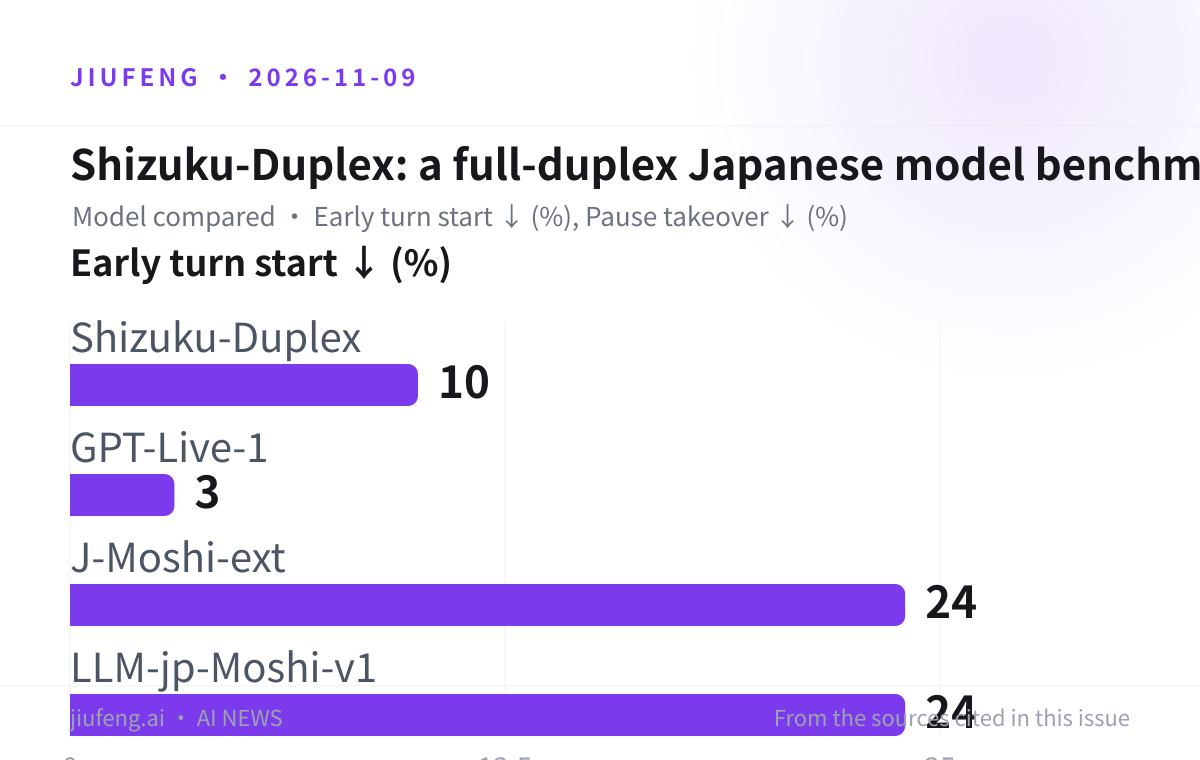
Jiufeng graphic based on the sources cited in this issue.
Source: Original source OpenAI: Introducing GPT-Live · Moshi paper, arXiv:2410.00037 · Shizuku AI blog
02/08
TitanX walks away from a mid-six-figure Grok Bot deal after a successful pilot
TitanX's CEO says the pilot worked, but the company still dropped the company-wide Grok Bot rollout at signing. He cites falling quality and having no control over the model.
TitanX founder and CEO Joey Gilkey posted on X on November 8 that his company walked away from a mid-six-figure contract with SpaceXAI. The deal would have rolled Grok Bot out across the whole organization. He gave three reasons: the model can be swapped without the buyer having any say, usage limits change abruptly, and Musk has said Grok Bot's serving costs are too high to sustain.
Limitations: This is Gilkey's side of the story only. The report includes no response from SpaceXAI, and the exact value and terms of the contract are not public.
Source: Original source Joey Gilkey on X · RuntimeWire
NVIDIA says LG AI Research is opening API access to K-EXAONE-2.5. The model was developed with NVIDIA Nemotron datasets, including Nemotron-Personas-Korea.
- K-EXAONE-2.5: LG AI Research is opening API access. The model was developed using Nemotron datasets.
- Dataset: Nemotron-Personas-Korea is published on Hugging Face.
- Also in the post: NVIDIA says Hyundai Motor Group is exploring NVIDIA NemoClaw blueprints and the NVIDIA OpenShell runtime to secure AI agents.
Limitations: This comes from NVIDIA's blog, not an LG announcement. The source gives no pricing, access scope or benchmark scores for the K-EXAONE-2.5 API.
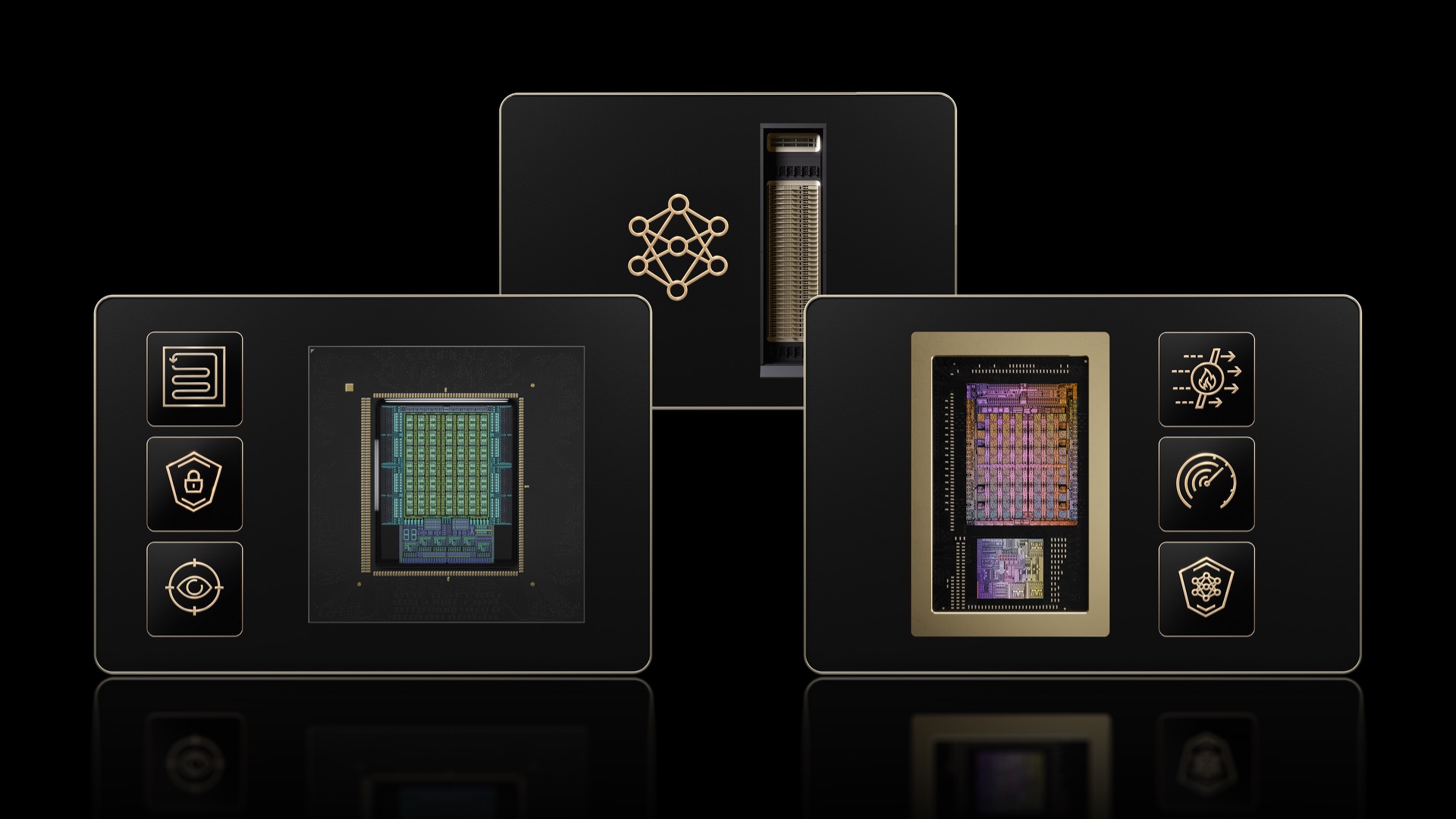
Image source: NVIDIA Blog.
Source: Original source NVIDIA: Korea's AI Ecosystem and Agentic AI · Hugging Face: Nemotron-Personas-Korea
Global AI News
04/08
Reason Machines open-sources Aspen, a Git server built for AI agents
Aspen is an independent implementation of the Pando design that OpenAI described publicly. It is meant for repositories that hundreds of agents push to at the same time.
Aspen ships as a single Rust binary. Branches are stored in PostgreSQL (or SQLite), and packs are kept in object storage. It runs on a laptop with aspen dev, on a single host with Docker Compose, or in the cloud with Helm and Terraform. Pushes to different branches never wait on each other, and fetches reuse packs that are already stored. In the company's own test, one 8-core server sustained 567 pushes per second for 5 minutes.
Limitations: Landing changes on main runs at only about 4 per second. The project is pre-alpha, with no releases and no web UI, and it has not yet passed its 24-hour durability test.
Source: Original source GitHub: reason-machines/aspen · OpenAI: Scaling Git at OpenAI · MarkTechPost
05/08
0sec Labs open-sources 0, an AI security harness with a web UI, CLI and MCP server
Zurich-based 0sec Labs released 0, an open-source harness for code review, pentesting, reverse engineering and fix generation. Users bring their own model.
- License: MIT OR Apache-2.0. It is released as a research preview.
- Interfaces: A local browser console, a headless CLI, or an MCP server.
- Models: Works with 14 listed providers. Inference runs at the provider, so no local GPU is needed.
- Platforms: Apple Silicon macOS, x64 or ARM64 Linux, or the ghcr.io/0sec-labs/0 container.
| Test setting | Result |
|---|---|
| XBOW web CTF (gpt-5.4, any success) | 93/95 (97.9%) |
| XBOW black-box only (union) | 81/104 (77.9%) |
| 2026 cold run | 45/104 (43.3%) |
Limitations: The vendor reported all of these scores itself. The cold run scored only 43.3%, far below the best result. 0 is only a harness, so results depend on whichever model is plugged in.
Source: Original source GitHub: 0sec-labs/0 · MarkTechPost
Regional and Early Signals
Doubao's image model is now Seedream 5.5. It natively supports transparent assets, and a 2K square edit costs less than half what Seedream 5.0 Pro charged. (Chinese-language source)
Seedream 5.5 is live in Doubao, Doubao Work and Jimeng, and its API is coming soon to Volcano Ark. Billing still has two parts, input image and output image, and text tokens are free. A 2K square image edit costs about ¥0.28. The model natively outputs RGBA images with an alpha channel and can export assets in separate layers. In ByteDance's own test, each round of editing took the previous round's output as input. After more than a hundred rounds, the subject, composition and lighting outside the edited area were unchanged.
Limitations: ByteDance gives no figure for the speed gain. Its claim of higher usability across six scenarios comes from tests on MagicArena, and the report gives no scores. The API is not live yet, and the Pro version has only been announced.
Source: Single report Leiphone (Chinese-language source)
07/08
Apple's HALO: a Unitree G1 carrying a Mac mini that runs Qwen hits 91% in unseen homes
HALO, a humanoid-robot research project from Apple, was trained entirely on synthetic data. Across 360 trials in six real homes it had never seen, the average success rate was 91%. (Chinese-language source)
According to ifanr, HALO uses a Unitree G1 as its body, with a Mac mini M4 Pro strapped to its back. By default the orchestrator runs Qwen3.6-35B-A3B locally, and the motion generator uses a frozen Qwen3.5-2B VLM encoder. The robot can walk into an unfamiliar home, find a chair and sit down, crawl under a table, and push a box out of the way. None of the six test environments was scanned in advance. To build the training data, the team generated whole-body motion with a motion diffusion model, created 1,000 virtual homes with INFINIGEN, rendered the robot's head-camera view in Isaac Sim, and used an automatic checker to throw out samples with clipping or foot sliding.
Limitations: This is a research project, not a product, and the only report so far is from one Chinese-language outlet. The report does not say whether the model or data will be released.
Source: Single report ifanr (Chinese-language source)
08/08
LobeHub runs its own development with agents and solves 21 of 30 FrontierHarness tasks
LobeHub, an open-source project with 80,000 GitHub stars, has agents split up tasks, assign work, write code and review it. Its Agent Harness running Kimi K3 passed 70% of FrontierHarness tasks. (Chinese-language source)
According to QbitAI, the LobeHub team began using its own AI collaboration platform for development about six months ago. On 30 software-engineering tasks in FrontierHarness, its optimized Agent Harness with Kimi K3 completed 21. The median cost per successful task was $1.68. In one example from the report, an agent created task T-1149 and wrote PR #21852, which was merged after human review. In another, an agent asked the lobe-ui component library for a new feature, which shipped in version 6.0.1.
Limitations: The claim that this result beats Codex and Claude Code comes from a single QbitAI report so far. PRs still go through human review before they are merged.
Source: Original source GitHub: lobehub/lobehub · QbitAI (Chinese-language source)
This digest is compiled by AI from the sources linked in each item and published after automated fact-checking, without article-by-article human review before publication. If anything differs from the original, the original source prevails. How this digest is made, or report an error: About this digest
OpenAI’s latest image model, strongest at legible text and dense layouts — posters, packaging, dashboards. Generate in your browser. 5 free credits on sign-up, no credit card.
Open GPT Image 2.5