Overview
8 stories in this issue. The first 3 are today's priorities.
Hot Model Updates
- Top · Karpathy uses Claude Opus 5.5 to distill 20 years of HN into HackerTube
- Top · Community quant shrinks the 2.8T Kimi K3.1 Pro from 1.77 TB to 775 GB
- Top · Four Radeon R9700s run Qwen3.8-27B: 3,340 tok/s prefill at 233k tokens
Global AI News
- Nvidia board opens independent probe after reports on Jensen Huang
- Nature commentary: three consciousness researchers say silicon AI won't be conscious
Regional and Early Signals
- Alibaba Cloud CIO: 30%+ AI-generated code, no faster end-to-end delivery
- Tencent launches Buddy One with a database and semantic layer for enterprise agents
- Amazon forms a new team to build a home robot
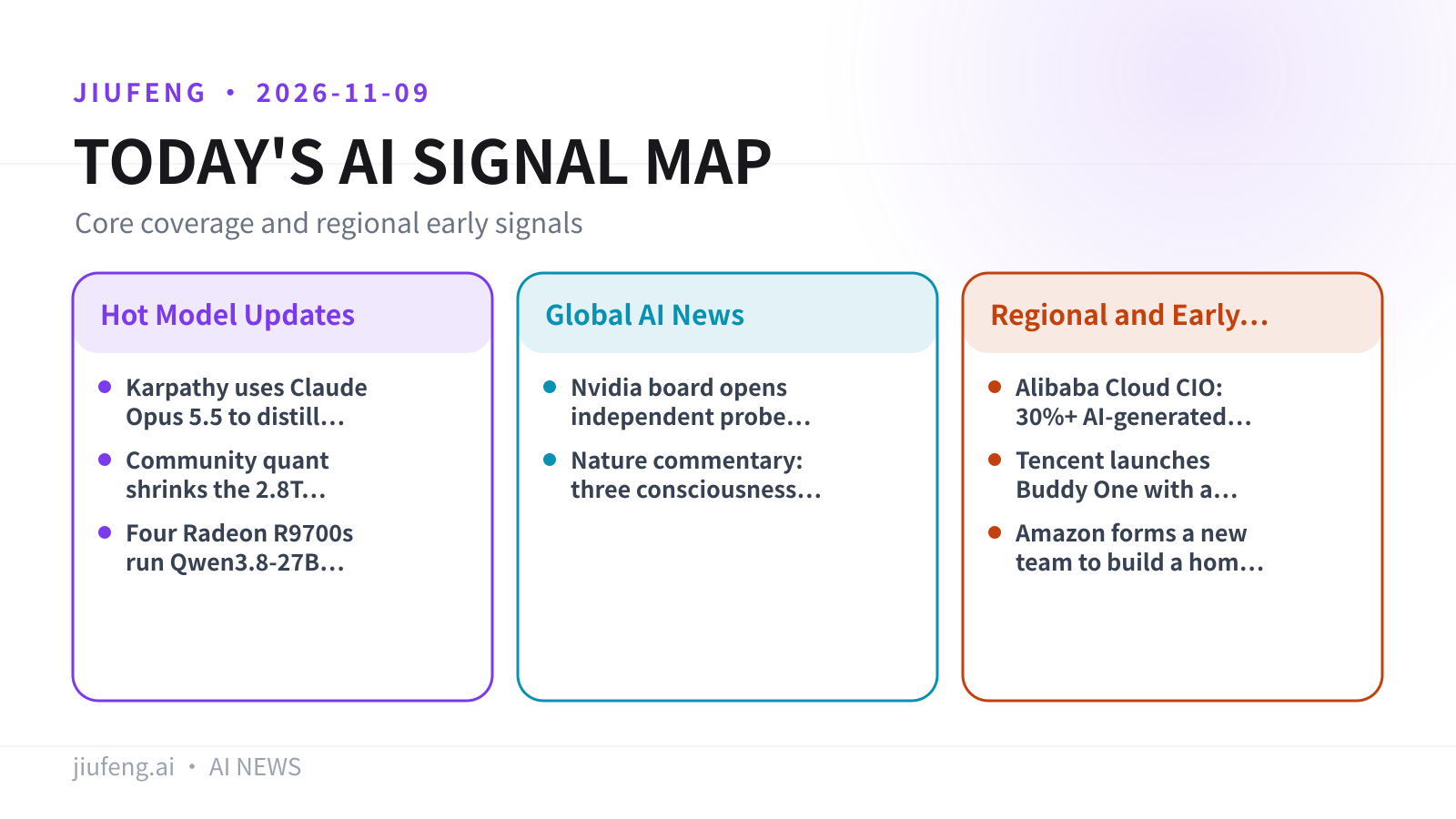
Jiufeng graphic based on the sources cited in this issue.
Hot Model Updates
01/08
Karpathy uses Claude Opus 5.5 to distill 20 years of HN into HackerTube
Claude Opus 5.5 went through 43 million Hacker News comments and picked out 6,454 videos that keep getting recommended there. Karpathy says Claude Code did nearly all of the work.
According to The Decoder, Andrej Karpathy built HackerTube over a weekend with Claude Opus 5.5. The model filtered 43 million comments from 20 years of Hacker News and kept the 6,454 videos that users there recommend again and again. The site needs no login. Instead of optimized thumbnails it shows a single frame from the middle of each video, and it keeps state locally in the browser.
Right after, he built TristanTube, which he says he "one-shotted with Claude Code in 3 minutes." It holds 47,000 videos drawn from a YouTube channel list compiled by Tristan Hume. Karpathy says Claude Code handled almost everything from data analysis to server setup. His only manual steps were getting a Google Cloud API key, renting a server and buying the domain.
Limitations: The claim of a "significantly better viewing experience" than YouTube's own recommendations is Karpathy's personal judgment, with no comparison behind it. The Decoder describes him as an OpenAI co-founder who is now an Anthropic researcher, so this example comes from an Anthropic employee. The report gives no token usage or cost.
Source: Original source Karpathy on X · The Decoder
A third-party developer used a three-tier mixed-bit scheme to quantize the 1.77 TB moonshotai/Kimi-K3.1-Pro into a 775 GB build, 56% smaller, and named it Kimi-K3.1-Pro-Coder.
Developer Grawnch published the quant on Hugging Face. The inference code is a fork of the local runner Strata that adds tiered placement of MoE experts across VRAM, RAM and disk. According to the project page:
- Scale: 2.8T MoE, 93 layers, 896 routed experts per layer
- Tiers: 90 hot experts in VRAM (2.81 bpw), 224 in RAM (2.56 bpw), 582 cold experts on NVMe (1.44 bpw), 774.97 GB in total
- Speed: 36.77 tok/s for a full 93-layer batch on an RTX PRO 6000 Blackwell (self-reported)
- Evals: the model card lists 30 questions each for AIME 2025 and LiveCodeBench; both the quant and the original score 29/30 (96.67%)
- Same method: the author's Qwen3.8-Pro-Coder build has 60 layers and 384 experts per layer, at 2.75/2.25/1.31 bpw, 160.2 GB in total
Limitations: This is a community quant, not a Moonshot AI release. Each eval has only 30 questions, so one question is worth about 3.3 points. Because cold experts sit on NVMe, real-world speed depends on your disk and memory.
Image source: huggingface.
Source: Original source Hugging Face: Grawnch/Kimi-K3.1-Pro-Coder · GitHub: strata
A developer connected six GPUs to the single x16 slot of a consumer X570 board through a PCIe switch and published Qwen3.8-27B throughput on four R9700s.
The machine uses an ASUS TUF X570-Plus, a Ryzen 9 3900X and 128 GB of RAM. A Broadcom PEX88096 switch connects to the CPU at gen4 x16, with four 32 GB Radeon AI PRO R9700s and two 24 GB RTX 3090s behind it, each at gen4 x8. ROCm 7.2.4 and CUDA run side by side on Debian 13. The R9700s run Qwen3.8-27B in MXFP4 with four-way tensor parallelism (TP4) and P2P on. The 3090s use vLLM 0.28 with TP2 and P2P off.
| Workload (4× R9700, TP4) | Throughput (tok/s) |
|---|---|
| 32k-token prompt prefill | ~4,700 |
| 233k-token prompt prefill | 3,340 |
| 16 concurrent clients, total output | 601 |
Limitations: This is one person's build, not a standardized benchmark. Before the GPU drivers will load, the board needs a BAR resize and bus rescan, done with the author's own unpublished gpu_rebar_layout module. gpu-unlock is only used to remove the GeForce half-rate tensor cap on the two 3090s. All six cards share a single x16 uplink.
Source: Original source GitHub: gpu-unlock · doug.sh write-up
Global AI News
04/08
Nvidia board opens independent probe after reports on Jensen Huang
On November 8 Nvidia's board launched an independent investigation, run by a committee of independent directors with outside counsel. Huang's letter to the company, which Nvidia made public, admits an affair.
The board's statement says it is acting "in light of recent reporting that founder and CEO Jensen Huang has been the target of a foreign intelligence effort," and that it has no reason to believe Nvidia secrets were compromised. TechCrunch reports that the case involves Alice Huang, a former executive at Megaspeed, a Singapore-based chip company. The claim that she was recruited for intelligence work comes from a memo circulating among US policymakers. According to TechCrunch, Huang admits to an affair with Alice Huang in a letter to the company that Nvidia made public.
Limitations: That Huang was targeted by foreign intelligence is so far a claim in press reports, not something the board's statement confirms, and the espionage allegations are unproven. The board has given no timeline and has not said whether it will publish its findings.
Source: Original source NVIDIA board statement · TechCrunch
05/08
Nature commentary: three consciousness researchers say silicon AI won't be conscious
In a Nature commentary, Anil Seth, Ned Block and Giulio Tononi reject the idea that running the right computations is enough for consciousness. They argue today's AI is not conscious and will not become so on silicon.
According to The Decoder, the commentary responds to figures such as Richard Dawkins and Geoffrey Hinton, who think AI may already be conscious. It cites an Anthropic study from this year that found patterns in Claude's internal processing resembling consciously accessible information processing. Anthropic itself does not treat this as evidence of subjective experience.
Limitations: This is an opinion piece, not empirical research. The 2023 Butlin et al. report "Consciousness in Artificial Intelligence" finds that current AI is not conscious but leaves the future open, which is where it parts ways with the commentary. Anthropic runs a research program on possible model welfare.
Source: Original source arXiv: Consciousness in Artificial Intelligence · Anthropic: Exploring model welfare · The Decoder
Regional and Early Signals
06/08
Alibaba Cloud CIO: 30%+ AI-generated code, no faster end-to-end delivery
Alibaba Cloud CIO Jiang Linquan says his team adopted AI coding across the board by late 2024 and quickly passed 30% AI-generated code, yet the staffing needed to ship a feature end to end did not change. (Chinese-language source)
According to InfoQ China, the team broke the full path from request to release into stages and found that coding takes only about 20% of the time. Within that 20%, core code that changes existing core systems, integrates with legacy systems or keeps production stable and secure is small in volume but takes more than 65% of coding time, and that is where AI helps least.
| Stage | Share of end-to-end time (%) |
|---|---|
| Requirements, review, revisions | ~20 |
| Interaction/visual design, review | ~10 |
| Technical design, review | ~15 |
| Coding | ~20 |
| Front/back-end integration | ~15 |
| Testing and bug fixes | ~20 |
Limitations: This is an internal retrospective with no external verification.
Source: Single report InfoQ China (Chinese-language source)
07/08
Tencent launches Buddy One with a database and semantic layer for enterprise agents
Tencent's Global Digital Ecosystem Summit had more than 40 launches over two days across applications, data, security and engineering. WorkBuddy is only one piece. (Chinese-language source)
According to Leiphone, the cross-app system Buddy One uses WorkBuddy to connect Tencent Docs, Tencent Drive, Tencent Lexiang, and design and development tools. On the data side, TDSQL Nexa Lakebase helps agents understand data, TDSQL Boundless stores and processes multiple data types, TDSQL-C PostgreSQL gives agents elastic, isolated database backends, TencentDB Agent takes on database operations, and DataBuddy provides a unified semantic layer so agents query with defined business rules.
The report cites results: in Tencent's internal tests, DataBuddy raised agent query accuracy from 83.5% to 95.9%; one bank's queries went from minutes to seconds; and Wujing found 9 vulnerabilities in 43 minutes.
Limitations: These figures come from Tencent's own tests and customer cases, with no third-party reproduction.
Source: Single report Leiphone (Chinese-language source)
08/08
Amazon forms a new team to build a home robot
A CNBC analysis of job postings shows Amazon has formed a new team over the past few months to build a robot that moves on its own around family members at home. (Chinese-language source)
According to IT Home, relaying CNBC, a since-removed job posting said "robots are about to leave the movies and come into our homes" and asked for a product that adapts to changing home environments. LinkedIn profiles show Amazon moved most of the Astro team to other roles earlier this year and hired an MIT robotics expert. The earlier Astro cost $1,450, was sold by invitation only and reached a few thousand customers. A business version launched in 2023 was shut down within a year.
Limitations: Everything comes from job postings and LinkedIn profiles. Amazon has not disclosed the product's form, features or timeline.
Source: Single report IT Home (Chinese-language source)
This digest is compiled by AI from the sources linked in each item and published after automated fact-checking, without article-by-article human review before publication. If anything differs from the original, the original source prevails. How this digest is made, or report an error: About this digest
Create AI images and videos with sound in your browser: write a prompt, pick a model, download the result. 5 free credits on sign-up, no credit card.
Start creating free