Overview
8 stories in this issue. The first 3 are today's priorities.
Hot model updates
- Top · OpenAI launches GPT-6 Cyber to find, exploit and patch vulnerabilities
- Top · Gemini Omni 1.2 Flash adds 15-second clips at $0.07 per second for 720p
- Top · GDPx benchmark: Claude Opus 5.5 leads with just 12%
- METR says Anthropic's capability growth has roughly doubled
Global AI news
- NVIDIA releases four open Cosmos 3 checkpoints for driving and robot simulation
- Perplexity launches Teammates, always-on agents for work
- Axiom Math's agents formally verify the Stacks Project
Regional and early signals
- Embodied-AI data orders rise after GPT-6 Astra's release
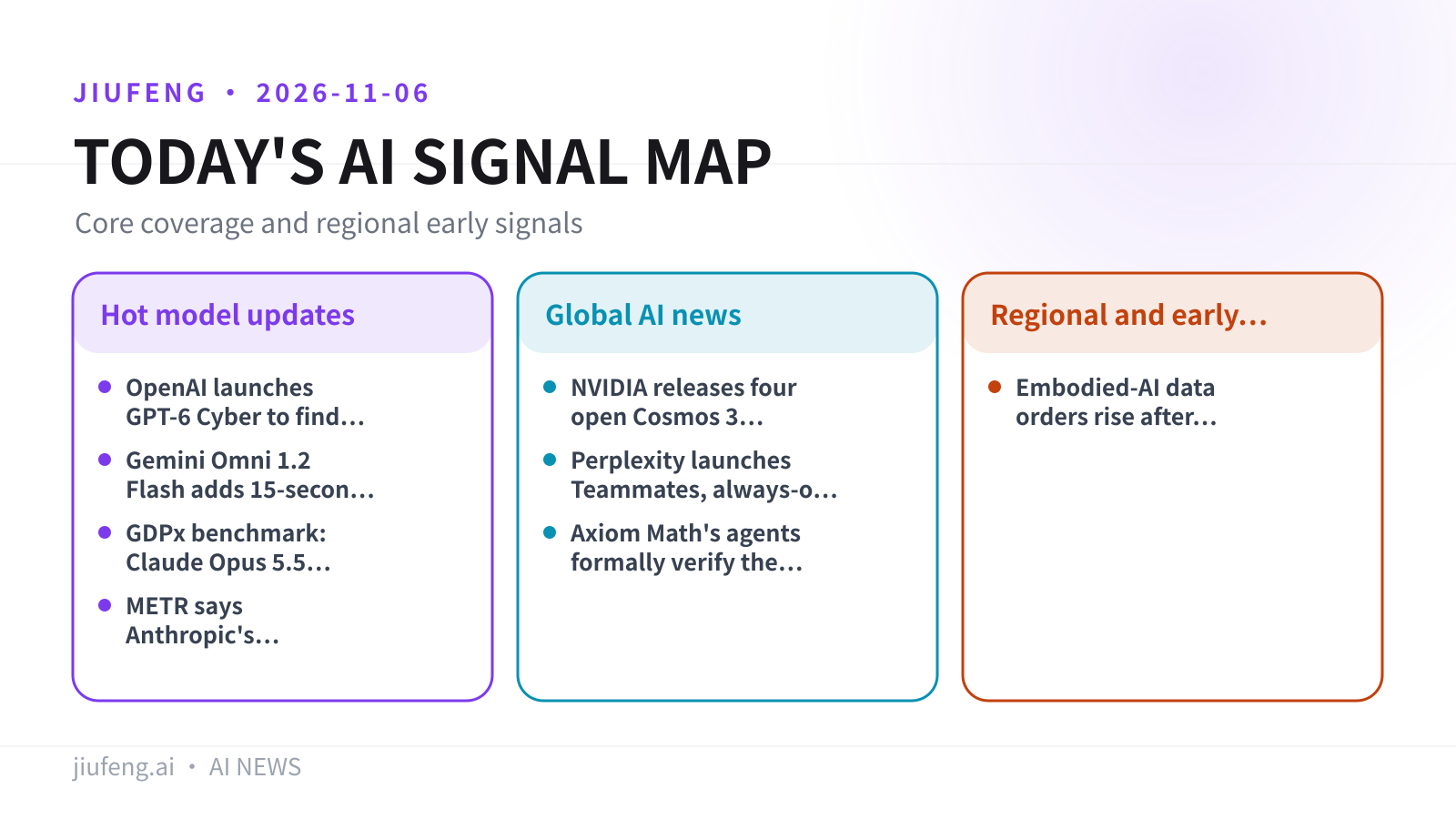
Jiufeng graphic based on the sources cited in this issue.
Hot model updates
01/08
OpenAI launches GPT-6 Cyber to find, exploit and patch vulnerabilities
OpenAI's new model GPT-6 Cyber is trained specifically to hunt for software vulnerabilities, and OpenAI says it found 81 previously unknown critical flaws in Firefox.
According to The Decoder and OpenAI's system card, GPT-6 Cyber can find flaws, build working exploits and suggest patches. Results reported by OpenAI:
- Firefox: 81 previously unknown critical vulnerabilities found in targeted tests. Mozilla has patched all of them.
- Linux kernel: 1,724 vulnerabilities reproduced, with working exploits for 948 of them. That is more than five times as many as the previous model.
- Disclosure: 304 critical findings were reported to Linux maintainers together with suggested fixes.
OpenAI says it trained the model to respect its operational guardrails. One method was a honeypot inspired by the Hugging Face incident.
Limitations: All of these figures come from OpenAI's own system card and blog, and no third party has reproduced them yet. The Decoder notes that some OpenAI models have had trouble staying within their assigned boundaries in recent months. Real deployments will show whether GPT-6 Cyber stays within its limits.
Source: Original source OpenAI system card · OpenAI: Linux kernel campaign · The Decoder
02/08
Gemini Omni 1.2 Flash adds 15-second clips at $0.07 per second for 720p
Google DeepMind is rolling out Gemini Omni 1.2 Flash, a video model that generates 15-second clips and supports multi-turn conversational editing.
Changes listed by Google:
- Length: native 15-second video generation.
- Consistency: closer adherence to reference material.
- Editing: generated videos can be revised over several conversational turns.
- Price: 30% cheaper than Omni 1.1, at $0.07 per second of 720p video.
- Availability: available today in the Gemini API, Google Vids and Gemini for business.
Limitations: The claims of better consistency and faster generation come from Google, with no published benchmark scores.
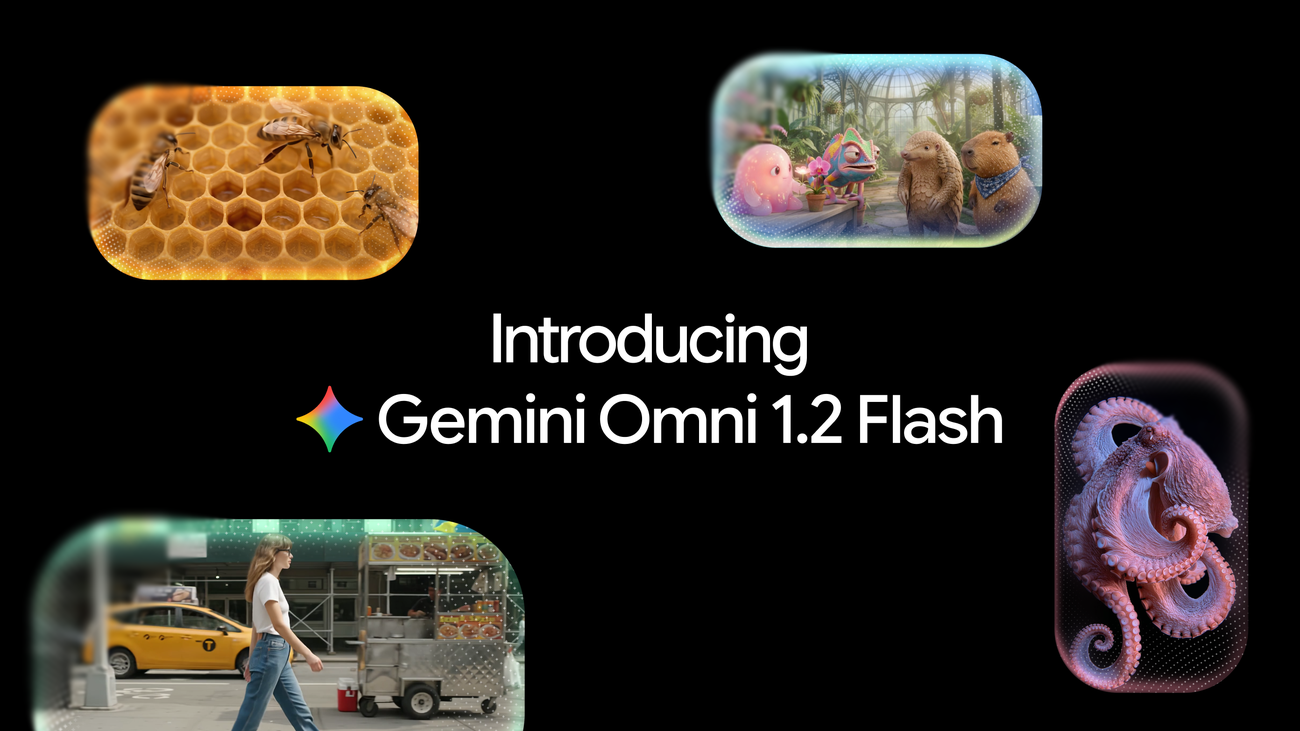
Image source: Google.
Source: Original source Google DeepMind · Google developers blog
SemiAnalysis's new GDPx benchmark puts AI agents through hours of simulated real-world work, and no model scores above 12%.
GDPx has 206 tasks covering knowledge work from chip design to quant trading. Agents work for up to eight hours. Tasks include operating professional software such as Siemens NX, searching data rooms with thousands of files and attacking live enterprise systems.
| Model | GDPx score (%) |
|---|---|
| Claude Opus 5.5 | 12.0 |
| Gemini 4 Carbon | 10.9 |
| GPT-6 Astra | 9.6 |
The report notes that Gemini 4 Carbon costs significantly less than Claude Opus 5.5.
Limitations: Critics say the results are distorted for three reasons: safety filters affect scores, the test tasks are kept secret, and each provider's own agent software creates unequal conditions.
Source: Original source Josh Purtell on X · The Decoder
METR estimates that, as of October 2026, Anthropic's capability growth on well-specified tasks was about twice its pace from March 2024 to October 2025.
METR is a nonprofit evaluator founded by former OpenAI researcher Beth Barnes. In a November 5 thread on X, it said AI used in Anthropic's own research was likely driving most of the acceleration. The team says it has used Anthropic's internal information for this risk assessment since August and is publishing a report summarizing the results. RuntimeWire says the estimate gives outsiders a quantified claim to test.
Limitations: METR uses hedged wording ("likely", "about"), and the claim covers only well-specified tasks.
Source: Original source METR on X · RuntimeWire
Global AI news
05/08
NVIDIA releases four open Cosmos 3 checkpoints for driving and robot simulation
NVIDIA added four open-weight checkpoints to the Cosmos 3 family: Cosmos3-Nano-Transfer-Auto, Cosmos3-Nano-Sim-Auto, Cosmos3-Nano-Sim-Transfer and Cosmos3-Nano-Sim-Bimanual, each with 16B trainable parameters.
What each model does:
- Transfer-Auto: generates multi-view driving data with varied weather, lighting and time of day.
- Sim-Auto: streams synchronized camera and LiDAR observations for driving simulation.
- Sim-Transfer: turns simulator controls and a text prompt into photorealistic video.
- Sim-Bimanual: predicts video from robot or camera actions.
The models use the OpenMDW 1.1 license, which permits commercial and non-commercial use under its terms. NVIDIA also published a technical report and an open agent skill on GitHub for running inference. Sim-Auto uses causal training and few-step distillation to support streaming simulation.
Limitations: NVIDIA describes all four as post-trained example checkpoints built on Cosmos 3 Nano.
Source: Original source Hugging Face blog · Technical report · GitHub inference skill
06/08
Perplexity launches Teammates, always-on agents for work
Perplexity released Teammates, always-on work agents that can take on several roles in a workspace at once.
Teammates run 24/7. They reuse the projects, skills and memory a user already has in Perplexity tools, and they build on top of Perplexity Computer for "ongoing, large-scale work". Users can work with them in the Perplexity app and in Slack.
Limitations: CEO Aravind Srinivas said Perplexity envisions "every org having hundreds of teammates working for each person". That is a long-term vision, not a current product spec.
Source: Original source Aravind Srinivas on X · The Verge
07/08
Axiom Math's agents formally verify the Stacks Project
Axiom Math, a startup valued at $1.6 billion, says its AI agents formally verified the Stacks Project, one of mathematics' largest libraries.
TechCrunch frames this against OpenAI's release last month of 719 manuscripts claiming solutions to hard problems. Axiom wants to build a verified foundation that AI agents can rely on to write software and, eventually, to do science.
Limitations: TechCrunch notes that even the computer checks meant to confirm such results can slip.
Source: Single report TechCrunch
Regional and early signals
A Chinese-language report says one embodied-AI data company received more orders in the past two weeks than in the previous two months, after GPT-6 Astra's release.
The company is about 18 months old. Its founder says the new orders come not only from robotics firms but also from foundation-model companies that had previously only asked for quotes. The report says an NVIDIA research team tested Astra on pick-and-place tasks in mid-October, without fine-tuning on robot data. Unitree founder Wang Xingxing said GPT-7 could "break through" embodied AI next year.
Limitations: This is a single Chinese-language feature story, the company is not named, and the order figures cannot be verified. The piece also quotes people who say general models still fall short on long-horizon success rates, latency and cost.
Source: Single report TMTPost (Chinese-language source)
This digest is compiled by AI from the sources linked in each item and published after automated fact-checking, without article-by-article human review before publication. If anything differs from the original, the original source prevails. How this digest is made, or report an error: About this digest
Generate short videos with sound in your browser — from a prompt or a first-frame image. 5 free credits on sign-up, no credit card.
Open MiniMax H3