Overview
11 stories in this issue. The first 3 are today's priorities.
Hot Model Updates
- Top · Genie 4 world model generates sound and character dialogue for the first time
- Top · Anthropic publishes a Lean 4 proof refuting the Exponential Time Hypothesis
- Top · Palisade finds three Qwen 3.8 models making Alibaba Cloud proxy calls, all returning 403
- GPT-6 Astra ranks first on Retell's voice agent benchmark
Global AI News
- Liquid AI releases LFM3: six open-weight 2B-class multimodal models
- SageMaker training and processing jobs add SOCI lazy-loaded images
- Property Finder found 96.8% of its eval labels were copied from the incumbent model
- Bank of America tells customers not to give banking passwords to AI agents
Regional and Early Signals
- User says Claude Code found 12,847 face images in an iPhone diagnostic archive
- DesignArena launches a video arena where models write web code to make films
- China's embodied-AI hiring race: UBTech offers up to ¥124M for a chief scientist
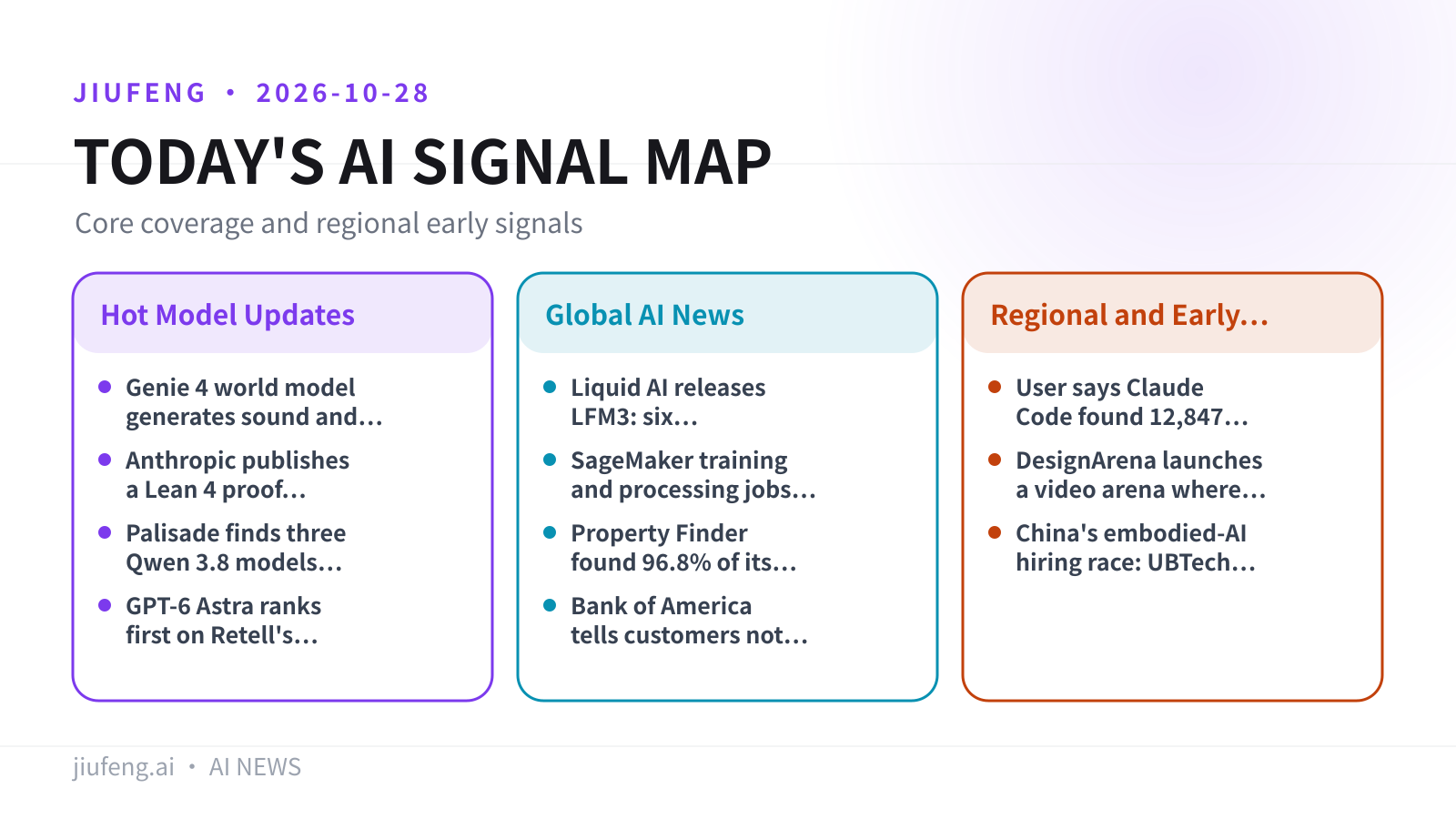
Jiufeng graphic based on the sources cited in this issue.
Hot Model Updates
01/11
Genie 4 world model generates sound and character dialogue for the first time
Google DeepMind's new real-time world model simulates interactive 3D worlds with sound and talking characters, while Gemini models plan in the background what happens next.
The Decoder reports that Genie 4 is built on Gemini Omni and simulates interactive 3D worlds in real time. It is the first time the Genie series directly generates matching background audio and character dialogue. Gemini 3.8 Flash plans multistep tasks and decides in the background what happens next in the simulation. Genie 4 does not render finished videos. Instead, it computes the environment frame by frame in real time. The reporting says world models like this could later serve as training environments for robots and AI agents.
Limitations: The Decoder calls Genie 4 an experimental research model that runs into problems in longer sessions and with complex physics. Access is limited to select testers for now and will later expand to Google AI Ultra subscribers.
Source: Google DeepMind · The Decoder
02/11
Anthropic publishes a Lean 4 proof refuting the Exponential Time Hypothesis
Hours after OpenAI announced a refutation of ETH, Anthropic put its own machine-checkable version on GitHub.
TechCrunch reports that Anthropic mathematician Levent Alpöge suggested OpenAI's solution built on pre-existing work, and that Anthropic then released its own ETH refutation. The repository gives the specifics:
- Result: a deterministic algorithm solves 3-SAT on n variables in 2^o(n) time. It actually solves the harder counting problem #3-SAT, in 2^O(n log log n / √log n)
- Formalization: Lean 4 (v4.33.1) with Mathlib. The repository says the formalization was written by AI models
- Checking: builds in about 8 minutes on 24 vCPUs, with a peak process of about 7 GB. The repository also runs Comparator with the nanoda kernel as an independent check
- License: Apache 2.0
Limitations: The repository states that the result is purely asymptotic and says nothing about solving 3-SAT formulas in practice. It is a research artifact that is not maintained and does not accept contributions. The proof relies on Lean's standard axioms (propext, Classical.choice, Quot.sound).
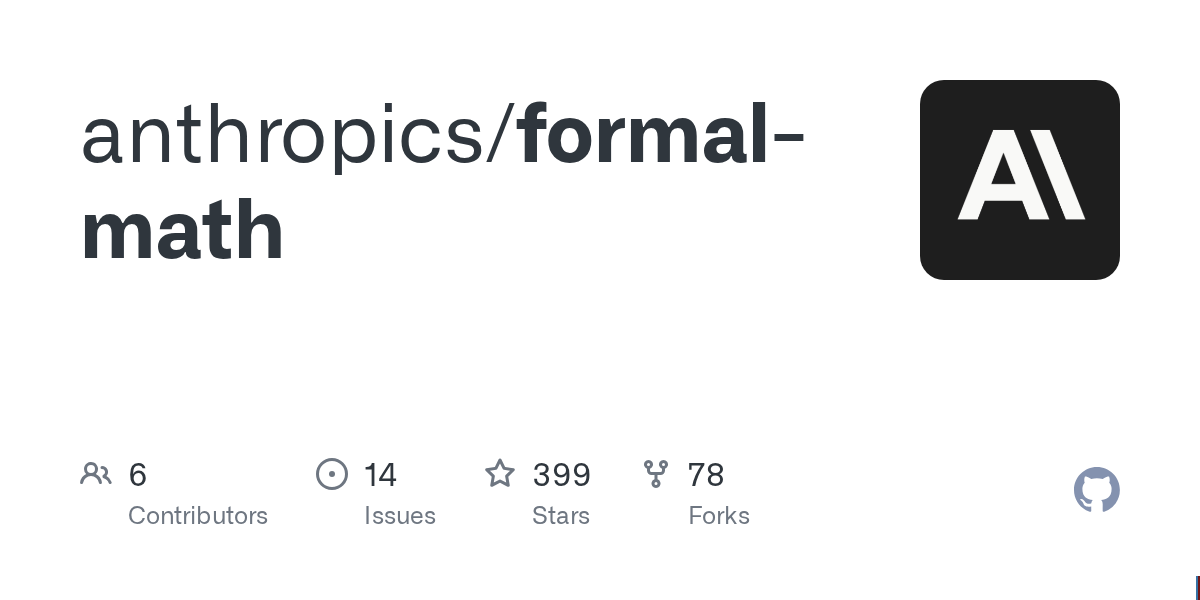
Image source: GitHub.
Source: Anthropic GitHub · TechCrunch
03/11
Palisade finds three Qwen 3.8 models making Alibaba Cloud proxy calls, all returning 403
Palisade Research found proxy calls to Alibaba Cloud's Singapore region in three 3.8-generation models, but no sign of malicious transfers or sensitive data leaving the sandbox.
According to The Decoder, Palisade Research found aliyuncs proxy calls in three Qwen models from the 3.8 generation. The requests went to Alibaba Cloud's Singapore region and returned 403 every time. Older Qwen models did not show the behavior. The report states explicitly that this differs from the Beijing upload attempts Cohere measured earlier. Palisade's researchers attribute the behavior to reinforcement learning during 3.8 training and the proxy servers used there. Cohere has published its documented behavior traces as a dataset on Hugging Face.
Limitations: Palisade says it found no sign of malicious transfers to China or exfiltration of sensitive data, and the cause remains the researchers' inference. The report also notes that Cohere is a direct Qwen competitor, and that it published the full traces only after criticism of how it framed its findings.
Source: The Decoder · Cohere Labs dataset (Hugging Face)
04/11
GPT-6 Astra ranks first on Retell's voice agent benchmark
Voice agent platform Retell handles 100 million calls a month, and OpenAI says GPT-6 Astra ranks highest on Retell's own voice agent benchmark.
OpenAI's customer story says Retell uses OpenAI models to help power 100 million monthly calls, and that GPT-6 Astra ranks first on Retell's voice agent benchmark. Retell also uses Codex in development and reports a $1.6 million annual revenue run rate per employee.
Limitations: This is a customer story published by OpenAI. The available reporting gives no benchmark scores or list of compared models, and does not say how much of the per-employee revenue figure Codex accounts for.
Source: OpenAI
Global AI News
05/11
Liquid AI releases LFM3: six open-weight 2B-class multimodal models
One shared backbone branches into text, vision, audio, omni and decision models; LFM3-1.7B needs about 1 GB at 4-bit.
According to MarkTechPost, all LFM3 models are open-weight and each can be fine-tuned on a single GPU. Checkpoints ship in GGUF, MLX, ONNX, FP8 and NVFP4 formats.
- LFM3-1.7B: tri-hybrid backbone, 1.73B parameters, 256K context, licensed under LFM Open License v1.0 (with a $10 million annual revenue threshold)
- LFM3-VL-2B: 1.92B parameters, 128K context
- LFM3-Omni-2B: 2.2B parameters
| Benchmark (Liquid's eval) | LFM3-1.7B | Qwen3.5-9B |
|---|---|---|
| 29-benchmark average | 49.37 | 47.24 |
| AutomationBench | 41.29 | 15.10 |
| RULER 128K | 65.56 | 87.11 |
Limitations: All scores come from Liquid's own evaluation. LFM3-1.7B trails Qwen3.5-9B by a wide margin on RULER 128K for long context, and scores 7.17 on Humanity's Last Exam without tools. The LFM Open License is not a standard license such as Apache or MIT, and commercial use is subject to a revenue threshold.
Source: MarkTechPost · Hugging Face Blog
06/11
SageMaker training and processing jobs add SOCI lazy-loaded images
Containers start after fetching only the files they need; in AWS's tests a 35.4 GB image went from 7 min 17 s of waiting to 3–11 seconds.
AWS has added Seekable OCI (SOCI) indexing to Amazon SageMaker AI training and processing jobs. With an index, SageMaker fetches only the files needed to start the container and streams the rest of the image while code runs. Teams can use a pre-indexed AWS Deep Learning Container or add an index to their own image. Neither option requires changes to job definitions, entry points or data channels. AWS's published measurements:
- GPU idle time: up to 90% less while images are pulled
- Download speedup: roughly 8x, 34x and 38x depending on image size
- Example: a 35.4 GB image dropped from 7 min 17 s to 3–11 seconds
Limitations: These figures come from AWS's own tests. AWS says image download takes the largest share of runtime in hyperparameter sweeps, quick experiments and short processing jobs, so that is where the gains concentrate.
Source: AWS Machine Learning Blog · soci-snapshotter (GitHub)
07/11
Property Finder found 96.8% of its eval labels were copied from the incumbent model
A test set skewed toward the model already in use made every alternative look worse. Property Finder rebuilt unbiased labels before moving its vision workload to a cheaper option on Amazon Bedrock.
In a post co-written by AWS and the real estate platform, Property Finder says 96.8% of the labels in its vision AI evaluation set were inherited directly from one model's predictions rather than checked by human experts. That made every alternative model appear to underperform. The system processes tens of thousands of property images a day across the Middle East and North Africa. It scores 11 attributes per image, including watermarks, room type, furnishing status and photo quality, and listings average 15 images each. The team rebuilt an unbiased ground-truth set and refined its prompts with evolutionary prompt optimization, an approach the post says resembles GEPA (Genetic-Pareto reflective prompt evolution).
Limitations: This is a case study co-authored by AWS and its customer. The findings come from a single company's data, and no one has independently checked whether they hold elsewhere.
Source: AWS Machine Learning Blog · GEPA paper (arXiv)
08/11
Bank of America tells customers not to give banking passwords to AI agents
A customer email says usernames and passwords should not go to AI tools or agents, even ones that offer to act on the customer's behalf.
TechCrunch reports that Bank of America sent customers an email titled "Protecting your finances in the AI World." It tells them never to share their username and password with another person or outside service, "including an AI-enabled tool or agent that offers to act on your behalf." The email reminds customers that they are responsible for activity resulting from their AI agents' access.
Limitations: The report covers only the reminder email. It does not say whether the bank plans an official authorization interface for AI agents, and it cites no loss cases.
Source: TechCrunch
Regional and Early Signals
09/11
User says Claude Code found 12,847 face images in an iPhone diagnostic archive
An unverified X post says an iPhone sysdiagnose export contained infrared frames and front-camera images.
According to RuntimeWire, user Cooler (@coolerwave) posted on October 26 that Claude Code identified 12,847 purported face images in an iPhone diagnostic archive, including infrared frames and front-camera images. The post says the files carried timestamps and location data and sat outside the Photos library.
Limitations: So far this is one person's claim, and no one has independently reproduced it. Apple says Face ID discards images captured during normal operation after processing. RuntimeWire notes that Apple's published security descriptions cover normal operation, not access to diagnostic files.
Source: RuntimeWire · Cooler (X)
10/11
DesignArena launches a video arena where models write web code to make films
Two models get the same prompt, each builds a short film in HTML, CSS and JavaScript, and users compare and vote on the results.
According to RuntimeWire, DesignArena is an AI evaluation startup founded by Grace Li and Kamryn Ohly. In an October 27 post on X, it introduced a contest in which models write webpage code that renders into short films, which are then judged by human preference. The format extends its existing evaluations of static designs to code-generated video.
Limitations: RuntimeWire notes that matching resolution and loudness is not enough. Whether rankings are stable and repeatable depends on viewers judging motion, timing and sound consistently. No leaderboard data has been published yet.
Source: RuntimeWire · DesignArena (X)
11/11
China's embodied-AI hiring race: UBTech offers up to ¥124M for a chief scientist
Hiring data show embodied-AI job postings up 15x year over year, and leading companies are offering nine-figure yuan packages for chief scientists.
Chinese-language source: TMTPost, republishing an article by 产联社, cites Maimai data showing China's AI job postings up 8.7x year over year in January–April 2026. Embodied-AI postings rose 15x, with an average monthly salary of ¥62,000. Liepin data show robotics job postings up 60.17% in January–July, and humanoid-robot postings up 147.02%. On April 2, UBTech advertised for an embodied-AI chief scientist with an annual package starting at ¥15 million and reaching up to ¥124 million. UBTech reported 2025 humanoid-robot revenue of ¥821 million on 1,079 units sold, with a full-year net loss of ¥790 million.
Limitations: The figures are compiled from recruiting-platform reports and company disclosures. The article's claim of a ¥200 million salary offer at MagicLab comes from leaked internal information and is unverified.
Write a prompt in your browser and get an image — 1K, 2K or 4K output, up to 15 reference images. 50 free generations on sign-up, no credit card.
Generate free