Overview
11 stories in this issue. The first 3 are today's priorities.
Hot model updates
- Top · GPT-6.1 Terra launches for computer use at half the standard API price
- Top · OpenAI shares model results on Kakeya, ETH and QCD
- Top · Study of 14 models finds six patterns that make AI prose hard to read
Global AI news
- Nace AI's Drex for Search scores 92.05% on BrowseComp-Plus with 12.6 searches per question
- Fortinet adds AI content inspection to FortiGate firewalls
- Agentic AI Foundation adds four projects, reaching ten in its first year
- Google and Stanford launch Polar Peaks to teach students how AI models are tested
- X user says a Claude Code-assisted scan found 15,100 vanished files in an iPhone backup
Regional and early signals
- Tencent sends QClaw shutdown notice after 188-day test, closing December 24
- CASBOT raises a Series A++ round and says its shoemaking robot orders exceed RMB 400 million
- Jimeng launches a short-drama studio built on its DreamScript script model
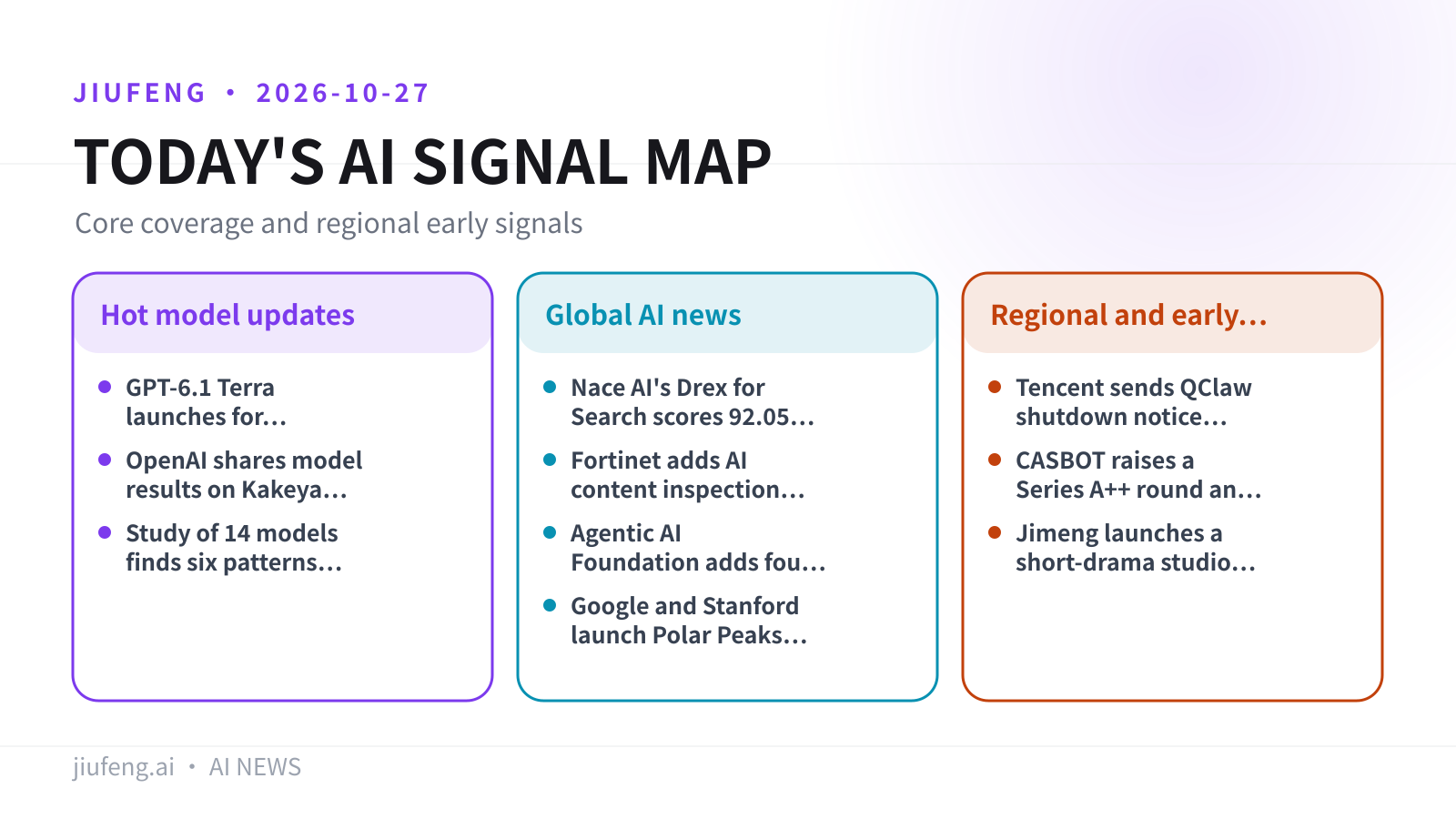
Jiufeng graphic based on the sources cited in this issue.
Hot model updates
01/11
GPT-6.1 Terra launches for computer use at half the standard API price
OpenAI released a lower-cost Terra-tier model for reading screens and handling routine computer tasks. Its standard API price is half that of GPT-6.1 Sol.
OpenAI released GPT-6.1 Terra on October 26. The company describes it as a low-cost model for software that needs to read screens and carry out routine computer work.
- Availability: ChatGPT Work, Codex and the API
- Pricing: OpenAI's launch post says Terra's standard API prices are 50% lower than those of GPT-5.6 Terra and GPT-6.1 Sol
- Safety documentation: OpenAI also published a page for GPT-6.1 Terra on its deployment safety site
Limitations: RuntimeWire notes that all of the benchmark comparisons are reported by OpenAI itself. It also advises operators to measure the full cost of a workflow, including tool calls and human review, rather than rely on the lower list price alone.

Image source: OpenAI Deployment Safety Hub; mirrored on Jiufeng R2.
Source: OpenAI · OpenAI Deployment Safety · RuntimeWire
02/11
OpenAI shares model results on Kakeya, ETH and QCD
OpenAI published model results on three research problems and explained how researchers can verify them and build on them.
In a post about working with academic communities, OpenAI shared model results in three areas: the Kakeya conjecture, the Exponential Time Hypothesis and quantum chromodynamics. The post also explains how researchers can check the results and use them in their own work.
Limitations: The candidate material includes only OpenAI's summary. It does not say which model produced the results, how complete they are or whether they have been peer reviewed. Answering those questions requires the full post and later checking by researchers.
Source: OpenAI
03/11
Study of 14 models finds six patterns that make AI prose hard to read
Researchers at NYU and UT Austin compared more than a thousand texts and found that frontier models systematically overuse patterns that people find hard to parse.
The team asked 14 language models to write in three settings: casual conversation, coding sessions and argumentative essays. The models included Claude, GPT-5.6, GLM-5 and Kimi K2.5, along with smaller open models such as Llama and Olmo.
- Sample: 120 conversations, 45 coding sessions and 980 essays
- Human baselines: movie subtitles, StackExchange posts and student essays
- Finding: six patterns that make AI text harder to read, such as nested sentences, odd word combinations and metaphors people would not use
Limitations: The paper is an arXiv v1 preprint and has not been peer reviewed. The human corpora are not an exact genre match for the AI writing tasks.
Source: arXiv · The Decoder
Global AI news
04/11
Nace AI's Drex for Search scores 92.05% on BrowseComp-Plus with 12.6 searches per question
Nace AI applied its Drex decision models to document search, offering coding agents a retrieval layer and publishing several benchmark results from its own tests.
Drex for Search is a hosted retrieval system that can search more than 1 million files. It works alongside an answering model such as GPT-5, Gemini 3.5 Flash or Qwen 27B. Coding agents such as Claude Code, Codex, Cursor and OpenCode can call it through a CLI, SDKs, MCP or REST. It can be deployed in four ways: on Nace's managed cloud, on a dedicated cloud, in a customer's own AWS or Azure account, or on-premises, including air-gapped systems.
- BrowseComp-Plus: 92.05% accuracy when paired with GPT-5, ranking 2nd of 86 entries, with an average of 12.61 search calls per question
- OfficeQA Pro: Nace tested 9 agent and model pairs on this 133-question benchmark built from U.S. Treasury Bulletins
| System | VisDocAgentBench R@1 (%) |
|---|---|
| Drex for Search | 77.5 |
| Claude Opus 5 | 67.5 |
Limitations: Nace ran these evaluations and reported the results itself. The claim that Drex places 1st or 2nd on 3 of 4 public leaderboards also comes from Nace. The MarkTechPost article is tagged Sponsored and Promote.
Source: MarkTechPost · BrowseComp-Plus leaderboard · OfficeQA Pro paper
05/11
Fortinet adds AI content inspection to FortiGate firewalls
FortiGuard Inline AI Security Service lets existing FortiGate firewalls inspect prompts sent to LLMs, agents and MCP tools in real time.
Fortinet launched FortiGuard Inline AI Security Service on October 26. Its guardrails come from FortiAIGate. Fortinet delivers the service from its cloud to FortiGate firewalls that customers already run, so they do not have to deploy a separate AI security stack. These firewalls could already detect shadow AI use and apply data loss prevention rules to AI traffic. The new service goes further: it inspects the content of those interactions and masks sensitive data as it passes through.
Limitations: Organizations with stricter privacy or sovereignty requirements can still host FortiAIGate themselves on Kubernetes. SiliconANGLE is the only source for this item, and the excerpt gives no pricing or availability details.
Source: SiliconANGLE
06/11
Agentic AI Foundation adds four projects, reaching ten in its first year
At AGNTCon + MCPCon North America 2026, the Agentic AI Foundation admitted four new projects, and the MCP discussion shifted toward security.
The four new projects are OpenSandbox, Open Responses, Agent Skills and OpenEnv. They bring the foundation to ten hosted projects in its first year. Keynote speakers at the event included representatives of Anthropic and OpenAI.
Limitations: The source material for this item is thin. It does not describe the specific MCP security changes or say who contributed each of the four projects.
Source: InfoQ
07/11
Google and Stanford launch Polar Peaks to teach students how AI models are tested
In the third AI Quest, students ages 11 to 14 map neurons, clean data and test an AI model in a fictional neuroscience case.
Google Research and the Stanford Accelerator for Learning launched Polar Peaks on October 26. It is the third interactive lesson in the AI Quests series. Students work out why a fictional character has lost their memory, and along the way they map neurons, clean data and test an AI model.
Limitations: RuntimeWire notes that Google's completion count shows how many students took part, not what they learned.
Source: Google · RuntimeWire
08/11
X user says a Claude Code-assisted scan found 15,100 vanished files in an iPhone backup
An X user says a scan done with help from Claude Code found leftover Instagram and Telegram media files, but shared no method that others can check.
In a four-post thread on X on October 25, starmex (@starmexxx) said a Claude Code-assisted scan of an iPhone backup turned up 15,100 Instagram and Telegram media files that should have disappeared from chats.
Limitations: The thread does not include the backup, file paths, screenshots of the scan results or a forensic method, so the count cannot be verified. RuntimeWire also says Apple's guidance does not support the thread's claim that Files & Folders access exposes other apps' private caches. Leftover copies do raise a real privacy question, but the thread does not show broad exposure across apps.
Source: X @starmexxx · RuntimeWire
Regional and early signals
09/11
Tencent sends QClaw shutdown notice after 188-day test, closing December 24
Tencent is shutting down QClaw and steering users to WorkBuddy. TMTPost sees this as part of a wider pattern in which Chinese tech firms launch and fold AI products quickly.
NextFin News, part of TMTPost, reports that QClaw entered public beta in March and received a shutdown notice in September, 188 days later. The product will close on December 24, and users are being steered to WorkBuddy, another Tencent tool. The report reviews product moves by eight companies across ten AI product lines: Tencent, Alibaba, Baidu, ByteDance, Moonshot, Zhipu, MiniMax and DeepSeek. It concludes that competitive cycles have shrunk from many months to a few, and that renames, internal mergers and formal exits are now routine.
Limitations: The shutdown date and the user migration are concrete facts. The claim that product lifespans are getting shorter is the outlet's own analysis. This item has a single regional source.
Source: TMTPost
10/11
CASBOT raises a Series A++ round and says its shoemaking robot orders exceed RMB 400 million
Chinese-language source: the embodied AI company says its orders for shoemaking robots exceed RMB 400 million, with thousands of units scheduled for production.
Beijing-based CASBOT (中科慧灵) has closed a Series A++ round worth several hundred million yuan. Investors include Zhilai Capital, Yonghua Capital, Maotian Investment and Yuanhe Chenkun. In June 2025 the company raised a Series A of nearly RMB 100 million, led by Lens Technology. CASBOT says its total orders for shoemaking robots passed RMB 400 million in 2026. Its lightweight perception-to-action model, CASBOT PA, can be trained on a single consumer GPU. The model is being tested on real workstations at a shoe factory in Putian.
Limitations: The order value, production scale and model performance figures all come from the company. The round size is given only as "several hundred million yuan." The only source is InfoQ China, which publishes in Chinese.
Source: InfoQ China
11/11
Jimeng launches a short-drama studio built on its DreamScript script model
Chinese-language source: Jimeng combines scripting, storyboarding and video production in one tool, with support for 100,000-character uploads and 100 consecutive episodes.
Jimeng AI launched its Short Drama Studio on October 26. The studio runs on DreamScript, Jimeng's first dedicated script model, which handles everything from writing scripts to reviewing them. Some features come from the short-drama agent in Xiaoyunque, another app under CapCut.
- Scripts: uploads of up to 100,000 characters, continuous generation of 100 episodes, and "script doctor" and "dialogue check" reviews
- Assets: automatically identifies characters, scenes, props, voices and costumes, links them to an asset library, and applies any edit everywhere
- Canvas: scales to 10,000 nodes; a team edition adds shared management of assets and credits across accounts
Limitations: The claim that the canvas is "more than ten times smoother than similar products" comes from the vendor's own tests, which do not name the products compared. The only source is Leiphone, which publishes in Chinese.
Source: Leiphone
Write a prompt in your browser and get an image — 1K, 2K or 4K output, up to 15 reference images. 50 free generations on sign-up, no credit card.
Generate free