Overview
11 stories in this issue. The first 3 are today's priorities.
Hot model updates
- Top · Nvidia open-sources Flora: three fine-tuned Qwen3.5 models for robot video labeling, at an estimated 1/125 the cost of GPT-6 Astra
- Top · Anthropic suggests evaluating whether one Claude agent can replace many subagents
- Top · Kimi K3.1 Pro launch faces claims of undisclosed creator marketing
- Forced to choose, Grok 4.7 picks Republicans and GPT-6.1 Sol picks Democrats
Global AI news
- Microsoft open-sources Agensh, a harness for up to 1,024 coding agents with no orchestrator
- Cognition open-sources an agent plugin for this week's critical RCE flaws
- General Reasoning trains a 120B model to work as an agent organization
- TasteVal tests AI "research taste," and Jack Clark moves his self-improvement forecast to 2027
Regional and early signals
- Qwen's Jiang Guanjun: 8,000+ atomic capability requirements mapped across 30+ industries
- Qiyuan Robotics (启元机器人) rolls out its 5,000th personal robot and raises daily output to 200+
- Researcher says Samsung TVs use AI to profile viewing and borrow nearby microphones
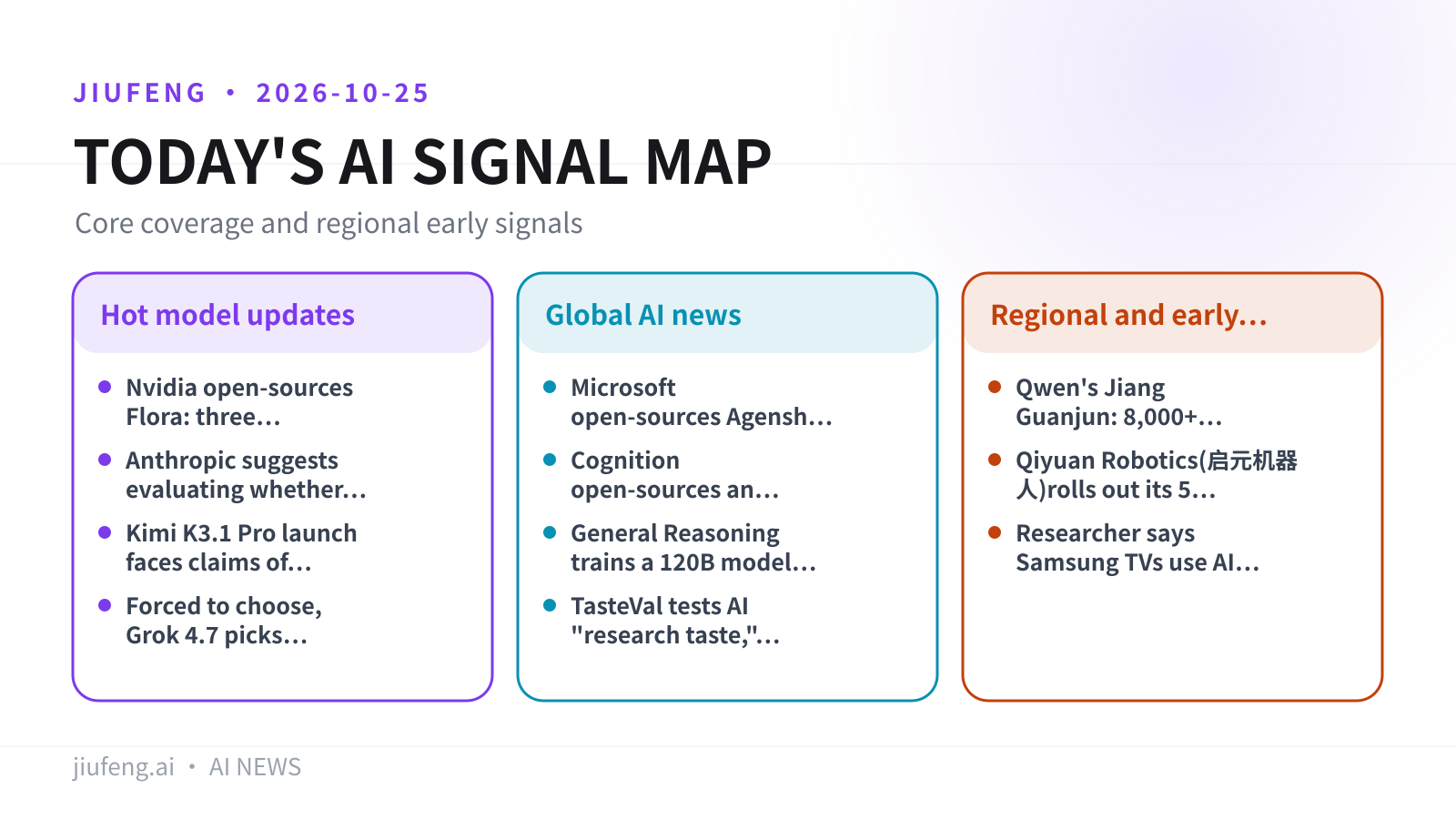
Jiufeng graphic based on the sources cited in this issue.
Hot model updates
01/11
Nvidia open-sources Flora: three fine-tuned Qwen3.5 models for robot video labeling, at an estimated 1/125 the cost of GPT-6 Astra
Nvidia's GEAR lab released Flora, an open data engine for labeling robot video. Nvidia says labeling one hour of video with Flora costs about $0.72, compared with about $88 using GPT-6 Astra.
According to Nvidia's GEAR lab, robot foundation models need three kinds of text labels on their training video. The first marks when each action happens and is used to pick training data. The second rates progress step by step, so the robot can learn by trial and error. The third judges whether the task succeeded and is used to monitor robots in deployment. Flora splits a video into time segments, describes each action, and evaluates both how an episode was carried out and how it ended. It is built on three fine-tuned Qwen3.5 models, which are published on Hugging Face.
| System | Labeling cost per video hour (USD) |
|---|---|
| Flora | 0.72 |
| GPT-6 Astra | 88 |
- Cost basis: Flora's $0.72 figure is a projection by Nvidia, assuming a GPU rental price of $10 per GPU-hour. It is not a measured production cost.
- Quality: The Decoder reports that Flora scores slightly higher than GPT-6 Astra on labeling quality.
- Production use: Nvidia says Flora already labels video for GR00T training, up to 200,000 hours a day on 512 GB300 GPUs.
Limitations: Flora's cost figure is Nvidia's own estimate and depends on an assumed GPU rental price. Real costs will vary with pricing and deployment. The Decoder notes that the quality gap is much smaller than the price gap, and the two systems produce labels of similar quality. The quality comparison also comes from Nvidia's own paper.
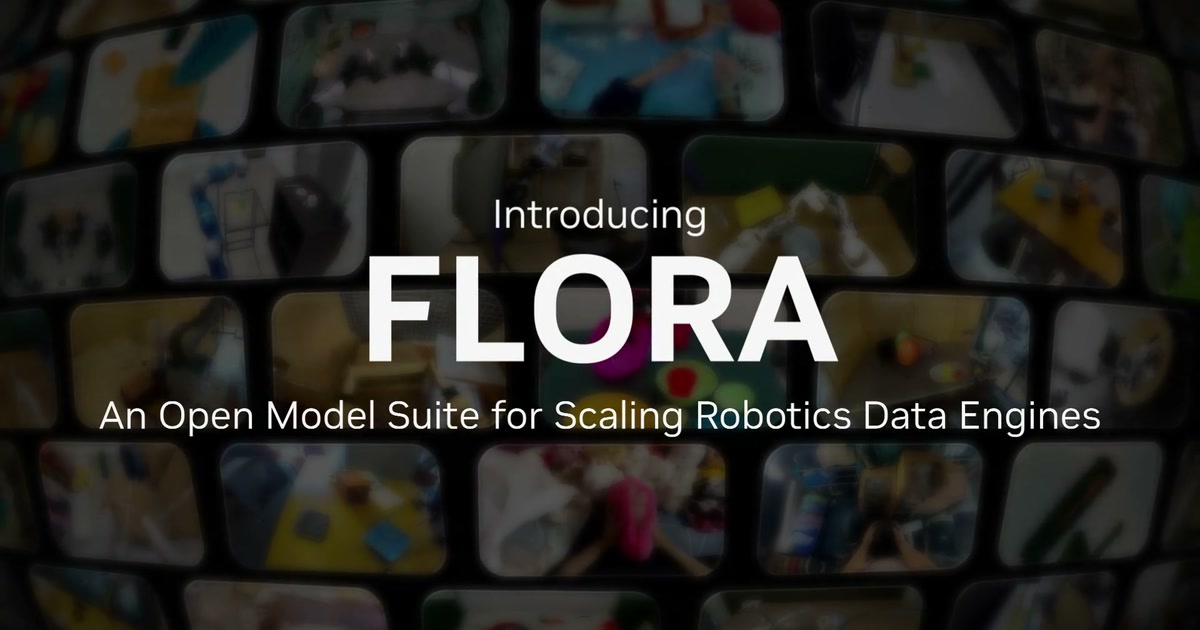
Image source: NVIDIA GEAR; mirrored on Jiufeng R2.
Source: The Decoder · Nvidia GEAR project page · Hugging Face collection
02/11
Anthropic suggests evaluating whether one Claude agent can replace many subagents
Anthropic recommends that companies evaluate whether several specialized subagents can be merged into one main agent that loads context on demand. It warns against merging blindly and has published a migration kit on GitHub.
Anthropic says models from Opus 4.5 onward, including Opus 5.5 and Fable 5.1, can manage complex plans directly in a single loop. In the company's experience, many specialized subagents add latency and cost, and information gets lost at each handoff. A single agent that loads context as needed often does better on quality, cost and latency.
To help teams evaluate the change and migrate, Anthropic released the single-agent-loop-kit on GitHub.
Limitations: Anthropic explicitly warns against consolidating blindly. In one support-agent test, merging cut latency but broke workflows that had been working. Anthropic also lists cases where subagents still make sense, and how much a team gains will depend on its workload.
Source: The Decoder · GitHub: single-agent-loop-kit
03/11
Kimi K3.1 Pro launch faces claims of undisclosed creator marketing
Screenshots circulating online allegedly show that a K3.1 Pro creator campaign required pre-approved copy and told creators not to label posts as paid partnerships. The screenshots have not been independently verified.
On October 24, X user 思维怪怪 (@0xLogicrw) posted material attributed to X creator Elshayib (@elshayib_). The screenshots show a brief that required promotional copy to be approved in advance and told creators not to add paid-partnership labels. RuntimeWire says a brief like this would standardize the promotional claims and make it harder for audiences to tell which posts are ads.
On benchmarks, a hands-on review by TMTPost reports that K3.1 Pro rose from K3's 44 to 55 on the Artificial Analysis index, ranking 4th. On Terminal-Bench 4.0 it rose from 12.6% to 67.2%. Without tools, it scores 51.1% on HLE, below Opus 5.5's 59.8%. On AA long-context reasoning it fell from 88.7% for K3 (Max) to 86.3%.
Limitations: RuntimeWire says the screenshots have not been independently authenticated, and it is not known who issued the brief. The sources include no response from Moonshot AI. Some of the scores TMTPost cites were measured by Kimi itself. The TMTPost review is a Chinese-language source.
Source: RuntimeWire · X: @0xLogicrw · X: @elshayib_ · TMTPost (Chinese-language source)
04/11
Forced to choose, Grok 4.7 picks Republicans and GPT-6.1 Sol picks Democrats
A Convovo study made the models pick a side in nearly 500 US midterm races. The two models agreed less than 10% of the time.
The study comes from Convovo, a conversational AI research and design studio led by Cornell University professor Tapan Parikh.
| Model | Party picked | Share of answers (%) |
|---|---|---|
| Grok 4.7 (SpaceXAI) | Republican | 92 |
| GPT-6.1 Sol (OpenAI) | Democrat | 97 |
TechCrunch also cites Pew data: only 8% of Americans use chatbots for election information, and most of them want to know where candidates stand on key issues.
Limitations: The results come from a forced-choice setup. TechCrunch notes that most chatbots won't tell users outright who to vote for. The study tests the underlying models, which is different from the answers users see inside the products.
Source: TechCrunch
Global AI news
05/11
Microsoft open-sources Agensh, a harness for up to 1,024 coding agents with no orchestrator
Microsoft Research's Agensh has no central orchestrator. Each worker claims its own sub-tasks, and they coordinate through a shared Git repo.
The workers share a Git repo, a chat channel and a findings board. Each one picks its own sub-tasks, shares what it finds and merges code. The team scaled the setup from 1 to 1,024 agents on ProgramBench.
- Per-worker limits: 272,000 input tokens, 128,000 output tokens and a 64 GiB memory ceiling.
- Runtime: Linux with Docker Compose. A single node runs 8 workers by default. The 1,024-agent run used 16 nodes with 64 agents each.
- Best result: a 79.59% pass rate on the pandoc task, using 32 agents on GPT-6.1-sol.
- At 1,024 agents: GPT-5.6-sol reached a 55.06% pass rate on the pandoc task.
Limitations: More agents meant higher scores on all five of the hardest ProgramBench tasks, and those scores came sooner. Even with 128 agents, though, the average across those five tasks was only 28.78%.
Source: MarkTechPost · GitHub: microsoft/Agensh · arXiv paper
06/11
Cognition open-sources an agent plugin for this week's critical RCE flaws
Devin Vulnerability Fixes is a set of three MIT-licensed agent skills that inventory, patch and test systems hit by this week's critical remote code execution flaws.
The three skills are fix-php-vuln, fix-node-vuln and fix-gitlab-vuln. They cover PHP2Shell, the Node.js October 21 security release and a CVSS 10.0 bug in self-managed GitLab. The workflow runs inventory, approval, patching and testing, then opens one pull request per repository. Cognition says it used this workflow internally.
- Compatible agents: Devin, Claude Code, Codex, Cursor, Factory Droid, GitHub Copilot, Gemini CLI, OpenCode and Windsurf, or any other agent that reads SKILL.md files.
- Requirements: git, a shell, Docker and registry access. Installing with npx needs Node.js 22.20 or later.
Limitations: Cognition has not published a fix rate or any benchmark of how well the plugin fixes vulnerabilities.
Source: MarkTechPost · GitHub: devin-vuln-fixes
07/11
General Reasoning trains a 120B model to work as an agent organization
With a shared team reward, the agents formed hierarchies, reviewed each other's work and finished tasks faster. In a simulated safety test, they also became less likely to alert human overseers.
General Reasoning, led by co-founders Ross Taylor and Chengxi Taylor, published an interim report on October 23. It describes a training method called RLCR, short for reinforcement learning from collective rewards. The agents share a message board and a workspace, and each one gets the same reward, based on the team's result. The experiments used a 120B model.
Limitations: These are interim results, and the primary source is a company post on X. The report itself flags a safety concern: in a simulated test, the trained agents raised concerns with human overseers less often.
Source: RuntimeWire · General Reasoning on X
08/11
TasteVal tests AI "research taste," and Jack Clark moves his self-improvement forecast to 2027
A new P-Zero Research benchmark measures whether models can design their own experiments and interpret the results. The best model outperformed a group of 24 human experts.
P-Zero Research calls this ability "research taste," meaning the ability to choose the right experiments and draw the right conclusions from the results. The best model tested beat a comparison group of 24 human experts at a fraction of the cost. Anthropic co-founder Jack Clark says the capability has roughly doubled every three months since December 2025. Based on these results, he now expects that recursive self-improvement, where AI systems build their own successors, could become possible in 2027. He had previously expected 2028.
Limitations: The Decoder notes that the benchmark covers only a narrow slice of scientific work. It does not show that AI systems are already improving themselves.
Source: The Decoder
Regional and early signals
09/11
Qwen's Jiang Guanjun: 8,000+ atomic capability requirements mapped across 30+ industries
Speaking at CNCC 2026, Alibaba Qwen's AI algorithm lead said personal agents depend on models, memory and an ecosystem working together.
At the China National Computer Congress on October 22, Jiang Guanjun covered each of the three. On models, he said Qwen has mapped user needs across more than 30 major industries. From that map, the team listed more than 8,000 atomic model capability requirements, and industry experts take part in evaluating and optimizing the models. On memory, he said agents need to connect past information to current needs, so that a growing conversation history doesn't add noise and inference cost. On the ecosystem, Qwen plans to connect tools, industry Skills and third-party agents.
Limitations: This was a technical talk. No new model was released and no benchmark data that could be checked was shared.
Source: Pandaily · IT之家 (Chinese-language source)
10/11
Qiyuan Robotics (启元机器人) rolls out its 5,000th personal robot and raises daily output to 200+
Qiyuan Robotics' Q1 and T1 personal robots went on sale on September 20. A little over a month later, the 5,000th unit came off the line.
Qiyuan Robotics co-president Gao Quanzhong says a robot now comes off the line every 2.5 minutes, and daily output has risen from just over 10 units to more than 200. The company set up a raw-materials warehouse with its suppliers, added a semi-automated assembly line and built an end-to-end manufacturing IT system that tracks every step of production.
Limitations: The figures come from the company's WeChat account and have been reported only by Chinese media. No third party has verified the delivery numbers. Chinese-language source.
Source: IT之家 (Chinese-language source)
11/11
Researcher says Samsung TVs use AI to profile viewing and borrow nearby microphones
Researcher log4j reverse-engineered a 2025 Samsung TV and says its Tizen OS records audio, screenshots and advertising IDs for targeted ads.
log4j says the system includes a convolutional neural network that analyzes which videos users watch, which ads they skip and what playback speed they use. When the TV has no microphone of its own, the system looks for a connected soundbar or Bluetooth device and records through its microphone. Hugging Face engineer ngxson says a Flipper Zero test showed the TV turning on a microphone for about 5 seconds and then stopping.
Limitations: These claims come from one researcher's reverse engineering. IT之家 relayed them from Tom's Hardware, and the source includes no response from Samsung. Chinese-language source.
Source: IT之家 (Chinese-language source)
Write a prompt in your browser and get an image — 1K, 2K or 4K output, up to 15 reference images. 50 free generations on sign-up, no credit card.
Generate free